



Hydrogen-bond-cross-linked PVA/MXene films for durable triboelectric nanogenerators and gesture sensing
 0

Abstract
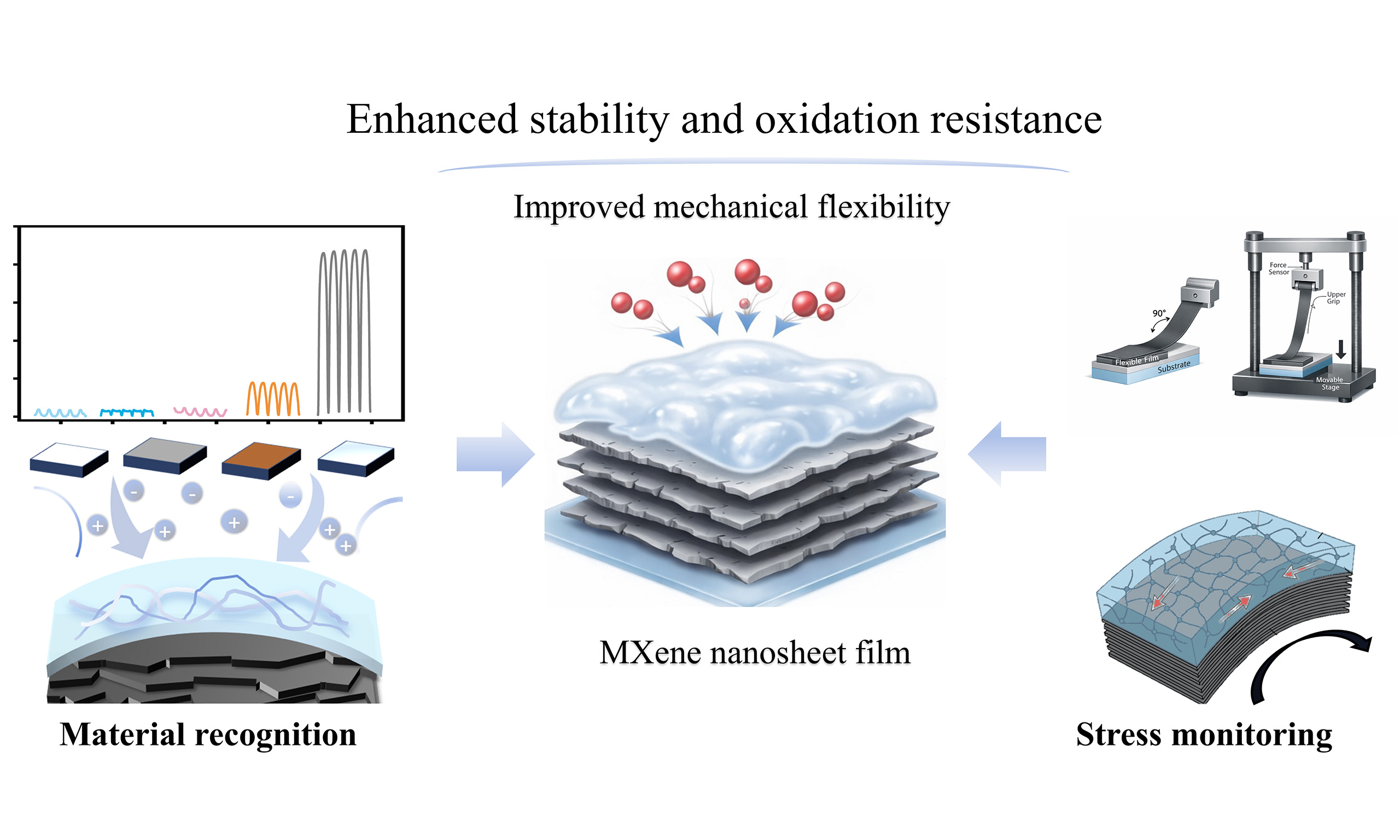
Flexible self-powered sensors based on transition metal carbides/nitrides (MXenes) are considered for intelligent human-machine interfaces (HMIs), but their use is limited by ambient oxidation and mechanical fragility during repetitive deformation. In this work, a surface-coating strategy is used to prepare PVA/MXene composite films, in which poly(vinyl alcohol) (PVA) is bonded to MXene through interfacial hydrogen bonds. The PVA layer reduces MXene’s exposure to moisture and oxygen and limits crack propagation under cyclic mechanical stress. The resulting triboelectric nanogenerator delivers a peak output voltage of 50 V with an Ecoflex counter layer and a maximum power density of
Keywords
INTRODUCTION
Transition metal carbides/nitrides (MXenes) are an emerging class of two-dimensional materials that exhibit excellent conductivity, supporting their application in flexible sensing[1-3]. Among various conductive materials applied in triboelectric nanogenerators (TENGs), MXene stands out as an ideal candidate for fabricating flexible electrodes or triboelectric layers, owing to its high metallic conductivity, abundant hydrophilic and electrophilic functional groups (-O, -OH, -F), and distinctive two-dimensional layered structure. However, MXene has insufficient flexibility and is prone to oxidation[4,5]. Overcoming these shortcomings remains a major challenge in the production of flexible sensing devices[6]. One approach to address this challenge is to incorporate polymers into MXene-based conductive materials[7,8]. A hydrogel is a hydrophilic, three-dimensional network structure that rapidly swells in water and retains a large volume of water in this swollen state without dissolving. As a hydrogel, poly(vinyl alcohol) (PVA) forms a cross-linked three-dimensional network of hydrophilic polymer chains bearing functional groups such as -OH, embedded in a water-rich environment, and possesses adjustable physical and chemical properties[9-11].
The -F and -OH groups on the MXene surface form hydrogen bonds with the -OH groups of PVA, producing a hydrogen-bond network[12-14]. PVA hydrogels are widely used as flexible, water-rich polymer matrices[15-17]. PVA networks are commonly formed by chemical cross-linking or by physical routes such as repeated freezing-thawing[10], and MXene nanosheets are introduced into such networks to yield conductive Ti3C2Tx MXene/PVA composite hydrogels[2,13,18]. This approach disperses MXene within the polymer network, and the resulting composite hydrogels have been explored for flexible and wearable devices[18-21]. However, uniform mixing of MXene cannot be guaranteed, leading to a non-uniform response of the gel to the same stimulus[22-24]. Moreover, because the dispersed MXene flakes lack a defined macroscopic shape, their arrangement and the continuity of the conductive network cannot be controlled, limiting reproducible device performance[23-27]. Protecting MXene from external stress, tension, torsion, and oxidation while maintaining electrical continuity remains a challenge[28-32].
In the force-response test, the open-circuit voltage increases monotonically with applied contact force
EXPERIMENTAL
Materials
Titanium aluminum carbide (Ti3AlC2) MAX-phase powder and lithium fluoride (LiF) were purchased from Xinxixi Technology Co., Ltd., and hydrochloric acid (HCl, 36%-38%) and PVA, (alcoholysis degree of 89%) were supplied by Aladdin Biochemical Technology Co., Ltd. All chemicals were used as received, without further purification.
Preparation of MXene nanosheets
Typically, a diluted HCl solution (approximately 9 mol/L) was prepared by mixing 12 mL of concentrated HCl with 4 mL of deionized water. LiF (0.8 g) was then weighed and transferred into a reaction vessel placed in a water bath to prevent overheating, and the HCl solution was added gradually in batches. Ti3AlC2 MAX-phase powder (approximately 0.5 g) was subsequently added to the mixture in 5-7 small portions. After cooling and stirring for 5 min, the water bath temperature was adjusted to 45 °C, and the etching reaction was maintained under constant heating and stirring for 48 h before the sample was collected. The resulting mixture was then centrifuged at 3,500 r/min, and the supernatant was poured out and stored in a refrigerator at 4 °C for 10 h. Thereafter, 120 mL of deionized water was added in batches to a 500 mL beaker containing the sediment, and the mixture was ultrasonicated for 1 h to achieve exfoliation, yielding a delaminated MXene suspension.
Fabrication of PVA/MXene composites
PVA powder (10.6 g, to give a final mass fraction of 15 wt%) was added to 60 mL of deionized water. After magnetic stirring for 5 min, the mixture was heated to 90 °C and stirred continuously at this temperature for 4 h. After cooling to room temperature, the PVA solution was stored for later use. The MXene film was dried, the PVA solution was drop-cast onto its surface, and the composite was returned to the oven for 12 h to complete dehydration, yielding the final PVA/MXene composite film (PVA coating ≈220 μm [0.22 mm] thick on the ≈10 μm-thick MXene film, giving a total composite thickness of ≈230 μm; dimensions
Preparation of gesture-recognition samples
Before classifier training, extracted signal features (time- and frequency-domain features; detailed feature list in Supplementary Table 1) were reduced to two dimensions using principal component analysis (PCA). The dataset was acquired from a single participant (the first author, a 27-year-old male) who performed six gestures, yielding 45 signal records sampled at 1 kHz under 1 Hz contact actuation. A support vector machine (SVM) classifier with a radial basis function kernel (C and γ optimized by grid search) was trained using stratified fivefold cross-validation (80/20 split).
Characterization
The structural and functional properties of the films were characterized using several instruments. The crystalline structures were analyzed via X-ray diffraction (XRD, Bruker, Germany; Cu Kα radiation, λ = 1.5406 Å). Surface chemical composition was evaluated by X-ray photoelectron spectroscopy (XPS, Thermo Fisher Scientific, USA). The morphology and elemental distributions were observed using a field-emission scanning electron microscope (FE-SEM, JEOL, Japan) equipped with an energy-dispersive X-ray spectrometer (EDS). Mechanical tensile behavior was tested on a universal testing machine (Instron, USA). Finally, the electrical outputs of the triboelectric sensors were measured using a programmable electrometer (Keithley Instruments, USA) connected to a linear motor system.
RESULTS AND DISCUSSION
Figure 1 shows the raw materials and functional characterizations of the composite film. PVA and MXene, shown on the left, were selected as the basic components. Three characterization measurements (tensile testing, triboelectric performance measurement, and gesture-recognition testing) were carried out, as shown on the right. The digital photograph at the bottom shows the coating process used to fabricate the composite film on the substrate.
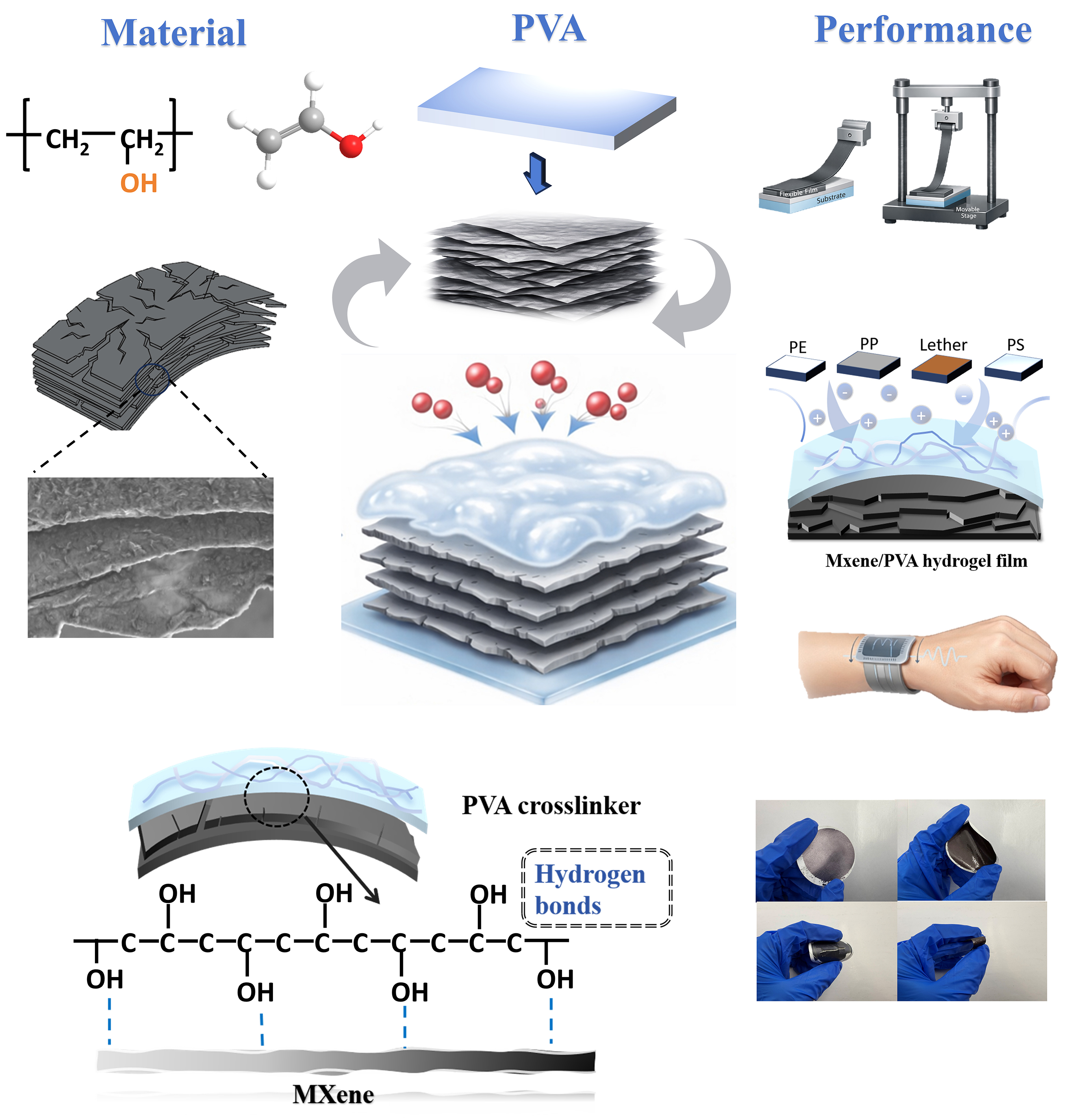
Figure 1. Schematic illustration of the fabrication, protective mechanisms, and application of the PVA/MXene composite film. The workflow includes the surface-coating process; the mechanical stretchability and interfacial adhesion/viscoelastic properties enhanced by hydrogen bonding; and the deployment of the film in a self-powered gesture-recognition system.
Morphology and composition of MXene and PVA/MXene composites
Comparison of the XRD patterns of the MAX phase and MXene confirms the selective etching of Al layers from the bulk MAX precursor [Figure 2A]: the characteristic peak at 39° disappears completely, and the (002) peak shifts toward a lower angle, confirming interlayer expansion.
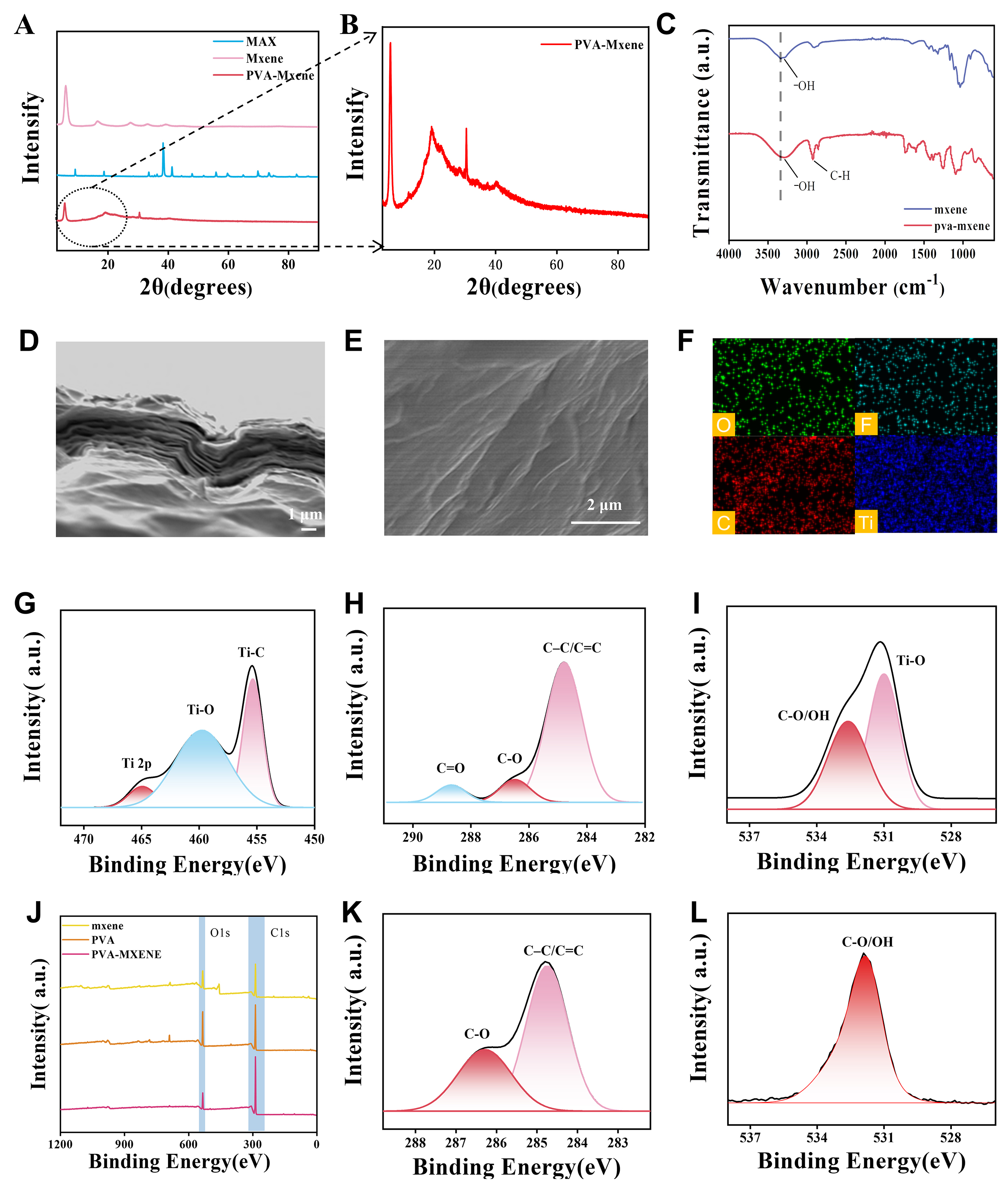
Figure 2. Structural, morphological, and compositional characterization of MXene, PVA, and PVA/MXene composite films. (A and B) X-ray diffraction (XRD) patterns of pure MXene, MAX phase, and the PVA/MXene composite film. (C) Fourier-transform infrared (FTIR) spectra comparing pure MXene and the PVA/MXene composite film, highlighting the chemical functional groups. (D and E) Surface and cross-sectional field-emission scanning electron microscope (FE-SEM) images of the MXene film at different magnifications. (F) Energy-dispersive X-ray spectroscopy (EDS) elemental mapping results showing the spatial distribution of characteristic elements within the composite. (G–I) High-resolution X-ray photoelectron spectroscopy (XPS) core-level spectra of (G) Ti 2p, (H) C 1s, and (I) O 1s of pure MXene. (J) XPS survey spectra of pristine MXene, pristine PVA, and the PVA/MXene composite film. (K and L) High-resolution XPS spectra of (K) C 1s and (L) O 1s of the PVA/MXene composite film.
In the PVA/MXene composite, the diffraction peaks at 5.21° and 19.91° correspond to the (002) plane of Ti3C2Tx and the (101) plane of PVA, respectively, confirming successful fabrication of the composite
According to Bragg’s law, this shift toward a lower angle corresponds to an enlarged interplanar spacing, indicating that PVA molecules infiltrated the top layers of the MXene film during coating and established a tight interfacial contact.
Figure 2D-F displays the FE-SEM images and the corresponding elemental mapping of the as-prepared MXene. Figure 2D shows that MXene exhibits a typical accordion-like multilayer structure, confirming successful etching of the Al layer from the MAX phase. The elemental mapping images [Figure 2F] show that Ti, C, O, and F are uniformly distributed throughout the MXene sample. This morphology and elemental composition confirm successful fabrication of high-purity MXene, providing a basis for subsequent hybridization with PVA. The cross-sectional SEM image of the PVA/MXene composite film confirms the continuity and uniformity of the PVA coating [Supplementary Figure 1].
The Ti 2p spectrum [Figure 2G] exhibits characteristic Ti-C peaks, confirming preservation of the MXene structure, whereas the Ti-O component suggests slight surface oxidation. The high-resolution C 1s spectrum [Figure 2H] can be deconvoluted into three components corresponding to C-C/C=C (284.6 eV), C-O (≈286 eV), and C=O (≈288 eV), indicating the presence of oxygen-containing surface groups on MXene. The O 1s spectrum [Figure 2I] can be deconvoluted into Ti-O and C-O/OH components, further confirming the oxygen-containing surface terminations on MXene.
The XPS survey spectra of pristine MXene, the PVA/MXene composite, and pristine PVA confirm the introduction of PVA onto the MXene surface [Figure 2J]. The enhanced C-O component after PVA coating further indicates successful introduction of PVA [Figure 2K]. In the C 1s and O 1s spectra of the PVA/MXene composite film [Figure 2K and L], the increased hydroxyl-related peak suggests interfacial interaction between PVA and MXene. The enhanced C-OH peak indicates that the MXene surface is covered after encapsulation by PVA, rendering the Ti-O signal undetectable. Quantitatively, the high-resolution spectra of pristine MXene give Ti 2p Ti-C ≈454.6 eV/Ti-O ≈458.3 eV; C 1s C-C/C=C ≈284.6 eV/C-O ≈286.0 eV/C=O ≈288.0 eV; and O 1s Ti-O ≈530 eV/C-O/OH ≈532 eV [Supplementary Table 2].
Mechanical properties and interfacial interactions
To investigate the effect of the PVA coating on the mechanical stability of MXene flexible devices, simulation analysis of the stress distribution during device bending was performed [Figure 3A]. For the MXene film without a PVA coating, pronounced stress concentration was observed in the central region of the device during bending, with stress values markedly higher than those in the edge region. The stress nephogram shows that the central region appears primarily in orange-red, whereas the edge region gradually transitions to blue, indicating that bending deformation is concentrated mainly in the central region of the device. In contrast, the MXene device coated with PVA exhibits a more uniform stress distribution under bending conditions. The high-stress areas in the central region are markedly reduced, and the color transitions overall from orange-red to a more uniform blue, indicating that the PVA layer effectively alleviates local stress concentration. This improvement is attributed primarily to the cushioning effect of the flexible PVA layer, which disperses local stress and reduces interfacial strain concentration during bending. These results indicate that the PVA coating effectively enhances the mechanical stability and bending resistance of MXene flexible devices, which is important for the long-term stable operation of wearable sensors.
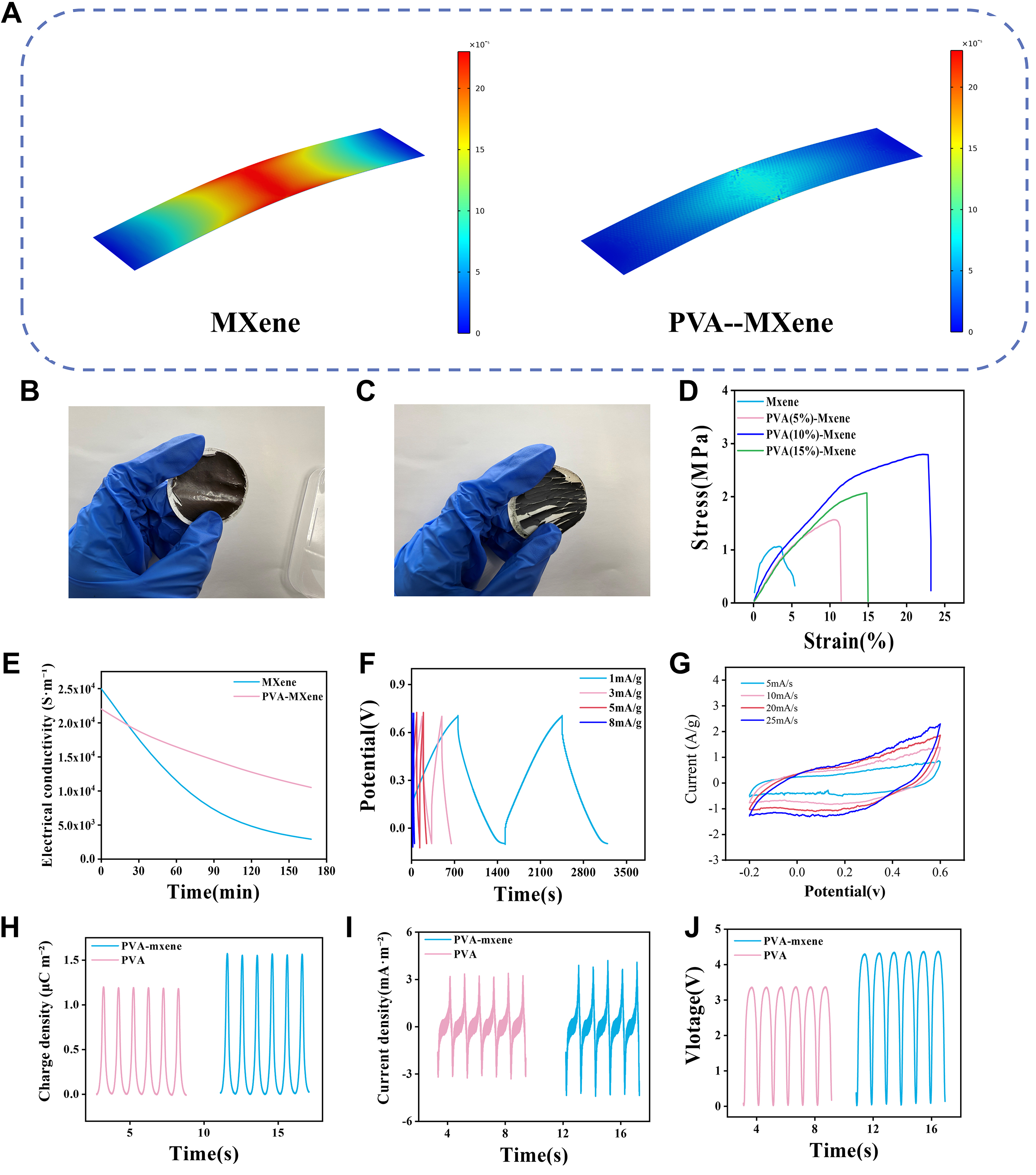
Figure 3. Mechanical robustness, anti-oxidation stability, electrochemical behavior, and triboelectric performance comparison of pure MXene and PVA/MXene composite films. (A) Computational simulation profiles of the bending tests for pure MXene and PVA/MXene films. (B and C) Digital photographs showing the physical appearance of the films during environmental oxidation-stability testing. (D) Tensile stress-strain curves showing the mechanical stretchability and tensile strength. (E) Evaluation curves showing the degradation of electrical conductivity. (F) Galvanostatic charge-discharge (GCD) profiles. (G) Cyclic voltammetry (CV) curves. (H-J) Comparison of the triboelectric output metrics. Simulation parameters: two-layer geometry (MXene, 5 cm × 1 cm × 10 μm; PVA, 5 cm × 1 cm × 220 μm; a representative strip of the actual 5 cm × 3 cm film), EMXene ≈ 300 GPa, EPVA ≈ 2 GPa, ν ≈ 0.3, tetrahedral mesh with a 0.5 mm maximum element size (0.05 mm at the interface), bottom fixed and top subjected to a 25 N cyclic load. Peak stress drops from ≈2.0 × 10⁸ Pa in bare MXene to < 5.0 × 10⁷ Pa after PVA coating (full parameter table in Supplementary Table 3).
Figure 3B and C compares the films after an accelerated oxidation test: both the bare MXene film and the PVA/MXene film were dehydrated in a vacuum oven for 2 h and then held in a 60 °C circulating-air oven, with conductivity measured every 20 h by a four-probe method. Under prolonged high-temperature exposure, the bare MXene film cracked after bending, whereas the PVA-coated film showed only edge warping and remained largely intact. Figure 3D shows tensile results for PVA coatings at different concentrations: tensile strength increases with PVA content, reaching ≈2.8 MPa at 15 wt% PVA, compared with 1.01 MPa for bare MXene (an increase of about 180%). The mechanistic interpretation of this protective effect is given in Supplementary Note 2, and the high-resolution XPS anti-oxidation spectra are provided in
Figure 3F and G shows electrochemical tests (galvanostatic charge-discharge (GCD) and cyclic voltammetry (CV)) of the PVA/MXene supercapacitors. The CV curve is rectangular at different scan rates, indicating pseudocapacitive energy-storage behavior. As the scan rate increases from 5 to 25 mV/s, the area enclosed by the CV curve increases gradually, indicating good ion-transport and charge-storage performance; the slight curve distortion at the high scan rate is attributed to increased ion-transport resistance in the PVA gel electrolyte. The slight voltage fluctuation (noise) observed in the CV curve may be owing to instability at the PVA gel electrolyte interface and non-uniform local ion transport during cycling. Despite these fluctuations, the CV curve remains relatively stable overall, indicating stable electrochemical performance and good structural stability for the PVA/MXene supercapacitors. The GCD curves of the PVA/MXene devices exhibit relatively symmetrical, triangular charge-discharge characteristics at different current densities, indicating excellent charge-discharge stability. As the current density increases from 1 to 8 mA/g, the discharge time shortens gradually, mainly owing to accelerated ion-diffusion kinetics. A slight IR drop (voltage drop associated with internal resistance) was observed at the initial stage of discharge, indicating internal resistance and interfacial impedance within the flexible device. From the GCD profile at 1 mA·g-1, the PVA/MXene interfacial specific capacitance is estimated to be ≈3 F·g-1 (integration details in
Finally, the voltage, current, and transferred charge of the pure PVA film and the PVA/MXene composite film were compared [Figure 3H-J]. The composite film shows higher output: current increases by about 25%, voltage by about 30%, and transferred charge density increases from 1.19 to 1.51 μC m-2. This improvement is attributed mainly to the high conductivity of the underlying MXene layer, which supports charge accumulation at the interface.
Triboelectric performance of PVA/MXene films
Figure 4A shows the construction of a contact-separation TENG consisting of PVA/MXene on one side and five reference materials (leather 1, leather 2, PS, PP, and PE), on the other side; the device’s performance was systematically evaluated and analyzed to understand its working mechanism. Initially, the two electrodes were separated and electrically neutral, with no potential difference or charge induction between them. When an external force is applied, the PVA layer on the surface of the PVA/MXene film contacts the polymer counter-layer first. Owing to the differing electron affinities of the two materials, equal but opposite charges are induced on the contact surface. When the applied force is released, interface separation triggers electrostatic induction, and electrons flow through the PVA layer to the MXene layer and then to the Ag electrode, generating a measurable electrical signal. As illustrated by the finite element simulation in
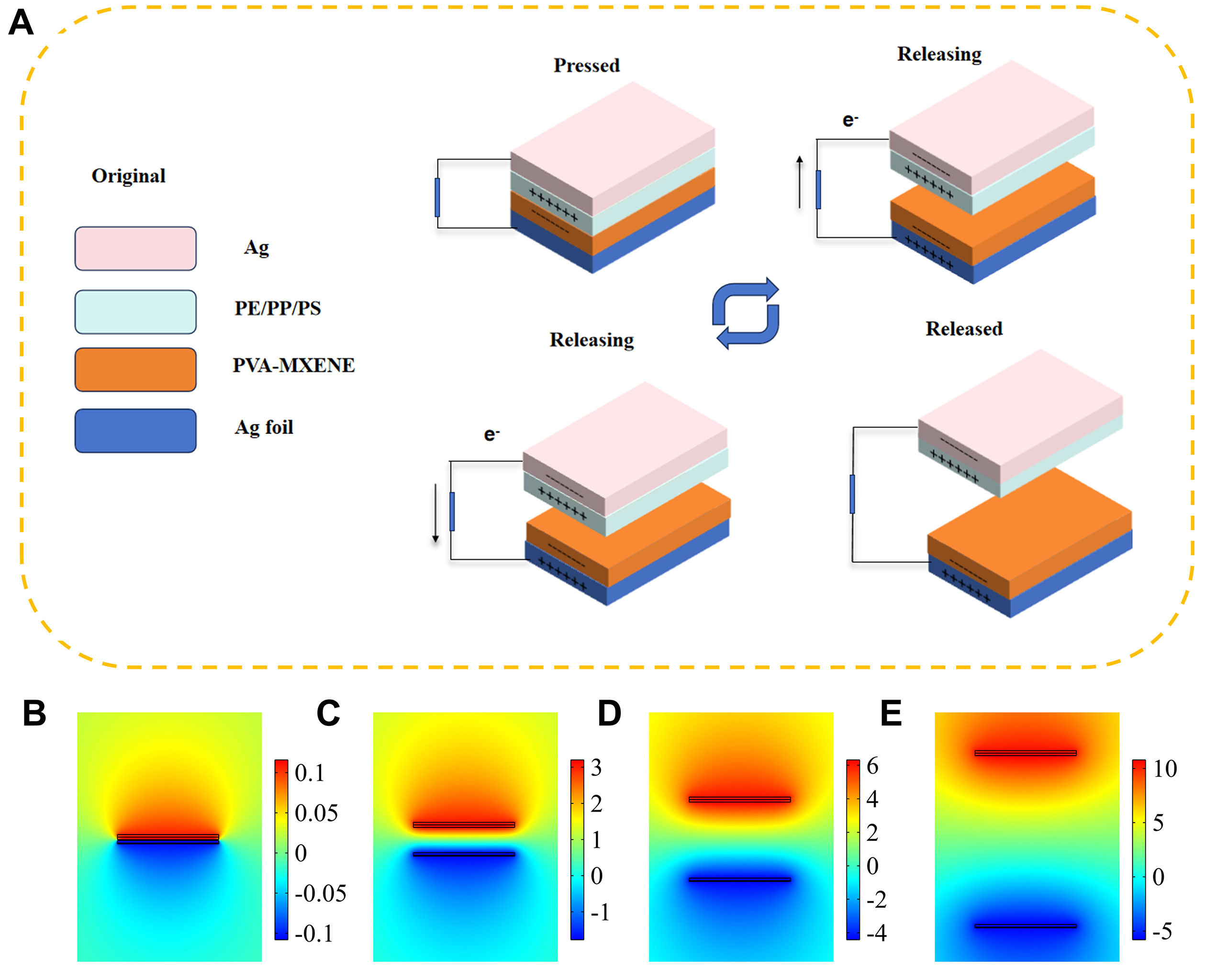
Figure 4. Experimental configuration and material screening. (A) Schematic diagram illustrating the experimental setup and working mechanism for triboelectric performance measurements. (B-E) Finite element method simulation of the triboelectric nanogenerator.
As shown in Figure 5A-C, the signal output of the PVA/MXene composite film was tested against different contact objects under the same contact-separation conditions; different excitation voltages were generated under the same applied pressure. The maximum voltage, 4.2 V, was generated in contact with PE, reflecting differences in electron affinity among the materials tested; voltage output increased nonlinearly across the different contact materials. Owing to differences in the physical properties of the materials, the peak shape of the frictional electrical signals also varies. Leather is soft and makes flexible contact during friction, producing a relatively neutral electrical response and smooth output signals, whereas PE, which has strong electronegativity, produces a sharp peak of short duration. Among the five reference materials tested, output voltage increased in the order leather 1, leather 2, PS, PP, and PE, reaching 4.2 V with PE. More importantly, device performance is further enhanced when Ecoflex is used as the counter layer, because Ecoflex exhibits a markedly higher electron affinity than PVA. Figure 5D shows that the PVA/MXene film exhibits different electrical responses under different contact forces, with force-scanning results ranging from 5 to 20 N.
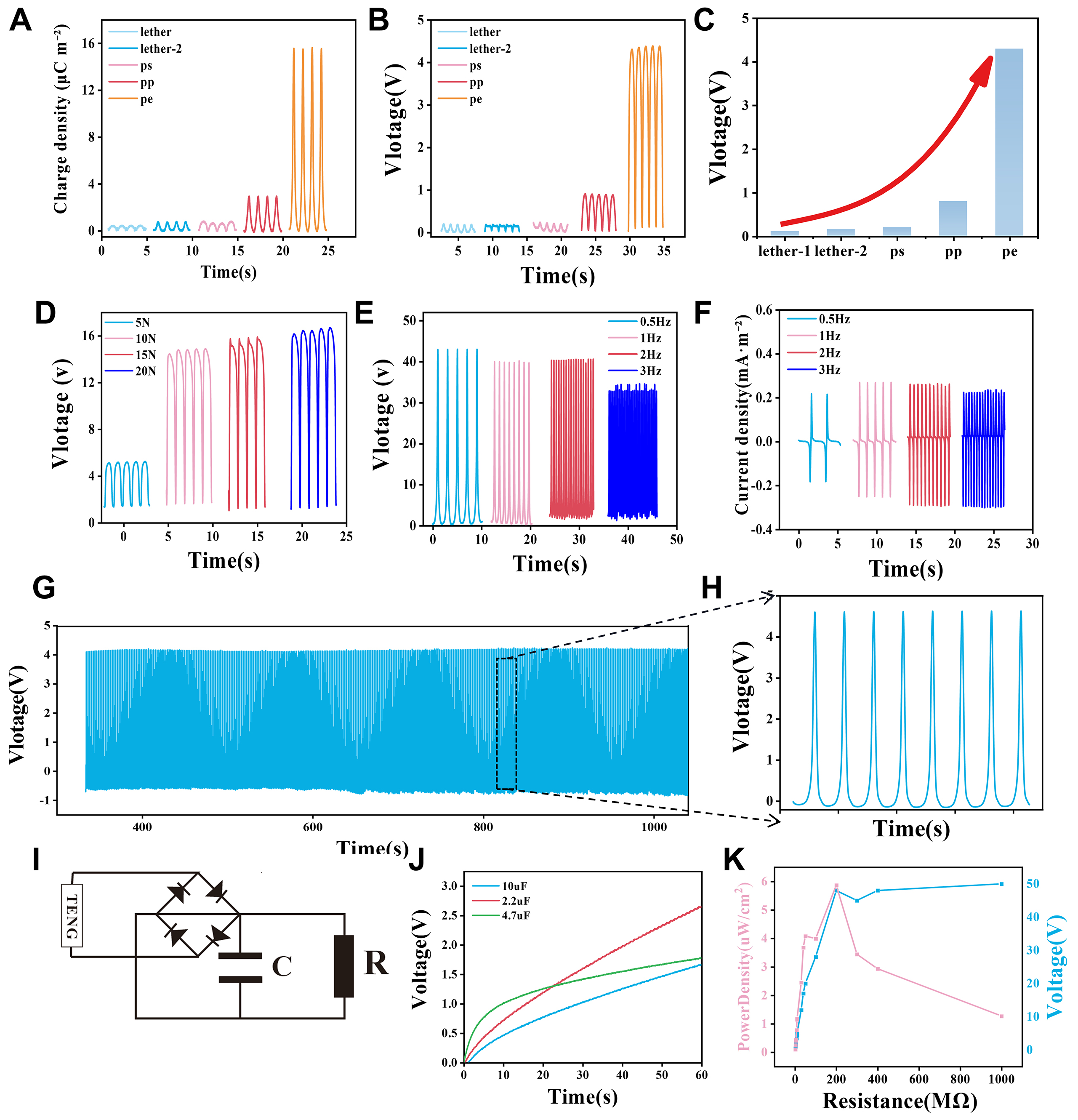
Figure 5. Comprehensive triboelectric performance, parameter dependence, long-term durability, and energy-harvesting applications of the PVA/MXene film. (A-C) Output voltage and transferred charge profiles when the composite film is paired with various distinct contact objects (leather 1, leather 2, PS, PP, and PE). (D) Output voltage variations under different mechanical contact forces ranging from 5 to 20 N (1 Hz). (E and F) Dependence of the output voltage and short-circuit current on the operating frequency. (G and H) Long-term durability and continuous cycling stability tests over 1,000 contact-separation cycles (5 N, 1 Hz), demonstrating the mechanical and electrical robustness of the device. (I) Schematic circuit diagram of the energy-harvesting system integrated with a full-wave rectifier bridge. (J) Voltage-time charging curves for different commercial capacitors (2.2, 4.7, and 10 μF; rated voltage, 10 V) driven by the self-powered system. (K) Output voltage and calculated power density (normalized to the effective contact area of ≈2 cm2) plotted as a function of external load resistance to evaluate impedance matching; the peak output voltage of 50 V was obtained at 25 N and 1 Hz with the Ecoflex counter layer Comprehensive triboelectric performance, parameter dependence, long-term durability, and energy-harvesting applications of the PVA/MXene film. (A-C) Output voltage and transferred charge profiles when the composite film is paired with various distinct contact objects. (D) Output voltage variations under different mechanical contact forces ranging from 5 to 20 N. (E and F) Dependence of the output voltage and Short-circuit current on alternative operating frequencies. (G and H) Long-term durability and continuous cycling stability tests demonstrating the mechanical and electrical robustness of the device. (I) Schematic circuit diagram of the energy-harvesting system integrated with a full-wave rectifier bridge. (J) Voltage-time charging curves for different commercial capacitors (2.2, 4.7, and 10 μF) driven by the self-powered system. (K) Output voltage and calculated power density plotted as a function of external load resistance to evaluate impedance matching.
Contact-separation tests were subsequently conducted under different force and frequency conditions, and the resulting signals were recorded [Figure 5E and F]. The generated voltage decreased gradually with increasing frequency, because at higher operating frequencies, the shorter contact-separation interval limits charge transfer between the layers. Figure 5G and H shows that after 1,000 cycles of contact separation (5 N, 1 Hz), the output voltage remained at 4.8 V. This stable output over an extended period confirms the durability of the material and its ability to consistently convert mechanical input into electrical signals.
To further evaluate the energy-harvesting and storage capabilities of the device, the generated AC power was converted to DC using a rectifier bridge and used to charge commercial capacitors (2.2, 4.7, and 10 μF; rated voltage, 10 V; specifications in Supplementary Table 4). As shown in Figure 5I and J, the charging curves of the 2.2 and 4.7 μF capacitors both exhibit a clear step-like upward trend, consistent with charge accumulation under periodic mechanical excitation. Because smaller capacitors generate larger voltage increments for the same charge input (U = Q/C), the 2.2 μF capacitor charged markedly faster than the
To evaluate the effective output power of the PVA/MXene film as a power source, the output voltage of the device was measured under different external load resistances (0 to 1 GΩ). As shown in Figure 5K, the output voltage increased progressively with load resistance because of load-voltage division. The power density was calculated according to the formula P = I2R. The results show that the device achieved a maximum power density of 6 μW/cm2 (normalized to the effective contact area of ≈2 cm2) at the optimal load resistance of 200 MΩ, indicating good impedance matching.
Our hydrogen-bond-cross-linked PVA/MXene film delivers a peak output voltage of 50 V with an Ecoflex counter layer and a power density of 6 μW/cm2, with output sustained under ambient conditions. Benchmarked against recent MXene- or PVA-based TENGs, the voltage obtained here is moderate compared with the 353.3 V of PVA/g-C3N4 TENGs[33], the 198.6 V of h-BN composite TENGs[34], the 120 V of Ti3C2Tx dual-function electrodes[35], the 190-212 V of silane-modified PVA/MXene hydrogels[36], the multifunctional PVA/MXene Hanji textile[37]; the masked-TENG letter recognition[38], and the 326.89 V of triple-network hydrogels[39] illustrate complementary machine-learning-enabled applications. These differences arise from variations in contact area, applied force, and load resistance; our device is instead optimized for long-term durability through PVA encapsulation that suppresses MXene oxidation (summarized in Supplementary Table 5). Regarding power density, reported figures range from
Figure 6A shows pronounced differences in the peak amplitude, waveform shape, and temporal characteristics of the voltage signals generated by different gestures, reflecting differences in contact intensity, deformation behavior, sliding trajectory, and motion speed among the gesture types. The flexible PVA/MXene sensing layer is highly sensitive to subtle mechanical stimuli and generates distinguishable frictional electrical responses under different gesture movements. These distinguishable signal features provide a basis for subsequent gesture classification and machine-learning-assisted recognition. To quantitatively evaluate the classification capability of the SVM model, stratified fivefold cross-validation was conducted. The average accuracy, precision, recall, and F1-score reached 93.33% ± 6.09%, 94.07% ± 7.57%, 93.33% ± 6.09%, and 92.44% ± 7.13%, respectively (Figure 6B; per-fold results in Supplementary Table 6). Comparison of the PCA results in Figure 6C shows that different gestures exhibit distinguishable clustering behavior in the feature space. Samples corresponding to the same gesture cluster within relatively compact regions, indicating good repeatability and signal consistency. Some gesture categories show pronounced separation along the PC1 and PC2 axes, indicating distinct electrical response characteristics. The partial overlap between several gesture clusters can be attributed to the similarity of motion patterns and the inevitable signal fluctuations during manual operation. Overall, PCA analysis confirms that the extracted signal features provide sufficient discriminative power for gesture recognition. It should be emphasized that the machine-learning-enabled gesture recognition is included only as a proof-of-concept human-machine interface demonstration; the central contribution of this work remains the oxidation-resistant PVA/MXene film and its durable TENG performance.
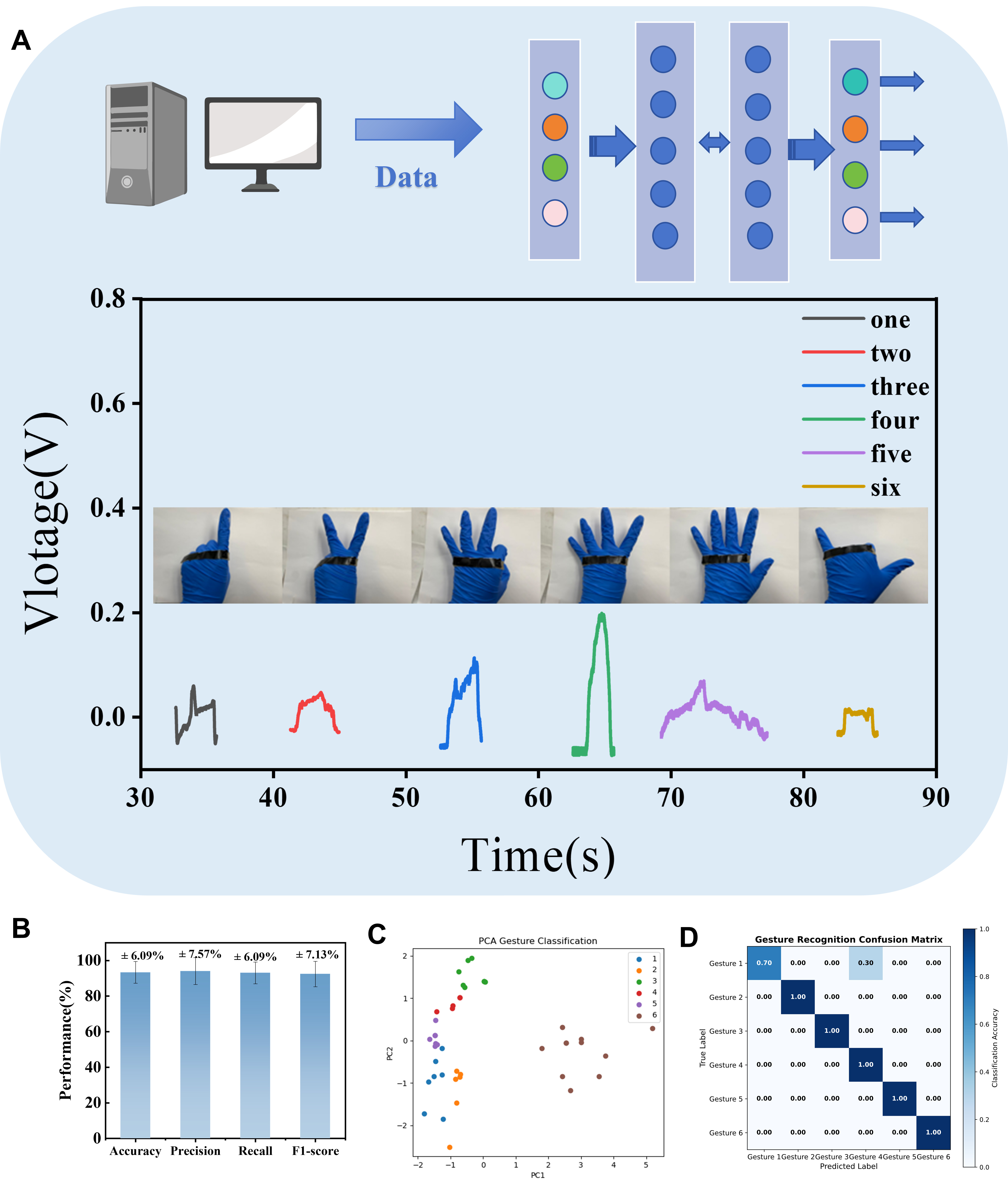
Figure 6. Machine-learning-assisted self-powered gesture-recognition system and classification performance. (A) Electrical signal response waveforms corresponding to six different hand gestures. (B) Multi-metric evaluation of gesture-recognition performance. (C) PCA score cluster plot based on PC1 and PC2. (D) Confusion matrix showing recognition accuracy and error distribution for the six gestures.
To further evaluate the gesture-recognition ability of the PVA/MXene sensors, an SVM model was used for classification analysis based on the extracted signal features. As shown in the confusion matrix in Figure 6D, most gesture categories exhibit high recognition accuracy, indicating strong discriminative ability of the extracted electrical features. Gesture 1, however, shows relatively low classification performance compared with the other categories, likely owing to the similarity in motion patterns and electrical response characteristics between gesture 1 and adjacent gesture classes.
In addition, signal fluctuations arising from manual operation and unstable interfaces in flexible sensors may further contribute to classification overlap. Although there is partial overlap in several gesture categories, the overall classification results still demonstrate the feasibility of the proposed sensor for gesture-recognition applications. Because the data were acquired from a single participant, the reported accuracy reflects intra-subject performance; multi-subject validation is required before a general claim of applicability.
Machine-learning decoding of TENG signals has expanded to handwriting and letter recognition, where tree/ensemble models reached high accuracy on h-BN TENGs[34] and a masked TENG achieved 88.7% letter recognition[38]; tree-based regression has likewise been applied to material-property prediction[40]. Our SVM attains 93.33% ± 6.09% gesture recognition on a single-participant dataset, comparable to the 96.36% reported for a Ti3CNTx/PVA TENG[7].
LIMITATIONS
Several limitations of this study should be noted. First, the gesture-recognition dataset was acquired from a single participant (the first author), and the reported accuracy therefore reflects intra-subject performance; generalization to a broader population remains to be validated with multi-participant datasets. Second, the dataset is small (45 records covering six gestures) and classification was performed with a shallow SVM on hand-crafted features; larger datasets and deep-learning models would be required to strengthen the recognition results. Third, the composite films were fabricated by laboratory-scale drop-casting, so the uniformity of large-area coating and the reproducibility of film thickness require further optimization. Fourth, the oxidation stability was evaluated under an accelerated condition (60 °C, circulating air); long-term stability under high humidity and under real wearable-service conditions warrants further investigation. Finally, the peak power density of the present device (6 μW/cm2) is lower than that of some reported MXene- or PVA-based TENGs, because the present design deliberately prioritizes durability and oxidation resistance over peak output; improving the output while retaining durability remains a subject for future work.
CONCLUSIONS
In summary, a PVA surface-coating strategy was used to reduce the ambient oxidation and mechanical fragility of two-dimensional MXene films, producing PVA/MXene composite films with improved durability. XRD and FTIR indicate hydrogen bonding between PVA and MXene surface groups, which promotes interfacial infiltration. The composite film shows higher electrical output than the pure PVA film, owing to the conductivity of the underlying MXene layer. The effects of excitation parameters and contact materials were examined: a peak output voltage of 50 V was obtained with an Ecoflex counter layer, and a peak power density of 6 μW/cm2 at an optimal load resistance of 200 MΩ. A self-powered sensor array based on the composite film generated distinct electrical maps for six gestures and reached 93.33% ± 6.09% gesture-recognition accuracy [Supplementary Table 6]. This coating approach, which balances output and operational lifetime, is a route to using transition metal carbides/nitrides in durable flexible self-powered electronics and HMIs. Looking forward, the surface-coating strategy can be extended to other MXene compositions and device architectures[7,33-39]; deep-learning models (CNN/LSTM) trained on larger multi-user datasets[34,38] could improve recognition robustness; and integration with IoT nodes and soft robots[37] would broaden practical deployment.
DECLARATIONS
Authors’ contributions
Investigation, Writing original draft, Software, Methodology, Data curation: Suo, L.
Resources, Investigation: Feng, H.
Validation, Software, Methodology, Investigation: Zhang, Z.
Investigation, Visualization, Methodology: Hu, H.
Conceptualization, Project administration, Funding acquisition, Writing review & editing: Wang, J.
Project administration, Funding acquisition, Writing review & editing: Chen, H.
Availability of data and materials
The data supporting the findings of this study are available within this Article and its Supplementary Materials. Further data are available from the corresponding authors upon request.
AI and AI-assisted tools statement
Not applicable.
Financial support and sponsorship
This work was supported by the National Natural Science Foundation of China (No. 12174172, 52201043), and the Natural Science Foundation of Fujian (Nos. 2024J011310 and 2023J011396), the Fuzhou Science and Technology Project (2024-Y-022), and the Sister Cities Science and Technology Innovation Project of Fuzhou and Fashu Charity Foundation of Minjiang University (MFK24024).
Conflicts of interest
All authors declared that there are no conflicts of interest.
Ethical Approval and Consent to Participate
Article 31 of the Measures for the Ethical Review of Life Science and Medical Research Involving Humans (Guo Wei Ke Jiao Fa [2023] No. 4) and Article 22 of the Measures for the Ethical Review of Science and Technology (Trial) (Guo Ke Fa Jian [2023] No. 167), under which such low-risk, non-invasive wearable-sensing experiments do not require formal ethical approval. The participant has signed a written informed consent form before participating in the study. Article 31 of the Measures for the Ethical Review of Life Science and Medical Research Involving Humans (Guo Wei Ke Jiao Fa [2023] No. 4) and Article 22 of the Measures for the Ethical Review of Science and Technology (Trial) (Guo Ke Fa Jian [2023] No. 167), under which such low-risk, non-invasive wearable-sensing experiments do not require formal ethical approval. The participant signed a written informed consent form before the study.
Consent for publication
Not applicable.
Copyright
© The Author(s) 2026.
Supplementary Materials
REFERENCES
1. Wang, Y.; Yue, Y.; Cheng, F.; et al. Ti3C2Tx MXene-based flexible piezoresistive physical sensors. ACS. Nano. 2022, 16, 1734-58.
2. Ghazizadeh, E.; Deigner, H.; Al-Bahrani, M.; Muzammil, K.; Daneshmand, N.; Naseri, Z. DNA bioinspired by polyvinyl alcohol -MXene-borax hydrogel for wearable skin sensors. Sens. Actuators. A. Phys. 2025, 386, 116331.
3. Du, T.; Han, X.; Yan, X.; Shang, J.; Li, Y.; Song, J. MXene-based flexible sensors: materials, preparation, and applications. Adv. Mater. Technol. 2023, 8, 2202029.
4. Hajian, S.; Maddipatla, D.; Narakathu, B. B.; Atashbar, M. Z. MXene-based flexible sensors: a review. Front. Sens. 2022, 3, 1006749.
5. Huang, T.; Huang, Y.; Mao, S.; et al. Flexible and electrically conductive 3D-printed Ti3C2Tx MXene-hydrogel copolymers for the high-precision sensing of biomechanical processes. Sensors 2026, 26, 1303.
6. Chen, L.; Geng, C.; Yu, S.; et al. Dual-conduction network in ionic/MXene hydrogels for advanced sensing and electromagnetic shielding. J. Polym. Sci. 2025, 64, 522-32.
7. Liu, R.; Feng, H.; Sun, Z.; et al. Enhancing output performance of triboelectric nanogenerator based on high-dielectric Ti3CNTx/PVA nanofiber membrane for human-computer interaction applications. Chem. Eng. J. 2025, 519, 165703.
8. Yang, W.; Lv, L.; Feng, H.; et al. Ultrasensitive dual-mode sensor with machine learning-decoupled pressure-temperature perception. Chem. Eng. J. 2026, 528, 172561.
9. Abdullah, Z. W.; Dong, Y.; Davies, I. J.; Barbhuiya, S. PVA, PVA blends, and their nanocomposites for biodegradable packaging application. Polym. Plast. Technol. Eng. 2017, 56, 1307-44.
10. Hassan, C. M.; Peppas, N. A. Structure and applications of poly(vinyl alcohol) hydrogels produced by conventional crosslinking or by freezing/thawing methods. Adv. Polym. Sci. 2000, 153, 37-65.
11. Dennis, J. O.; Shukur, M. F.; Aldaghri, O. A.; et al. A review of current trends on polyvinyl alcohol (PVA)-based solid polymer electrolytes. Molecules. 2023, 28, 1781.
12. Erol, İ.; İsmail, İ.; Hazman, Ö.; Demirelli, K.; Güney, B. Interfacial interactions in electrospun PVA-MC/MXene nanofibers: a route to enhanced dielectric and antimicrobial properties. Mater. Sci. Eng. B. 2026, 324, 119012.
13. Gao, F.; Song, J.; Wang, Y.; et al. PEDOT/PVA/MXene ternary hydrogel-based flexible and wearable electrochemical sensor for non-invasive uric acid detection in sweat. SensActuators. B. Chem. 2026, 465, 140240.
14. Ghazizadeh, E.; Sadeghi, M.; Deigner, H.; Neshastehriz, A. Engineered sustainable Mxene-PVA hydrogel as an inspiring co-delivery carrier for targeting solid tumors. Pharmaceutics 2025, 17, 823.
15. Hema, M.; Selvasekerapandian, S.; Hirankumar, G.; Sakunthala, A.; Arunkumar, D.; Nithya, H. Structural and thermal studies of PVA:NH4I. J. Phys. Chem. Solids. 2009, 70, 1098-103.
16. Jiang, S.; Liu, S.; Feng, W. PVA hydrogel properties for biomedical application. J. Mech. Behav. Biomed. Mater. 2011, 4, 1228-33.
17. Kumar, A.; Han, S. S. PVA-based hydrogels for tissue engineering: a review. Int. J. Polym. Mater. Polym. Biomater. 2016, 66, 159-82.
18. Ji, D.; Li, B.; Zhang, D.; et al. A multifunctional MXene/PVA hydrogel as a continuous ionic thermoelectric generator and a strain/temperature sensor. Small 2024, 21, 2407529.
19. Qin, R.; Nong, J.; Wang, K.; et al. Recent advances in flexible pressure sensors based on MXene materials. Adv. Mater. 2024, 36, 2312761.
20. Ma, Y.; Liu, N.; Li, L.; et al. A highly flexible and sensitive piezoresistive sensor based on MXene with greatly changed interlayer distances. Nat. Commun. 2017, 8, 1207.
21. Ma, C.; Ma, M. G.; Si, C.; Ji, X. X.; Wan, P. Flexible MXene-based composites for wearable devices. Adv. Funct. Mater. 2021, 31, 2009524.
22. Thong, C.; Teo, D.; Ng, C. Application of polyvinyl alcohol (PVA) in cement-based composite materials: a review of its engineering properties and microstructure behavior. Constr. Build. Mater. 2016, 107, 172-80.
23. Teodorescu, M.; Bercea, M.; Morariu, S. Biomaterials of PVA and PVP in medical and pharmaceutical applications: perspectives and challenges. Biotechnol. Adv. 2019, 37, 109-31.
24. Lin, Z.; Gao, Y.; Chen, L.; Wang, W.; Chen, T. Design and fabrication of PVA/SA/MXene@TA-Fe hydrogel as an efficient solar evaporator for desalination. J. Environ. Chem. Eng. 2025, 13, 117584.
25. Zhang, R.; Zhang, Y.; Lv, Z.; et al. Interfacially engineered MXene hydrogels with dual-conductive networks for high-performance multifunctional sensingviaa green and sustainable strategy. Green. Chem. 2026, 28, 7782-92.
26. Zhang, Y.; Wang, L.; Zhao, L.; et al. Flexible self-powered integrated sensing system with 3D periodic ordered black phosphorus@MXene thin-films. Adv. Mater. 2021, 33, 2007890.
27. Yu, Y.; Ma, T.; Wei, Q.; et al. Highly conductive, stable, and self-healing MXene-based hydrogel sensor via a controlled assembly of polydopamine and cellulose nanocrystal. Energy. Environ. Mater. 2025, 9, e70105.
28. Yang, R.; Song, H.; Zhou, Z.; et al. Ultra-sensitive, multi-directional flexible strain sensors based on an MXene film with periodic wrinkles. ACS. Appl. Mater. Interfaces. 2023, 15, 8345-54.
29. Vukonic, L.; Piljević, M.; Ostermann, M.; et al. Green-synthesized MXenes enable low-friction, cytocompatible PVA-chitosan hydrogels. Int. J. Biol. Macromol. 2026, 352, 151144.
30. Teng, F. R.; Zheng, H.; Tan, S. C.; et al. Self-healing Pd NPs@ MXene/PVA hydrogel strain sensor: high sensitivity and wide range for electronic skin. 2026. Available from: https://papers.ssrn.com/sol3/papers.cfm?abstract_id=6631501 [Last accessed on 18 Sep 2026].
31. Tang, Q.; Zhang, W.; Cai, H.; et al. Lignin-containing cellulose nanofibers enhanced PVA/MXene hydrogels: combining toughness and conductivity for durably wearable sensing. ACS. Sustain. Chem. Eng. 2025, 13, 20486-94.
32. Su, T.; Liu, N.; Lei, D.; et al. Flexible MXene/bacterial cellulose film sound detector based on piezoresistive sensing mechanism. ACS. Nano. 2022, 16, 8461-71.
33. Umapathi, R.; Rani, G. M.; Patil, S. R.; et al. Human motion driven energy harvesting system enabled by a flexible PVA/g-C3N4 triboelectric nanogenerator. Ceram. Int. 2026.
34. Umapathi, R.; Rethinasabapathy, M.; Kakani, V.; et al. Hexagonal boron nitride composite film based triboelectric nanogenerator for energy harvesting and machine learning assisted handwriting recognition. Nano. Energy. 2025, 136, 110689.
35. Anwer, S.; Umair, Khan. M.; Alazzam, A.; Mohammad, B.; Abu, Nada. E. 2D Ti3C2Tx-MXene and its superstructures as dual-function electrodes for triboelectric nanogenerators for self-powered electronics. Chem. Eng. J. 2024, 502, 157985.
36. Lai, B.; Lai, S.; Lin, H.; Wu, J. M. Silane-modified MXene/PVA hydrogel for enhanced streaming vibration potential in high-performance flexible triboelectric nanogenerators. Nano. Energy. 2024, 125, 109554.
37. Kim, J.; Choi, Y.; Jang, H.; et al. Thermo-chemo-mechanically robust, multifunctional MXene/PVA/PAA-hanji textile with energy harvesting, EMI shielding, flame-retardant, and joule heating capabilities. Adv. Mater. 2024, 36, 2411248.
38. Ming, W.; Zhao, Y.; Zhang, Z.; et al. Self-powered handwritten letter recognition based on a masked triboelectric nanogenerator for intelligent personal protective equipment. ACS. Appl. Mater. Interfaces. 2024, 16, 57936-45.
39. Xie, B.; Ma, Y.; Luo, N.; et al. Triple network hydrogel-based structure triboelectric nanogenerator for human motion detection and structural health monitoring. Nano. Energy. 2024, 130, 110095.
Cite This Article
 Open Access
How to Cite
Download Citation
Export Citation File:
Type of Import
Tips on Downloading Citation
Citation Manager File Format
Type of Import
Direct Import: When the Direct Import option is selected (the default state), a dialogue box will give you the option to Save or Open the downloaded citation data. Choosing Open will either launch your citation manager or give you a choice of applications with which to use the metadata. The Save option saves the file locally for later use.
Indirect Import: When the Indirect Import option is selected, the metadata is displayed and may be copied and pasted as needed.
About This Article
Copyright

Data & Comments
Data
0








Comments
Comments must be written in English. Spam, offensive content, impersonation, and private information will not be permitted. If any comment is reported and identified as inappropriate content by OAE staff, the comment will be removed without notice. If you have any queries or need any help, please contact us at support@oaepublish.com.