



Bismuth chloride additive regulated anode interphase and kinetics in manganese-ion batteries
 0
0 
Abstract
The use of nonaqueous electrolyte in manganese-ion batteries (MIBs) has attracted increasing scientific attention because of their unique properties. These systems significantly reduce water-molecule interference in electrode reactions, effectively precluding unwanted side reactions such as the hydrogen evolution reaction, which commonly occurs in aqueous electrolytes. Nonaqueous electrolyte development is still a challenge, though. Mn2+ has a high charge density, which leads to sluggish Mn2+ kinetics and greatly limits the development of nonaqueous MIBs. In this study, BiCl3 is used as an electrolyte additive to enhance the reaction kinetics of Mn2+ in a diglyme-based nonaqueous electrolyte. Electrochemical testing shows that the polarization voltage of Mn||Mn symmetric cells is greatly reduced following the addition of BiCl3. Full characterization by X-ray diffraction and scanning electron microscopy, combined with density functional theory calculations, suggests that Bi3+ undergoes a spontaneous galvanic replacement reaction with the Mn anode. This process enables the in situ formation of a Bi-containing interphase, which helps reduce the activation barrier for charge transfer. Thus, the full cell with a Cu1.8S cathode delivered an improved average discharge capacity of
Keywords
INTRODUCTION
The world’s growing need for sustainable energy and increased awareness of the need to mitigate environmental effects have contributed to a significant shift toward electric mobility from internal combustion engine vehicles. In this context, lithium-ion batteries (LIBs) have become the cornerstones of the clean energy revolution[1-4]. But the rapid growth of electric vehicle (EV) sales has created a “staggering” need for lithium, highlighting the critical weaknesses in the supply chain. Lithium reserves are vast, but only a portion is high-quality, low-cost, and geographically concentrated. Lithium demand is forecast to grow rapidly and may not meet the demands of the global energy transition over the next decade. To overcome these problems, researchers have started investigating alternative energy storage systems, including sodium-ion batteries[5-7] and potassium-ion batteries[8,9]. At the same time, multivalent metal anodes (Mg, Ca, Zn, Cu, Fe, and Mn) have been attracting great attention because of their multi-electron transfer nature and excellent cost-effectiveness, supported by the fact that these metals are widely available on Earth. Among the different multivalent systems reported to date, such as magnesium[10,11], zinc[12-15], and aluminum-ion batteries[16,17], manganese-ion batteries (MIBs) are one of the most promising candidates[18-21].
Manganese (Mn) is a cost-effective and earth-abundant transition metal, and the reserves in the Earth’s crust are more than 1.5 billion tons. Mn is the 12th most abundant element in the Earth’s crust and could be a strategic option to mitigate the risks of lithium resource depletion[22,23]. Similarly, Mn is relatively stable in air and can be stored in air, which significantly lowers manufacturing, storage, and transportation costs as compared to other highly reactive metals[24]. As an anode material, Mn metal has a moderate reduction potential of -1.19 V vs. the standard hydrogen electrode (SHE), allowing Mn metal batteries to achieve a relatively high discharge voltage. Mn has a high specific capacity (976 mAh g-1) and volumetric capacity (7,250 mAh cm-3). These performance benefits demonstrate the potential applications and practical value of the Mn metal anode[25,26].
Electrolyte research on MIBs falls into two categories: aqueous and nonaqueous. Many strategies were proposed for aqueous MIBs, but the world’s aqueous MIB systems are often hampered by capacity fading and shortened cycle life as a result of interfacial polarization, hydrogen evolution reaction (HER), irreversible parasitic reactions, and continuous electrolyte depletion[19,21,27]. Nonaqueous electrolytes offer a strategic advantage by significantly reducing water-related parasitic reactions compared with aqueous systems. They provide an electrochemical stability window that extends far beyond the inherent electrochemical limits of aqueous media. Recent advances have demonstrated this: He et al. developed an electrolyte using N, N-dimethylformamide and ethylenediamine (EDA)[22]. The symmetric cell of Mn||Mn had a minimum overpotential of 0.5 V at a current density of 0.2 mA cm-2. The complexes of EDA in the electrolyte promote the desorption of Mn2+ and decrease the overpotential in the symmetric cell[22]. Shen et al. then proposed a halogen-mediated approach that introduced the first halogen-mediated nonaqueous electrolyte (HM-NAE)[24]. Cycling instability can be reduced by incorporating less electronegative Cl atoms into the first solvation shell of the Mn2+, which decreased the cation-solvent interaction, resulting in > 700 h of stable cycling[24]. Zhang et al. further improved this with an asymmetric tetramethylene sulfone (TMS) coordinated Mn2(μ-Cl)Cl2(TMS)x(TFSI)n+ cluster electrolyte (AS-NAE), which provides higher ionic conductivity of 3.63-4.68 mS cm-1 and allows robust operation at -40 °C[28]. Recently, Jing et al. introduced a synergistic approach combining the use of an indium nitride interfacial layer and 2-methoxyethylamine additive to maximize the lifespan of symmetric cells for more than 3,400 h[29].
However, several major hurdles must be overcome before these MIBs can be used in practice. The charge density of Mn2+ is high, and it has a strong tendency to coordinate with solvent molecules, resulting in a high energy barrier for the desolvation process[24]. The tendency for electrode passivation leads to naturally low redox kinetics. A dense oxide film forms spontaneously on the surface of the Mn metal, resulting in a high resistance to charge transfer between the metal and electrolyte, which further hinders the plating/stripping of Mn2+ ions[29]. Together, these factors contribute to high overpotentials, high polarizations, and poor cycle kinetics, which in turn greatly limit the rate capability and stability of MIBs.
To tackle these kinetic challenges, this study introduces a judicious electrolyte additive to modify the anode-electrolyte interface. The unique electronic configurations of Bi and its derivatives are highly effective in optimizing ion transport across the interfaces in different types of batteries, including sodium-ion batteries[30,31], potassium-ion batteries[32], zinc-ion batteries[33], and magnesium-ion batteries[34]. We introduced BiCl3 into a basic diglyme electrolyte to create a new nonaqueous electrolyte (G2-BiCl3). In this setup, a facile in situ chemical reaction occurs between Bi3+ and a Bi-containing interphase is formed on the Mn anode. Theoretical simulations and experimental characterization show that this interphase aids Mn deposition/stripping. Thus, the Mn||Mn symmetric cell can be reversibly cycled for more than 1,000 h at
EXPERIMENTAL
Materials
Mn(II) trifluoromethanesulfonate (Mn(OTf)2, 99.5%) was obtained from Dodo Chemical Reagent Co., Ltd. Bismuth(III) chloride (BiCl3, >98%), copper(II) chloride dihydrate (CuCl2·2H2O, 99.99%), thiourea
Preparation of different electrolytes
AE: Mn(OTf)2 was dissolved in deionized water to prepare an AE containing 0.5 M Mn(OTf)2.
All G2-based electrolytes were prepared in an argon-filled glovebox (uNIVERSAL, 2440/750/900, Mikrouna, China). The electrolyte components were weighed using an analytical balance (Quintix 125D-1CN, Sartorius, China) and continuously stirred at room temperature at 200 rpm for 24 h using a magnetic stirrer (TMHB-180CL, Taisite Instrument Co., Ltd., China).
G2-Mn(OTf)2: Mn(OTf)2 was dissolved in G2 solvent to obtain a 0.5 M Mn(OTf)2/G2 electrolyte. The solution was sealed and stirred for 24 h to ensure complete dissolution and homogeneous mixing.
G2-Mn(OTf)2-BiCl3: BiCl3 was added to the 0.5 M Mn(OTf)2/G2 electrolyte, and the mixture was stirred for 24 h. By adjusting the amount of BiCl3, electrolytes with different BiCl3 concentrations (5, 10, and 25 mM) were prepared and denoted as G2-5mM BiCl3, G2-BiCl3, and G2-25mM BiCl3, respectively.
G2-Mn(OTf)2-LiCl: Based on the 0.5 M Mn(OTf)2/G2 electrolyte, LiCl was added to achieve a final concentration of 30 mM. After stirring for 24 h, the G2-Mn(OTf)2-LiCl electrolyte (denoted as G2-LiCl for simplicity) was obtained. The LiCl concentration was selected to provide the same Cl- concentration as that introduced by 10 mM BiCl3.
Preparation of Mn anode and Cu1.8S cathode
Mn anode: The preparation procedure for the Mn anode in this study was based on previously reported methods[24]. Mn powder, Super P, and poly(vinylidene fluoride) (PVDF) were mixed in a weight ratio of 8:1:2, followed by adding N-methyl-2-pyrrolidone (NMP) to form a homogeneous slurry (TMHB-180CL, Taisite Instrument Co., Ltd., China; room temperature; 200 rpm for 2 h). Using a 500 μm doctor blade, the well-stirred slurry was uniformly coated onto a glass plate and dried in a vacuum oven (MSK-H200A, Hefei KJ Magnetic Electronics Co., Ltd., China) at 80 °C for 12 h. The dried electrode film was peeled off the glass plate and cut into circular electrodes with a diameter of 12 mm. The mass of each Mn anode was approximately 12-13 mg. As shown in Supplementary Figures 1 and 2, the Mn anode prepared in this study exhibits high chemical purity and good mechanical integrity, showing no cracking or powder shedding after operations such as tweezer handling and battery cell encapsulation.
Cu1.8S cathode: The preparation procedure for the Cu1.8S cathode material in this study follows the reported literature[35]. Briefly, 2.0 g CuCl2·2H2O (11.7 mmol) and 3.6 g thiourea (47.3 mmol) were dissolved in 80 mL ethylene glycol at 120 °C individually. Then, the two hot, transparent solutions were mixed and stirred at
Material characterization
X-ray diffraction (XRD, 2θ range: 10°-80°, Shimadzu XRD-6100) and X-ray photoelectron spectroscopy (XPS, ESCALAB250Xi, Thermo Fisher Scientific) were used to characterize the chemical composition of the Mn anode surface. Scanning electron microscopy (SEM, accelerating voltage: 20 kV, HITACHI SU8220, Japan; ZEISS 300 Carl Zeiss, Germany) was used to observe the surface morphology of the Mn electrode. High-resolution mass spectrometry (HRMS, Bruker ESI-Q-TOF MS/MS) was used to characterize the electrolyte. Ultraviolet photoelectron spectroscopy (UPS, Thermo Fisher Scientific ESCALAB Xi) was used to determine the work function and valence band maximum of the electrodes.
Electrochemical testing
All batteries were assembled in an argon-filled glovebox with moisture and oxygen levels below 0.01 ppm. The electrochemical performance was evaluated using CR2032-type coin cells in several configurations: Mn||Mn symmetric cells, Mn||Ti, Mn||Cu, and Mn||SS asymmetric cells, as well as Mn||Cu1.8S full cells. For the asymmetric cells, Ti foil (20 μm thick, 12 mm diameter) and Cu foil (100 μm thick, 12 mm diameter) were utilized as current collectors. Whatman GF/D glass fiber (17 mm diameter) served as the separator. Following assembly, the cells were sealed under a constant pressure of 85 kg cm-2 and allowed to equilibrate for at least 8 h prior to testing. Galvanostatic charge discharge (GCD) profiles were recorded using a LANHE battery testing system (CT3004A, Wuhan, China). Additionally, Cyclic voltammetry (CV) and Tafel polarization curves were obtained via an electrochemical workstation (CHI660E, Shanghai, China).
Tafel polarization curves: Three-electrode electrochemical measurements were performed using a Swagelok-type cell to evaluate the interfacial redox kinetics of the Mn anode. A pristine Mn anode or a BiCl3-modified Mn anode was used as the working electrode, while an untreated Mn anode was used as both the counter and reference electrodes. The BiCl3-modified Mn anode was obtained after cycling in the G2-BiCl3 electrolyte, followed by rinsing with G2 and drying. To eliminate the direct contribution of BiCl3 or dissolved Bi-containing species in the electrolyte, all three-electrode measurements were conducted in the G2-Mn(OTf)2 electrolyte without BiCl3. Prior to the measurements, the cells were allowed to equilibrate at the open-circuit potential for 30 min. Tafel measurements were subsequently performed at a scan rate of
Density functional theory (DFT) calculations
All spin-polarized DFT calculations were performed by employing the Vienna ab initio simulation package. The exchange-correlation interaction was described using the Perdew-Burke-Ernzerhof functional within the generalized gradient approximation. Grimme’s DFT-D3 method was used to treat van der Waals interactions. The Brillouin zone was sampled using a 3 × 3 × 1 k-point grid, and the plane-wave energy cutoff was set to 400 eV. The convergence criteria were set to 10-5 eV for energy and
The binding energy (Eb) between two isolated systems can be calculated by the formula:
where EAB represents the total energy of the AB system. EA and EB are the energies of isolated A and B systems, respectively.
The adsorption energy (Eads) was defined as:
where Etotal, Esub, and Eadsorbate are the total energies of the substrate with adsorbate, the substrate, and the free adsorbate, respectively.
RESULTS AND DISCUSSION
Effect of BiCl3 additive on Mn deposition/stripping behavior and the Mn anode interface
Firstly, the chemical stability of the Mn anode in various electrolytes was evaluated. It is evident from Supplementary Figure 3 that the Mn anode demonstrated vigorous gas evolution upon immersion in the AE, whereas it remained stable in the nonaqueous counterparts (G2-Mn(OTf)2 and G2-BiCl3). This underscores the chemical incompatibility between the Mn anode and aqueous media, which precludes stable Mn deposition.
Electrochemical assessments in Mn||Mn symmetric cells further validated these results
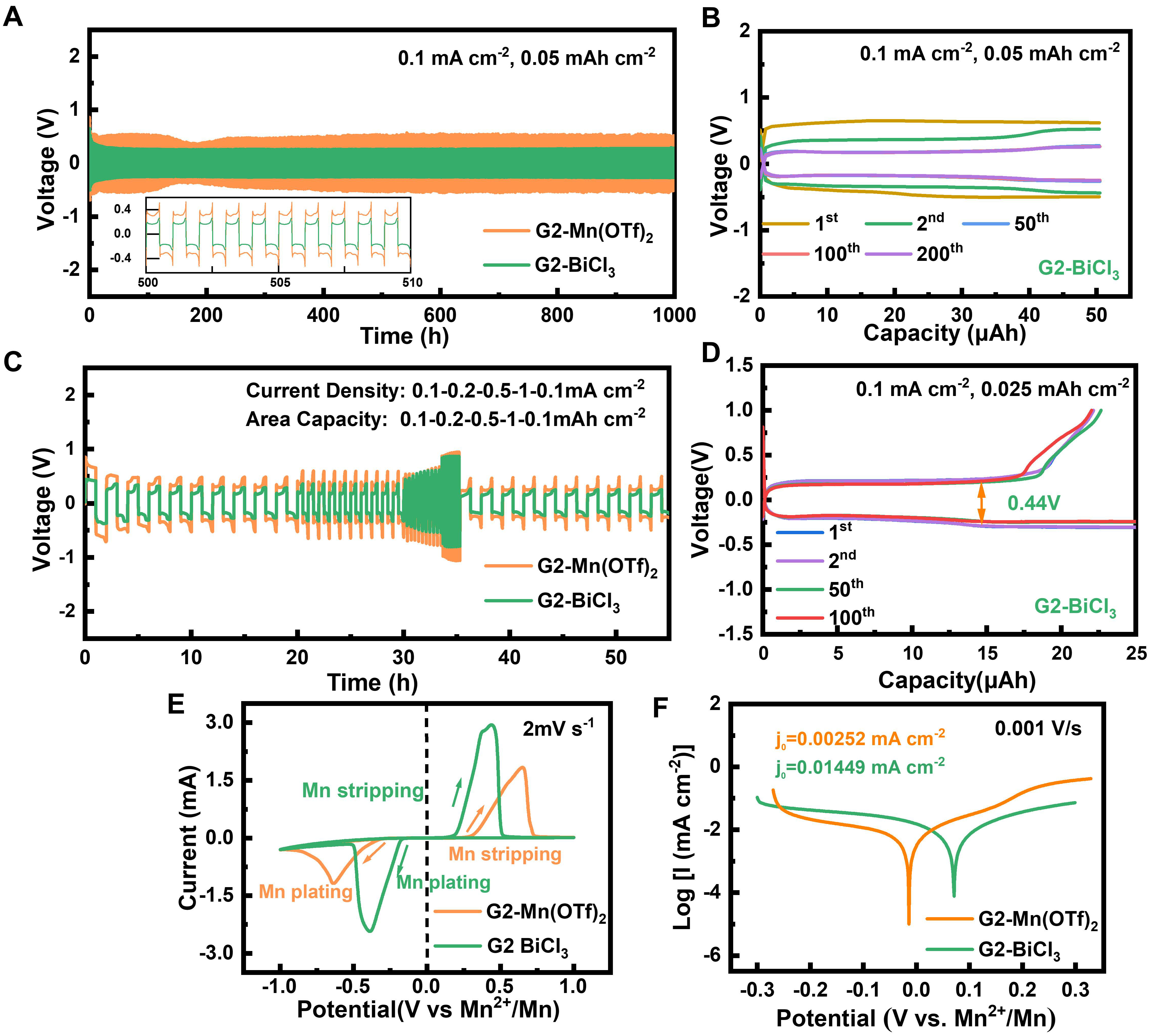
Figure 1. (A) Long-term cycling performance of Mn||Mn symmetric cells with different electrolytes; (B) Voltage profiles at selected cycles for the Mn||Mn symmetric cell using the G2-BiCl3 electrolyte; (C) Rate capability of Mn||Mn symmetric cells with different electrolytes at various current densities; (D) Voltage profiles at designated cycles for the Mn||Cu half-cell using the G2-BiCl3 electrolyte; (E) CV curves of the Mn||Cu half-cells with different electrolytes; (F) Tafel plots of pristine Mn anode and BiCl3-modified Mn anode measured in a three-electrode configuration.
The overpotential of symmetric cells decreased significantly with BiCl3 addition. Concentration-dependent studies [Supplementary Figure 7] indicated that 10 mM BiCl3 was optimal, as a lower concentration (5 mM) was insufficient to reduce polarization, whereas the higher concentration (25 mM) showed an abrupt increase in overpotential at the end of cycling. The rate-capability measurements [Figure 1C] also showed the kinetic benefits of the BiCl3 additive. In G2-BiCl3, no significant polarization was observed with an increase in current density, whereas in G2-Mn(OTf)2, polarization was observed to increase with the rise in current density. Furthermore, the overpotential was restored to the initial level when the current density was reset back to 0.1 mA cm-2, indicating good electrochemical reversibility and improved reaction kinetics.
To demonstrate the effect of BiCl3 on Mn deposition, asymmetric cell cycling was carried out. Stable cycling was also achieved for Mn||Cu cells at 0.1 mA cm-2 and 0.025 mAh cm-2 over 100 cycles [Figure 1D, Supplementary Figure 5B]. However, a kinetic difference was found in CV [Figure 1E]. The strong coordination of Mn2+ with solvent molecules in the G2-Mn(OTf)2 electrolyte may contribute to sluggish interfacial Mn deposition kinetics, resulting in a more negative onset potential of -0.32 V (vs. Mn2+/Mn). This led to a deposition/dissolution overpotential of 1.29 V, corresponding to slow redox kinetics. The improved kinetics in the G2-BiCl3 electrolyte are attributed to the BiCl3 additive, which regulates the Mn anode interface and facilitates reversible Mn deposition and stripping.
The response current density and the integrated CV peak area of the symmetric cells
To elucidate the interfacial effects of BiCl3 incorporation on the Mn anode, XRD was used to characterize the Mn anode surface after immersion. By-product Mn3O4 (PDF#18-0803) was formed after the immersion of the Mn anode in AE [Figure 2A], while the Mn anode in the G2-Mn(OTf)2 electrolyte was still pristine [Figure 2B]. In the Mn anode in the G2-BiCl3 system, however, clear diffraction peaks of Bi metal were found [Figure 2C]. These results suggest that a spontaneous interfacial reaction between Mn and Bi3+ species occurs during immersion, forming Bi-related species on the Mn surface (3Mn + 2Bi3+ → 3Mn2+ + 2Bi). SEM and energy dispersive spectrometer (EDS) analyses further confirmed this surface change
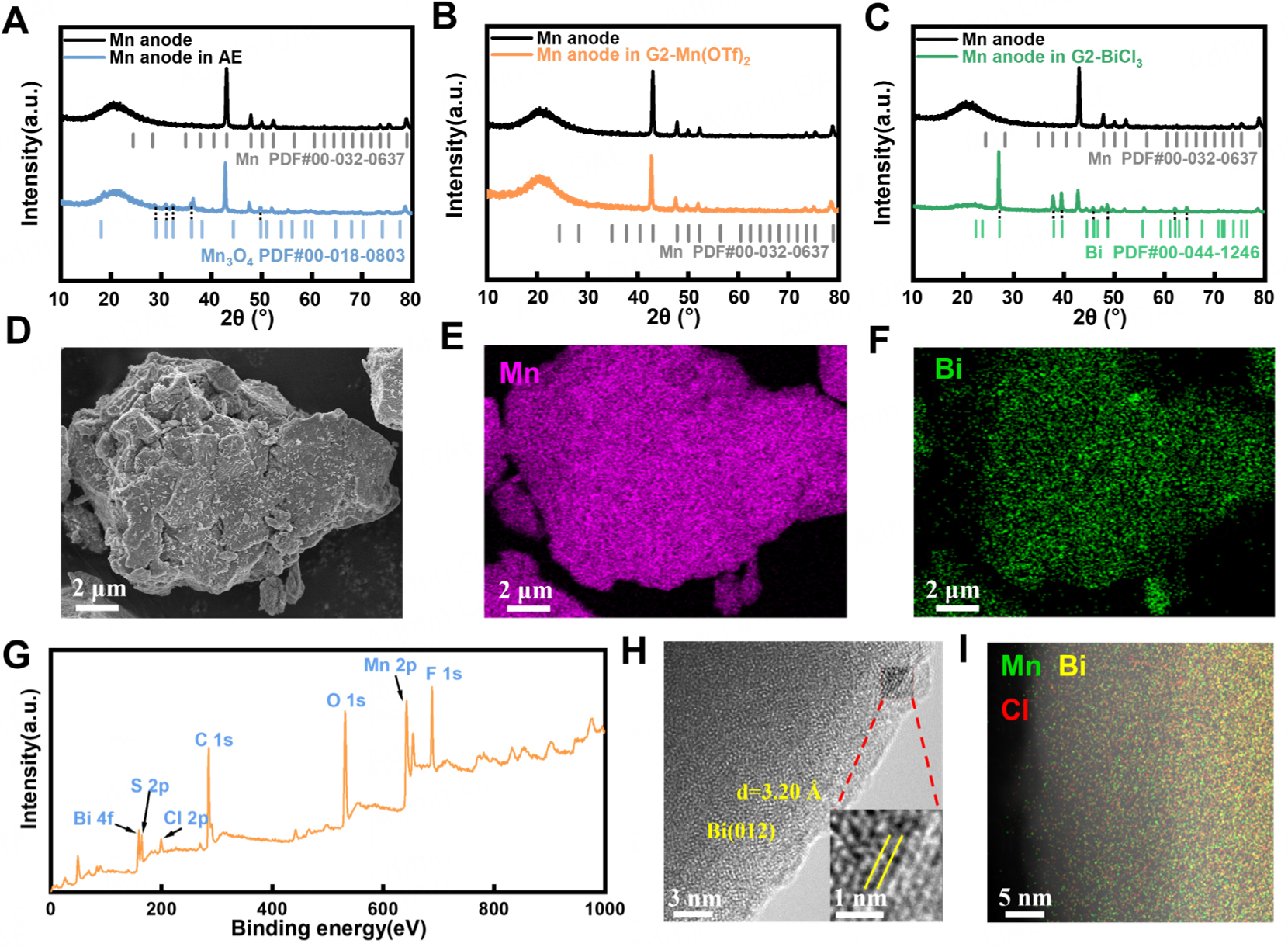
Figure 2. (A-C) XRD patterns of Mn anodes treated with different electrolytes; (D) SEM image and (E), (F) corresponding Mn and Bi EDS elemental mappings of Mn powder immersed in the G2-BiCl3 electrolyte; (G) XPS survey spectrum of the Mn anode after immersion in the G2-BiCl3 electrolyte; (H) TEM image and (I) corresponding EDS elemental mapping of the Bi-containing interphase on the immersed Mn anode.
Revealing the mechanism of BiCl3 additive in enhancing reaction kinetics
Recent studies suggest that halogen atoms (X = Cl, Br, I), characterized by large ionic radii and low electronegativity, can reduce the coordination between Mn2+ and solvent molecules, reducing deposition overpotentials. Considering that BiCl3 provides Cl atoms to the electrolyte, one hypothesis was that the kinetic advantages could be due to a halogen-mediated solvation effect. To investigate this, HRMS was performed on G2-Mn(OTf)2 and G2-BiCl3 electrolytes [Figure 3].
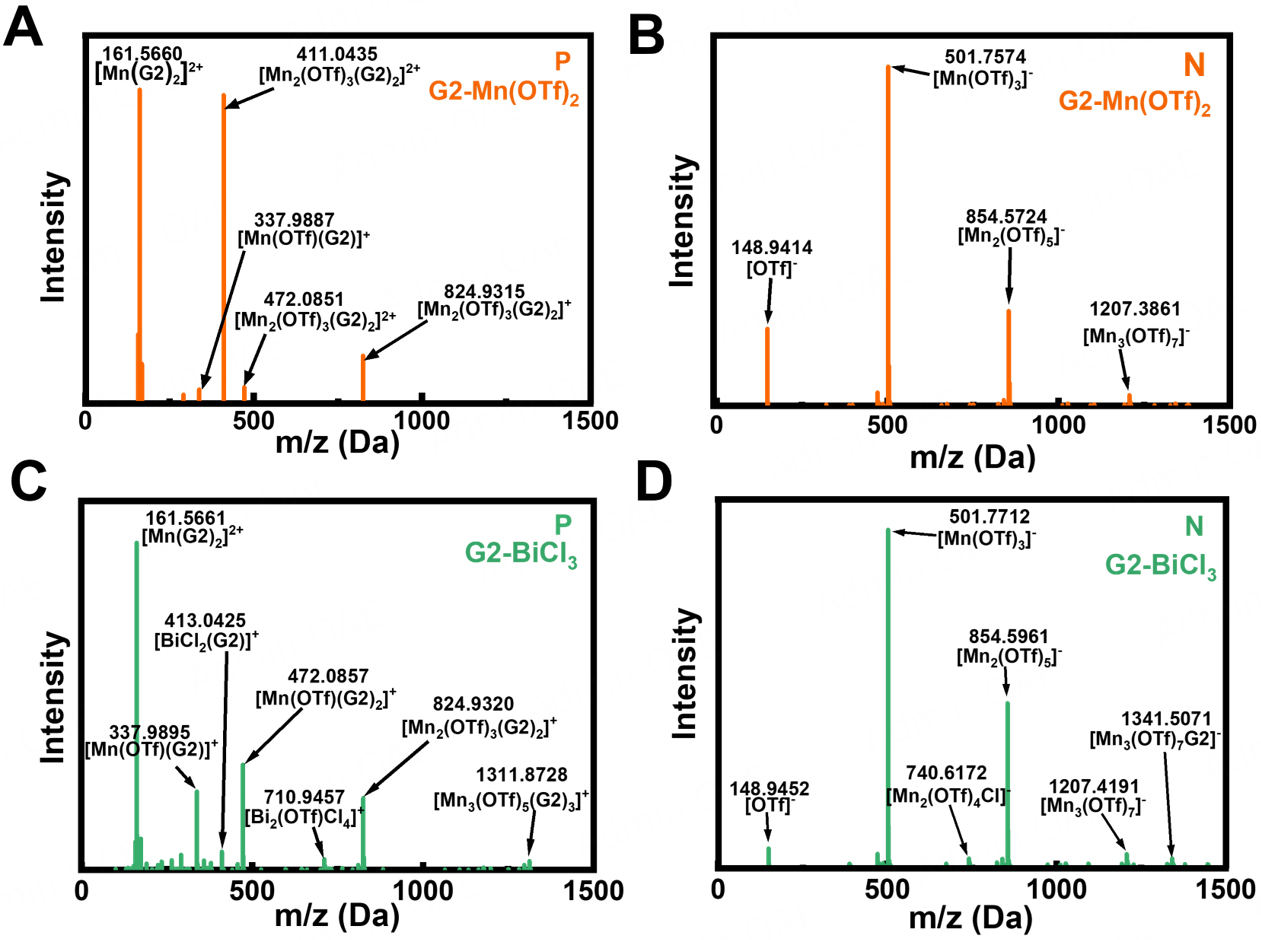
Figure 3. ESI-MS analysis of the different electrolytes. High-resolution ESI-MS spectra obtained in (A and B): G2-Mn(OTf)2 electrolyte; (C and D): G2-BiCl3 electrolyte. P/N denotes positive/negative ion mode, respectively.
It is evident from Figure 3A and B that in the G2-Mn(OTf)2 electrolyte, Mn2+ coordinates with G2 and OTf- to form various cationic and anionic complexes, including [Mn(G2)2]2+, [Mn2(OTf)3(G2)2]+, [Mn(OTf)3]-, and [Mn2(OTf)5]-. It is important to note that the mass spectrometry measurements for the G2-BiCl3 electrolyte [Figure 3C and D] show that the most abundant species are the same as those found in the G2-Mn(OTf)2 electrolyte, namely various cationic and anionic complexes formed between Mn2+, G2, and OTf-. Meanwhile, complexes directly formed between Bi3+ and Cl- (e.g., [BiCl2(G2)]+ and [Bi2(OTf)Cl4]+) are present only in trace amounts. These results show that the coordination environment of Mn2+ in the G2-BiCl3 electrolyte is primarily governed by G2 and OTf-, and that adding BiCl3 has no significant effect on the dominant Mn2+ solvation structure. As additional support for refuting the halogen-mediated hypothesis, another control additive was selected, LiCl [Supplementary Figure 10]. In the cell with the electrolyte G2-LiCl
To explain the kinetic acceleration, DFT calculations and UPS characterization were carried out. The results obtained from the DFT calculations [Figure 4A and B] show that the adsorption energy of Mn atoms on the Bi(012) crystal plane is more negative than that on the Mn(411) plane. This stronger interaction between Mn species and the Bi surface suggests that the Bi-containing interphase may provide favorable adsorption sites, improve Mn adsorption and interfacial charge-transfer conditions, and consequently promote a more controlled Mn deposition process. Moreover, the work function (ϕ) of the Mn anode decreased from
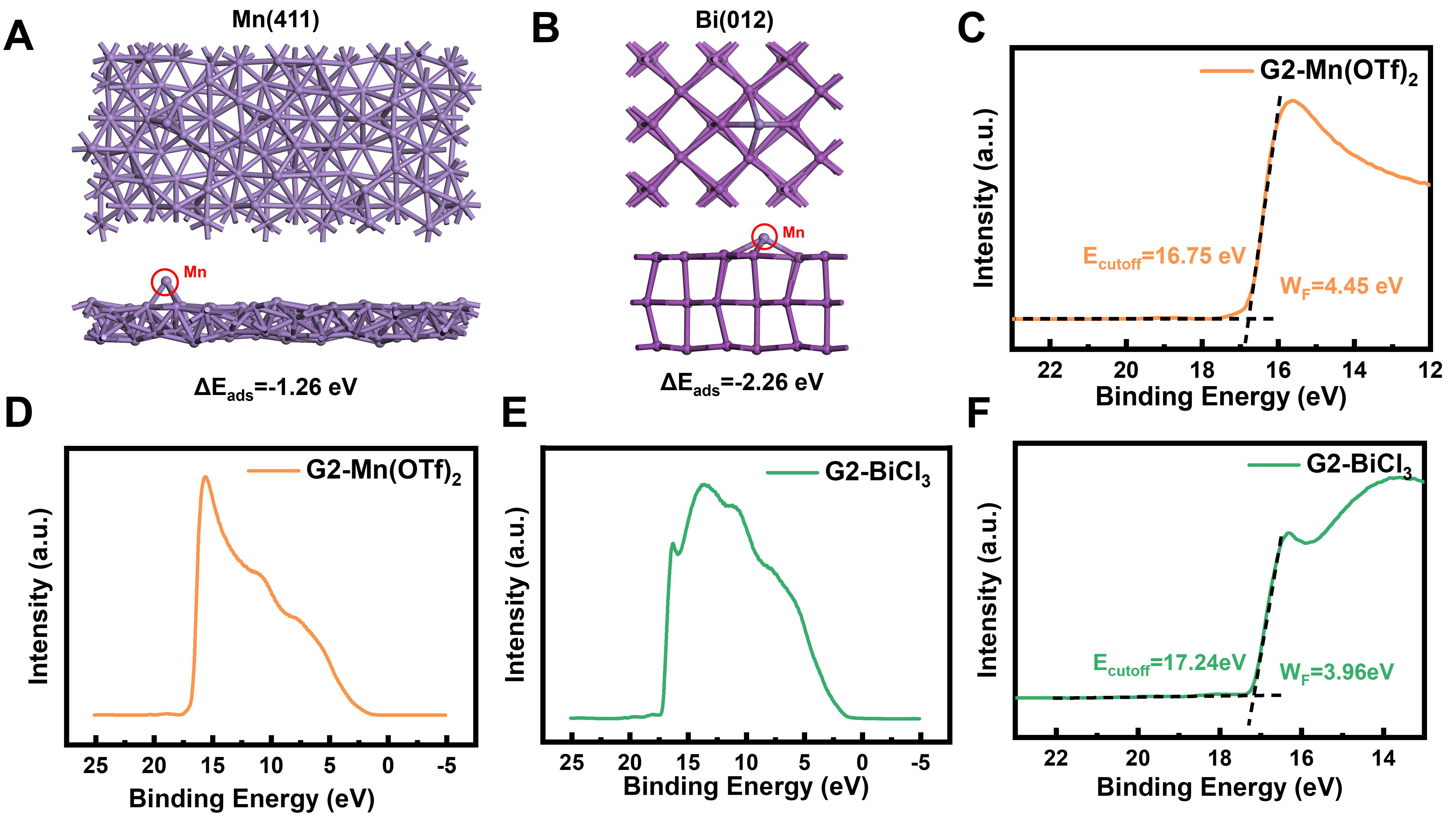
Figure 4. (A and B) Calculated adsorption energy of a Mn atom on Mn (411) and Bi (012) surfaces, respectively; UPS measurements of the work function of the (C), (D) Mn anode in G2-Mn(OTf)2 electrolyte and (E), (F) Mn anode in G2-BiCl3 electrolyte.
To further understand the interfacial kinetic behavior, distribution of relaxation times analysis was performed based on the electrochemical impedance spectroscopy spectra. As shown in
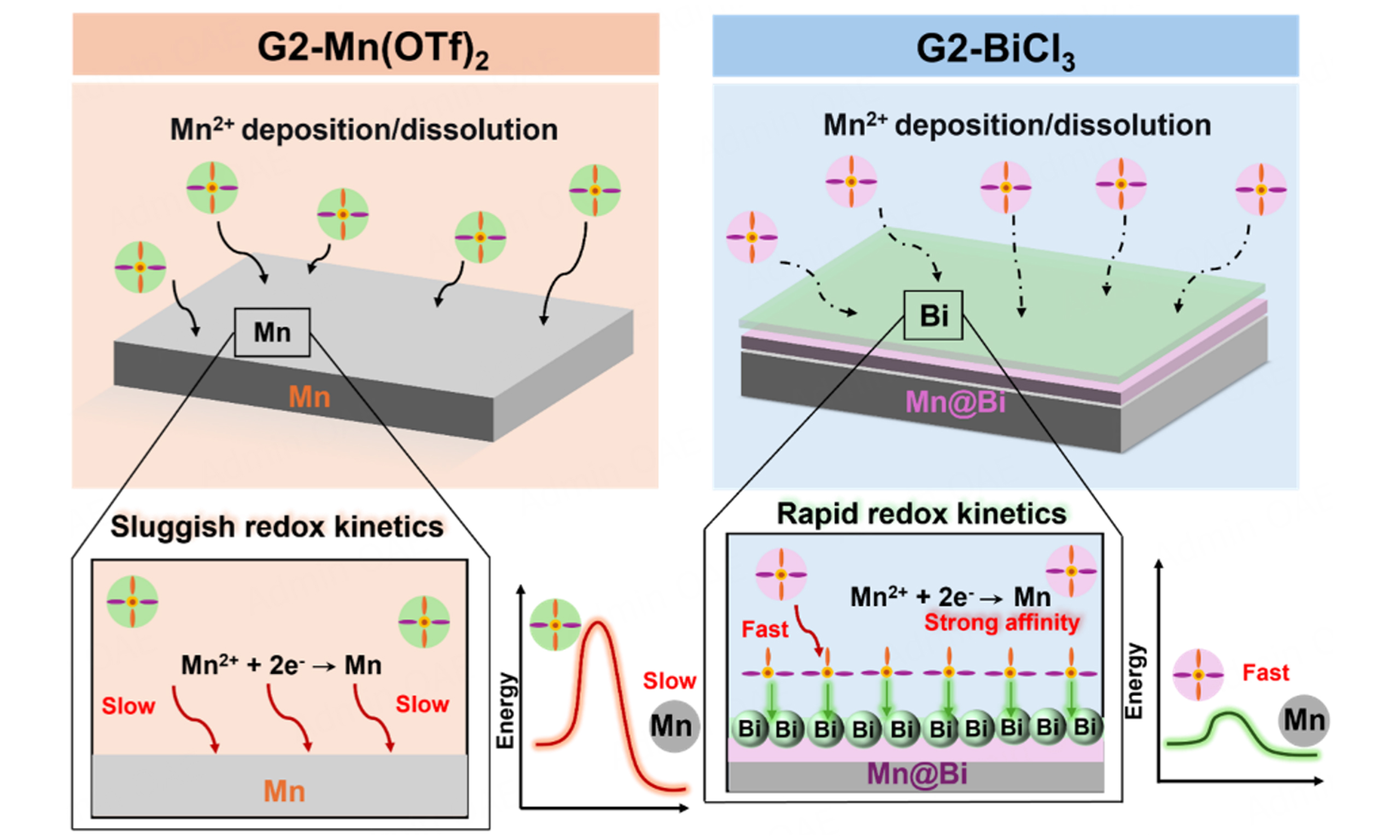
Based on these results, BiCl3 acts as a multifunctional interfacial regulator, as shown in the schematic
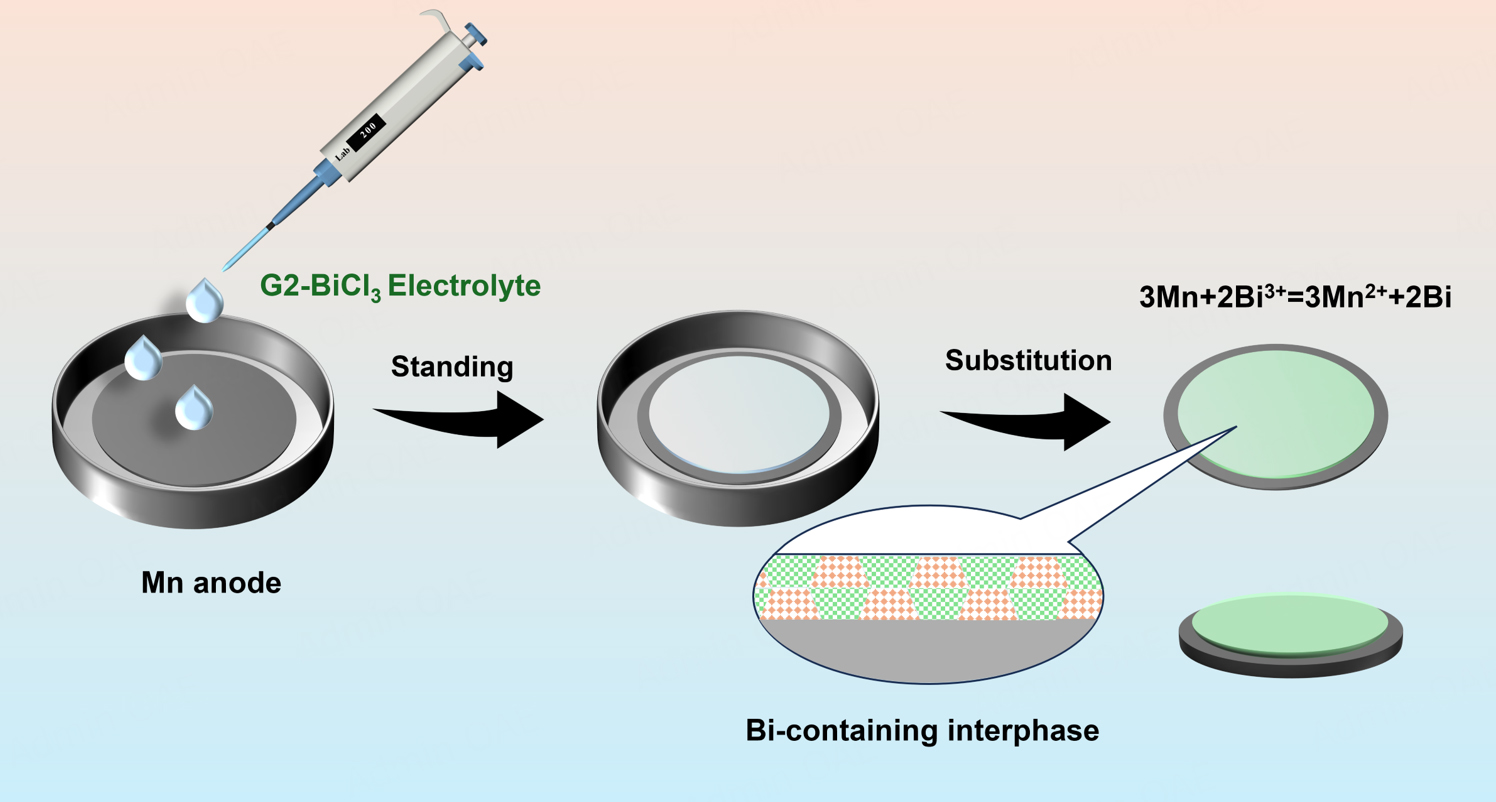
Figure 5. Graphical representation of the displacement reaction mechanism between Bi3+ and Mn in the G2-BiCl3 electrolyte.
Electrochemical performance of Mn||Cu1.8S full cells
The practical effectiveness of the interface modified with BiCl3 was investigated by synthesizing the cathode material Cu1.8S by a solvothermal process[35]. The successful preparation of Cu1.8S was confirmed by XRD, XPS, and SEM elemental mapping analyses [Supplementary Figure 12].
The effect of the BiCl3 additive on the full-cell performance was systematically studied. The Mn||G2-BiCl3||Cu1.8S cell delivered an average discharge capacity of 214.6 mAh g-1 over 100 cycles, which was higher than that of the Mn||G2-Mn(OTf)2||Cu1.8S cell (158.0 mAh g-1) at a current density of 20 mA g-1 [Figure 6A]. Concentration-dependent studies [Supplementary Figure 13] showed that 10 mM BiCl3 was optimal. When tested at a current density of 100 mA g-1, the Mn||Cu1.8S cell with 10 mM BiCl3 delivered an average discharge capacity of 166.1 mAh g-1 over 200 cycles, while maintaining almost 100% capacity retention after 200 cycles [Figure 6B]. These results are consistent with the symmetric cell findings. Moreover, the LiCl-based control cell [Supplementary Figure 14] showed no performance enhancement, reinforcing the conclusion that the kinetic gains are uniquely induced by the Bi-containing interphase rather than the presence of Cl atoms.
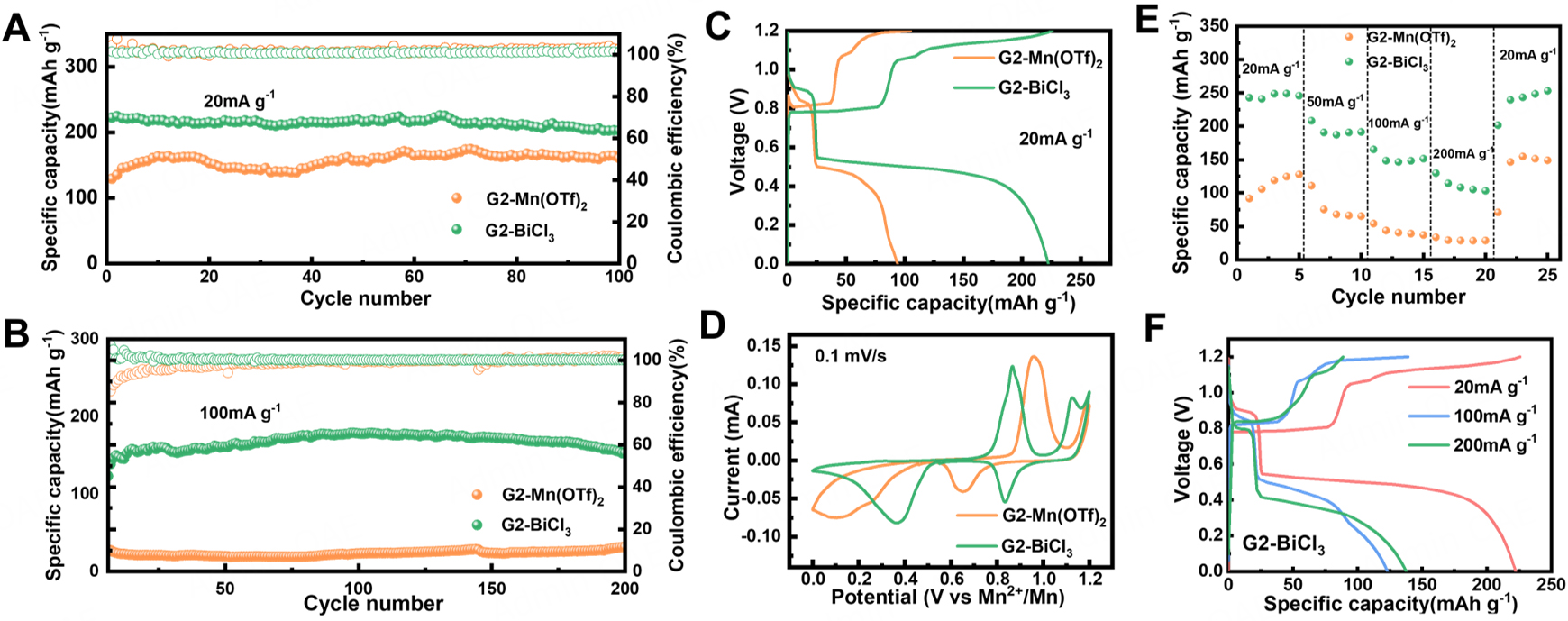
Figure 6. Electrochemical performance of Mn||Cu1.8S full cells with different electrolytes. (A) Long-term cycling performance at 20 mA g-1, (B) Long-term cycling performance at 100 mA g-1; (C) First-cycle charge/discharge profiles at a current density of 20 mA g-1; (D) CV curves; (E) Rate capability at various current densities; (F) First-cycle charge/discharge profiles of the Mn||G2-BiCl3||Cu1.8S full cell at different current densities.
The GCD profile of the Cu1.8S cathode in both electrolytes is similar to the dual storage mechanism described in the literature [Figure 6C]. However, the most significant finding is the comparison of the profiles, showing that the BiCl3 additive significantly reduces voltage polarization, one of the most important parameters in electrochemical processes. This kinetic enhancement was confirmed by CV, which showed that the G2-BiCl3 system exhibited narrower peak separations and more distinct redox features [Figure 6D], indicating improved reaction reversibility and accelerated redox kinetics[36].
To understand how the BiCl3 additive affects the full-cell kinetic characteristics, the rate capability of the full cells was measured [Figure 6E]. At current densities of 20, 50, 100, and 200 mA g-1, the Mn||G2-BiCl3||Cu1.8S cell demonstrates outstanding discharge capacities of 245.4, 193.6, 152.0, and 112.1 mAh g-1, respectively. By comparison, the full cell with the G2-Mn(OTf)2 electrolyte exhibits much lower capacities of 113.7, 77.1, 42.9, and 29.7 mAh g-1 at the same current densities. Further, by increasing the current density to 200 mA g-1 for long-term cycling stability testing [Supplementary Figure 15], the Mn||G2-BiCl3||Cu1.8S full cell delivered an average specific capacity of 48.3 mAh g-1 over 800 cycles. In contrast, the cell with the G2-Mn(OTf)2 electrolyte exhibited almost no measurable capacity under these high-current-density conditions. Furthermore, the first-cycle charge/discharge profiles at different current densities were analyzed
To quantify the charge-storage mechanism, a CV was carried out as a function of scan rate. The b-values (i = avb) obtained for both electrolytes were found to be in the range 0.59-0.66, indicating that the electrochemical process is predominantly diffusion-controlled Figure 7). The calculated values of diffusion coefficients (D) for the G2-BiCl3 system were significantly larger than those for the baseline, indicating that the Bi-containing interphase facilitates Mn2+ transport and charge transfer across the Mn/electrolyte interface. These results demonstrate that BiCl3 effectively reduces interfacial kinetic limitations and enhances the electrochemical reaction kinetics of the Mn||Cu1.8S full cell.
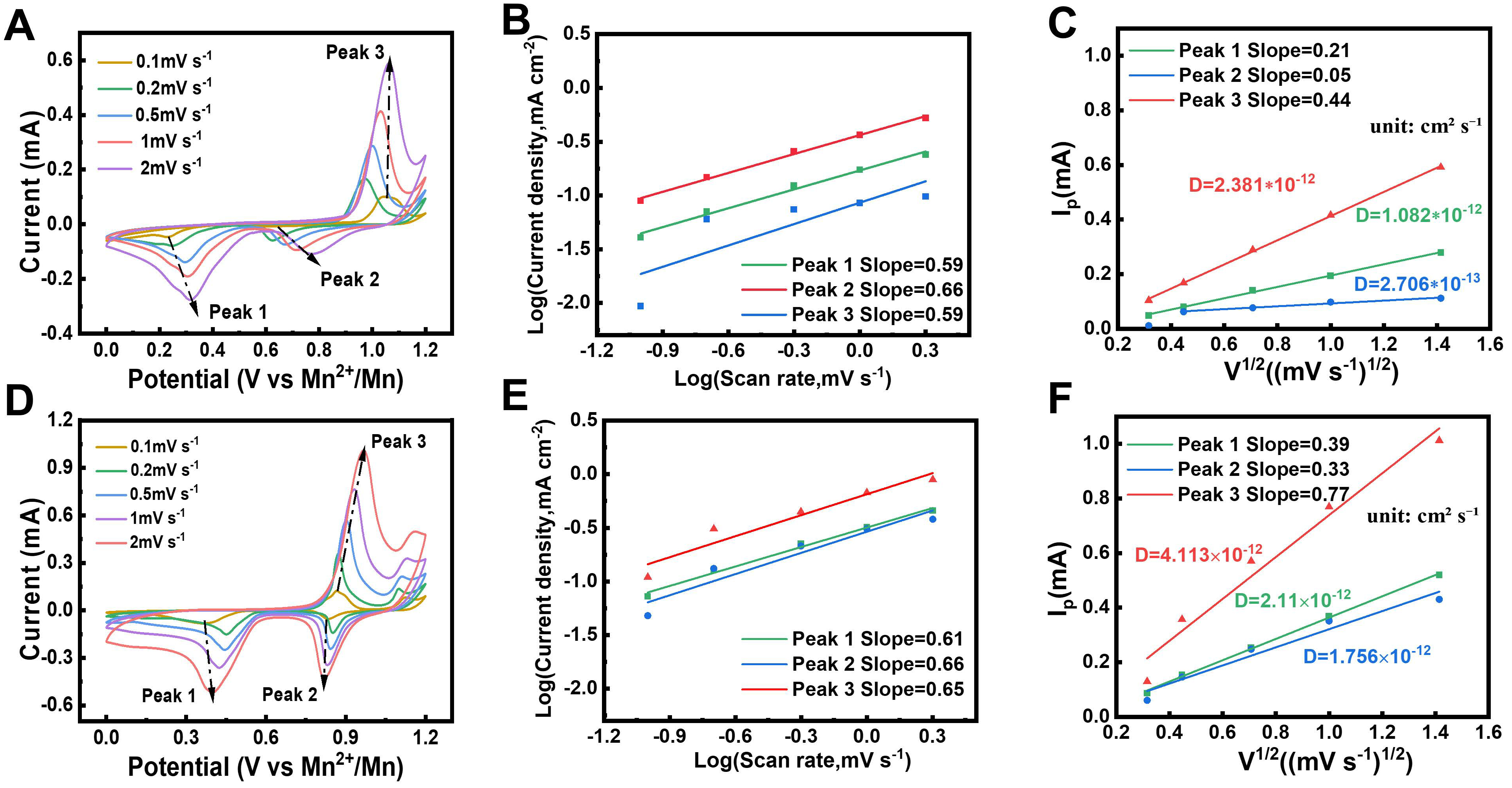
Figure 7. CV curves and kinetic analysis of Mn||Cu1.8S full cells in the G2-Mn(OTf)2 and G2-BiCl3 electrolytes. (A, D) CV curves at different scan rates; (B, E) Corresponding log(i) vs. log(v) plots used to determine the b values; (C, F) Peak current vs. v1/2 plots used to calculate the Mn2+ diffusion coefficient (D, cm2 s-1).
The schematic diagram of the Mn||Cu1.8S cell structure and its operation mechanism is shown in Figure 8A. At the anode, the Mn atoms are oxidized and enter the electrolyte in the form of ions Mn2+. The electrons from the oxidation process at the anode travel to the cathode through the external circuit. At the cathode, Mn2+ and electrons react with Cu1.8S to yield MnS and metallic Cu via a displacement reaction. The charge process proceeds through the corresponding reverse electrochemical pathways.
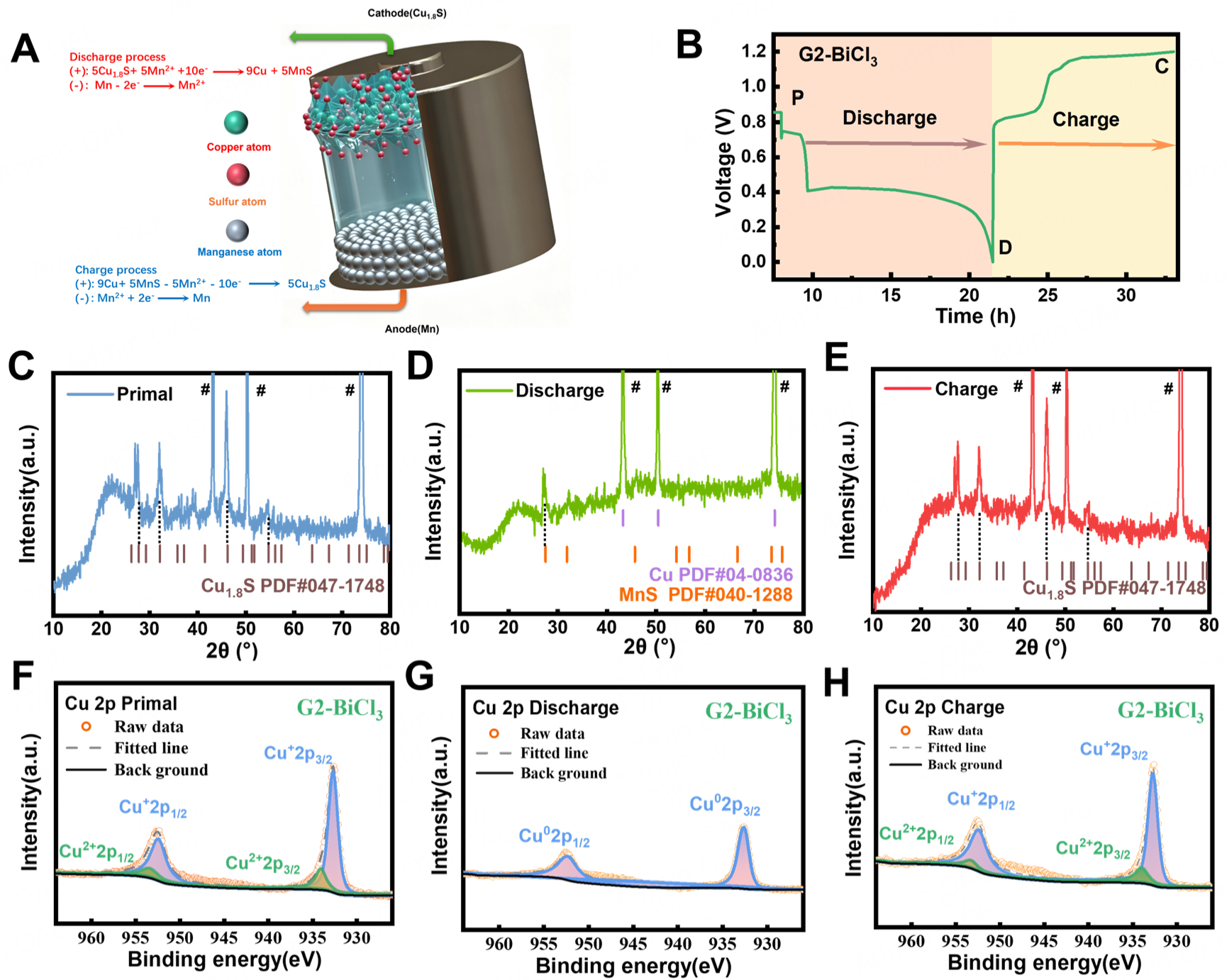
Figure 8. (A) Schematic representation of the internal conversion reaction mechanism in the Mn||Cu1.8S full cell; (B) Within the voltage range of 0 to 1.2 V, the GCD profile of the Mn||Cu1.8S full cell with G2-BiCl3 electrolyte, indicating the states designated for ex situ measurements; (C-E) Ex situ XRD patterns, the # marks in the figure correspond to the XRD of the Cu current collector; (F-H) Ex situ XPS spectra of the Mn||Cu1.8S full cells at the corresponding states.
Ex-situ XRD measurements of the cathodes were conducted at different electrochemical states during the first electrochemical cycle to track the phase evolution during cycling and to elucidate the role of BiCl3 in cathode reactions and the resulting improvement in full-cell kinetics. Figure 8B and
The phase evolution pathways of the two electrolytes are significantly different when the state of charge is fully discharged (D). The sluggish kinetics of the Mn anode cause severe polarization in the G2-Mn(OTf)2 electrolyte, leading to the rapid onset of the cut-off condition and therefore premature end of the discharge process, as shown by the presence of the Cu1.8S phases in the XRD pattern [Supplementary Figure 17B]. The latter G2-BiCl3 electrolyte, in comparison, allows for the full conversion of the Cu1.8S cathode, with all of the primary diffraction peaks from Cu1.8S fully disappearing [Figure 8D]. At the same time, a comparison of the diffraction profiles in the fully discharged state (D) also shows a significant difference in the formation of the MnS reaction product. The characteristic peaks of the MnS phase are, in particular, more intense and well resolved for the G2-BiCl3 electrolyte when compared to the G2-Mn(OTf)2 electrolyte, which means that the transformation is more complete.
The difference in phase reversibility remains very large under fully charged conditions (C). The diffraction peaks corresponding to the discharge products MnS disappear entirely in the cell with the G2-BiCl3 electrolyte, while the diffraction peaks of the Cu1.8S phase are completely recovered and restored [Figure 8E]. In contrast, the fully reconstructed Cu1.8S cathode in the baseline G2-Mn(OTf)2 system was only partially reconstructed under standard conditions. The complete recovery of Cu1.8S in the electrolyte G2-Mn(OTf)2 can only be realized when the charge voltage is raised to 1.3 V [Supplementary Figure 17C and D]. This requires a higher overpotential due to sluggish Mn anode interfacial kinetics, which hinder efficient Mn deposition/stripping processes. To further verify the different conversion behaviors, ex situ XPS analyses were also performed on the cathodes at the pristine (P), fully discharged (D), and fully charged (C) states [Figure 8F-H, Supplementary Figure 17E-G]. Notably, in the fully discharged state, the Cu 2p spectrum of the G2-Mn(OTf)2 control still exhibits a detectable Cu2+ signal, indicating incomplete conversion of Cu1.8S. In contrast, the Cu 2p spectrum of the G2-BiCl3 cathode shows no detectable Cu2+ signal, with the Cu species predominantly converted to metallic Cu0. These results provide additional chemical-state evidence for the more complete conversion of Cu1.8S in the G2-BiCl3 electrolyte. Collectively, the XRD and XPS results indicate that the BiCl3 additive regulates the Mn anode interface, reduces the interfacial kinetic polarization, and thereby facilitates more complete and reversible Cu1.8S conversion within the normal operating voltage range.
CONCLUSIONS
Here, we show how to improve the electrochemical properties of nonaqueous MIBs by rationally designing a BiCl3-functionalized electrolyte. A kinetically active Bi-containing interphase layer was successfully engineered on the Mn anode by taking advantage of a spontaneous in situ galvanic displacement reaction, which enhances Mn deposition/stripping kinetics as supported by DFT calculations and UPS analysis. The resulting kinetic improvements lead to excellent electrochemical stability: symmetric Mn||Mn cells can be cycled for more than 1,000 h, and Mn||Cu1.8S full cells deliver an average discharge capacity of
DECLARATIONS
Authors’ contributions
Writing - original draft, investigation, formal analysis: Zhang, Y. (Yuxuan Zhang); Zhang, Y. (Ying Zhang)
Methodology, Software, Validation, Formal analysis, Visualization: Liu, S.; Wuliji, H.
Writing - review & editing, conceptualization, supervision: Liu, H.; Bayaguud, A.
Availability of data and materials
Some results supporting this study are presented in the Supplementary Materials. Other raw data that support the findings of this study are available from the corresponding author upon reasonable request.
AI and AI-assisted tools statement
Not applicable.
Financial support and sponsorship
This work was supported by the National Natural Science Foundation of China (22301151), the National Key R&D Program of China (2023YFB2405800), and the Natural Science Foundation of Inner Mongolia Autonomous Region of China (2025MS02004).
Conflicts of interest
Bayaguud, A. is the Guest Editor of the special issue “Beyond Lithium-Ion Batteries: Materials and Mechanisms for Sustainable Energy Storage” of the journal Energy Materials. Bayaguud, A. was not involved in any stage of editorial processing, including reviewer selection, manuscript handling, and decision-making, while the other authors have declared that they have no conflicts of interest.
Ethical approval and consent to participate
Not applicable.
Consent for publication
Not applicable.
Copyright
© The Author(s) 2026.
Supplementary Materials
REFERENCES
1. Hu, S.; Pillai, A. S.; Liang, G.; et al. Li-rich layered oxides and their practical challenges: recent progress and perspectives. Electrochem. Energy. Rev. 2019, 2, 277-311.
2. Xiong, F.; Tan, S.; Yao, X.; An, Q.; Mai, L. Crystal defect modulation in cathode materials for non-lithium ion batteries: progress and challenges. Mater. Today. 2021, 45, 169-90.
3. Su, M.; Song, Y.; Xu, Q.; et al. Garnet conductor network with Zr doping to implement surface bifunctional modification for Ni-rich cathodes. J. Energy. Storage. 2024, 95, 112585.
4. Li, C.; Zhang, X.; Zhu, Y.; et al. Modulating the lithiophilicity at electrode/electrolyte interface for high-energy Li-metal batteries. Energy. Mater. 2022, 1, 100017.
5. He, Z.; Huang, Y.; Liu, H.; et al. Anode materials for fast charging sodium-ion batteries. Nano. Energy. 2024, 129, 109996.
6. Usiskin, R.; Lu, Y.; Popovic, J.; et al. Fundamentals, status and promise of sodium-based batteries. Nat. Rev. Mater. 2021, 6, 1020-35.
7. Tan, S.; Wen, Y.; Li, J.; et al. Fast-charging capabilities of hard carbon anodes in sodium-ion batteries: mechanisms, strategies, and prospects. Carbon. Neutraliz. 2025, 4, e70071.
10. Niu, J.; Zhang, Z.; Aurbach, D. Alloy anode materials for rechargeable Mg ion batteries. Adv. Energy. Mater. 2020, 10, 2000697.
11. Zhang, Z.; Cui, Z.; Qiao, L.; et al. Novel design concepts of efficient Mg-ion electrolytes toward high-performance magnesium-selenium and magnesium-sulfur batteries. Adv. Energy. Mater. 2017, 7, 1602055.
12. Ming, J.; Guo, J.; Xia, C.; Wang, W.; Alshareef, H. N. Zinc-ion batteries: materials, mechanisms, and applications. Mater. Sci. Eng. R. Rep. 2019, 135, 58-84.
13. Jin, X.; Song, L.; Dai, C.; et al. A self-healing zinc ion battery under -20 °C. Energy. Storage. Mater. 2022, 44, 517-26.
14. Zhou, S.; Meng, X.; Chen, Y.; et al. Zinc-ion anchor induced highly reversible Zn anodes for high performance Zn-ion batteries. Angew. Chem. Int. Ed. 2024, 63, e202403050.
15. Zhou, Y.; Wei, X.; Li, Y.; et al. Zincophilic vertically aligned hydrogel electrolyte with enhanced ion transport and dendrite suppression for stable zinc-ion batteries. Carbon. Neutraliz. 2026, 5, e70116.
16. Zhang, E.; Cao, W.; Wang, B.; et al. A novel aluminum dual-ion battery. Energy. Storage. Mater. 2018, 11, 91-9.
17. Li, C.; Hou, C.; Chen, L.; Kaskel, S.; Xu, Q. Rechargeable Al-ion batteries. EnergyChem 2021, 3, 100049.
18. Nimkar, A.; Chae, M. S.; Wee, S.; et al. What about manganese? Toward rocking chair aqueous Mn-ion batteries. ACS. Energy. Lett. 2022, 7, 4161-7.
19. Yang, Q.; Qu, X.; Cui, H.; et al. Rechargeable aqueous Mn-metal battery enabled by inorganic-organic interfaces. Angew. Chem. Int. Ed. 2022, 61, e202206471.
20. Zheng, H.; Cheng, L.; Lu, W.; et al. An Mn2+ cross-linked gel electrolyte enables reversible quasi-solid-state manganese metal batteries. Nano. Lett. 2025, 25, 7716-24.
21. Wang, M.; Meng, Y.; Xu, Y.; et al. Aqueous all-manganese batteries. Energy. Environ. Sci. 2023, 16, 5284-93.
22. He, X.; Li, Z.; Tang, R.; et al. Rechargeable and highly stable Mn metal batteries based on organic electrolyte. Chem. Commun. 2023, 59, 1337-40.
23. Yang, M.; Chen, R.; Shen, Y.; Zhao, X.; Shen, X. A high-energy aqueous manganese-metal hydride hybrid battery. Adv. Mater. 2020, 32, 2001106.
24. Shen, D.; Zheng, X.; Luo, R.; et al. A rechargeable, non-aqueous manganese metal battery enabled by electrolyte regulation. Joule 2024, 8, 780-98.
25. Fan, W.; Liu, F.; Liu, Y.; et al. A high voltage aqueous zinc–manganese battery using a hybrid alkaline-mild electrolyte. Chem. Commun. 2020, 56, 2039-42.
26. Luo, H.; Guo, H.; Li, X.; et al. Aqueous manganese-ion batteries: the past, present, and future. Matter 2025, 8, 102379.
27. Hou, Z.; Lu, W.; Zheng, H.; et al. An Mn-enriched interfacial layer for reversible aqueous Mn metal batteries. Nano. Lett. 2024, 24, 14034-41.
28. Zhang, J.; Chen, F.; Yu, J.; et al. Asymmetric Mn2+ cluster electrolyte for high-performance Mn-metal batteries. Adv. Funct. Mater. 2025, 36, e15536.
29. Jing, P.; Zhou, Y.; Liu, Y.; et al. Deciphering Mn2+ solvation and interfacial chemistry for rechargeable nonaqueous Mn-metal batteries. Angew. Chem. Int. Ed. 2025, 64, e202515941.
30. Liu, R.; Yu, L.; He, X.; et al. Constructing heterointerface of Bi/Bi2S3 with built-in electric field realizes superior sodium-ion storage capability. eScience 2023, 3, 100138.
31. Zhang, J.; Lu, X.; Li, M.; Sun, Z. Application of porous bismuth-based materials in sodium ion batteries. Chem. Commun. 2025, 61, 13616-31.
32. Huang, J.; Lin, X.; Tan, H.; Zhang, B. Bismuth microparticles as advanced anodes for potassium-ion battery. Adv. Energy. Mater. 2018, 8, 1703496.
33. Chen, H.; Zhang, W.; Yi, S.; et al. Zinc iso-plating/stripping: toward a practical Zn powder anode with ultra-long life over 5600 h. Energy. Environ. Sci. 2024, 17, 3146-56.
34. Bi, J.; Li, J.; Zhou, Z.; et al. In situ formation of a Bi/Mg-based hybrid interphase for highly reversible magnesium metal anodes. Adv. Mater. 2025, 37, 2502098.
35. Shen, D.; Zhao, G.; Jiang, T.; et al. A high-capacity manganese-metal battery with dual-storage mechanism. Angew. Chem. Int. Ed. 2025, 64, e202423921.
Cite This Article
 Open Access
How to Cite
Download Citation
Export Citation File:
Type of Import
Tips on Downloading Citation
Citation Manager File Format
Type of Import
Direct Import: When the Direct Import option is selected (the default state), a dialogue box will give you the option to Save or Open the downloaded citation data. Choosing Open will either launch your citation manager or give you a choice of applications with which to use the metadata. The Save option saves the file locally for later use.
Indirect Import: When the Indirect Import option is selected, the metadata is displayed and may be copied and pasted as needed.
About This Article
Special Topic
Copyright

Data & Comments
Data
0











Comments
Comments must be written in English. Spam, offensive content, impersonation, and private information will not be permitted. If any comment is reported and identified as inappropriate content by OAE staff, the comment will be removed without notice. If you have any queries or need any help, please contact us at support@oaepublish.com.