


Efficient solar-driven interfacial steam-hydropower co-generation by high-quality carbon nanotube from discarded polyolefin separator
 0
0 
Abstract
Converting discarded polyolefin separators into valuable carbon nanotubes (CNTs) not only contributes to the high-value utilization of discarded separators, but also offers a green approach to construct advanced CNT-based generators. However, the controlled carbonization of discarded polyolefin separators into high-quality CNTs remains challenging, and the mechanism of electricity generation in CNTs remains obscure. Herein, we report the “all-in-one” catalytic strategy using multi-component Ni/Mo/Mg catalysts to realize the controllable carbonization of discarded polyolefin separators into high-quality CNTs. By adding Mo and Mg to Ni in a molar ratio of 5/0.1/0.5 (Ni/Mo/Mg), the catalyst displays high catalytic activity, dispersion, and stability, and achieves a CNT yield of
Keywords
INTRODUCTION
With the rapid advancement of the global energy transformation strategy, the lithium-ion battery industry has shown explosive growth[1-3]. During the industrial production of polyolefin battery separators, discarded polyolefin separators are generated when they fail to meet the requisite quality standards[4] and are unsuitable for use as lithium-ion battery separators. Typically, these discarded polyolefin separators are produced in large volumes and possess a uniform composition with high purity. However, they are predominantly sold as raw plastic materials at a relatively low price. By contrast, converting these discarded polyolefin separators into high-value-added products has become a green and economical upcycling strategy[5-7], expected to meet the requirements of sustainable industrial development. Interestingly, these discarded polyolefin separators are considered ideal precursors for the preparation of high-value-added carbon nanotubes (CNTs)[8-10] due to their high purity, high carbon content, and low cost. However, the pyrolysis products of discarded polyolefin separators are usually complex, making it extremely difficult to precisely control the carbonization process. Additionally, during the carbonization process, carbon readily deposits on the catalyst surface, thereby deactivating the catalyst. A range of carbonization techniques have been reported to suppress carbon deposition and achieve precise tailoring of the morphology and porosity of CNTs, such as the Joule flash heating method[11], microwave-assisted carbonization[9,12,13], and combined catalyst carbonization[14]. Joule flash heating and microwave irradiation are inseparable from high-precision equipment and high energy consumption. The catalytic carbonization method can achieve the pyrolysis of polymer skeletons and the controlled growth of carbon materials by selecting appropriate catalysts[15-17]; however, additional catalysts are required to tune the morphology of the resulting carbon materials. Therefore, it is essential to rationally design a multi-in-one catalyst for converting discarded polyolefins into CNTs. Furthermore, during the upcycling process, the structure-activity relationship between the catalyst and CNT morphology remains ambiguous.
On the other hand, carbon materials are uniquely suited for solar-driven energy conversion owing to their broad-spectrum light absorption, superior thermal conductivity, and chemical stability[18-20]. By harnessing solar energy, carbon materials can enable the co-generation of multiple forms of clean energy[21,22], offering a powerful strategy to mitigate global water scarcity and the energy crisis. Specifically, interfacial solar steam generation technology achieves rapid conversion from liquid water to gaseous water by localizing photogenerated heat on the surface of photothermal materials[19,23-25]. A complex microenvironment is concomitantly formed during interfacial photothermal evaporation, thereby providing a platform for the construction of multifunctional integrated systems[26-30]. Typically, integration with hydropower technology allows for the co-generation of freshwater and electricity by harnessing environmental latent heat[31,32]. Recently, driven by the photothermal conversion and modifiable surface/interfacial chemistry of carbon materials, a variety of dual-functional evaporators have been reported to generate freshwater and power[33,34]. Wei et al. prepared CNT dual-functional evaporators, achieving an evaporation rate of 2.79 kg m-2 h-1 and an output voltage of 0.26 V[14]. Hu et al. constructed a carbon foam evaporator from waste polycarbonate, which achieved an evaporation flux of 3.03 kg m-2 h-1 and an open-circuit voltage of 0.33 V[35]. They proposed that thermal and solar energy work together to increase power output. Ding et al. proposed a CNT/wood generator to yield freshwater (1.19 kg m-2 h-1) and electricity (0.35 mW m-2)[36]. Despite the great progress in this field[37], the synergistic mechanism for co-generating freshwater and power by dual-functional CNT-based evaporators remains underexplored.
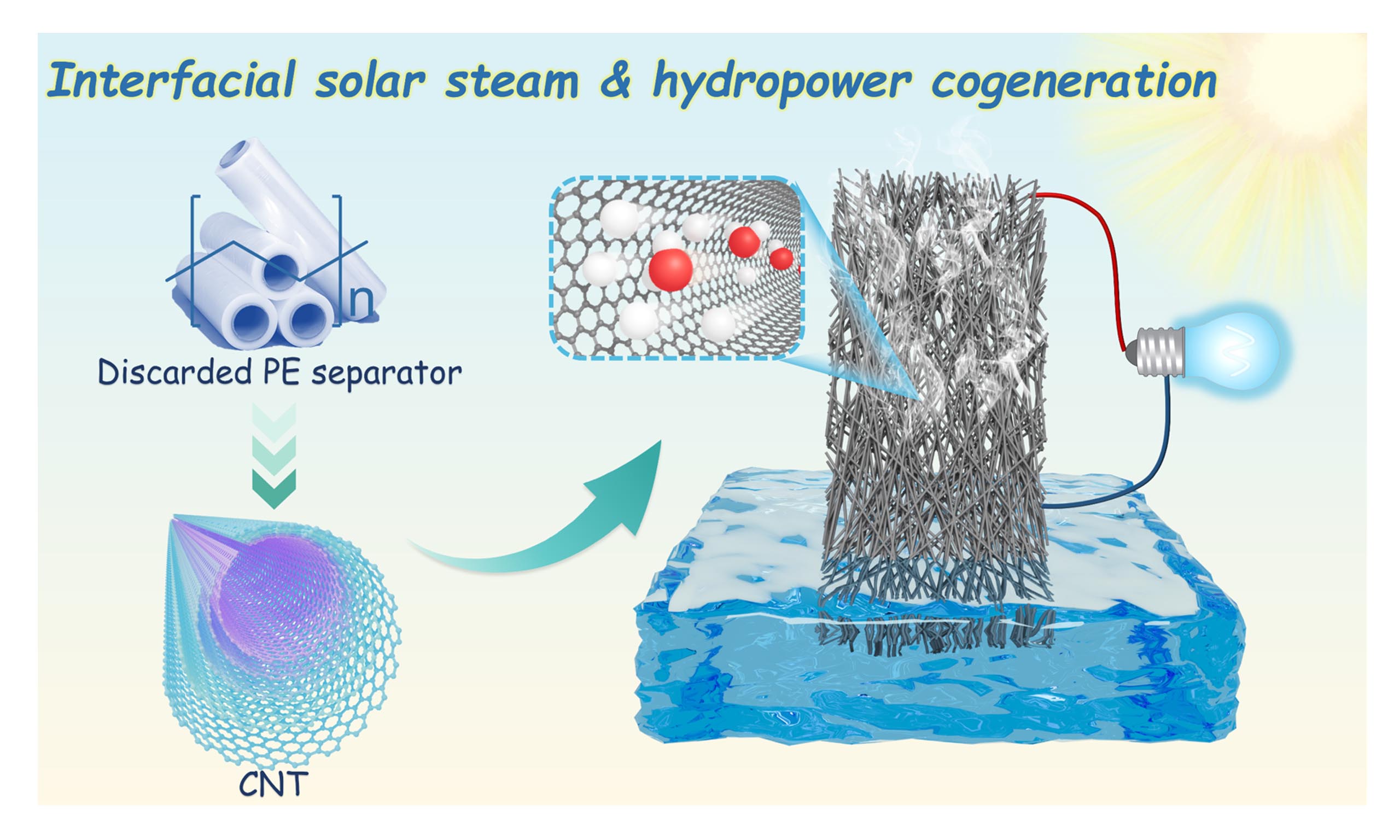
In this work, we design a multi-component nickel (Ni)-based catalyst (NixMoyMgz) to convert discarded polyethylene (PE) separators into CNTs and then construct CNT dual-functional evaporators for freshwater and electricity co-generation [Figure 1A]. As the catalytic activity center in NixMoyMgz, the Ni component mainly affects the carbonization reaction rate and the morphology of the carbon product. Mo effectively enhances the reducibility of NiO and prevents the sintering of Ni particles at high temperature. MgO prevents carbon deposition and improves CNT yield. Benefiting from good photo-to-thermal conversion capability, excellent hydrophilicity, and abundant oxygen-containing functional groups, the CNT evaporator achieves an evaporation rate of 2.73 kg m-2 h-1, a photothermal efficiency of 95.4%, and an open-circuit voltage of 0.221 V. Molecular dynamics (MD) simulation reveals the mechanism of electricity generation. The oxygen-containing functional groups on the CNT surface dissociate upon contact with water molecules, generating surface charge. With continuous water evaporation, H3O+ is attracted by surface functional groups and follows the water flow to the evaporation end of the device, thereby establishing a potential difference between the upper and lower ends of the device.
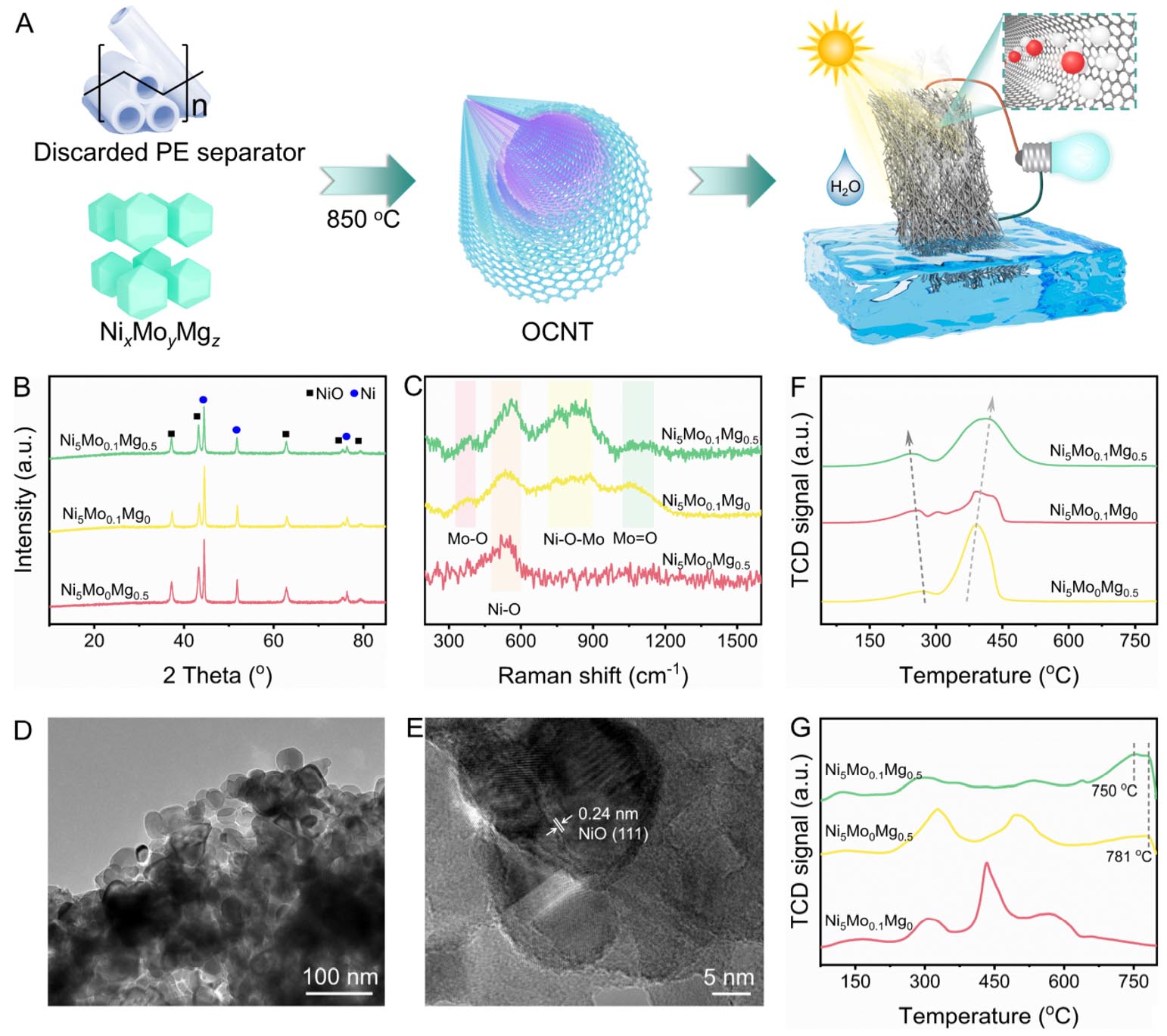
Figure 1. (A) Schematic of an OCNT evaporator from discarded PE separators for interfacial solar-driven steam and power cogeneration. (B) X-ray diffraction (XRD) profiles and (C) Raman spectra of different catalysts. (D and E) HRTEM images of Ni5Mo0.1Mg0.5. (F) H2-temperature programmed reduction (H2-TPR) and (G) CO2-temperature programmed desorption (CO2-TPD) curves of different catalysts.
EXPERIMENTAL
Materials and chemicals
Discarded PE separators were provided by Zhongxing Innovative Material Technologies Co. Ltd. [Supplementary Figure 1]. Mg(NO3)2·6H2O and Ni(NO3)2·6H2O were supplied by Shanghai Aladdin Biochemical Technology Co. Ltd. Poly(ethylene glycol) (PEG-200) and (NH4)6Mo7O24·4H2O were purchased from Sinopharm Chemical Reagent Co. Ltd. Gelatin and glutaraldehyde were supplied by Shanghai Macklin Biochemical Co. Ltd. The non-woven cotton was procured from EAXAY.
Synthesis of NixMoyMgz catalysts and OCNTx-y-z
NixMoyMgz catalysts (where x, y, and z refer to the mole ratio of Ni, Mo, and Mg) were synthesized by the combustion method. Firstly, 30.00 g Ni(NO3)2·6H2O, 2.64 g Mg(NO3)2·6H2O, 0.36 g (NH4)6Mo7O24·4H2O, and 10.00 g PEG-200 were mixed and milled thoroughly and then calcined at 350 °C for 15 min in a muffle furnace to prepare Ni5Mo0.1Mg0.5 catalysts. Other catalysts with different proportions were prepared by fixing the molar amount of Ni salt added and adjusting the amounts of Mo salt and Mg salt. The detailed amounts of metal salts are listed in Supplementary Table 1.
Discarded PE separators (5.00 g) and NixMoyMgz catalyst (0.50 g) were mixed in a crucible (30 mL) and subsequently carbonized in a muffle furnace to afford CNTx-y-z (850 °C, 4 min). Then, CNTx-y-z was refluxed in concentrated HNO3 at 60 °C to produce oxidized CNTs (denoted as OCNTx-y-z).
Preparation of OCNTx-y-z evaporators
Firstly, OCNTx-y-z (20.5 mg) was added to the gelatin solution (2 wt%, 460 μL) and stirred overnight at room temperature (ca. 25 oC, 12 h, 400 rpm). Then, the mixture was spread onto cotton cloth (6.15 cm2) and dried in air. OCNTx-y-z evaporators used in the indoor water evaporation experiments were prepared after soaking and crosslinking with aqueous glutaraldehyde solution (5 wt%). For comparison, a modified cotton evaporator without OCNTx-y-z was constructed using the same process. To meet the requirements of various scenarios, evaporators with different scales were fabricated using the same preparation process. The specific material quantities were listed in Supplementary Table 2.
Interfacial solar-driven water evaporation
An experimental system was constructed to simulate solar interfacial evaporation, including a sunlight simulator (Perfectlight, PLS-SEX300, China) and an analytical balance (Sunny Hengping Instrument, JA1003L, China) to track water mass loss. The surface temperature of evaporators was monitored using an infrared camera (Dongmei, DMI220, China). The computational methods of calculating evaporation rate and photothermal efficiency were described in Supplementary Note 1.
Hydroelectric power generation
A polyethylene terephthalate (PET) substrate (15 × 5 cm2) was ultrasonically washed in deionized water and ethanol. Subsequently, an OCNTx-y-z evaporator (15 cm2) was placed on the PET substrate and fixed with conductive adhesive as electrodes. The power generation electrodes (two L-shaped pieces) were fabricated and coated with epoxy resin. After drying at room temperature for 15 min, the encapsulated evaporation device was obtained. The generated voltage and current were monitored using a Source Measure Unit.
Characterization
A high-resolution transmission electron microscope (HRTEM, FEI, Tecnai G2 F30, Netherlands) was used to investigate the microstructure of the materials. Other characterizations were described in
RESULTS AND DISCUSSION
Fabrication of NixMoyMgz catalysts and OCNTx-y-z
NixMoyMgz catalysts were produced through the combustion method [Supplementary Figure 2]. As shown in Figure 1B, the NiO diffraction peaks at 2θ = 37.3°, 43.3°, 62.9°, 75.2°, and 79.6° are assigned to the (111), (200), (220), (311), and (222) planes, respectively. Peaks attributable to Ni appear at 2θ = 44.7° (111), 51.8° (200), and 76.3° (220). Interestingly, the diffraction intensities of Ni and NiO are affected by the addition of Mo and Mg [Supplementary Figure 3]. Compared with Ni, the diffraction intensity of NiO increases with an increase in the Mo/Ni mole ratio from 0 to 0.1/5; correspondingly, the yield of CNT5-y-0.5 rises from 11.7 to 57.4 wt%
The effects of Mo and Mg on the overall performance of catalysts were studied using H2-TPR and CO2-TPD. The two reduction peaks of the H2-TPR profile are observed at 200-300 and 300-500 °C [Figure 1F]. After the addition of Mo to the catalysts, the reduction peaks of Ni5Mo0.1Mg0 and Ni5Mo0.1Mg0.5 catalysts within 200-300 °C shift to the low-temperature region, indicating that their reducibility is stronger than that of Ni5Mo0Mg0.5. Mo promotes the formation of smaller NiO clusters, thereby exposing more active sites on the catalyst[42]. Furthermore, the reduction peaks at 300-500 °C shift to higher temperatures, implying a robust interaction between Mo and Ni. A wider temperature range was observed in the Ni5Mo0.1Mg0.5 profile because mixed-metal clusters with stronger interactions formed after the Mg addition. The characteristic peaks at low CO2 desorption temperatures represent the weakly alkaline adsorption sites on the Ni-O-support, while the peaks at high temperatures correspond to the strongly alkaline sites. Different from Ni5Mo0.1Mg0, high-temperature CO2 desorption peaks appear at 700-800 °C for Ni5Mo0Mg0.5 and Ni5Mo0.1Mg0.5 [Figure 1G], which confirms the presence of the stronger alkaline Mg-O site and the generation of strongly monodentate carbonate[43]. Previous work showed that strong adsorption is beneficial for the efficient elimination of carbon deposition by strong basic sites (O2-)[44].
The morphology of carbon products is significantly affected by the mole ratio of Ni/Mo/Mg [Figure 2A]. CNTx-y-z was oxidized using concentrated HNO3 to prepare OCNTx-y-z with enhanced hydrophilicity. By using Ni5Mo0.1Mg0 as a catalyst, the carbon product (OCNT5-0.1-0) is composed of agglomerated spherical carbon with a size of 50-200 nm [Figure 2B, Supplementary Figure 8]. By contrast, the addition of Mg to the catalyst results in CNT formation, implying that MgO in the catalyst plays a crucial role in suppressing carbon deposition and promoting CNT growth. When the Mg/Ni mole ratio increases to 2/5, the diameter of CNT becomes significantly wider, and the yield of CNT decreases [Supplementary Figure 9]. By using Ni5Mo0Mg0.5 as a catalyst, the OCNT5-0-0.5 consists of amorphous carbon and a few CNTs with a length of ca.
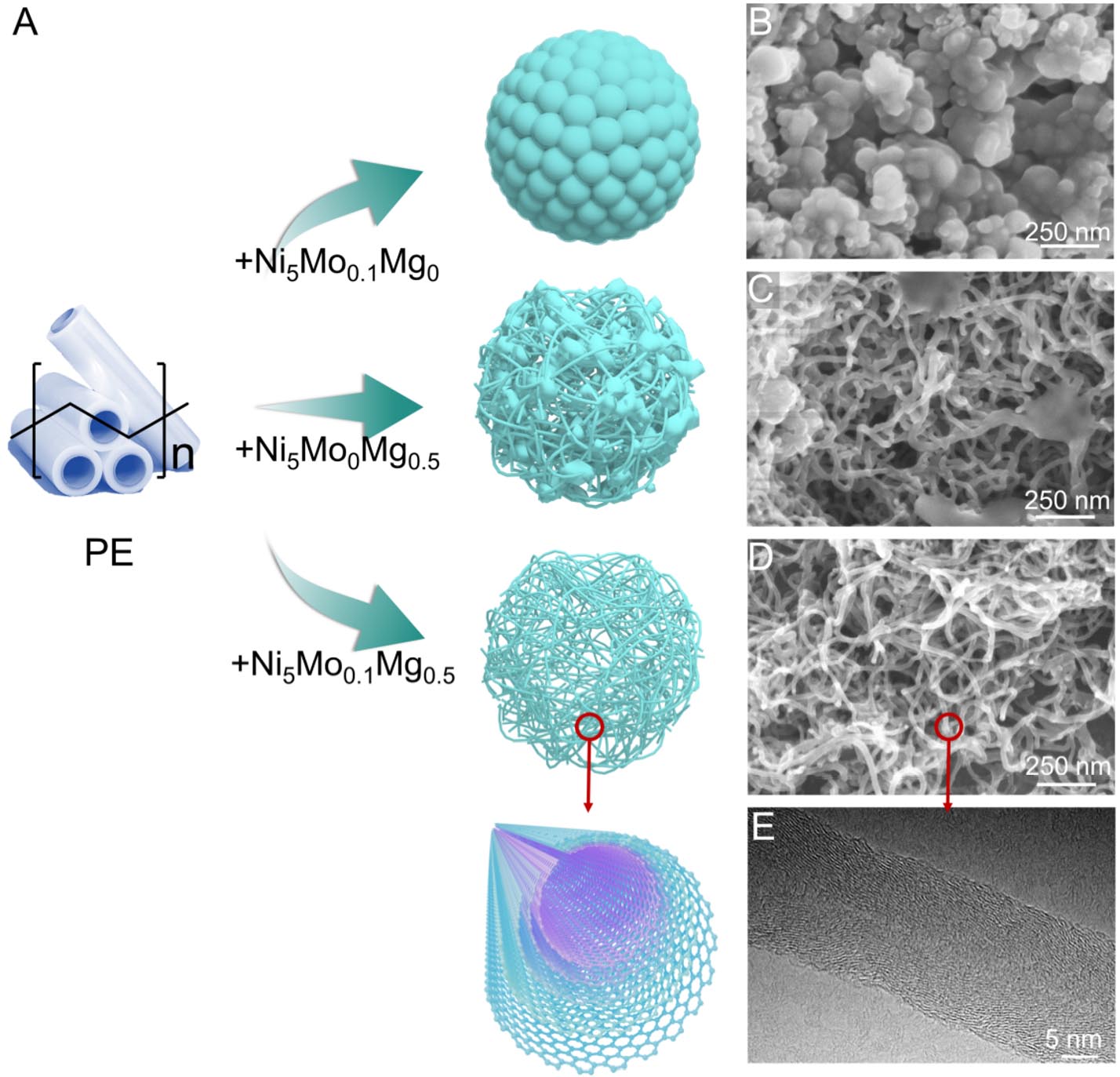
Figure 2. (A) Schematic illustration and (B-D) scanning electron microscopy (SEM) micrographs of OCNT5-0.1-0, OCNT5-0-0.5 and OCNT5-0.1-0.5, and (E) HRTEM image of OCNT5-0.1-0.5.
The phase structure of OCNT5-0.1-0.5 was analyzed by X-ray diffraction (XRD) and Raman spectroscopy. A sharp graphite peak (002) in the XRD patterns appears at 2θ=26.5° [Figure 3A,
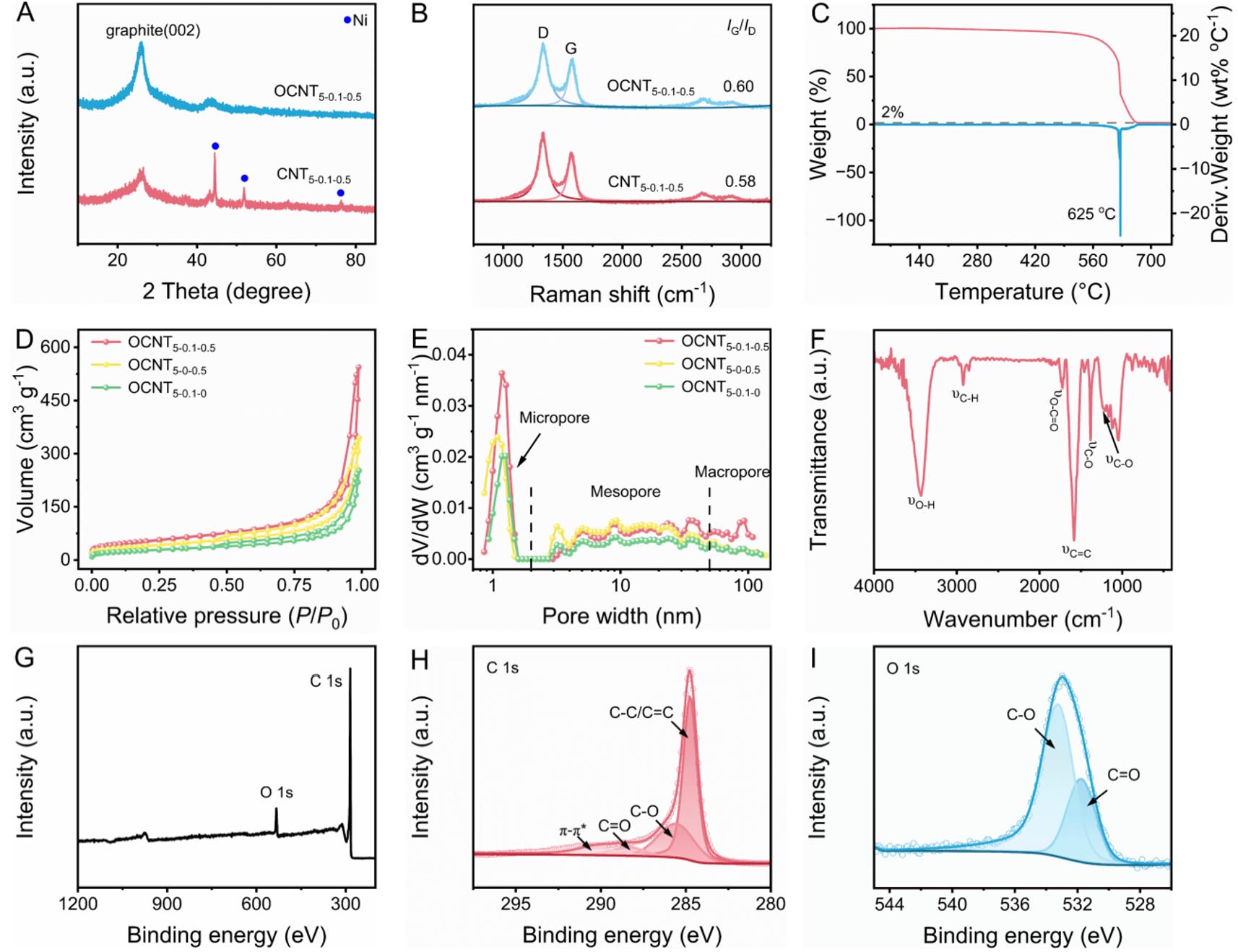
Figure 3. (A) XRD profiles and (B) Raman patterns of OCNT5-0.1-0.5 and CNT5-0.1-0.5. (C) Thermal gravimetric analysis (TGA) and derivative thermogravimetry (DTG) curves of OCNT5-0.1-0.5. (D) N2 adsorption-desorption isotherms and (E) corresponding pore size distribution using the density functional theory (DFT) model of OCNT. (F) Fourier transform infrared spectroscopy (FT-IR), (G) X-ray photoelectron spectroscopy (XPS), high-resolution (H) C 1s, and (I) O 1s XPS spectra of OCNT5-0.1-0.5.
A variety of methods have been reported for converting waste polyolefins into CNTs, for instance, chemical vapor deposition[47], Joule flash heating method[11], microwave-assisted carbonization[9,12,13], and combined catalyst carbonization[14]. Compared with these methods, the “all-in-one” catalytic strategy in this work possesses the following advantages. Firstly, the catalytic performance of Ni is synergistically enhanced by the addition of Mo and Mg, thereby enabling the controlled growth of CNTs from a single catalyst without additional degradation catalysts. Secondly, CNTs are directly prepared in a few minutes under ambient air without any protective gas. Finally, the catalytic method shows potential for large-scale CNT preparation.
Photothermal properties of OCNTx-y-z evaporators
The OCNT5-0.1-0.5 evaporator is constructed by coating the dispersion of OCNT5-0.1-0.5 and gelatin on cotton cloth, followed by crosslinking with glutaraldehyde [Figure 4A]. OCNT5-0.1-0.5 is evenly distributed on the surface of the evaporator [Figure 4B and C, Supplementary Figure 16]. Similarly, OCNT5-0.1-0 and OCNT5-0-0.5 evaporators are prepared [Supplementary Figures 17 and 18]. The optical absorption performance of the evaporators was characterized by a UV-Vis-NIR absorption spectrum. The OCNT5-0.1-0.5 evaporator exhibits an average light absorption of 98% within a broadband spectral range of 300-2500 nm [Figure 4D], greater than that of the cotton evaporator (ca. 48%). The absorptions of OCNT5-0-0.5 and OCNT5-0.1-0 evaporators reached 97% and 95%, respectively [Supplementary Figure 19A]. Due to high light absorption, the surface temperature of the OCNT5-0.1-0.5 evaporator increased rapidly to 94.2 °C after irradiation of 1 Sun for 2 min [Figure 4E and F], reflecting dramatic photothermal conversion ability. Under 1 Sun illumination for 15 min, the surface temperature of the cotton evaporator reaches only 44 °C. For OCNT5-0.1-0 and OCNT5-0-0.5 evaporators, the temperature was stable at ca. 94 and 96 °C under irradiation of 1 Sun, respectively [Supplementary Figures 19B and 20]. The hydrophilicity of evaporators is evaluated by water contact angle. It takes 84 s for a water droplet to completely wet the cotton evaporator. The contact angle of the OCNT5-0.1-0.5 evaporator decreases rapidly to 0° within 0.03 s [Supplementary Video 1], while OCNT5-0.1-0 and OCNT5-0-0.5 evaporators require 3 and 0.03 s, respectively [Figure 4G, Supplementary Figure 21]. The hydrophilic property is inseparable from rich oxygen-containing functional groups and large amounts of pore channels, which improve water transport capacity during evaporation.
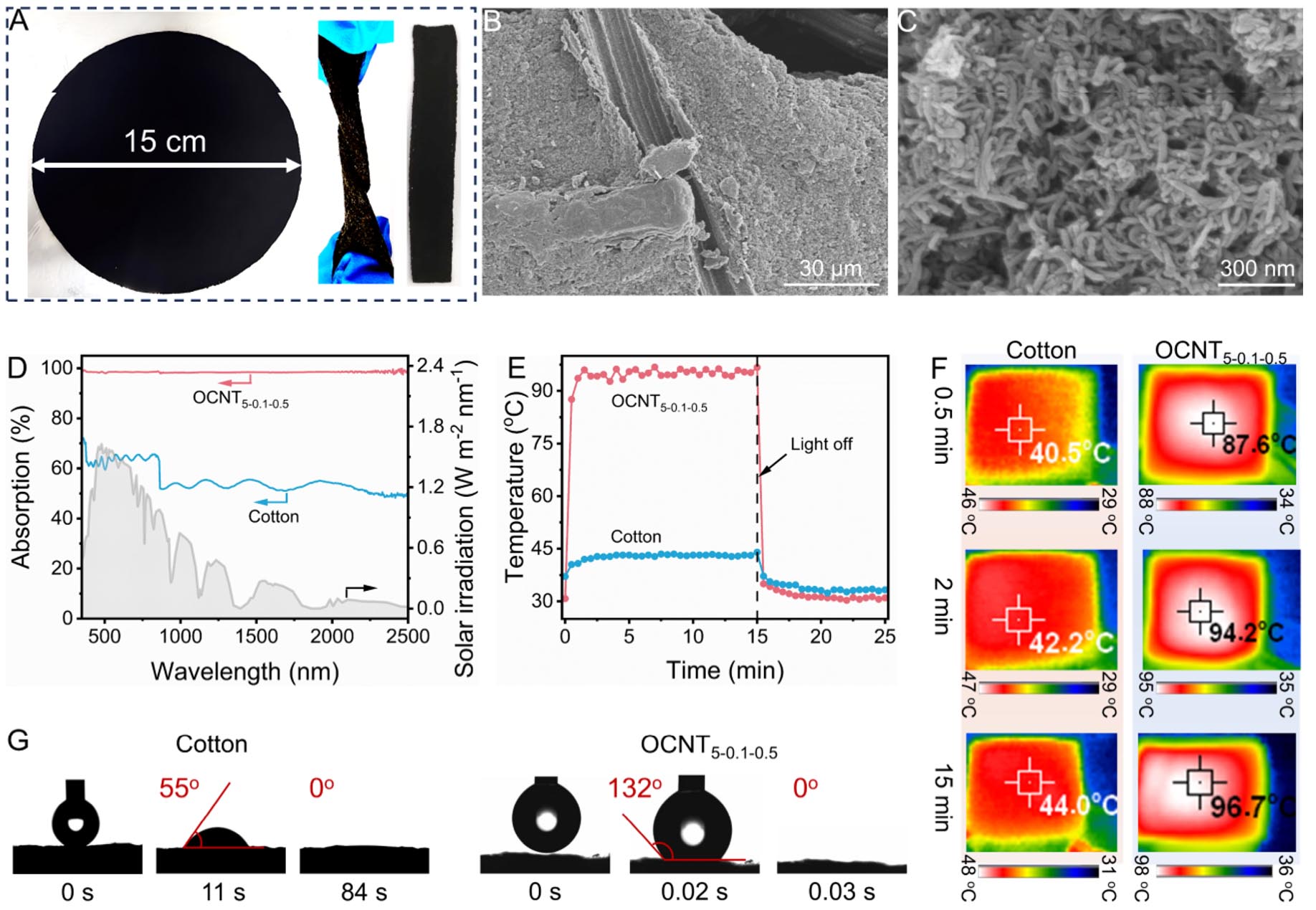
Figure 4. (A) Photographs and (B and C) SEM images of the OCNT5-0.1-0.5 evaporator. (D) UV-Vis-NIR absorption spectra, (E) surface temperature curves, (F) infrared thermal images, and (G) water contact angles of cotton and OCNT5-0.1-0.5 evaporators.
Solar interfacial steam-power cogeneration using OCNTx-y-z evaporators
A self-built evaporation device was established for solar interfacial steam generation, as shown in Figure 5A and Supplementary Figure 22. A polystyrene (PS) foam serves as a supporting and thermal isolation material to prevent heat loss and transfer. Based on the good photothermal conversion ability and hydrophilicity of the OCNT5-0.1-0.5 evaporator, water rapidly transfers to its surface to complete evaporation (from liquid to gas). For all evaporation systems, water mass loss increases linearly with irradiation time [Figure 5B]. The evaporation rate of the OCNT5-0.1-0.5 evaporator is 2.73 kg m-2 h-1 [Figure 5C], higher than that of the OCNT5-0.1-0 evaporator (2.39 kg m-2 h-1), OCNT5-0-0.5 evaporator (2.48 kg m-2 h-1), or cotton evaporator
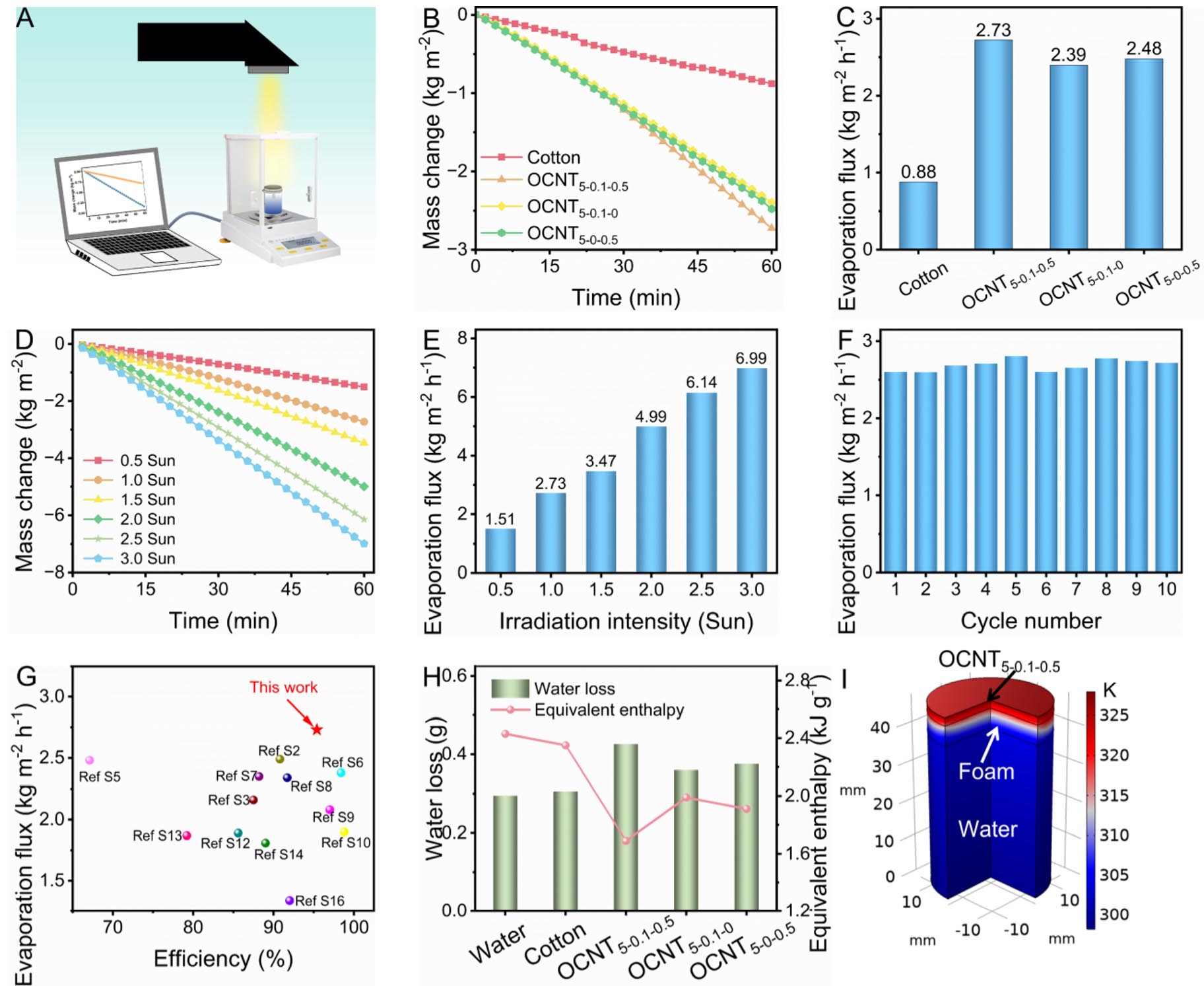
Figure 5. (A) Schematic diagram of interfacial solar steam generation. (B) Water mass losses of evaporation systems and (C) evaporation fluxes for various evaporators under 1 Sun irradiation. (D) Water mass change and (E) evaporation flux of the OCNT5-0.1-0.5 evaporator under solar intensities ranging from 0.5 to 3 Sun. (F) Water evaporation fluxes of the OCNT5-0.1-0.5 evaporator over 10 cycles. (G) Solar-evaporation performance comparison between the OCNT5-0.1-0.5 evaporator and previously reported evaporators. (H) Mass loss of water in the dark and vaporization enthalpy for various evaporators. (I) COMSOL simulation of the temperature distribution in the OCNT5-0.1-0.5 evaporation system.
The evaporation performance is closely tied to the latent heat of water evaporation. Under dark conditions, the water mass losses are 426 mg for OCNT5-0.1-0.5, 360 mg for OCNT5-0.1-0, 375 mg for OCNT5-0-0.5, and 306 mg for cotton, higher than that of pure water (295 mg) [Figure 5H]. Correspondingly, the evaporation enthalpies were calculated as 1.686, 1.995, 1.915, and 2.347 kJ g-1 [Supplementary Note 3], which are similar to those of the DSC measurement [Supplementary Figure 23 and Supplementary Table 4]. The lowest evaporation enthalpy of the OCNT5-0.1-0.5 evaporator is the fundamental reason for its higher evaporation rate than that of other evaporators[48]. Compared with pure water, the evaporation enthalpy is reduced by 30.7% for the OCNT5-0.1-0.5 evaporator. In addition, the thermal conductivity of the OCNT5-0.1-0.5 evaporator is measured as
The water-evaporation power-generation device is shown in Figure 6A. The evaporator was cut into rectangles (10 × 1.5 cm2) to facilitate the generation of electrical energy [Supplementary Figures 25 and 26]. The electrodes at the ends of the evaporators were encapsulated with epoxy resin to prevent short circuits or oxidation, and the device was placed at 45°. The numerous oxygenated chemical groups and abundant pore channels of OCNT5-0.1-0.5 facilitate water transport. Under the synergistic action of capillary forces and hydrophilic properties, water is continuously transported from the bottom of the evaporator to the surface. The abundant oxygen-containing functional groups of OCNT5-0.1-0.5 dissociate and generate surface charge upon contact with water molecules. Under the electric double-layer effect at the solid-liquid interface, the counterions selectively migrate in the nanochannels of the evaporator. The continuous enrichment of counterions at the evaporation end leads to the formation of a potential difference
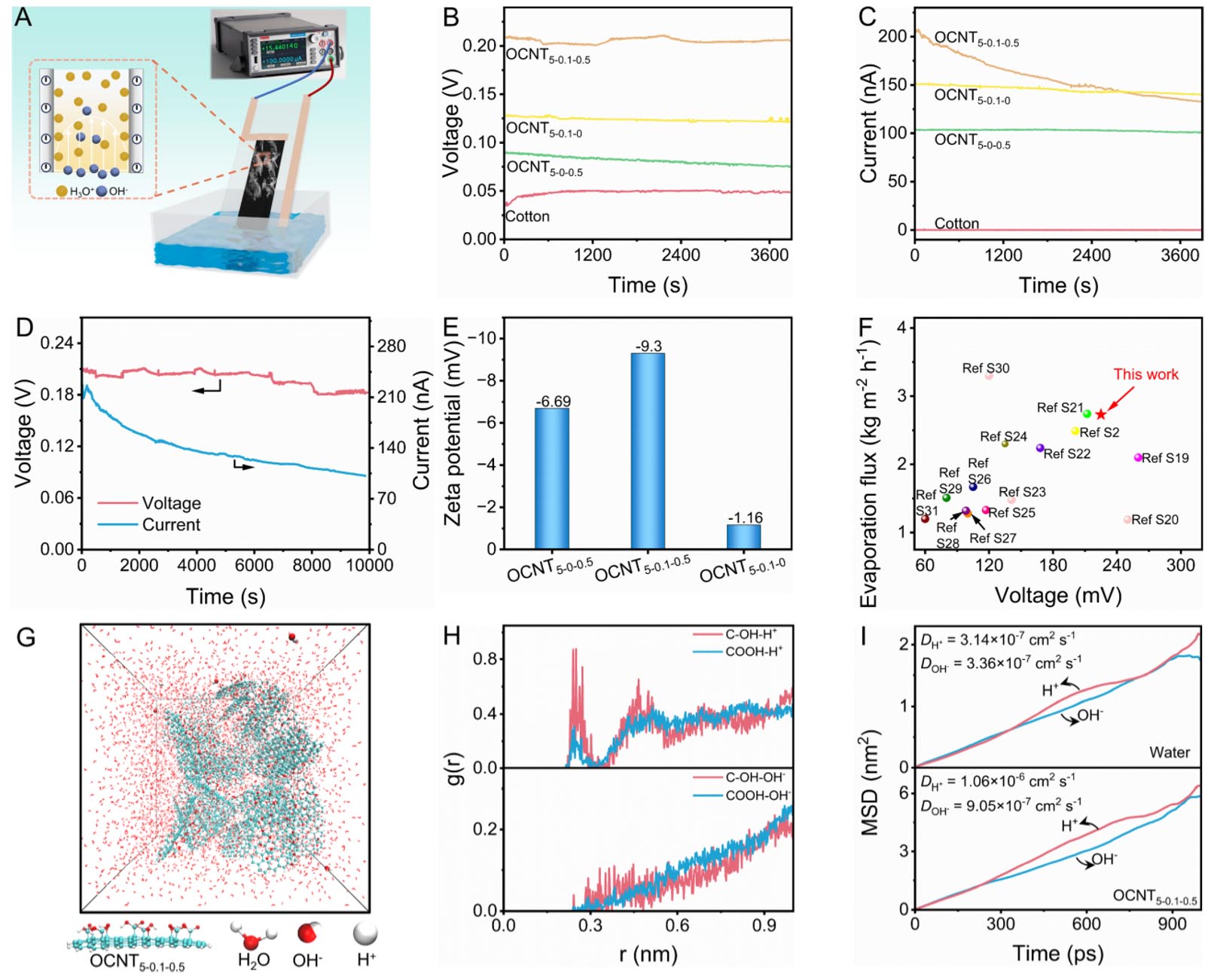
Figure 6. (A) Water evaporation electricity generation device schematic. (B) Open-circuit voltage and (C) short-circuit current generated for various devices. (D) Electricity generation curves for the OCNT5-0.1-0.5 device after running for 10,000 s. (E) Zeta potential of
Streaming potential is commonly accepted as the primary mechanism underlying electricity generation in hydrovoltaic processes[49-52]. During spontaneous water evaporation, the aqueous electrolyte solution migrates from the bottom to the top and flows over the surface of the charged material. The counterions from the electrolyte solution are attracted by the charged ions in the nanopores of OCNT5-0.1-0.5, resulting in the formation of an electric double layer. The potential difference between the upper and lower ends is gradually formed due to the continuous directional migration and accumulation of free charge. Actually, hydrovoltaic power generation is the process of converting environmental latent heat into electrical energy, which depends on the interaction between ions and OCNT5-0.1-0.5 materials. Ion selectivity and charge separation in the nanochannel are usually governed by the ion-functional-group interactions, which are further investigated using MD simulation [Supplementary Figure 28 and Supplementary Note 6]. H3O+ and OH-, produced by the dissociation of water molecules, were added to the simulation system [Figure 6G]. To simplify the simulation, H+ was placed in the simulation system instead of H3O+ in the real-world environment. The MD simulation was performed in an NPT ensemble (constant number of particles (N), pressure (P), and temperature (T)) with a simulation time of 20 ns. The relationship between the ionic charge and the surface functional groups of materials in the simulation system was analyzed using the radial distribution function (RDF). As shown in Figure 6H, the first peaks of radial distribution between H+ and oxygen-containing functional groups in OCNT5-0.1-0.5 molecules appear at 0.25 nm (C-OH) and 0.238 nm (COOH), respectively. By comparison, the first peak of C-OH-H+ is stronger than that of COOH-H+. However, there is no obvious peak in the radial distribution between OH- and oxygen-containing functional groups, indicating the absence of coordination. The diffusion coefficients of H+ and OH- are 1.06 × 10⁻⁶ and 9.05 × 10⁻⁷ cm2 s-1, respectively [Figure 6I]. In the pure water system, the diffusion coefficients are 3.14 × 10⁻⁷ and 3.36 × 10⁻⁷ cm2 s-1, respectively. The faster diffusion of H+ after the addition of OCNT5-0.1-0.5 confirms the strong attraction between H+ and OCNT5-0.1-0.5. During water evaporation, H3O+ selectively migrates in the nanochannels of the evaporator and accumulates at the evaporation section, resulting in the formation of a potential difference.
Outdoor solar evaporation-hydrovoltaic co-generation of OCNT5-0.1-0.5 device
The practical freshwater-power co-generation experiment was carried out outdoors
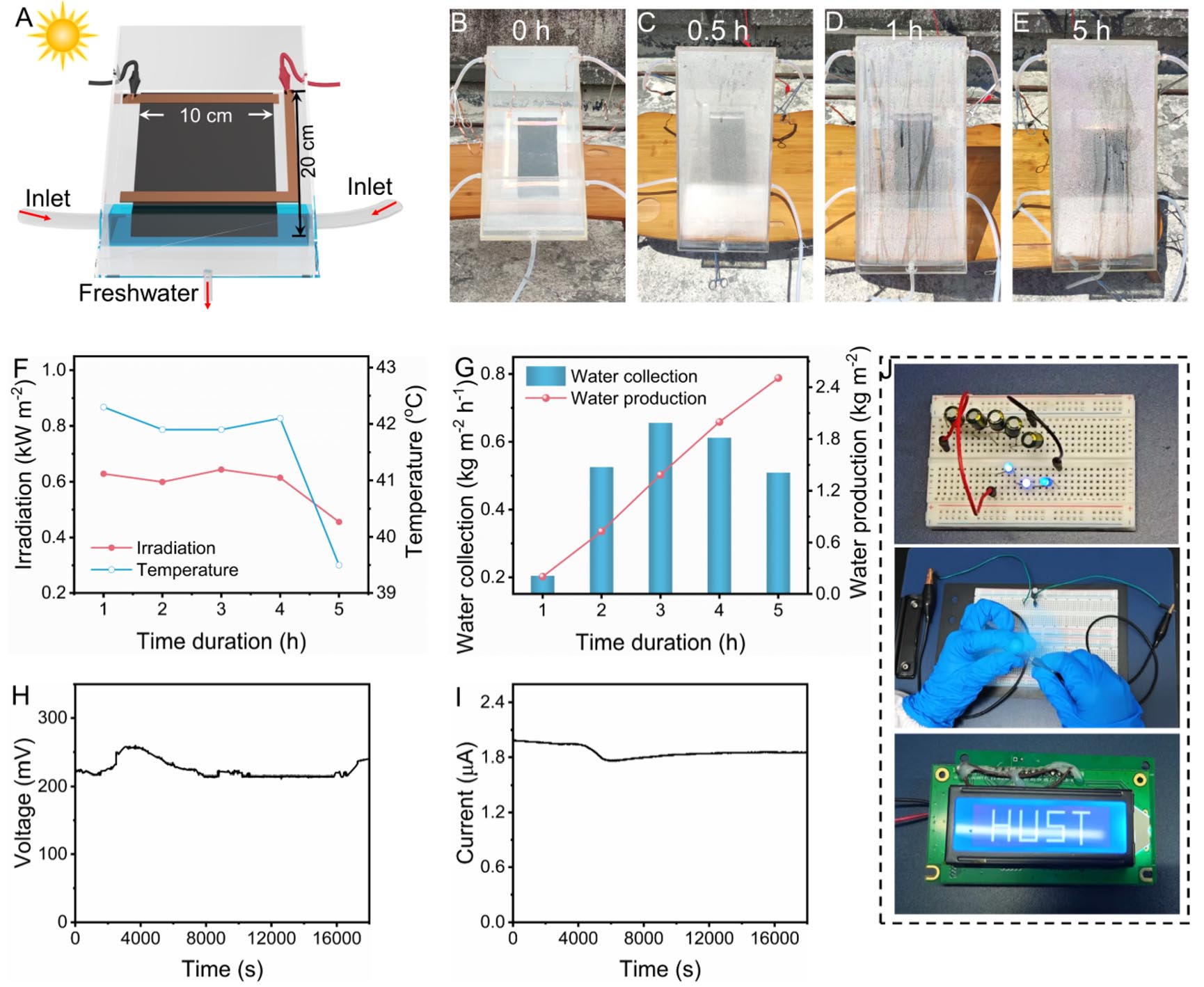
Figure 7. (A) Scheme and (B-E) photographs of the outdoor device. (F) Solar irradiation intensity and temperature, (G) water production, (H) voltage, and (I) current curves of the OCNT5-0.1-0.5 device in the practical experiment. (J) Photographs showing low-power electrical appliances powered by series-connected capacitors.
CONCLUSIONS
In summary, a versatile OCNT photothermal evaporator is developed to enable the simultaneous production of freshwater and electricity under solar illumination. Particularly, a Ni5Mo0.1Mg0.5 catalyst with high catalytic activity, dispersion, and stability is designed and prepared to convert discarded polyolefin separators into OCNT. Under the synergistic effect of Ni, Mo, and Mg, the Ni5Mo0.1Mg0.5 catalyst exhibits high reducibility, sintering resistance, and carbon elimination ability. CNT5-0.1-0.5 is produced with a yield of 57.4 wt%. The OCNT5-0.1-0.5 presents a diameter of 20-30 nm, a length of 10-30 μm, and contains abundant oxygen-containing functional groups. The OCNT5-0.1-0.5 evaporator exhibited good photo-to-thermal conversion ability, satisfying hydrophilicity, high photo-to-thermal conversion efficiency (95.4%), and minimal vaporization enthalpy (1.686 kJ g-1). Consequently, an evaporation rate of 2.73 kg m-2 h-1 and a voltage output of 0.221 V are achieved. In the outdoor experiment, the total water output is 2.51 kg m-2 over 5 h, and the voltage and current are 0.215-0.265 V and 1.8-2.0 μA, respectively. The electricity can power an LED light bulb, fan, and display screen. MD simulations reveal that H+ from the dissociation of water molecules interacts more strongly with the surface functional groups (C-OH and COOH) of OCNT. As a result, H+ migrates faster in the nanochannels of the evaporator than OH-, causing a potential difference across the two ends of the device. This work presents green strategies for upcycling discarded polyolefin separators to prepare CNT and address the shortage of freshwater and energy.
DECLARATIONS
Acknowledgments
We are grateful to the Analytical and Testing Center of HUST for access to their facilities. The authors extend their gratitude to the Theoretical and Computational Chemistry Team (from Scientific Compass www.shiyanjia.com) for providing invaluable assistance.
Authors’ contributions
Conceptualization, data curation, writing and manuscript revision: Gong, J.; Wang, H.; Niu, R.
Experimentation, methodology, formal analysis: Wang, H.; Xu, M.; Wen, X.; Hu, G.; Wei, Q.
Performed the simulations: Wang, H.; Feng, L.; Zhang, X.
All authors contributed to the discussion of the manuscript.
Availability of data and materials
The data supporting the findings of this study are available within this Article and its Supplementary Materials. Further data are available from the corresponding author upon request.
AI and AI-assisted tools statement
Not applicable.
Financial support and sponsorship
The present work is supported by the National Natural Science Foundation of China (No. 52373099).
Conflicts of interest
All authors declared that there are no conflicts of interest.
Ethical approval and consent to participate
Not applicable.
Consent for publication
Not applicable.
Copyright
© The Author(s) 2026.
Supplementary Materials
REFERENCES
1. Wu, S.; Huang, C.; Shen, W.; et al. A water-soluble binder for recyclable lithium-ion batteries. Nat. Sustain. 2026, 9, 575-84.
3. Liu, Q.; Yu, Z.; Hu, Y.; Tang, M.; Zhang, Q.; Ye, M. Designing advanced separators toward lithium-ion batteries. Adv. Energy. Mater. 2025, 15, e03217.
5. Sun, J.; Dong, J.; Gao, L.; Zhao, Y.; Moon, H.; Scott, S. L. Catalytic upcycling of polyolefins. Chem. Rev. 2024, 124, 9457-579.
6. Conk, R. J.; Stahler, J. F.; Shi, J. X.; et al. Polyolefin waste to light olefins with ethylene and base-metal heterogeneous catalysts. Science 2024, 385, 1322-7.
7. Li, H.; Wu, J.; Jiang, Z.; et al. Hydroformylation of pyrolysis oils to aldehydes and alcohols from polyolefin waste. Science 2023, 381, 660-6.
8. Ren, S.; Xu, X.; Hu, K.; et al. Salt-templated transformation of waste plastics into single-atom catalysts for environmental and energy applications. Nat. Commun. 2025, 16, 8194.
9. Jie, X.; Li, W.; Slocombe, D.; et al. Microwave-initiated catalytic deconstruction of plastic waste into hydrogen and high-value carbons. Nat. Catal. 2020, 3, 902-12.
10. Zhang, S.; Sun, N.; Li, X.; Soomro, R. A.; Xu, B. Closed pore engineering of activated carbon enabled by waste mask for superior sodium storage. Energy. Storage. Mater. 2024, 66, 103183.
11. Wyss, K. M.; Li, J. T.; Advincula, P. A.; et al. Upcycling of waste plastic into hybrid carbon nanomaterials. Adv. Mater. 2023, 35, 2209621.
12. Irfan, M.; Saleem, R.; Shoukat, B.; et al. Production of combustible fuels and carbon nanotubes from plastic wastes using an in-situ catalytic microwave pyrolysis process. Sci. Rep. 2023, 13, 9057.
13. Qiao, Y.; Chen, X.; Wang, Z.; Xu, W.; Gan, Z.; Wang, J. Microwave-assisted catalytic upcycling of polyolefin wastes into hydrogen and carbon nanotubes over Pt-promoted Fe/Ni bimetallic catalysts. Appl. Catal. B. Environ. Energy. 2026, 384, 126214.
14. Wei, Q.; Hu, G.; Wang, H.; et al. When waste plastics meet with MOF: upcycling waste polypropylene separator into carbon nanotube for efficient freshwater and hydroelectricity co-generation. Sustain. Mater. Technol. 2026, 47, e01785.
15. Wu, Q.; Lv, X.; Xu, N.; et al. Upcycling plastic polymers into single-walled carbon nanotubes from a magnesia supported iron catalyst. Carbon 2023, 215, 118492.
16. He, S.; Li, C.; Sun, H.; et al. Promotion of manganese on Fe-based catalyst for the production of carbon nanotubes (CNTs) from plastics. Chem. Eng. J. 2024, 492, 152306.
17. Zhao, J.; Gao, J.; Wang, D.; et al. Microwave-intensified catalytic upcycling of plastic waste into hydrogen and carbon nanotubes over self-dispersing bimetallic catalysts. Chem. Eng. J. 2024, 483, 149270.
18. Dong, C.; Chen, L.; Lin, W.; et al. Nature-inspired 3D hierarchical carbon nanotube matrices enable extraordinary solar steam generation. Carbon. Energy. 2025, 7, e655.
19. Li, Y.; Shi, Y.; Wang, H.; et al. Recent advances in carbon-based materials for solar-driven interfacial photothermal conversion water evaporation: assemblies, structures, applications, and prospective. Carbon. Energy. 2023, 5, e331.
20. Zhang, Q.; Xiao, X.; Zhao, G.; et al. An all-in-one and scalable carbon fibre-based evaporator by using the weaving craft for high-efficiency and stable solar desalination. J. Mater. Chem. A. 2021, 9, 10945-52.
21. Sun, J.; Farid, M. U.; Xi, W.; et al. Hydrogel-based photothermal-catalytic membrane for efficient cogeneration of freshwater and hydrogen in membrane distillation system. Adv. Funct. Mater. 2025, 36, 2416768.
22. Wei, D.; Wang, C.; Zhang, J.; et al. Water activation in solar-powered vapor generation. Adv. Mater. 2023, 35, 2212100.
23. Dang, C.; Cao, Y.; Nie, H.; et al. Structure integration and architecture of solar-driven interfacial desalination from miniaturization designs to industrial applications. Nat. Water. 2024, 2, 115-26.
24. Opoku, K. N.; Wei, Y.; Dankwa, C. A. A.; et al. Advances in photothermal water evaporation: synthesis, mechanisms, and coupled techniques. Energy. Mater. 2025, 5, 500020.
25. Mao, Z.; Chen, X.; Chen, Y.; et al. A hierarchical salt-rejection strategy for sustainable and high-efficiency solar-driven desalination. Nano. Mater. Sci. 2024, 6, 38-43.
26. Liu, M.; Sun, Y.; Shao, K.; et al. Synergistic solar-powered water-electricity generation: an integrated floating system on water. Nano. Energy. 2024, 119, 109074.
27. Wang, W.; Shi, Y.; Zhang, C.; et al. Conversion and storage of solar energy for cooling. Energy. Environ. Sci. 2022, 15, 136-45.
28. Wang, J.; Sun, M.; Liu, C.; et al. Customized microenvironments spontaneously facilitate coupled engineering of real-life large-scale clean water capture and pollution remediation. Adv. Mater. 2023, 35, 2306103.
29. Li, Z.; Zhang, J.; Zhang, J.; et al. Solar evaporator coupled with strong/weak convection and its cascade utilization. Sci. Bull. 2025, 70, 1264-74.
30. Huang, W.; Gao, X.; Sun, L.; et al. Black g-C3N4-based hydrogel for water evaporation and photothermal persulfate activation. J. Mater. Sci. Technol. 2026, 249, 153-63.
31. Li, N.; Zhang, X.; Zhu, J.; Xiong, S.; Xu, Y.; Li, Y. Bioinspired flexible composite hydrogels for efficient solar steam generation and stable electricity harvest. Nano. Lett. 2025, 25, 10072-81.
32. Zhang, X.; Guo, J.; Zou, Z.; et al. Bioinspired and 3D-printed solar evaporators for highly efficient freshwater-electricity co-generation. Mater. Horiz. 2025, 12, 5211-24.
33. Wang, F.; Zhang, Y.; Shi, J.; et al. Bioinspired and biodegradable functionalized graphene oxide/deacetylated cellulose acetate composite janus membranes for water evaporation-induced electricity generation. ACS. Sustain. Chem. Eng. 2023, 11, 9792-803.
34. Ma, J.; Guo, Z.; Han, X.; et al. Reduced graphene oxide/FeOOH-based asymmetric evaporator for the simultaneous generation of clean water and electrical power. Carbon 2023, 201, 318-27.
35. Hu, G.; Liu, H.; Liu, K.; et al. All-in-one carbon foam evaporators for efficient co-generation of freshwater and electricity. Adv. Funct. Mater. 2025, 35, 2423781.
36. Ding, Y.; Li, S.; Tian, J.; et al. CNTs/Wood composite nanogenerator for producing both steam and electricity. ACS. Appl. Electron. Mater. 2021, 3, 5287-95.
37. Wu, Y.; Ma, J.; Zang, S.; et al. Multifunctional composite membranes for interfacial solar steam and electricity generation. Chem. Eng. J. 2023, 472, 144600.
38. Aboul-enein, A. A.; Awadallah, A. E. Production of nanostructured carbon materials using Fe-Mo/MgO catalysts via mild catalytic pyrolysis of polyethylene waste. Chem. Eng. J. 2018, 354, 802-16.
39. Beck, A.; Huang, X.; Artiglia, L.; et al. The dynamics of overlayer formation on catalyst nanoparticles and strong metal-support interaction. Nat. Commun. 2020, 11, 3220.
40. Sattari, O.; Nematollahi, B.; Rezaei, M.; Alavi, S. M. Effect of MgO on the catalytic activity and stability of nickel-based catalyst in methane dry reforming reaction. Sci. Rep. 2025, 15, 39649.
41. Dekermenjian, M.; Ruediger, A. P.; Merlen, A. Raman spectroscopy investigation of magnesium oxide nanoparticles. RSC. Adv. 2023, 13, 26683-9.
42. Lu, J.; Veksha, A.; Lisak, G. Conversion of municipal sewage sludge into biogenic multi-walled carbon nanotubes and hydrogen using X-Mo/MgO (X = Co, Fe, Ni) catalysts through pyrolysis-chemical vapor deposition process. Chem. Eng. J. 2024, 496, 153794.
43. Gao, W.; Zhou, T.; Wang, Q. Controlled synthesis of MgO with diverse basic sites and its CO2 capture mechanism under different adsorption conditions. Chem. Eng. J. 2018, 336, 710-20.
44. Xue, Q.; Li, Z.; Yi, H.; et al. Controlling sintering and carbon deposition with post-coated MgO confined group VIII metal-based catalysts towards durable high-temperature steam reforming. Appl. Catal. B. Environ. 2022, 318, 121874.
45. Popov, V. Carbon nanotubes: properties and application. Mater. Sci. Eng. R. Rep. 2004, 43, 61-102.
46. Dresselhaus, M.; Jorio, A.; Saito, R. Characterizing graphene, graphite, and carbon nanotubes by Raman spectroscopy. Annu. Rev. Condens. Matter. Phys. 2010, 1, 89-108.
47. Kim, H.; Nam, E.; An, K.; Lim, H. Laboratory-scale plastic upcycling and green growth: evaluating the upcycling of plastic waste into carbon nanotubes from economic and environmental aspects. Chem. Eng. J. 2024, 495, 153300.
48. Sun, Y.; Liu, D.; Zhang, F.; Gao, X.; Xue, J.; Zheng, Q. Multiscale biomimetic evaporators based on liquid metal/polyacrylonitrile composite fibers for highly efficient solar steam generation. Nano. Micro. Lett. 2025, 17, 129.
49. Lin, J.; Zhang, Z.; Lin, X.; et al. All wood-based water evaporation-induced electricity generator. Adv. Funct. Mater. 2024, 34, 2314231.
50. Liu, Z.; Liu, C.; Ni, A.; et al. Tortuosity regulation of two-dimensional nanofluidic films for water evaporation-induced electricity generation. Nano. Res. 2024, 17, 6192-202.
51. Liu, Y.; Li, Z.; Wang; L; et al. Surface functional modification for boosting power density of hydrovoltaic devices. Adv. Funct. Mater. 2023, 34, 2312666.
Cite This Article
 Open Access
How to Cite
Download Citation
Export Citation File:
Type of Import
Tips on Downloading Citation
Citation Manager File Format
Type of Import
Direct Import: When the Direct Import option is selected (the default state), a dialogue box will give you the option to Save or Open the downloaded citation data. Choosing Open will either launch your citation manager or give you a choice of applications with which to use the metadata. The Save option saves the file locally for later use.
Indirect Import: When the Indirect Import option is selected, the metadata is displayed and may be copied and pasted as needed.
About This Article
Copyright

Data & Comments
Data
0











Comments
Comments must be written in English. Spam, offensive content, impersonation, and private information will not be permitted. If any comment is reported and identified as inappropriate content by OAE staff, the comment will be removed without notice. If you have any queries or need any help, please contact us at support@oaepublish.com.