



fig2
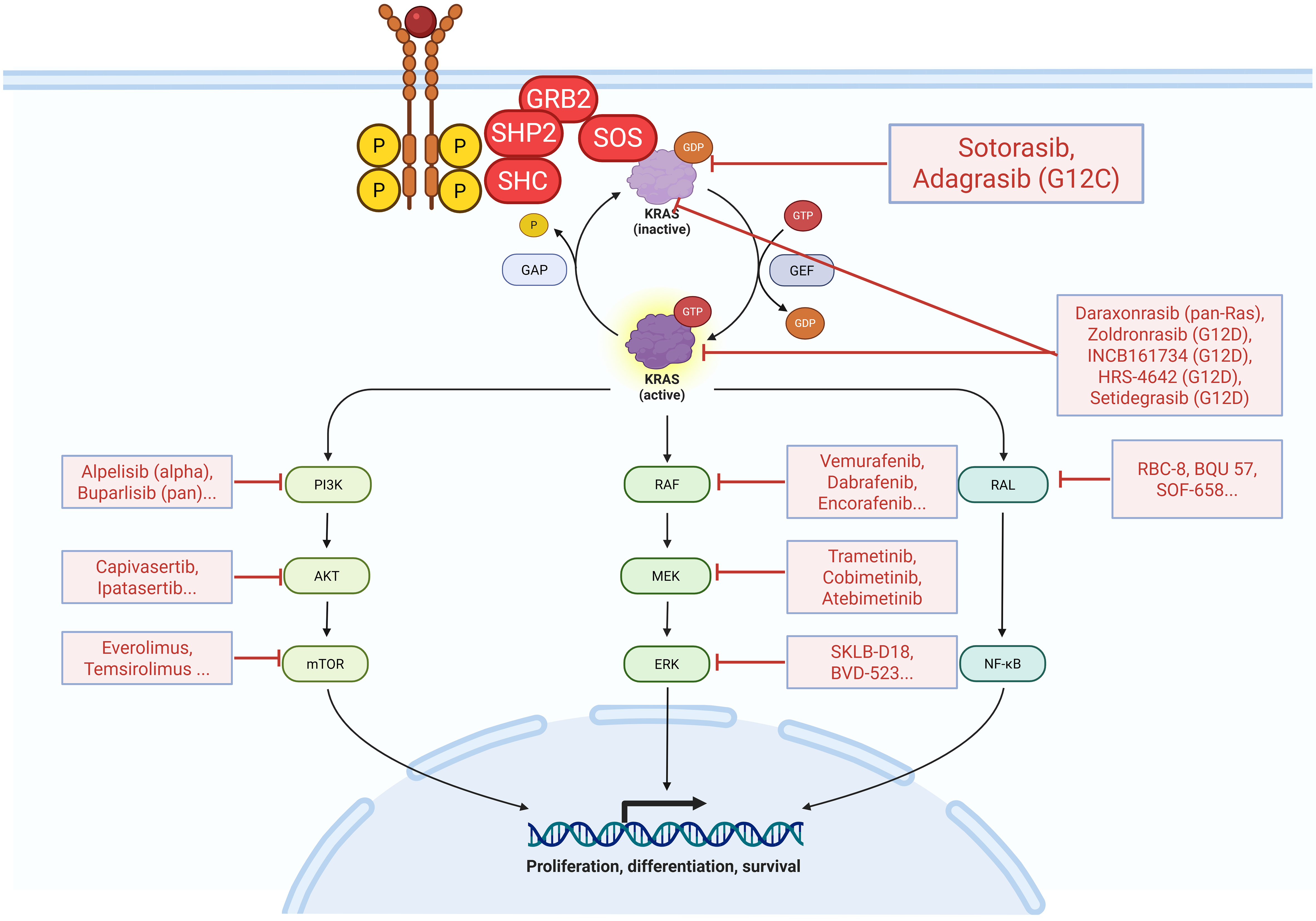
Figure 2. RAS and EGFR interactions represent a primary cell signalling axis that controls cell growth and division. EGFR is a cell-surface receptor that, when activated by its ligand, passes a signal downstream to RAS proteins, which then trigger the MAPK and PI3K cascades. The RAS signal transduction cascade has been implicated in EGFR TKI resistance, and several drugs have been identified to inhibit this pathway, with some already approved for clinical use. As of March 2026, 73 different RAS inhibitors have entered 236 clinical trials, essentially evaluating almost all RAS mutations. However, resistance develops rapidly, and toxicity remains a significant problem (e.g., daraxonrasib). In contrast, novel deep cyclic MEK inhibitors (e.g., atebimetinib) were found to be less toxic with comparable efficacy. Targeting ERK1,2 was a major challenge in the past as these inhibitors appeared to be very toxic in animal models; however, the newly developed compound SKLB-D18 (IC50 values: 38.7 nM for ERK1, 40.1 nM for ERK2, and 59.7 nM for ERK5) has shown a very favourable toxicity profile in preclinical models[77]. This figure was created using BioRender.com (https://biorender.com/xc5lpem). RAS: Rat sarcoma virus; EGFR: epidermal growth factor receptor; MAPK: mitogen-activated protein kinase; PI3K: phosphoinositide 3-kinase; TKI: tyrosine kinase inhibitor; MEK: mitogen-activated protein kinase kinase; ERK: extracellular signal-regulated kinase; GRB2: growth factor receptor-bound protein 2; SHP2: src homology region 2 domain-containing phosphatase-2; SOS: son-of-sevenless; SHC: src homology 2 domain containing; KRAS: Kirsten rat sarcoma virus; GDP: guanosine diphosphate; GAP: GTPase-activating protein; GTP: guanosine triphosphate; GEF: guanine nucleotide exchange factor; AKT: protein kinase B; mTOR: mechanistic target of rapamycin; RAF: RAF family of serine/threonine protein kinases; RAL: RAS-related proteins (RAL-A and RAL-B); NF-κB: nuclear factor kappa B.