




Volume 6, Issue 3 (2026) – 28 articles
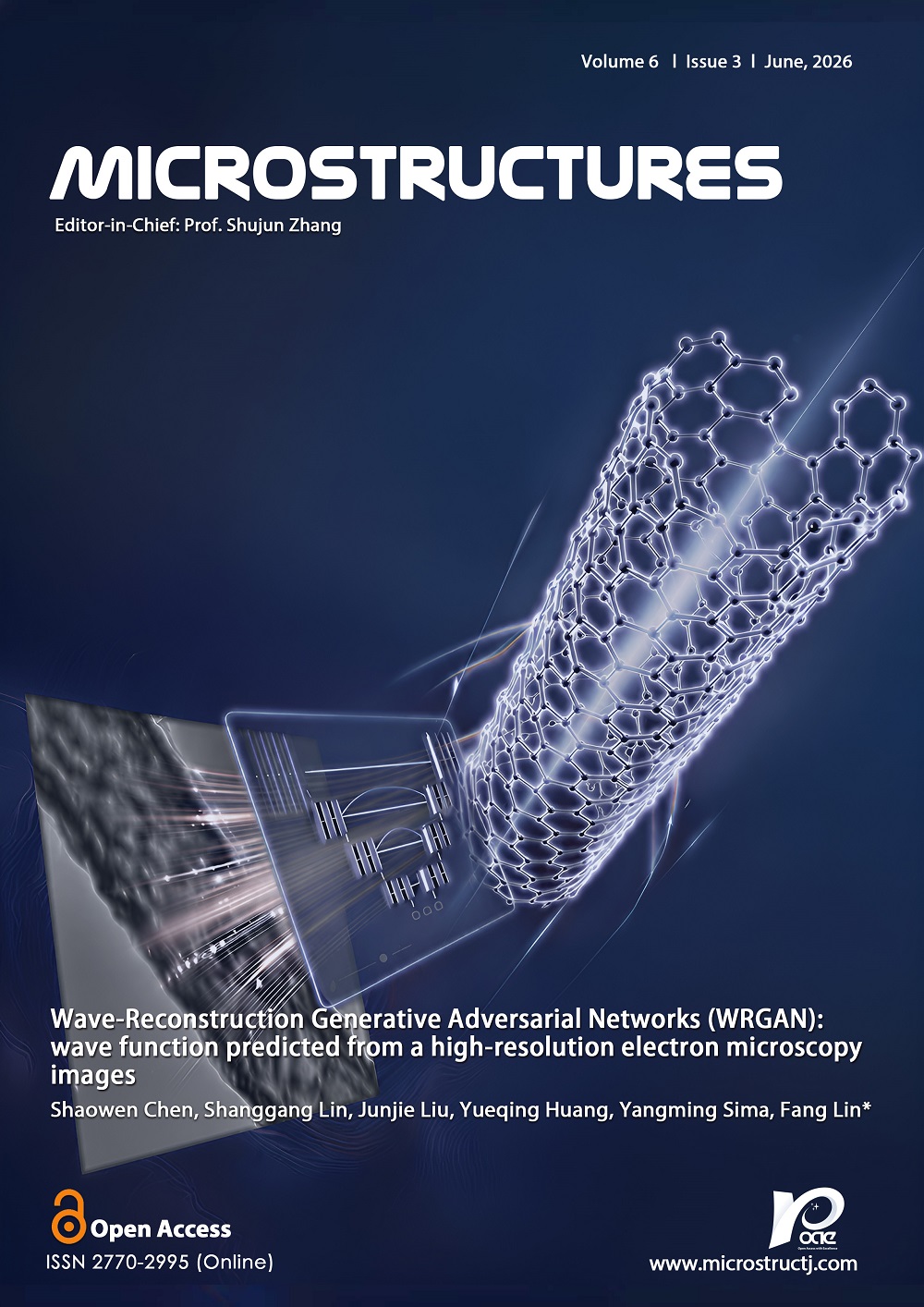
Cover Picture: High-resolution transmission electron microscopy (HRTEM) is indispensable for atomic-scale characterization yet fundamentally limited by the inherent phase loss in conventional detectors including CCD. To overcome this barrier, we propose Wave-Reconstruction Generative Adversarial Networks (WRGAN) that directly predict wave function amplitude and phase from single HRTEM images. Our physics-guided framework employs a Unet++ generator within a Generative Adversarial Networks (GAN) architecture via defining a physics-guided consistency loss. A key advantage is that WRGAN, trained solely on simulated data, demonstrates robust performance when directly applied to experimental images. Validation on experimental Nb8W9O47 image shows predicted amplitudes and phases closely match the groundtruth wave functions. Significantly, WRGAN successfully resolves upper and lower surface projections in noisy single-wall carbon nanotube (SWCNT) images, enabling near-atomic-resolution 3D reconstruction.
view this paper 
Back Cover Picture: With the trend toward miniaturized and intelligent infrared systems, high-performance light source chips featuring a high modulation depth and rapid thermal response have emerged as key components for advancing interdisciplinary applications. In this study, a dual-band infrared source chip featuring a suspended membrane structure on a silicon-on-insulator substrate is reported. The suspended polysilicon emissive layer was prepared via high-concentration boron doping and micro-nano processing techniques. Relative to a closed membrane configuration, the suspended structure yields superior thermal and optical characteristics including a thermal response time of 36 ms to reach 450 °C, a modulation depth of 50% at 60 Hz, and dual-band emission centered at 3.6 and 9.54 μm. Structural-property correlation analysis reveals that the specific infrared emission signatures are intrinsically linked to the lattice microstructure. In particular, the 3.6 μm emission is attributed to the stretching vibrations of hydrogen-bridged bonds and Si-H bonds localized at oxygen vacancies within the surface SiO2 layer. In addition, the 9.54 μm peak originates from the coupling between the SiO2 network bending modes and the localized vibrational modes of Si-B bonds introduced by boron doping. Furthermore, the suspended membrane architecture plays a critical role in enhancing modulation performance by geometrically confining heat, thereby suppressing lateral thermal diffusion and reducing thermal capacitance. These insights establish a direct mapping between micro/nano-structural design and optoelectronic performance, offering a robust theoretical framework for developing high-efficiency infrared emitters for gas sensing and photodetection applications.
view this paper