




fig3
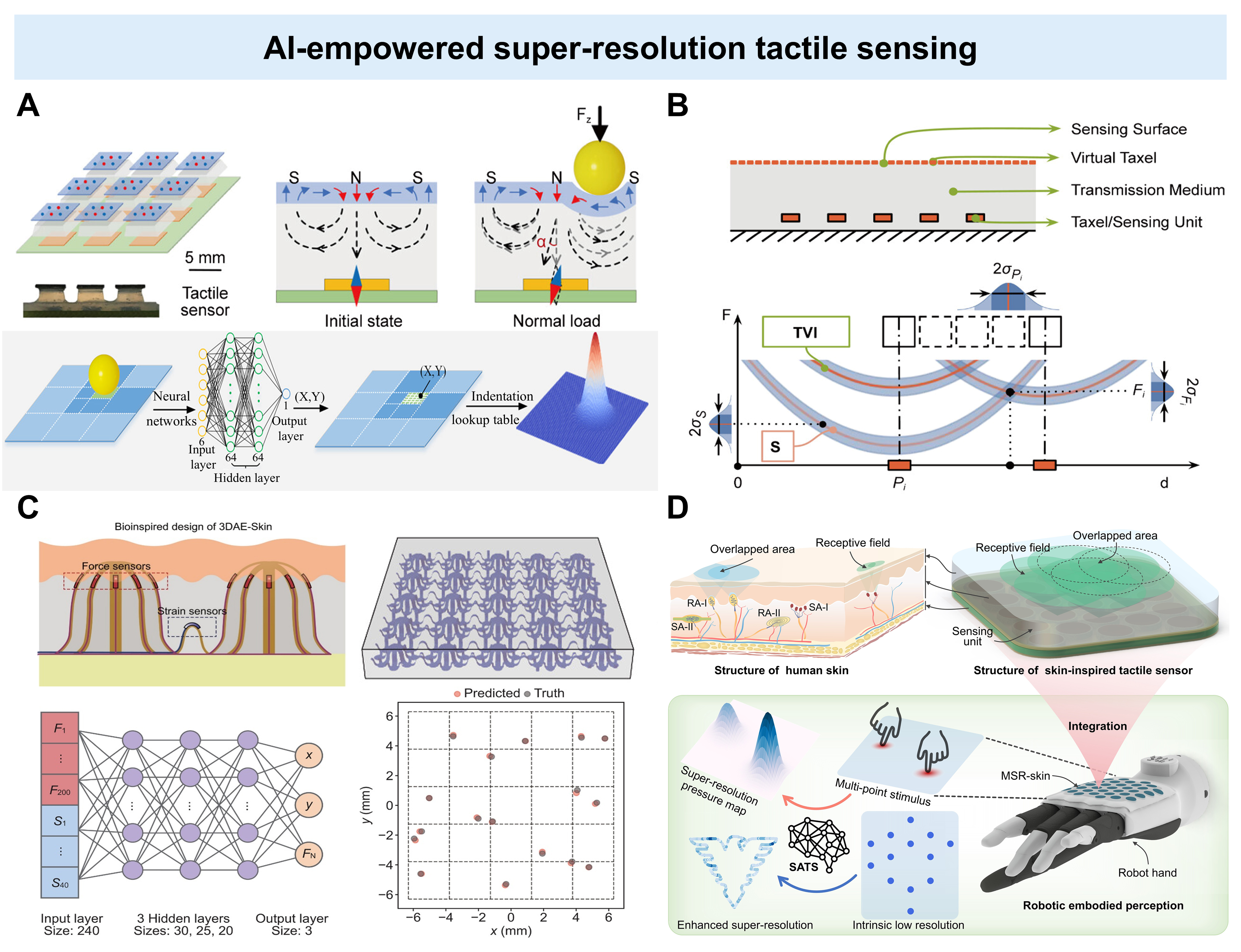
Figure 3. SR tactile sensing enabled by AI algorithms with sparse taxel layouts. (A) Soft magnetic e-skin that combines a sparse Hall-sensor array with a sinusoidally magnetized flexible film, enabling force self-decoupling and deep learning-enhanced tactile SR. Reproduced with permission from Ref.[79], Copyright © 2021 The American Association for the Advancement of Science; (B) A barometer-based tactile skin with a sparse array embedded in an elastomer for SR contact localization. Reproduced with permission from Ref.[80], Copyright © 2022 The American Association for the Advancement of Science; (C) Tactile e-skin with a bioinspired 3D layout of force and strain sensors, enabling SR sensing through decoupled multimodal mechanosensation. Reproduced with permission from Ref.[81], Copyright © 2024 The American Association for the Advancement of Science; (D) A skin-inspired sparse taxel array with overlapped receptive fields, where a self-attention-assisted deep learning model reconstructs SR pressure distributions. Reproduced from Ref.[82] under the CC BY 4.0 license, Copyright © 2025 The American Association for the Advancement of Science. SR: Super-resolution; AI: artificial intelligence; e-skin: electronic-skin; TVI: taxel value isoline; 3DAE-Skin: three-dimensionally architected electronic skin; RA: rapid adapting; SA: slowly adapting; SATS: self-attention-assisted tactile super-resolution; MSR: multi-point super-resolution.