




fig5
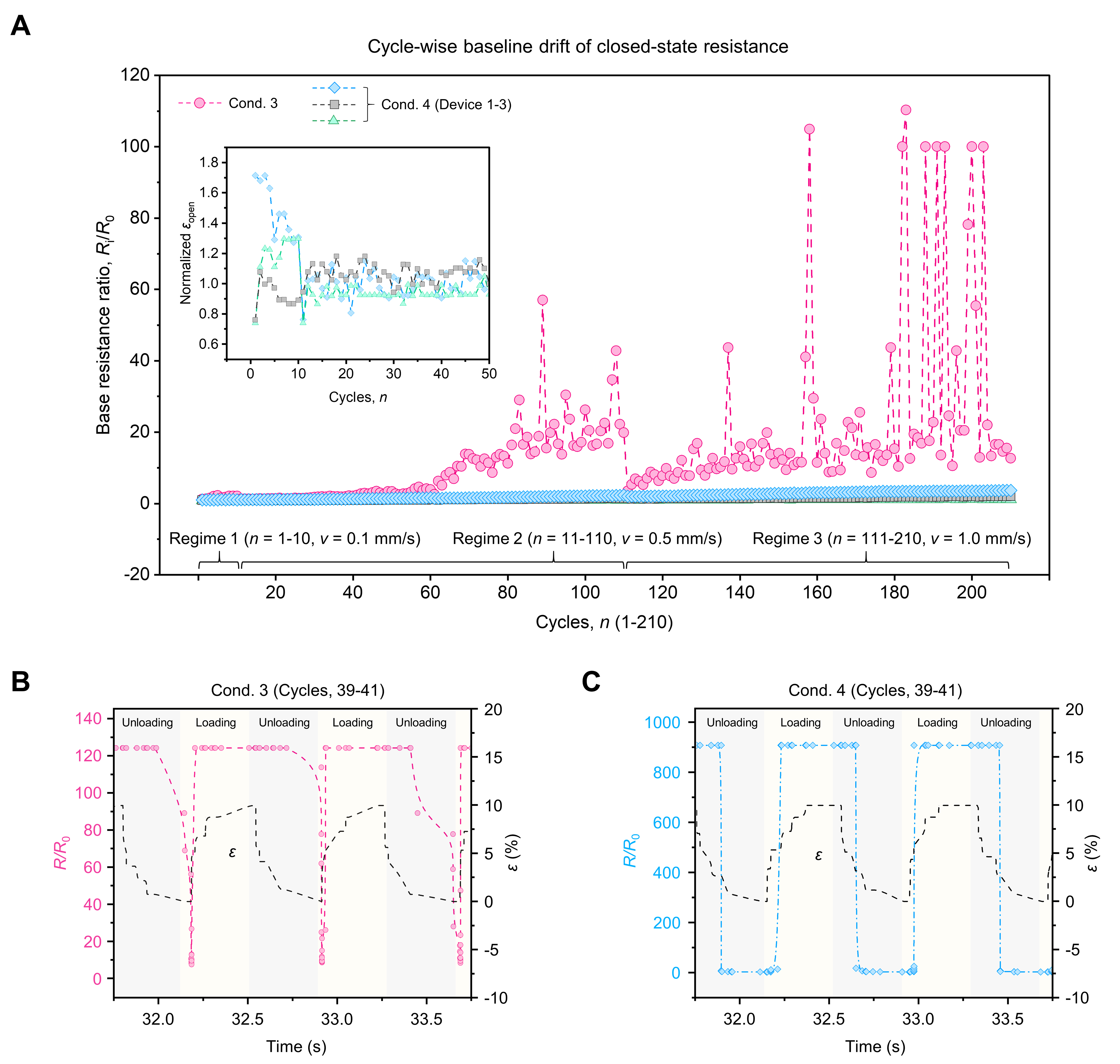
Figure 5. Cyclic stability of crack-based mechanical switching. (A) Cycle-by-cycle baseline R/R0 of Cond. 3 and Cond. 4 over 210 cycles under three tensile speed conditions (0.1, 0.5, and 1.0 mm/s). Three independent Cond. 4 devices are shown overlaid (Device 1: range 0.84-1.24, mean 1.04; Device 2: range 0.80-2.01, mean 1.33; Device 3: range 1.01-3.70, mean 2.19), in clear contrast to the long-term cyclic drift of a single Cond. 3 device (mean R/R0 ≈ 15.5, maximum up to ~110). Inset shows the normalized switching strain (εopen/‹εopen›steady) as a function of cycle number for the same three Cond. 4 devices, demonstrating convergence to unity within the initial ~10 cycles and stable maintenance thereafter; (B) Resistance–time curves of the Cond. 3 sample during cyclic loading and unloading. Although loading and unloading occur over identical time intervals, resistance recovery is delayed. This delay is attributed to contact re-formation kinetics of the delaminated film rather than mechanical recovery of the substrate; (C) Resistance–time curves of the Cond. 4 sample during cyclic loading and unloading. The device exhibits rapid and synchronized on-state and off-state switching in response to mechanical deformation.