




fig1
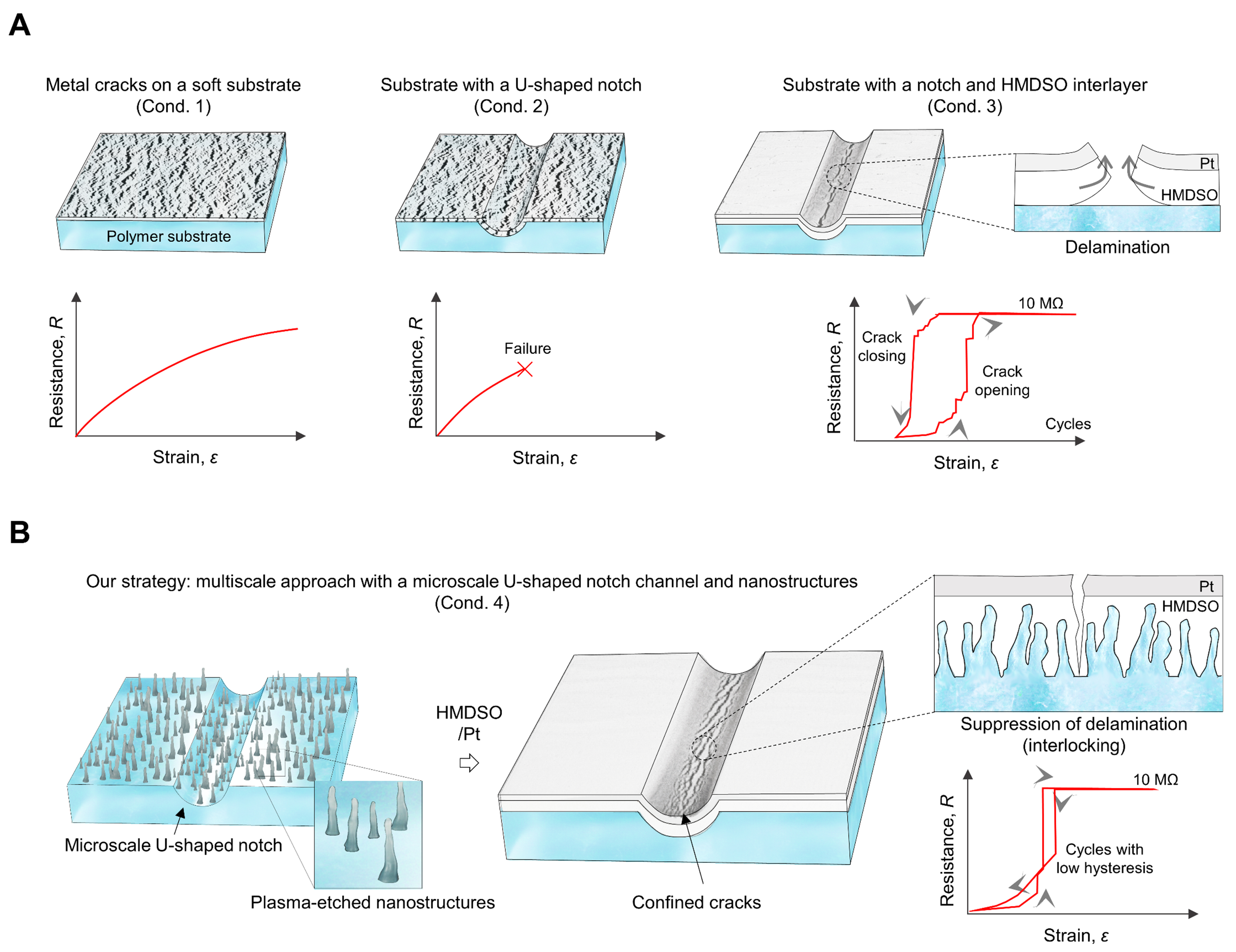
Figure 1. From distributed crack sensors to confined cracks for mechanical switching. (A) Three crack-device configurations. Cond. 1: a metal crack layer formed on a flexible flat substrate. Cond. 2: a metal crack layer formed on a U-shaped notch. Cond. 3: a metal crack layer formed on a flexible notched substrate incorporating a brittle interlayer (HMDSO). Cond. 1 and Cond. 2 exhibit conventional crack-based resistive sensing behavior as a function of applied strain. In contrast, Cond. 3 shows an abrupt resistance increase (up to ~10 MΩ) due to crack opening prior to substrate fracture; however, cyclic reliability is limited due to interfacial delamination; (B) Micro–nano structural strategy for fracture pathway control. Cond. 4: A confined metal crack layer on a microscale U-shaped notch combined with plasma-induced surface nanostructuring suppresses interfacial delamination of the HMDSO/metal films and enables stable crack opening and closing, thereby establishing mechanical switching behavior. HMDSO: Hexamethyldisiloxane.