




fig1
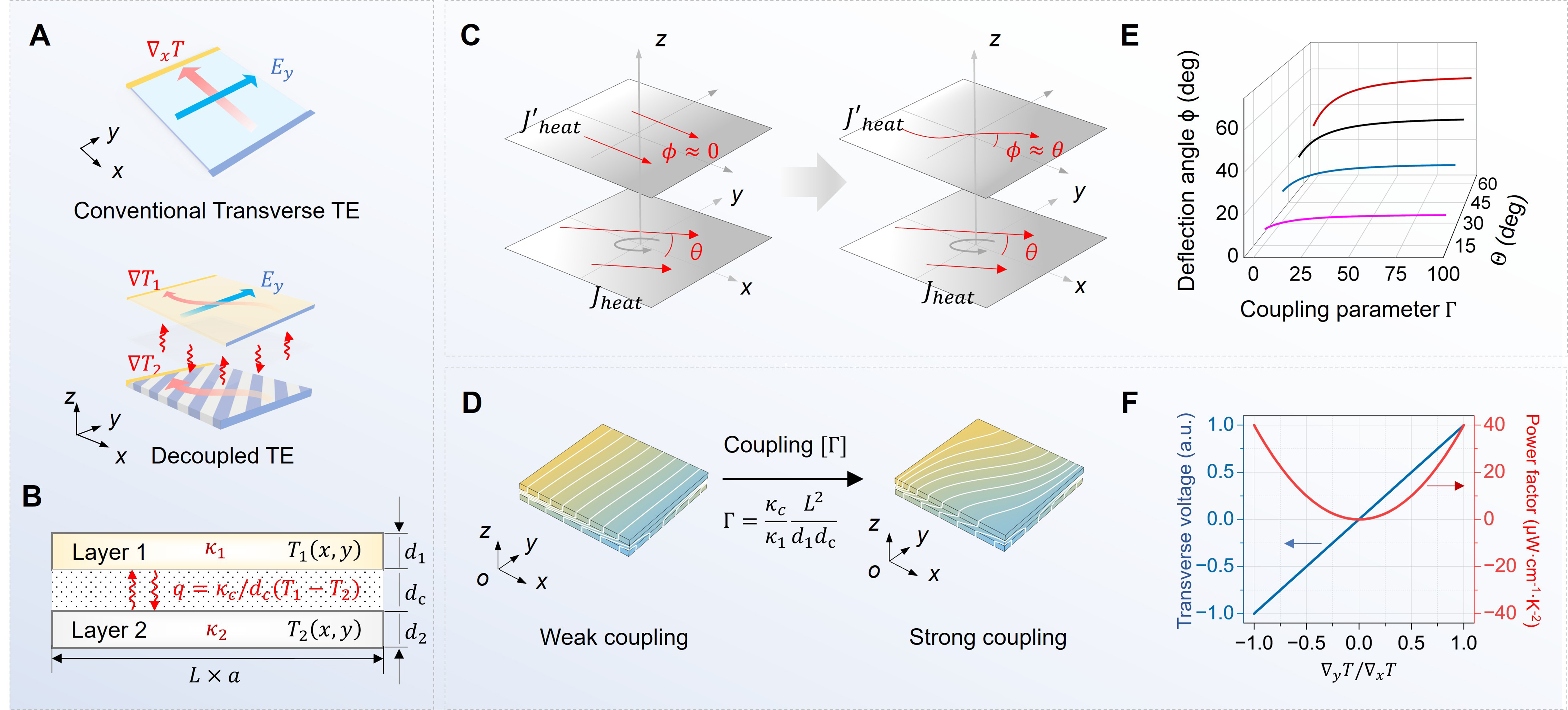
Figure 1. Principle of spatially decoupled transverse thermoelectric response. (A) Comparison between conventional transverse TE elements (top) and the proposed decoupled TE architecture (bottom); (B) Schematic of a two-layer thermal diffusion system model. The thermal conductivities and thicknesses of Layer 1 and Layer 2 are denoted as κ1, κ2 and d1, d2, with their corresponding temperature fields defined as T1, T2. A thermally coupled interlayer with equivalent thermal conductivity κc and thickness dc exists between the two layers; (C) Schematic illustration of the 3D thermal coupling mechanism: the lower layer with thermal deflection angle θ drives the upper layer to present continuously adjustable oblique angles that shift from ϕ = 0 to ϕ ≈ θ; (D) The effect of the dimensionless coupling parameter Γ =