




fig2
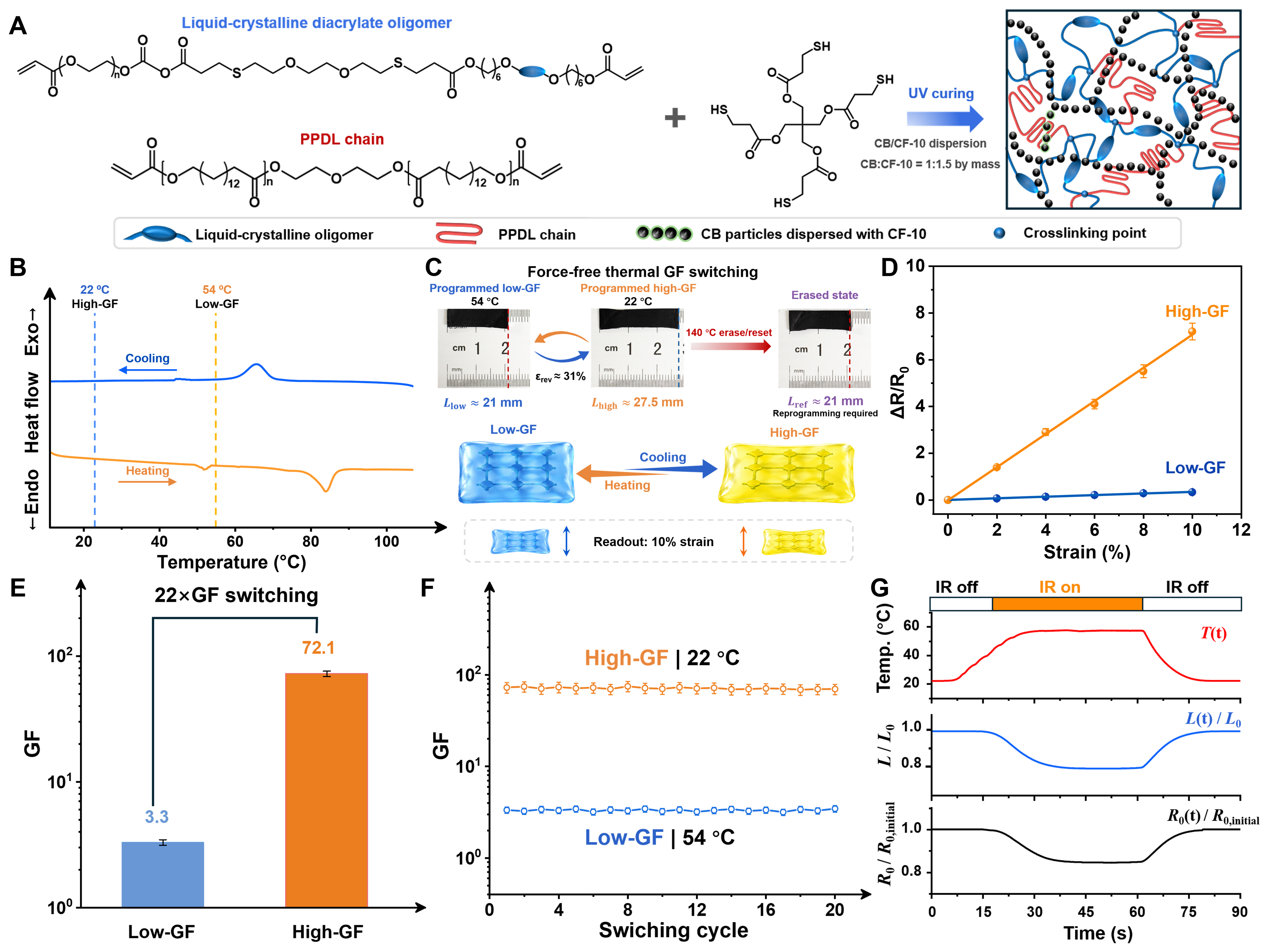
Figure 2. Single-pixel thermally switchable GF bit based on an rSMP/CB composite. (A) Material design of the programmed dual-phase rSMP/CB network containing the liquid-crystalline component, PPDL crystalline phase, and CB conductive fillers prepared with CF-10 as a dispersing additive; (B) DSC heating and cooling curves of the dual-phase network. The vertical dashed lines at 22 and 54 °C mark the representative high- and low-GF readout temperatures, respectively, rather than material phase-transition onset or peak temperatures. The operational GF-switching interval of approximately 45-54 °C was identified separately from temperature-dependent electromechanical measurements [Supplementary Figure 5]; (C) Reversible thermal switching of the programmed sensor between the contracted low-GF state at 54 °C and the elongated high-GF state at 22 °C after thermomechanical programming. The 50% pre-strain is applied only during programming, whereas the subsequent stress-free reversible actuation is approximately 31%. The approximately 21 mm length observed after the 140 °C erase/reset corresponds to the restored unprogrammed reference length of the photographed specimen. Although this length is numerically close to that of the programmed low-GF state at 54 °C, the two configurations represent physically different internal states: the programmed PPDL crystalline alignment is retained at 54 °C but erased at 140 °C, after which thermomechanical reprogramming is required to re-establish the switchable GF states; (D) ΔR/R0–strain responses of the sensor in the low- and high-GF states; (E) GF comparison between the two states; (F) Repeated thermal switching of the high- and low-GF states over the initial 20 heating–cooling cycles. Extended cycling behavior up to 50 cycles is provided in Supplementary Figure 6; (G) IR-triggered photothermal response and corresponding length change, demonstrating photothermal access to the low-GF state. Data in (E and F) are presented as the mean ± SD (n = 3 independently prepared sensors). The time-dependent traces in (G) are representative of three independently repeated measurements. GF: Gauge factor; rSMP: reversible shape-memory polymer; CB: carbon black; PPDL: poly(pentadecanolide); DSC: differential scanning calorimetry; IR: infrared; SD: standard deviation; UV: ultraviolet.