




fig1
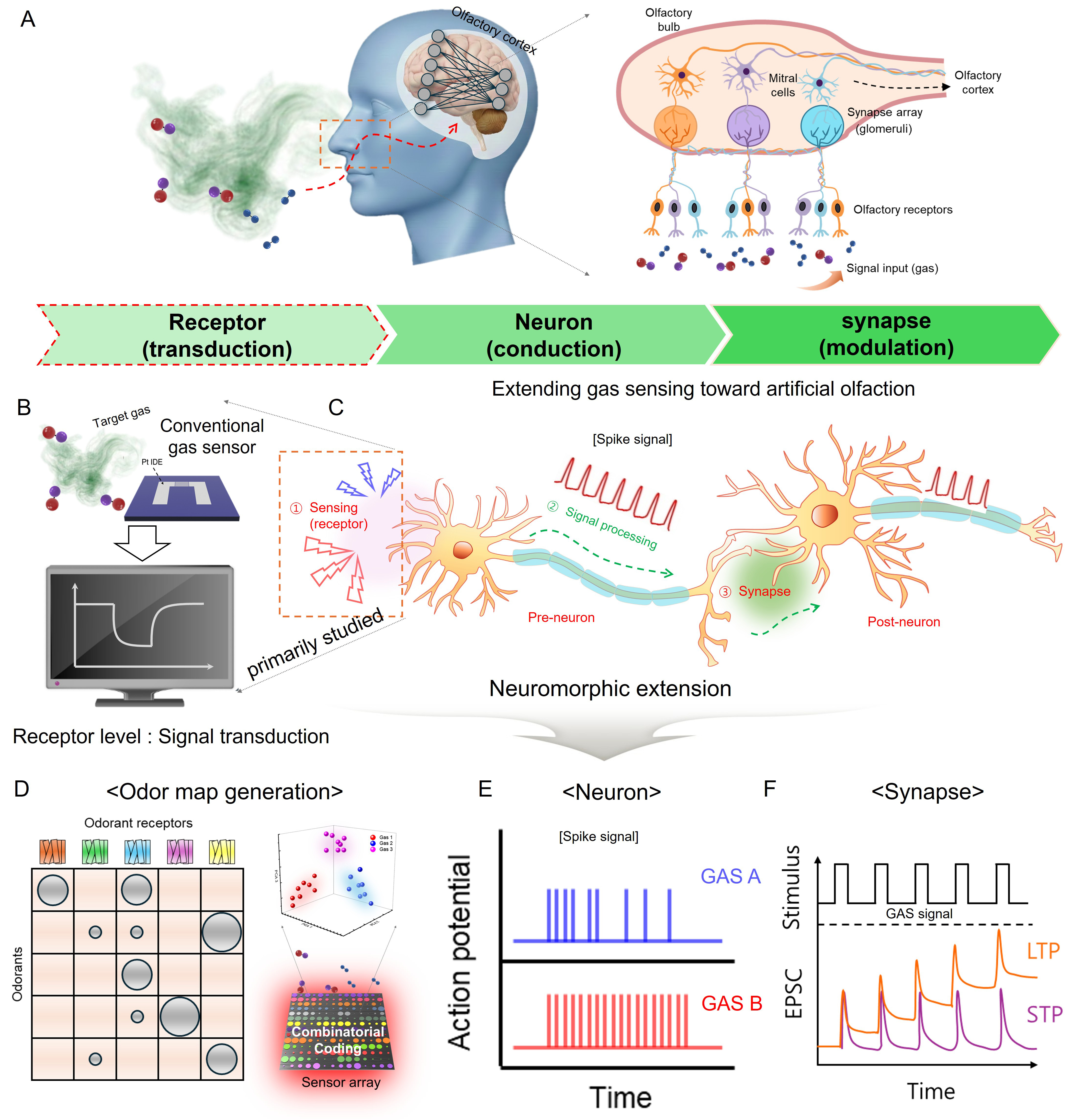
Figure 1. (A) Diagram of the biological olfactory system showing odorant receptors, signal transduction to glomeruli, and processing in the olfactory bulb; (B) Conventional gas sensor architecture emphasizing receptor-level signal transduction, where gas-induced resistance changes are mainly analyzed through steady-state electrical responses; (C) Neuromorphic extension of gas sensing through the integration of receptor-level sensing with neuron- and synapse-inspired spike processing; (D) Unique pattern generation through combinatorial coding, where different odorants activate distinct sets of receptors and generate characteristic response patterns; (E) Illustration of neuron-inspired signal encoding, in which different gas stimuli are represented by stimulus-dependent spike trains over time; (F) Illustration of synaptic weight modulation with stimulus frequency driving short term potentiation(STP) or long term potentiation(LTP). EPSC: Excitatory postsynaptic current.