


fig1
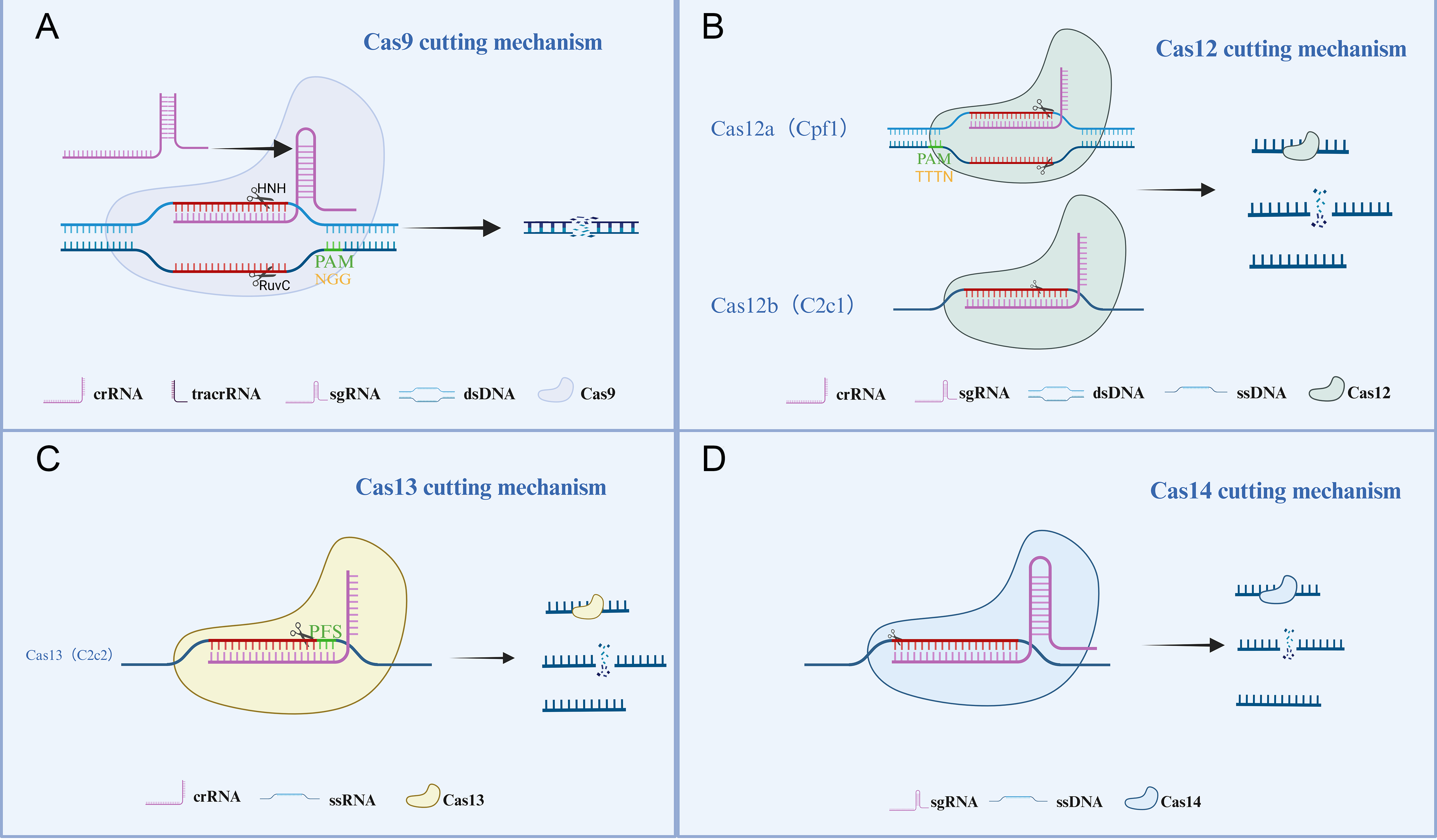
Figure 1. Mechanisms of cleavage action of various Cas enzymes. (A) Cas9 recognizes the PAM sequence (NGG) on dsDNA via sgRNA (crRNA:tracrRNA complex). The HNH and RuvC nuclease domains of Cas9 cleave the DNA strand complementary to the sgRNA and the opposite DNA strand, respectively, generating a site-specific dsDNA break. (B) Cas12a recognizes the PAM sequence (TTTV/TTTN) on dsDNA via crRNA; Cas12b targets ssDNA via sgRNA without requiring a PAM sequence. Their trans-cleavage activity is then activated, leading to the degradation of ssDNA reporters in the system. (C) Cas13 recognizes the 3'protospacer flanking site (PFS) on single-stranded RNA (ssRNA) via crRNA, which activates its trans-cleavage activity and subsequently degrades ssRNA reporters. (D) Cas14 targets ssDNA via sgRNA independently of a PAM sequence; its trans-cleavage activity is activated, resulting in degradation of ssDNA reporters.(Created in BioRender. Yan, S. (2026) https://BioRender.com/k9vp6hk).