

fig4
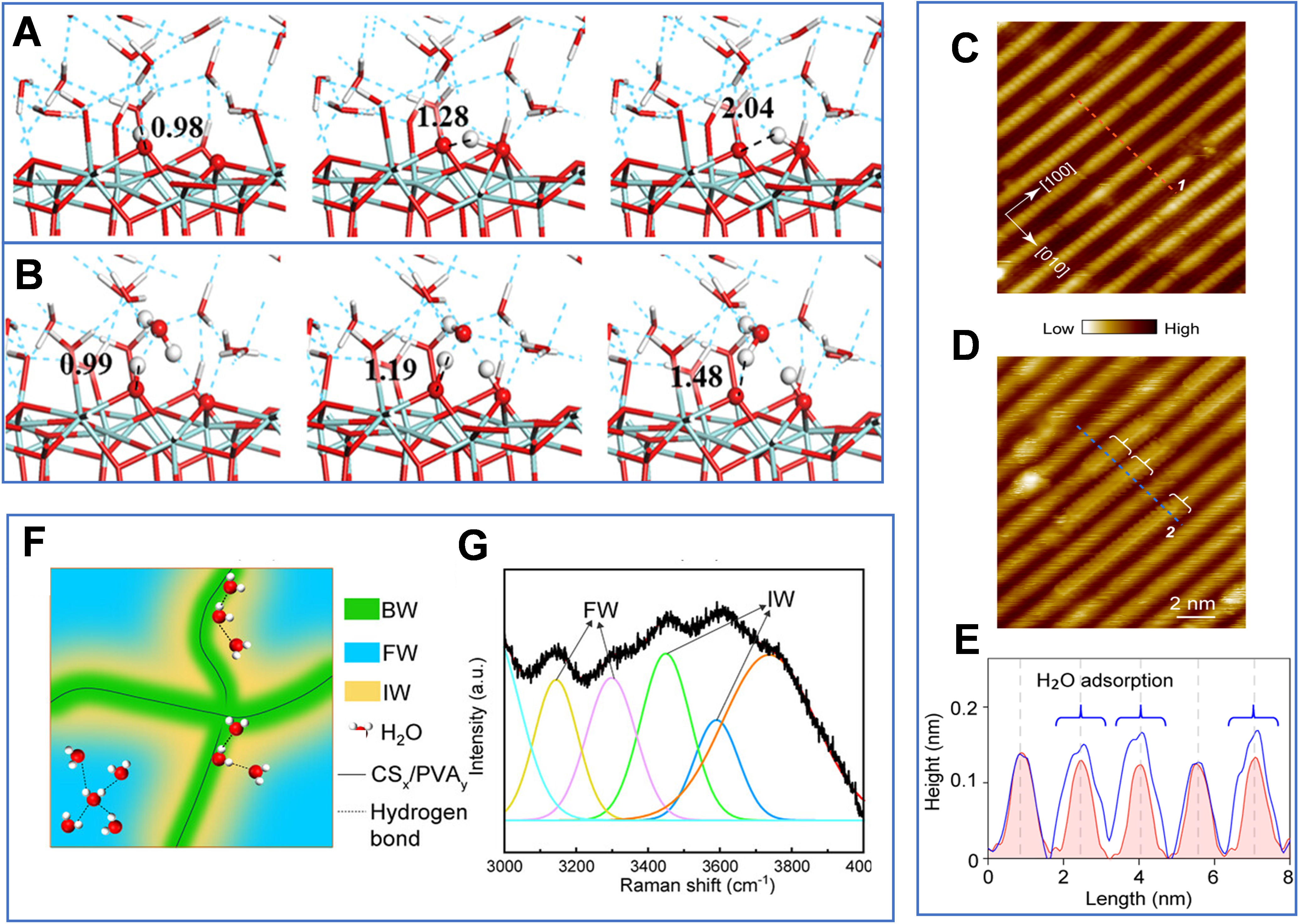
Figure 4. (A) Proton transfer between 2-fold coordinated oxygen (O2c) and 3-fold coordinated oxygen (O3c) sites on the ZrO2(111) surface in condensed water; (B) Proton transfer between O2c and O3c sites on ZrO2(111) mediated by the Grotthuss mechanism. (A and B) Ref.[57] Copyright © 2017 American Chemical Society; (C) Atomically resolved STM images of bare anatase TiO2(001)-(1 × 4) surfaces and water-covered surfaces (acquisition conditions: 1.0 V, 10 pA, 80 K); (D) STM image of the surface after water adsorption (acquisition conditions: 1.2 V, 10 pA, 80 K), where fuzzy stripes represent mobile H2O molecules, and brackets indicate assembled water molecule structures; (E) Line profiles extracted along the marked lines in the STM images of the bare (red) and water-covered (blue) surfaces, and structural diagrams of the H2O-OH monolayer; (C-E) Ref.[60] Copyright © 2022 American Chemical Society; (F) Schematic illustration of three water states and the distribution of water molecules in the hydrogel, including bond water, free water, and interfacial water; (G) Gaussian deconvolution of the O-H stretching band of water confined in the polymer. (F and G) Ref.[72] Copyright © 2025 Wiley-VCH GmbH. BW: Bound water; FW: free water; IW: intermediate water; PVA: poly(vinyl alcohol); STM: scanning tunneling microscopy.