
fig5
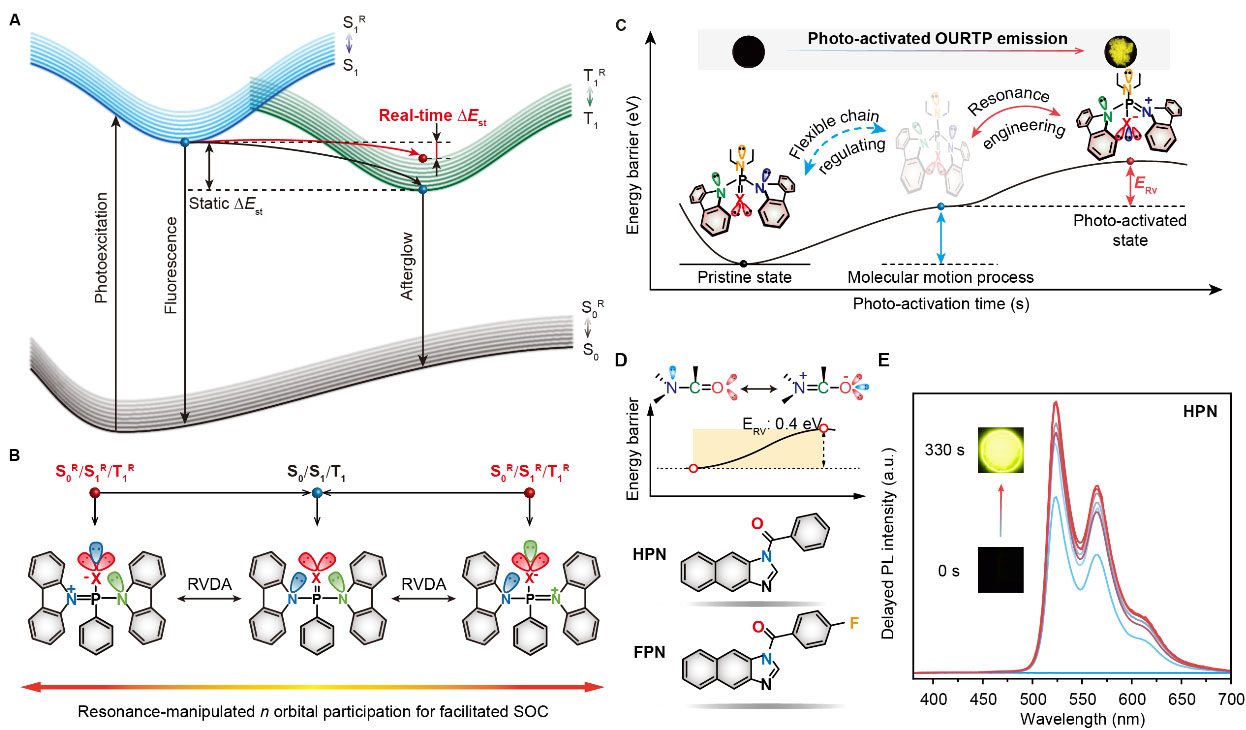
Figure 5. (A) Resonance-enhanced intersystem crossing (ISC) by reducing singlet-triplet splitting (ΔEST). Resonance variation induces shifts in the lowest singlet (S1) and triplet (T1) excited states, denoted as S1R and T1R; (B) Schematic illustration of the mechanism by which resonance variation manipulates n-orbital participation to enhance the SOC process. Figure 5A and B is adapted from Ref.[32] Copyright © 2018 WILEY; (C) Photoactivated mechanism mediated by chain flexibility and resonance modulation of DECzPO (X=O) and DECzPS (X=S); Figure 5C is adapted from Ref.[33] Copyright © 2022 American Chemical Society; (D and E) ΔERV values, molecular structures (D) and delayed PL spectra (E) of RVDA molecules HPN and FPN. Figure 5D and E is adapted from Ref.[34] Copyright © 2024 American Chemical Society. RVDA: Resonance variation-based dynamically adaptive; SOC: spin-orbit coupling.