

fig3

Hole transport layers regulate polaron formation in perovskite solar cells

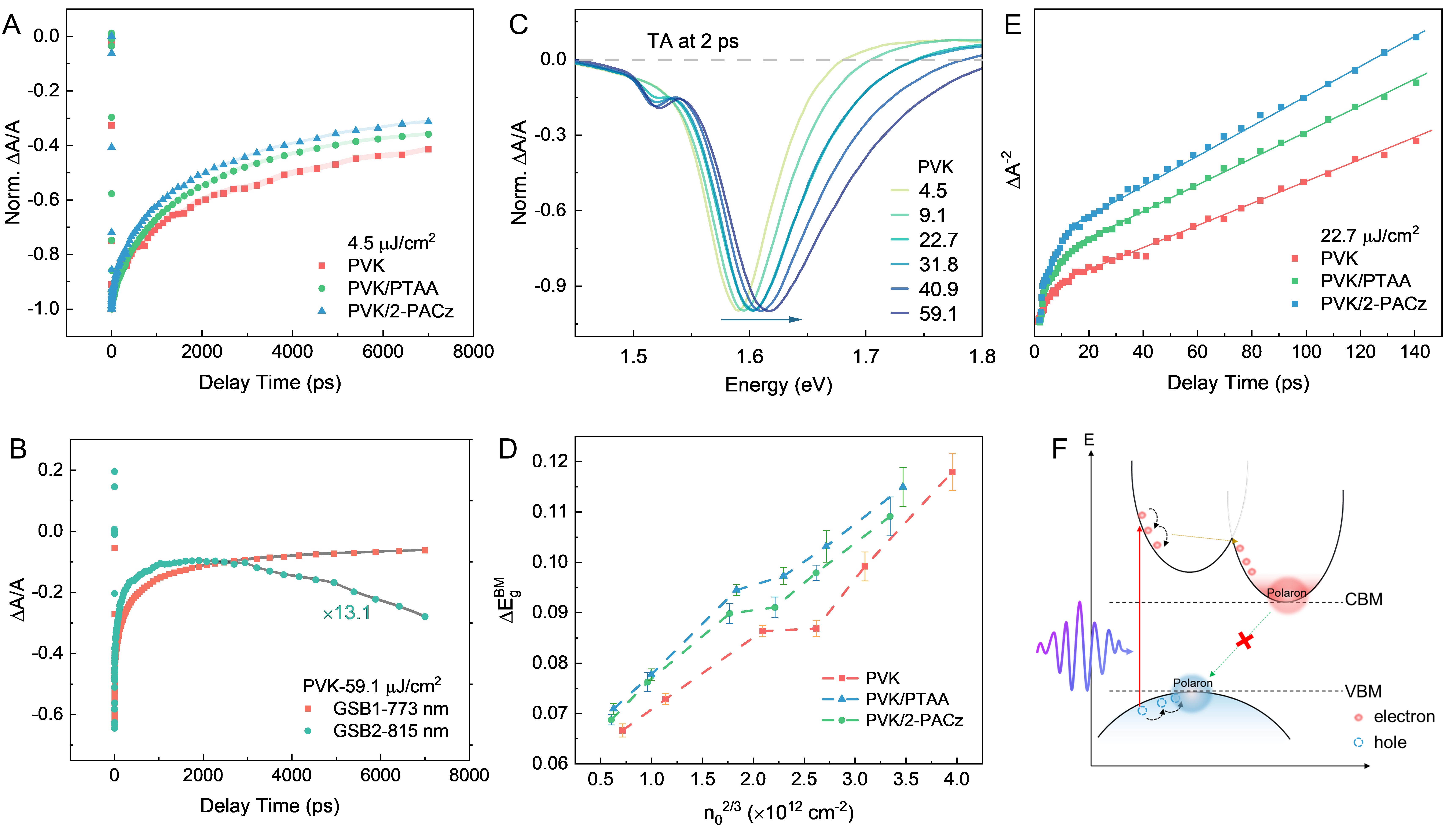
Figure 3. Influence of hole transport layer on ultrafast carrier dynamics. (A) Normalized fs-TA kinetics at the GSB1 position for the pristine PVK, PVK/PTAA, and PVK/2-PACz under 660 nm excitation at a fluence of 4.5 µJ/cm2; (B) TA kinetic curves of GSB1 and GSB2 for the pristine PVK film at a fluence of 59.1 µJ/cm2, where the GSB2 signal is scaled by a factor of 13.1 for clarity. Data points are represented by symbols, and the shaded colored regions indicate the standard error derived from three independent measurements performed at different locations on the same sample in both (A) and (B); (C) Normalized TA spectra of the pristine PVK at 2 ps for pump fluences ranging from 4.5 to 59.1 µJ/cm2; (D) Variation of $$ \Delta E_{g}^{B M} \\ $$ as a function of the 2/3 power of the excitation carrier density, extracted from TA spectra at 2 ps. Error bars represent the measurement variability across spatial positions on the same sample; (E) ΔA-2 as a function of delay time at GSB1 for pristine PVK, PVK/PTAA, and PVK/2-PACz at 22.7 µJ/cm2. The linear region after 15 ps indicates Auger recombination dominance; (F) Schematic illustration of carrier dynamics in perovskite under high carrier density excitation. PVK: Pristine perovskite; PTAA: Poly[bis(4-phenyl)(2,4,6-triMethylphenyl)aMine]; 2-PACz: [2-(9H-carbazol-9-yl)ethyl]phosphonic acid; TA: transient absorption; GSB: ground-state bleach; CBM: conduction band minimum; VBM: valence band maximum.