

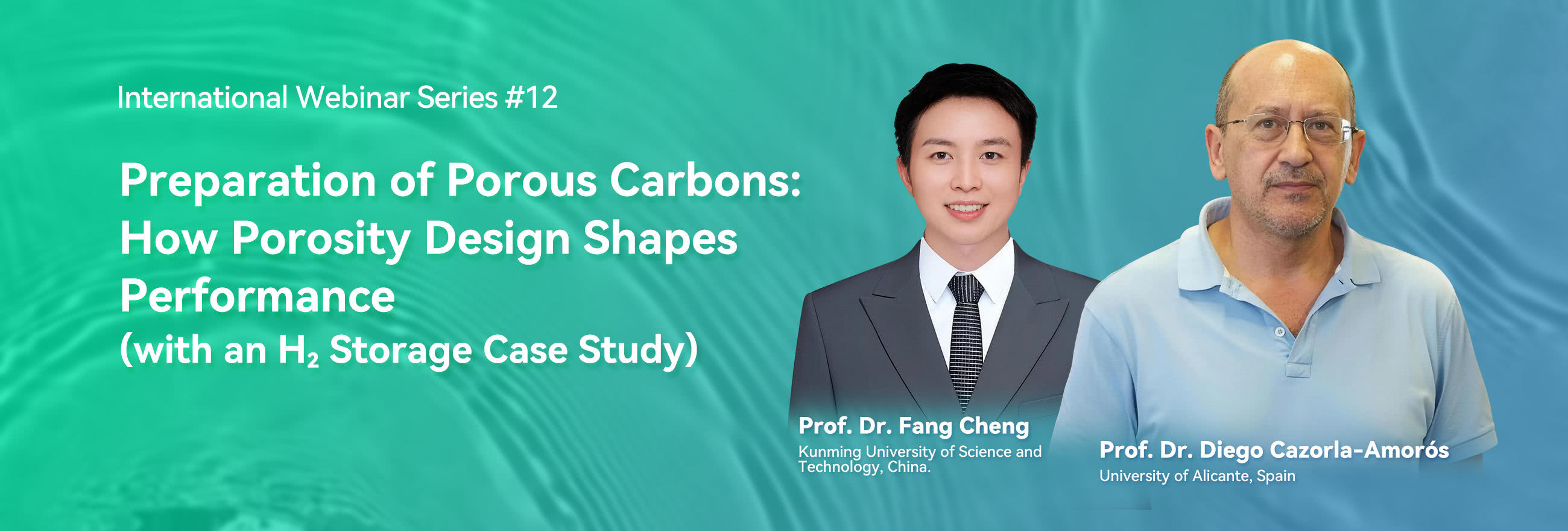
Preparation of Porous Carbons: How Porosity Design Shapes Performance (with an H₂ Storage Case Study)
Contents
Host
Prof. Dr. Fang Cheng
Dr. Fang Cheng received his Ph.D. from the School of Chemical Science and Technology, Yunnan University, in 2020, where he continued his postdoctoral research from 2020 to 2022. He is now a "Xingdian Talent Support Program" Young Talent of Yunnan Province, and also a Master's supervisor and a faculty member (recruited as high-level talent) at the School of Metallurgical and Energy Engineering, Kunming University of Science and Technology. As a core member of the National and Local Joint Engineering Research Center of Lithium-ion Batteries and Materials Preparation Technology, his research interest focuses on the design, preparation and application of high-performance electrochemical energy storage devices (e.g., supercapacitors, lithium metal batteries, and lithium-ion batteries, etc.) and their key materials (e.g., electrodes, functional electrolyte materials, and solid-state polymer electrolytes, etc.).
He has served as the Principal Investigator of three funded projects, including a grant from the National Natural Science Foundation of China (Regional Program), a Young Scholars Project of the Yunnan Fundamental Research Programs, and a Yunnan Postdoctoral Science and Technology Innovation Grant. He has also participated as a major contributor in several projects, including the Yunnan Provincial Major Science and Technology Special Program, the Yunling Program High-Level Innovation and Entrepreneurship Team Project, and the Yunnan Province - Kunming University of Science and Technology "Double First-Class" Key Program.
Over the past decade of research, he has published more than 20 high-level SCI papers as first or corresponding author in renowned international journals such as Nano-Micro Lett., Nano Energy, Energy Storage Mater., and J. Mater. Chem. A. He has been invited to author two chapters in English monographs. He serves as a Youth Editorial Board Member of Energy Materials and as a reviewer for journals including Adv. Energy Mater., Nano Energy, Nano Research and J. Energy Storage, etc. He has filed and been granted 12 invention patents, led the development of one industry standard issued by the Ministry of Industry and Information Technology (MIIT) of China (now in effect), and contributed to one volume in the national "14th Five-Year Plan" textbook series.
Speaker
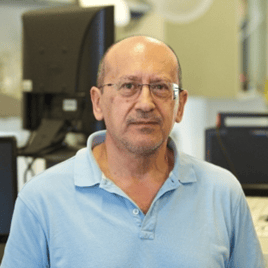
Prof. Dr. Diego Cazorla-Amorós
Topic: Preparation of Porous Carbons: How Porosity Design Shapes Performance (with an H₂ Storage Case Study)
Dr. Diego Cazorla-Amorós is Full Professor at the University of Alicante in Spain. He spent pre- and postdoctoral stays at the Université Claude Bernard (France), Tohoku University (Japan), University of Amsterdam, and Brown University (USA). He has been Head of the Materials Institute and Director of the Department of Inorganic Chemistry, both at the University of Alicante. He has also been President of the Spanish Carbon Group. He has published over 390 publications in peer reviewed journals and 18 patents (one of them led to a spin-off company and the technology for high pressure adsorption equipment was transferred to a multinational company). He has been advisor of 40 PhD Thesis. His research interests include the design of a wide range of materials and their use in energy storage and production and pollutant removal. He is also very much interested in the development and improvement of chemical technologies. He has received the 2025 European Carbon Association Award.