


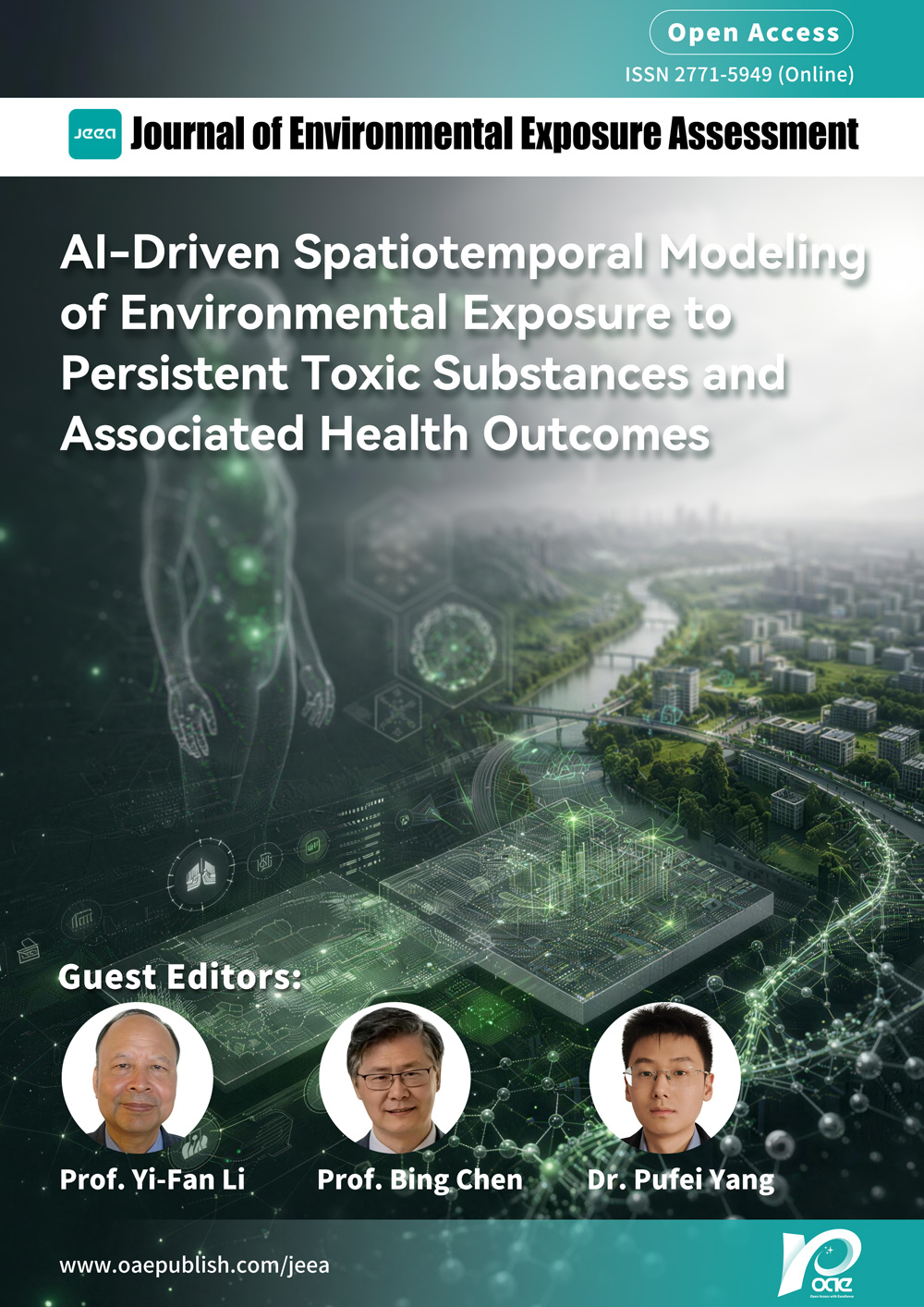
Topic: AI-Driven Spatiotemporal Modeling of Environmental Exposure to Persistent Toxic Substances and Associated Health Outcomes
A Special Topic of Journal of Environmental Exposure Assessment
ISSN 2771-5949 (Online)
Submission deadline: 19 Nov 2026
Guest Editors
Assistant Guest Editor
Special Topic Introduction
Persistent Toxic Substances (PTS), as a class of semi-volatile, bioaccumulative, and toxic substances (including POPs and other persistent toxic pollutants), pose severe threats to ecological security and human health. Due to their strong stability in the environment, PTS can accumulate in the food chain and enter the human body through multiple pathways, leading to a series of adverse health outcomes. The relationship between PTS exposure and health outcomes is complex, involving multiple factors and nonlinear interactions, which are difficult to accurately quantify using conventional statistical and dynamic models.
With the rapid development of artificial intelligence (AI) technologies (e.g., machine learning, deep learning, spatiotemporal neural networks) and the popularization of multi-source data (e.g., remote sensing imagery, environmental monitoring data, individual behavior data, health records), it has become feasible to construct high-precision, real-time, and individual-specific spatiotemporal models for PTS exposure assessment and health outcome prediction.
By bringing together interdisciplinary studies from environmental science, public health, data science, and AI, this Special Issue seeks to promote the development of comprehensive spatiotemporal modeling frameworks that overcome the shortcomings of traditional methods. Such research is not only of great theoretical significance for advancing the field of environmental health but also of critical practical value for enhancing PTS pollution risk management, protecting public health, and supporting the formulation of targeted, science-based environmental and health policies.
Keywords
Artificial intelligence (AI), model, persistent toxic substances (PTS), POPs, pollution exposure, human health
Submission Deadline
Submission Information
For Author Instructions, please refer to https://www.oaepublish.com/jeea/author_instructions
For Online Submission, please login at https://www.oaecenter.com/login?JournalId=jeea&IssueId=jeea26051910467
Submission Deadline: 19 Nov 2026
Contacts: Tracy Duan, Assistant Editor, Tracy@jeeajournal.net