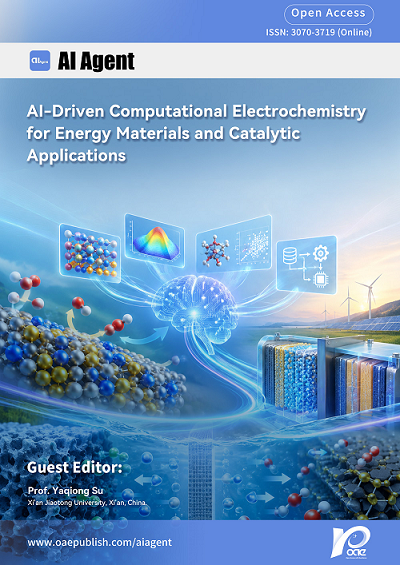
Topic: AI-Driven Computational Electrochemistry for Energy Materials and Catalytic Applications
Guest Editor
Special Topic Introduction
The urgent transition toward sustainable energy systems demands accelerated discovery and rational design of advanced materials for electrochemical energy conversion and storage. However, conventional computational electrochemistry workflows, rooted in first-principles calculations and microkinetic modeling, remain computationally intensive, limiting their throughput for exploring vast chemical spaces.
Recent advances in artificial intelligence (AI), particularly machine learning potentials, deep generative models, and active learning strategies, are transforming this landscape. This special issue aims to showcase cutting-edge research at the intersection of AI and computational electrochemistry, focusing on energy materials (e.g., batteries, fuel cells, electrolyzers) and catalytic applications (e.g., oxygen reduction, CO₂ reduction, nitrogen fixation).
Topics of interest include, but are not limited to:
Topics include AI-accelerated electronic structure calculations, data-driven prediction of electrochemical stability and activity descriptors, generative design of novel electrocatalysts, and autonomous workflows for high-throughput screening.
We welcome original research, reviews, and perspectives that demonstrate how AI can bridge atomic-scale insights with device-level performance, enabling inverse design and closed-loop optimization. By uniting computational chemists, materials scientists, and AI researchers, this issue seeks to define emerging paradigms that dramatically shorten the discovery cycle for next-generation electrochemical technologies.
Keywords
Artificial intelligence, energy materials, computational electrochemistry, autonomous workflows, electrolytes, molecular dynamics
Submission Deadline
Submission Information
For Author Instructions, please refer to https://www.oaepublish.com/aiagent/author_instructions
For Online Submission, please login at https://www.oaecenter.com/login?JournalId=aiagent&IssueId=aiagent26101310647
Submission Deadline: 30 Jun 2027
Contacts: Margie Ma, Managing Editor, margie@oaepublish.com; Jocelyn Xue, Editor, Jocelyn@oae-publish.com