




From tactile sensing to mechanical perception: a route towards perceptive materials
 0
0 
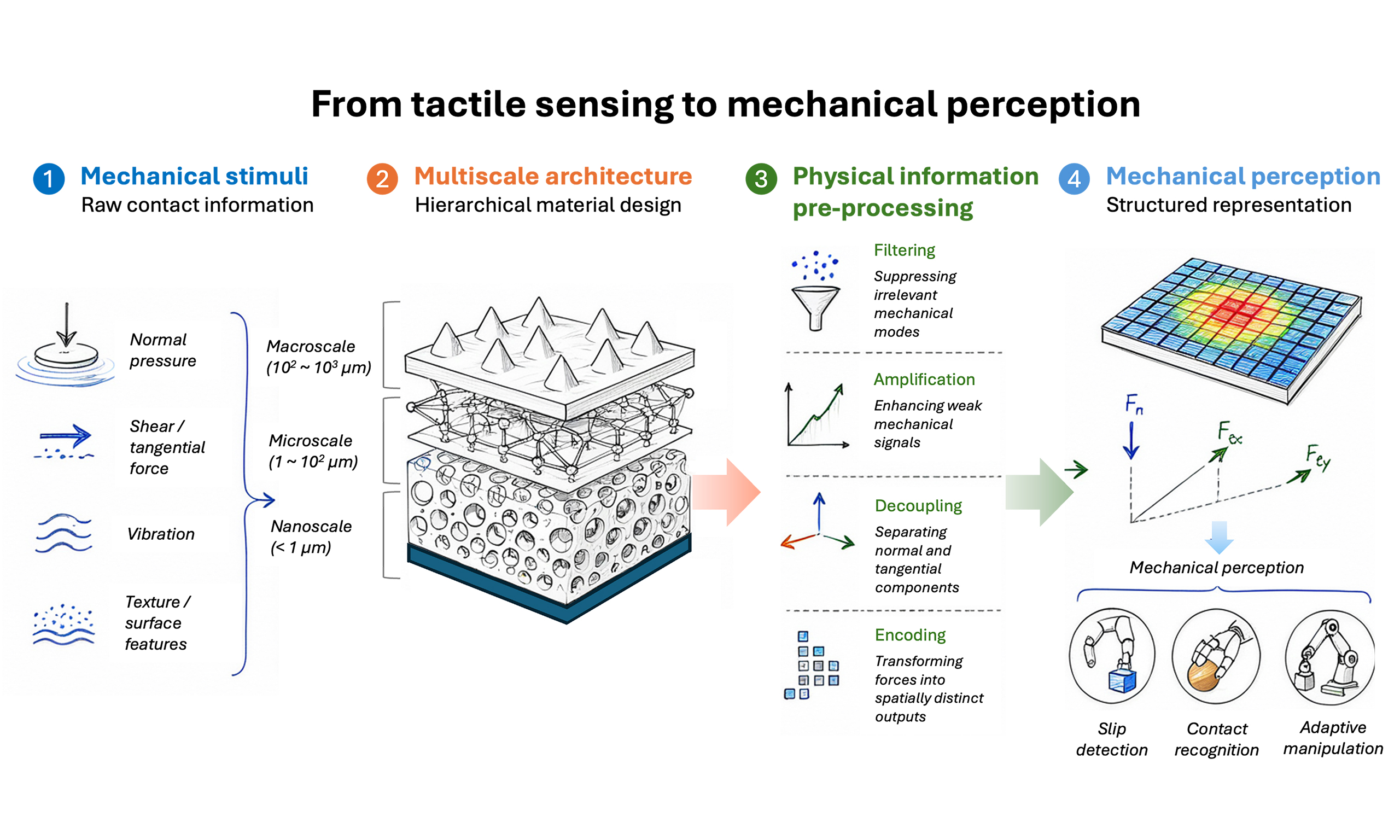
For decades, the development of tactile electronics has been driven by a straightforward objective: measure mechanical stimuli with ever-increasing sensitivity, resolution and robustness. From flexible pressure sensors to electronic skins and robotic fingertips, remarkable progress has been made in reproducing aspects of the human sense of touch[1]. Yet biological skin is far more than a force transducer. Through a hierarchy of structures extending from epidermal ridges and dermal microarchitectures to specialised mechanoreceptors and neural circuits, it selectively filters, distributes, amplifies and encodes mechanical information before it reaches the brain[2,3]. Rather than relying on a single sensing mechanism, biological tactile perception emerges from the coordinated action of multiple physical structures operating across different length scales. The challenge for next-generation tactile technologies is therefore not only to detect forces, but also to emulate the physical mechanisms that transform forces into meaningful information[4]. Here, tactile sensing evolves from the pure physical transduction of mechanical stimuli into measurable electrical signals towards mechanical signal preprocessing, where the mechanical stimuli are filtered, amplified or redistributed by the material architecture itself, towards mechanical perception, whereby the physically encoded information supports directly the interpretation of contact states and interactions, hence reducing the computational burden on downstream algorithms.
Recent advances in biomimetic tactile interfaces have demonstrated how mechanical architectures inspired by fingerprints, mechanoreceptors and skin microrelief can selectively amplify specific classes of biomechanical signals while suppressing others[5]. Similarly, biomimetic metamaterial interfaces have shown that heterogeneous mechanical responses can be engineered to selectively capture and decode distinct mechanodermal activities associated with physiological and behavioural states[6]. These studies suggest that the future of intelligent sensing may lie not in increasing the amount of information collected, but in improving how information is physically encoded before computation begins.
In the Nature Materials article titled “Multiscale-structured miniaturized 3D force sensors”, Yun, Hasan and colleagues present an elegant example of this principle by demonstrating a multiscale-structured graphene-liquid metal tactile sensor capable of highly sensitive three-dimensional force sensing, directional discrimination and slip detection[7]. Their device combines anisotropic conductive particle networks, microporous architectures and epidermis-inspired pyramidal microstructures to achieve exceptional force sensitivity while accurately decoupling normal and tangential force components. More importantly, the work illustrates a broader transition from sensors that simply transduce mechanical stimuli toward materials that actively preprocess and structure information before it reaches downstream electronics. Whereas biological skin inherently combines mechanical filtering, amplification, directional decoupling and neural encoding, most existing electronic skins primarily perform signal transduction and rely on external algorithms for interpretation. Engineered perceptive materials occupy an intermediate position, embedding part of this processing directly within their mechanical design so that filtering, force decoupling and information encoding occur physically before computation.
Similar to the hierarchical structure of human skin, the device reported by Yun, Hasan and colleagues integrates several complementary architectural elements[7]. Aligned nickel particle chains provide anisotropic electrical pathways, few-layer graphene nanosheets bridge conductive networks, liquid-metal droplets create deformable conductive junctions, and microporous elastomers enhance sensitivity through controlled deformation. These are further combined with epidermis-inspired pyramidal geometries that concentrate stress and enable force-direction discrimination. These structures not only improve sensitivity but also perform specific information-processing functions, so the material itself becomes part of the computational pipeline. The anisotropic conductive network suppresses interference from lateral deformation while selectively amplifying force responses along preferred directions. The microporous architecture redistributes strain and enhances pressure sensitivity. The pyramidal geometry transforms complex three-dimensional forces into spatially distinct electrical outputs that can be directly related to normal and tangential force components. As a result, force decoupling emerges from the physical architecture of the material rather than being performed exclusively through downstream computational algorithms, achieving force sensitivities of 110 kPa-1 over a 500 kPa linear range and accurate decoupling of normal and tangential forces, enabling reliable slip detection.
Such ideas resonate strongly with emerging concepts of physical intelligence, embodied intelligence and morphological computation. In these frameworks, functionality is distributed across materials, structures and algorithms rather than residing solely in software. Biological systems provide numerous examples of this principle. Spider webs perform mechanical signal filtering before sensory detection. Cochlear structures mechanically separate acoustic frequencies before neural processing. Intelligence, in these cases, begins within the material substrate, which becomes a perceptive material: an engineered material system that physically transforms external stimuli into structured representations that directly facilitate interpretation by downstream electronics or decision-making algorithms.
Viewed from this perspective, the work of Yun, Hasan and colleagues represents an important step towards mechanically perceptive systems[7]. Their multiscale architecture effectively transforms force magnitude, direction and contact dynamics into a structured representation that can be directly interpreted by downstream electronics, performing an initial stage of perception through its geometry and internal organization.
The implications extend beyond robotic manipulation. Future perceptive materials may increasingly integrate mechanical sensing with optical, thermal, electromagnetic and even chemical transduction pathways, enabling multimodal perception through complementary physical mechanisms. As the field moves from tactile sensing towards tactile perception, such approaches may provide a blueprint for future generations of biomimetic electronic skin, intelligent robotics and perceptive materials capable of physically participating in the interpretation of their environment. By reducing the burden on external computation, such approaches may enable faster, more energy-efficient and more adaptive interactions with the physical world. Related concepts also emerge in photonic sensing, where physics-enabled signal amplification mechanisms, including photonic spin Hall effect-based devices, enable enhanced sensitivity and multifunctional sensing through engineered light–matter interactions[8].
Despite these advances, important engineering challenges remain before widespread deployment becomes feasible. Multiscale architectures must maintain stable performance under repeated loading, while minimizing hysteresis, mechanical fatigue, drift, calibration instability and crosstalk between sensing modes. Scalable manufacturing and long-term reliability will therefore remain critical research directions alongside sensing performance under different real-life conditions.
DECLARATIONS
Authors’ contributions
The author contributed solely to the article.
Availability of data and materials
Not applicable.
AI and AI-assisted tools statement
Not applicable.
Financial support and sponsorship
None.
Conflicts of interest
Occhipinti, L. G. is Editorial Board Member of the journal Soft Science. He was not involved in any steps of editorial processing, notably including reviewers’ selection, manuscript handling and decision making.
Ethical approval and consent to participate
Not applicable.
Consent for publication
Not applicable.
Copyright
© The Author(s) 2026.
REFERENCES
1. Yao, Z.; Wu, W.; Gao, F.; et al. Flexible tactile sensing systems: challenges in theoretical research transferring to practical applications. Nanomicro. Lett. 2025, 18, 37.
2. Lumpkin, E. A.; Caterina, M. J. Mechanisms of sensory transduction in the skin. Nature 2007, 445, 858-65.
4. Liu, Z.; Hu, X.; Bo, R.; et al. A three-dimensionally architected electronic skin mimicking human mechanosensation. Science 2024, 384, 987-94.
5. Xu, M.; Zhang, J.; Dong, C.; et al. Simultaneous isotropic omnidirectional hypersensitive strain sensing and deep learning-assisted direction recognition in a biomimetic stretchable device. Adv. Mater. 2025, 37, e2420322.
6. Xu, M.; Zhang, J.; Dong, C.; et al. Biomimetic metamaterial-based interface for decoding heterogeneous mechanodermal activity. Sci. Adv. 2026, 12, eaee2625.
7. Yun, G.; Chen, Z.; Chen, Z.; et al. Multiscale-structured miniaturized 3D force sensors. Nat. Mater. 2026, 25, 1011-9.
Cite This Article
 Open Access
How to Cite
Download Citation
Export Citation File:
Type of Import
Tips on Downloading Citation
Citation Manager File Format
Type of Import
Direct Import: When the Direct Import option is selected (the default state), a dialogue box will give you the option to Save or Open the downloaded citation data. Choosing Open will either launch your citation manager or give you a choice of applications with which to use the metadata. The Save option saves the file locally for later use.
Indirect Import: When the Indirect Import option is selected, the metadata is displayed and may be copied and pasted as needed.
About This Article
Copyright

Data & Comments
Data
0











Comments
Comments must be written in English. Spam, offensive content, impersonation, and private information will not be permitted. If any comment is reported and identified as inappropriate content by OAE staff, the comment will be removed without notice. If you have any queries or need any help, please contact us at support@oaepublish.com.