




Topological insulator modified nickel oxide nanoflowers for low-temperature hydrogen sulfide gas sensing
 0
0 Abstract
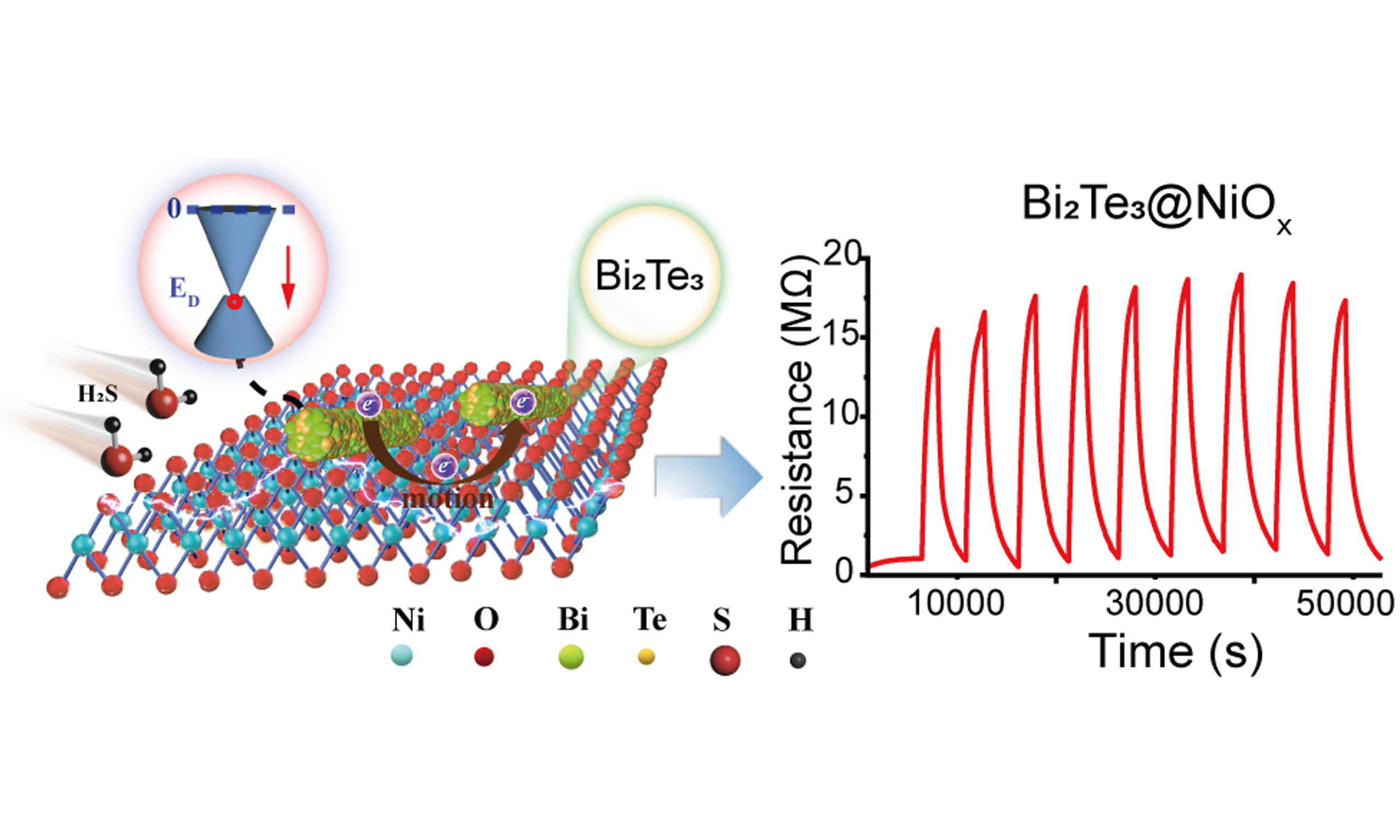
Developing low-cost, highly responsive low-temperature H2S sensors is critical due to rising air pollution, as well as the high energy consumption and safety risks associated with conventional semiconductor sensors. Non-stoichiometric NiOx offers enhanced carrier concentration and active sites via nickel vacancies, thereby improving low-temperature sensitivity. Composite sensors were fabricated by incorporating various mass fractions of the topological insulator Bi2Te3 into NiOx. The 10% Bi2Te3@NiOx sensor delivered the best performance [11.81 response to 10 ppm H2S at 90 °C, 30% relative humidity (RH)], surpassing most reported H2S sensors. Its sensitivity is attributed to enhanced carrier mobility and Bi2Te3 Dirac point shift upon H2S physisorption. With excellent H2S selectivity and stability, this composite offers a safer, energy-efficient, low-temperature alternative to high-temperature sensors.
Keywords
INTRODUCTION
Modern industrialization has improved convenience but worsened air quality. Hydrogen sulfide (H2S), a toxic reducing agent that smells of rotten eggs, threatens both the environment and public health. Semiconductor-based gas sensors have drawn significant interest, with performance enhanced via heterojunction construction[1], element doping[2], and morphology modification[3]. However, these sensors typically require high operating temperatures (200-400 °C) for optimal sensitivity. Given the diffusivity and explosivity of H2S in air, high-temperature operation poses safety risks. Heating consumes substantial energy, shortens sensor lifespan, and degrades performance. Thus, low-cost, highly responsive H2S sensors operable at low temperatures are urgently needed.
As a p-type semiconductor, NiO offers high thermochemical stability and favorable electrochemistry, making it a preferred sensing material for CO, NO2, and H2 detection[4-6]. However, NiO-based H2S sensors are seldom documented. Notable examples include NiO thin films on Ni foil fabricated via thermal evaporation[7] and NiO nanoparticles (7-50 nm) prepared via chemical co-precipitation[8]. Most existing H2S sensors, however, require high-temperature operation, including post-growth of metal oxide particles, compromising stability and durability and elevating fire risk in flammable-gas environments. Low-temperature NiO-based H2S sensors are therefore imperative.
Defect concentration critically influences semiconductor properties[9]; specifically, the carrier concentration in the sensitive layer is critical for gas sensitivity. In non-stoichiometric NiOx, nickel vacancies at cation sites increase both active sites and carrier concentration, enhancing H2S sensitivity, as recent studies confirm. Mokoena et al. synthesized p-type NiO nanostructures with abundant nickel vacancies via co-precipitation, achieving exceptional H2S selectivity at operating temperatures[10]. Amu-Darko et al. reported flower-like ZnO-NiO sensors with high sensitivity, selectivity, and stability toward H2S gas at an optimal temperature of 250 °C[11]. These studies underscore the superior H2S sensitivity of non-stoichiometric NiOx-based sensors toward reducing gases.
As a topological insulator, Bi2Te3 features an insulating bulk with metallic conductive surfaces[12,13]. Strong spin-orbit coupling generates topologically protected surface states that suppress defect-induced electron backscattering and lower surface resistivity[14,15]. These time-reversal symmetry-protected states enhance surface carrier concentration and amplify reactive sites for H2S interaction. Gas adsorption modulates the Dirac point energy of topological insulators, with reducing gases acting as n-type dopants[16] and oxidizing gases as p-type dopants[15]. For Bi2Te3, n-type doping from H2S lowers the Dirac point, facilitating charge transfer and larger resistance changes, thereby enhancing the sensing response. This makes Bi2Te3@NiOx heterojunctions highly promising for H2S detection.
Non-stoichiometric NiOx nanoparticles were synthesized via chemical co-precipitation, and Bi2Te3 nanoparticles via hydrothermal synthesis. Composites with Bi2Te3 0, 1, 5, 10, and 15 wt% relative to NiOx were fabricated and drop-cast onto substrates for gas sensor fabrication. To identify the optimal Bi2Te3 loading, gas-sensing performance was evaluated via dynamic resistance changes to H2S at 90 °C and 30% relative humidity (RH). The 10 wt% Bi2Te3@NiOx sensor yielded the highest response (11.81 to 10 ppm H2S), substantially outperforming other compositions, while also exhibiting strong selectivity and excellent stability.
MATERIALS AND METHODS
Synthesis of non-stoichiometric NiOx
NiOx nanoparticles were synthesized via chemical co-precipitation. First, 0.125 mol of Ni(NO3)2•6H2O was dissolved in 25 mL of deionized water and stirred for 30 min to obtain a dark green transparent solution. A 10 mol L-1 KOH solution was added dropwise to the solution until the pH reached 10. After another 30 min of stirring, the bright green turbid solution was centrifuged and washed three times with deionized water at 1,500 rpm. The precipitate was redispersed in water, dried at 80 °C for 8 h, ground and sieved through a 300-mesh screen to yield Ni(OH)2 nanopowder. This powder was calcined at 240 °C for 2 h to yield black NiOx nanoparticles (top row, Supplementary Figure 1).
Synthesis of Bi2Te3
Bi2Te3 nanoparticles were synthesized hydrothermally. First, 0.96 g of polyvinyl pyrrolidone (PVP) was dissolved in 42 mL of ethylene glycol under stirring for 30 min. Subsequently, 1.18 mmol of Bi2O3 and 3.6 mmol of TeO2 were introduced and stirred for another 45 min, followed by the addition of 6 mL of 4 mol NaOH solution, yielding a yellow suspension after stirring at 300 rpm at 25 °C for 30 min. This suspension was transferred to a hydrothermal reactor and kept at 200 °C for 4 h. After natural cooling, the product was centrifuged with ethanol at 2,000 rpm for 4 min; this process was repeated three times to ensure purity. The product was then dispersed in ethanol, vacuum-dried at 60 °C for 8 h, ground, and sieved through a 250-mesh sieve to obtain a grayish-black Bi2Te3 nanopowder.
Fabrication and measurement of gas sensor
Bi2Te3 nanopowder was mixed with NiOx nanopowder at mass fractions of 0, 1, 5, 10, and 15 wt%. The mixtures were dispersed in solution at 20 mg/mL and ultrasonicated for 30 min. NiOx sensors with varying Bi2Te3 doping levels were fabricated by drop-casting the respective dispersions onto the sensor chip using disposable syringes. The resulting sensors were labeled as 1%, 5%, 10%, and 15% Bi2Te3@NiOx sensors.
Supplementary Figure 1 (bottom) presents the sensor testing system, in which the micro-electro-mechanical systems (MEMS) chip is wired to a four-pin in-line socket base for performance evaluation. The prepared powder was weighed, mixed with anhydrous ethanol, and sonicated to form a uniform dispersion, which was then drop-cast onto the MEMS chips using a syringe. The coated MEMS devices were placed in an eight-channel test chamber for simultaneous testing of up to eight chips. The chamber included temperature and humidity sensors, with an external direct current power supply driving the test electrodes. Heating was regulated via a wireless-controlled module, and output signals were processed by dedicated software and transmitted wirelessly to a computer for real-time data monitoring. The computer terminal automatically adjusted multiple mass flow controllers according to preset gas parameters to maintain stable target gas concentration. Relative humidity was regulated by passing dry air through a humidity generator [Supplementary Figure 1]. Sensor response to reducing gases is defined as the ratio of resistance in the target gas to that in air, and inversely for oxidizing gases. Response time is the duration required to reach 90% of the response value, while recovery time is the time needed to return to 10% of the response value.
Characterizations
The crystal structures of NiOx and Bi2Te3@NiOx were analyzed via wide-range X-ray diffraction (XRD) patterns (Bruker D8 ADVANCE) using Cu Kα radiation at 40 kV and 40 mA with θ-2θ scans from 20° to 70°. Surface morphology and microstructure were conducted using a ZEISS GeminiSEM 300 field emission scanning electron microscope (SEM). SEM imaging was performed at 10 kV and 100,000× magnification. Transmission electron microscopy (TEM) analysis was executed on a Talos F200X instrument (Thermo Fisher) at 200 kV. Carrier mobility was measured using an HMS-7000 Optical Hall Effect tester (Ecopia). Electrochemical impedance spectroscopy (EIS) and photocurrent intensity response measurements were carried out on a CHI660E electrochemical workstation using a three-electrode system. Test samples were coated onto clean fluorinated tin oxide glass as the working electrode, with a platinum plate as the counter electrode and a silver/silver chloride (Ag/AgCl) electrode as the reference. The Brunauer-Emmett-Teller (BET) specific surface areas were determined from nitrogen adsorption isotherms using a Micromeritics Accelerated Surface Area and Porosimetry 2460 instrument.
RESULTS AND DISCUSSION
Microstructure and electronic properties
Powdered specimens were characterized by XRD. Figure 1A presents the XRD patterns for NiOx and 10% Bi2Te3/NiOx. Three distinct diffraction peaks appear at 2θ = 37.1°, 43.2°, and 62.5°, corresponding to the (111), (200), and (220) planes of cubic NiOx, consistent with the reference values from the standard card (JCPDS No. 4-0835). In the XRD pattern of the 10% Bi2Te3/NiOx heterojunction, diffraction peaks appearing at 2θ = 27.6°, 41.2°, 50.2°, 57.1°, and 66.9° correspond to the (015), (110), (205), (0210), and (125) planes of trigonal Bi2Te3 (JCPDS 82-0358), confirming the coexistence of both phases in the heterojunction. Notably, only NiOx and Bi2Te3 diffraction peaks were observed, with no impurity phases detected, confirming the successful synthesis of the heterojunction.
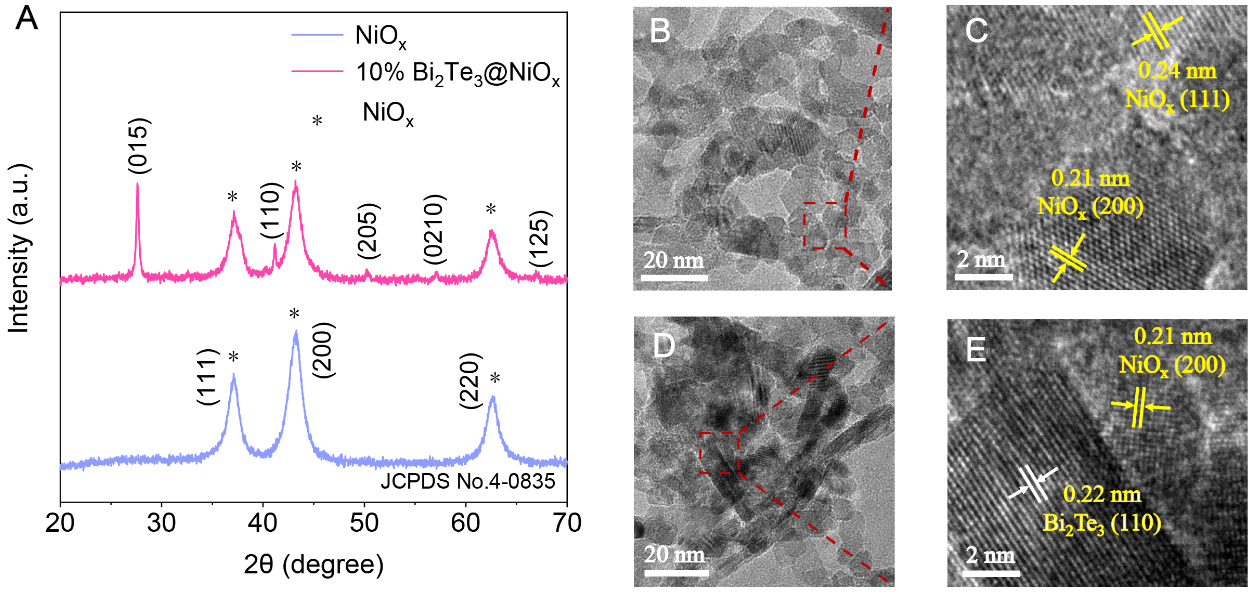
Figure 1. (A) XRD patterns of NiOx and 10% Bi2Te3@NiOx, (B) TEM image of NiOx, (C) HRTEM micrographs of NiOx, (D) TEM image of 10% Bi2Te3@NiOx, and (E) HRTEM micrographs of 10% Bi2Te3@NiOx. XRD: X-ray diffraction; TEM: transmission electron microscopy; HRTEM: high-resolution TEM.
TEM analysis was conducted on NiOx and 10% Bi2Te3@NiOx. Figure 1B reveals uniformly dispersed NiOx nanoparticles with grain sizes of 10-22 nm. The high-resolution TEM (HRTEM) image in Figure 1C (corresponding to the red-boxed area in Figure 1B) reveals crystal lattice spacings of 0.21 and 0.24 nm, corresponding to the (200) and (111) planes of NiOx, respectively. The TEM image in Figure 1D confirms the integration of Bi2Te3 nanorods with NiOx nanoparticles in the 10% composite. The HRTEM image in Figure 1E illustrates a 0.22 nm lattice fringe assigned to Bi2Te3 (110), in contact with the NiOx (200) plane, revealing the heterojunction microstructure of the 10% composite.
SEM images [Figure 2A] illustrate pristine NiOx as flower-like aggregates of interconnected nanosheets, while energy-dispersive X-ray spectroscopy (EDS) mapping [Figure 2B] confirms uniform Ni distribution, indicating compositional homogeneity of the NiOx scaffold. After Bi2Te3 introduction, the 10% Bi2Te3@NiOx composite presents a distinctly different morphology. Figure 2C presents rod-shaped Bi2Te3 nanostructures (indicated by the yellow dashed boxes) dispersedly anchored onto NiOx nanoflower surfaces. EDS Ni mapping [Figure 2D] reveals uniform Ni distribution in NiOx regions, while Bi2Te3 nanorods appear as Ni-free dark-contrast areas. EDS mappings for Bi [Figure 2E] and Te [Figure 2F] reveal that both elements are predominantly concentrated in the nanorod regions, matching the dark areas observed in the Ni map. EDS spectrum [Supplementary Figure 2] verifies the presence of Ni, O, Bi, and Te in the 10% composite, with no detectable impurities beyond the Si substrate. Quantitative analysis yields a Bi:Te atomic ratio of 2:3, confirming compositional homogeneity.
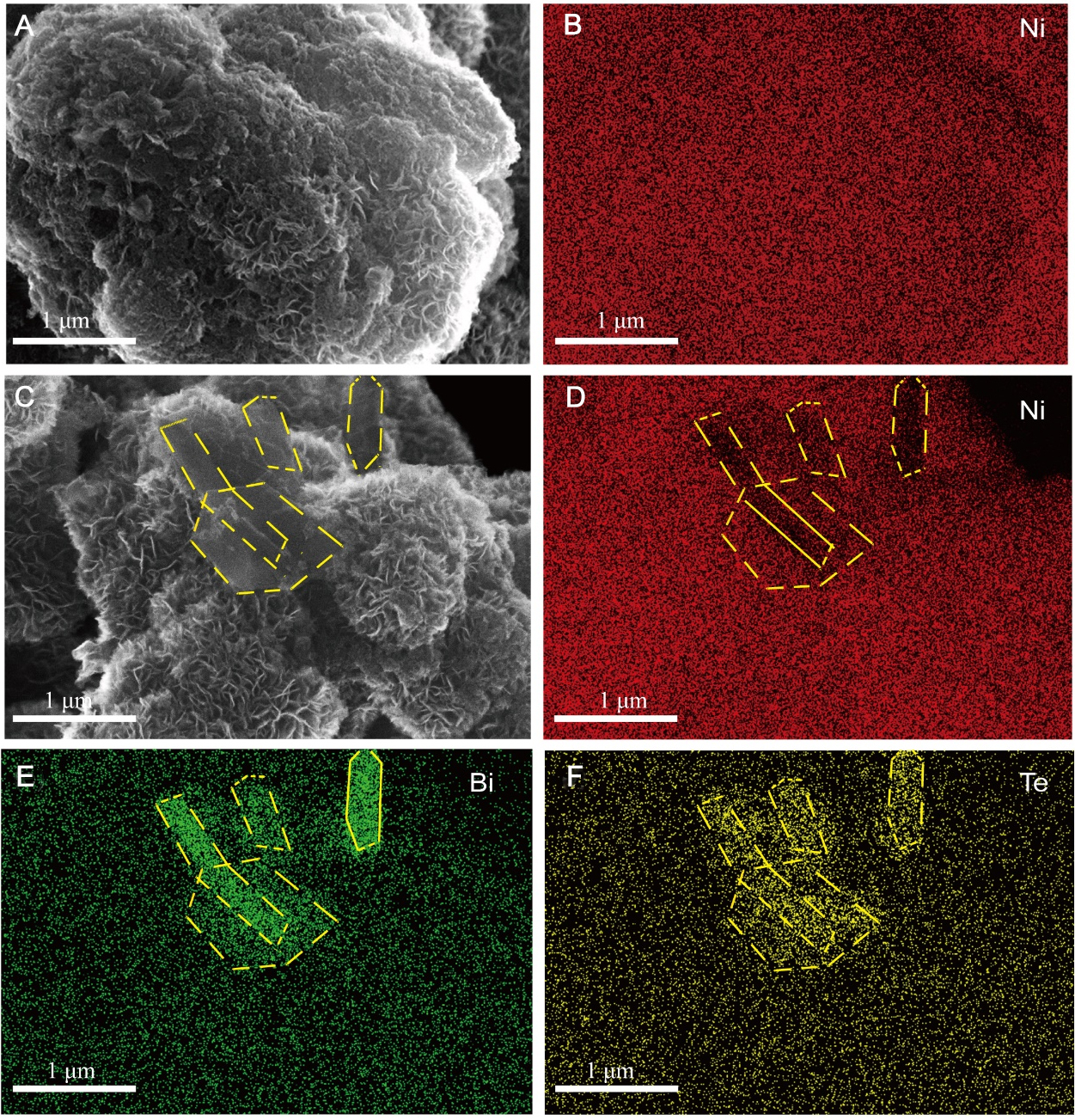
Figure 2. (A) Top-view SEM image of NiOx and (B) the corresponding Ni EDS mapping; (C) SEM image of 10% Bi2Te3@NiOx and the corresponding EDS mappings for (D) Ni, (E) Bi, and (F) Te. The yellow dashed box highlights a Bi2Te3-dominated area. SEM: Scanning electron microscope; EDS: energy-dispersive X-ray spectroscopy.
To investigate the effects of Bi2Te3 concentration on interfacial charge transfer, EIS was performed on all samples (0-15 wt% Bi2Te3). The spectra were simulated using the equivalent circuit (Figure 3A; inset), including electrolyte resistance and charge transfer resistance (Rct) at the nanocomposite interface, to extract key electrical parameters. Nyquist analysis demonstrates that Rct is minimized at 10% Bi2Te3@NiOx (0.74 × 10⁶ Ω) compared with pure NiOx (1.50 × 10⁶ Ω) and other ratios, indicating heterojunction formation for electron transfer. Higher Bi2Te3 loadings likely cause agglomeration, increasing interfacial resistance. Optical Hall measurements [Figure 3B] reveal that carrier mobility fluctuates with Bi2Te3 content rather than following a linear trend, suggesting it is more sensitive to localized synthesis variations and heterostructure quality than to Bi2Te3 loading alone. The enhanced gas-sensing performance of the 10% Bi2Te3@NiOx sensor stems primarily from minimized interfacial charge transfer resistance and optimal heterojunction modulation, rather than bulk carrier mobility. This optimized interfacial property enables more efficient utilization of active sites, leading to superior sensing responses.
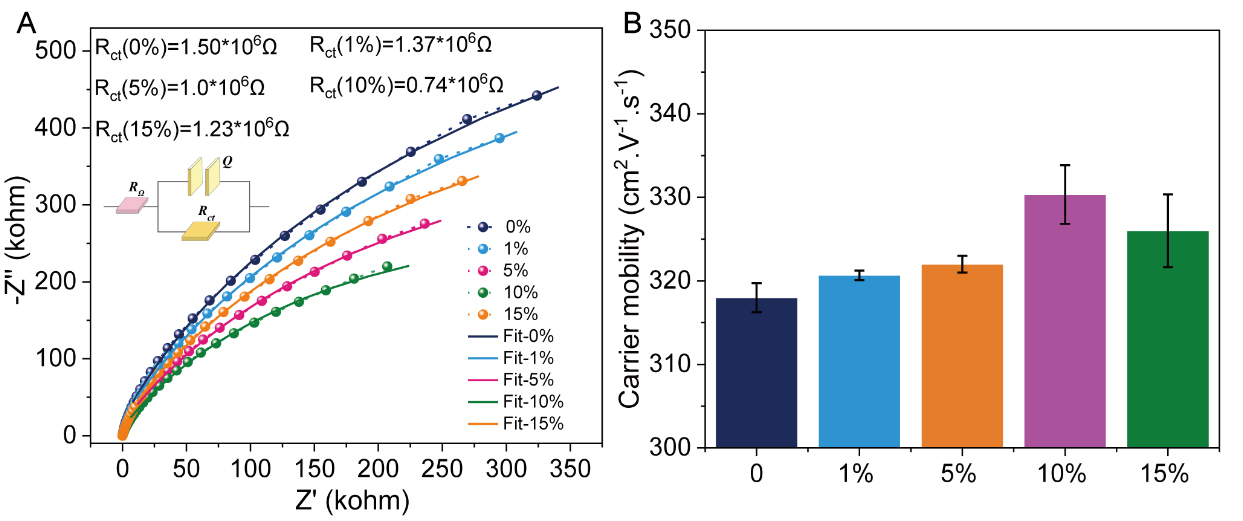
Figure 3. (A) Impedance spectra and (B) carrier mobility of NiOx with different Bi2Te3 concentrations (0, 1, 5, 10, and 15 wt%). Mobility values represent the averages of at least three independent measurements; vertical error bars indicate standard deviation.
Gas sensitive properties
To investigate the effect of Bi2Te3 on NiOx gas sensitivity, pristine NiOx and the 10% Bi2Te3@NiOx composite were employed as sensitive layers and systematically evaluated with a dynamic testing system. Given the influence of operating temperature on gas sensor responses, the 10% Bi2Te3@ NiOx sensor was tested toward 10 ppm H2S at 30% RH across a range of temperatures. The sensor responses were 1.09, 1.32, 5.37, 11.81, and 5.14 at 30, 50, 70, 90, and 110 °C, respectively, peaking at 11.81 at 90 °C [Figure 4A]. This temperature was selected for all subsequent measurements. This trend is attributed to insufficient activation energy at low temperatures, limiting both charge carrier excitation and surface reactions. As temperature increases, these reactions are progressively promoted. However, excessively high temperatures suppress adsorption and reduce efficiency, causing a decline in response[17,18].
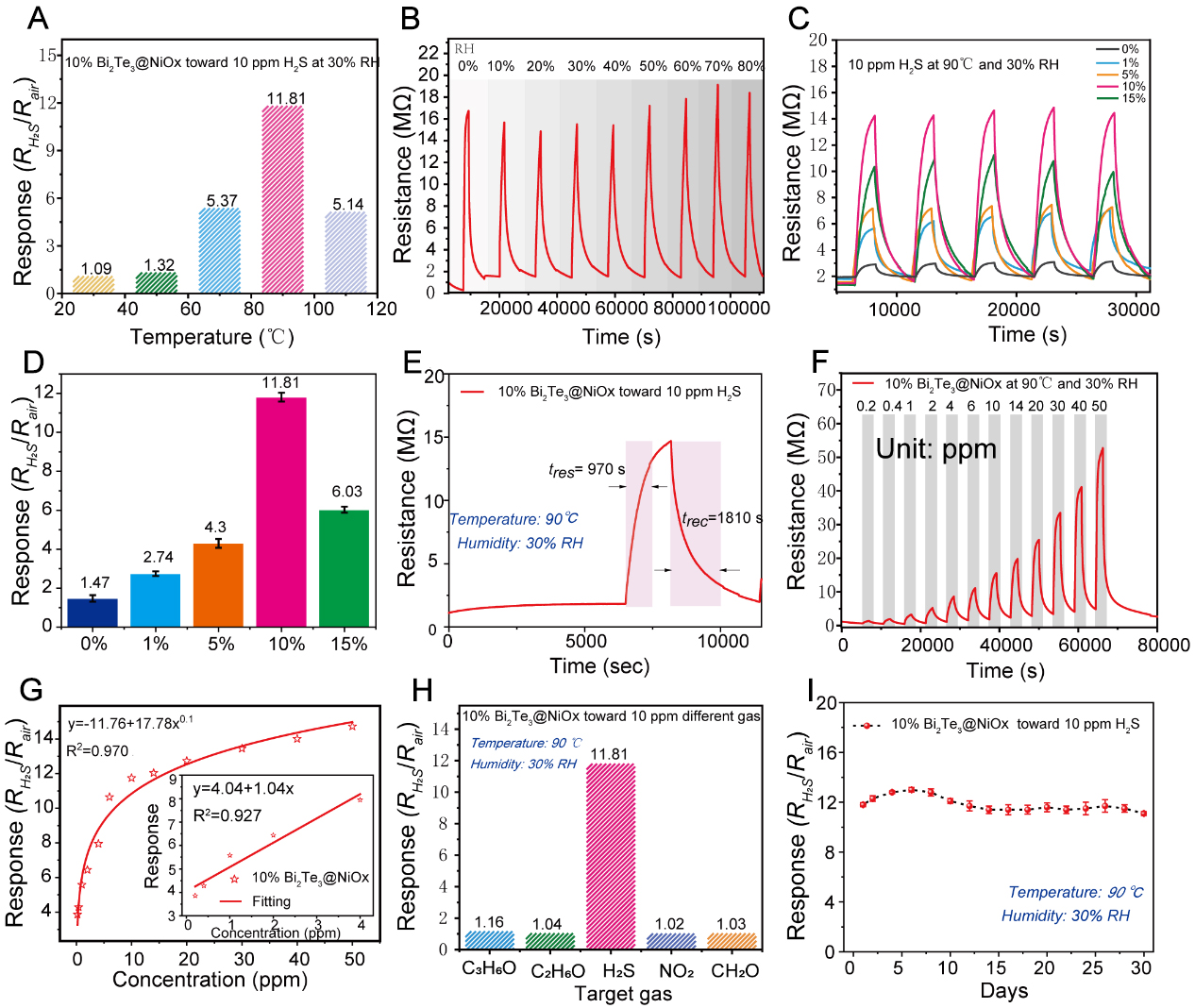
Figure 4. (A) Temperature-dependent response to 10 ppm H2S (30% RH), measured at 30, 50, 70, 90, and 110 °C; (B) Humidity-dependent H2S response at 90 °C; (C) Bi2Te3 loading optimization for H2S detection (90 °C, 30% RH); (D) Response comparison of Bi2Te3@ NiOx sensor (error bars: SD, n = 5); (E) Response - recovery transient of 10% Bi2Te3@NiOx to 10 ppm H2S (first cycle); (F) Dynamic responses to varying H2S concentrations; (G) Concentration-response relationship (inset: linear range 0.2-4 ppm; stars: experimental data; red curve: nonlinear fit); (H) Selectivity toward 10 ppm of various gases; (I) Long-term stability tests. RH: Relative humidity.
To examine humidity effects, the sensor’s dynamic response to 10 ppm H2S at 90 °C was tested from 0% to 80% RH in 10% steps [Figure 4B]. The baseline resistance remains stable across humidity variations, reflecting satisfactory environmental stability. This notable humidity independence is attributed to the strong competitive adsorption of H2S, which exhibits a significantly higher affinity for active sites than H2O and dominates the adsorption process. The 90 °C operating temperature thermodynamically inhibits water physisorption. Based on this stability, 30% RH was selected as the baseline for all subsequent tests. Unlike idealized dry air (0% RH), 30% RH accurately simulates real ambient and industrial environments, making the assessment of selectivity and stability metrics more applicable to practical deployment.
The effect of Bi2Te3 loading on NiOx sensing performance was investigated via dynamic flow measurements [Figure 4C]. At 90 °C and 30% RH, responses to 10 ppm H2S for 0-15 wt% Bi2Te3 were 1.47, 2.74, 4.3, 11.81, and 6.03, respectively [Figure 4D]. The 10% Bi2Te3@NiOx sensor demonstrated the highest response, attributed to an optimized p-n heterojunction effect. The Bi2Te3/NiOx interface generates a built-in field that promotes carrier separation and migration upon gas adsorption[19,20], while the 10% loading minimizes interfacial defects that could impede mobility[21]. Bi2Te3 doping also lowers sensor resistance via its high conductivity[21,22]; moderate doping enhances response, but excess doping over-enhances conductivity and suppresses gas adsorption, reducing sensitivity[20].
The response-recovery curve for 10 ppm H2S (first cycle, Figure 4C) is presented in Figure 4E, with response and recovery times of 970 s and 1,810 s, respectively. Dynamic transients of the 10% Bi2Te3@NiOx sensor to 0.2-50 ppm H2S were measured at 90 °C and 30% RH [Figure 4F]. The response scales positively with H2S concentration, enabling resistance-based concentration estimation, with the corresponding response values summarized in Figure 4G. Power-law fitting gave the relationship between response (y) and the H2S concentration (x): y = -11.76 + 17.78x0.1 (R2 = 0.97, where R2 near 1 indicates good fit). At low concentrations (0.2-4 ppm), a near-linear fit yielded: y = 4.04 + 1.04x (R2 = 0.927) (inset). The sensor response is defined as follows:
where
Sensor selectivity was evaluated against 10 ppm of acetone, ethanol, H2S, NO2, and formaldehyde at 90 °C and 30% RH [Figure 4H]. The 10% Bi2Te3@NiOx sensor demonstrates a distinctly higher response to H2S than to all interferents, exhibiting exceptional H2S selectivity. Long-term stability tests [Figure 4I] reveal a response fluctuation below 5% over a month, confirming reliable performance for continuous H2S monitoring. The initial slight increase in response over the first few days is due to surface activation and aging[23-25], during which residual impurities desorb and chemisorbed oxygen species equilibrate, exposing additional active sites and marginally enhancing performance. After this brief activation, the sensor exhibits excellent long-term stability with negligible degradation, highlighting its practical applicability. Compared to recently reported low-temperature gas sensors, the Bi2Te3@NiOx sensor exhibits markedly superior sensing performance [Supplementary Table 1].
Gas sensing mechanism
These results indicate that Bi2Te3 loading modulates sensor performance. To elucidate this mechanism, density functional theory (DFT) calculations were performed to determine the adsorption energy (Eads) and charge density difference for H2S adsorption on NiOx and Bi2Te3@NiOx.
Adsorption energy (Eads), which quantifies interaction strength and adsorption difficulty, is calculated as follows:
where Etotal, Esub, and Egas present the free energies of the adsorption structure, substrate, and gas molecule, respectively. Negative Eads denotes stable exothermic adsorption. Optimal H2S adsorption models on NiOx and Bi2Te3@NiOx were constructed [Figure 5A]. Bi2Te3@NiOx exhibited lower H2S Eads than NiOx, suggesting stronger adsorption, which is key to enhanced sensing performance. Differential charge densities and Bader charges (Δq) of adsorbed H2S were also evaluated. Differential charge density is given by:
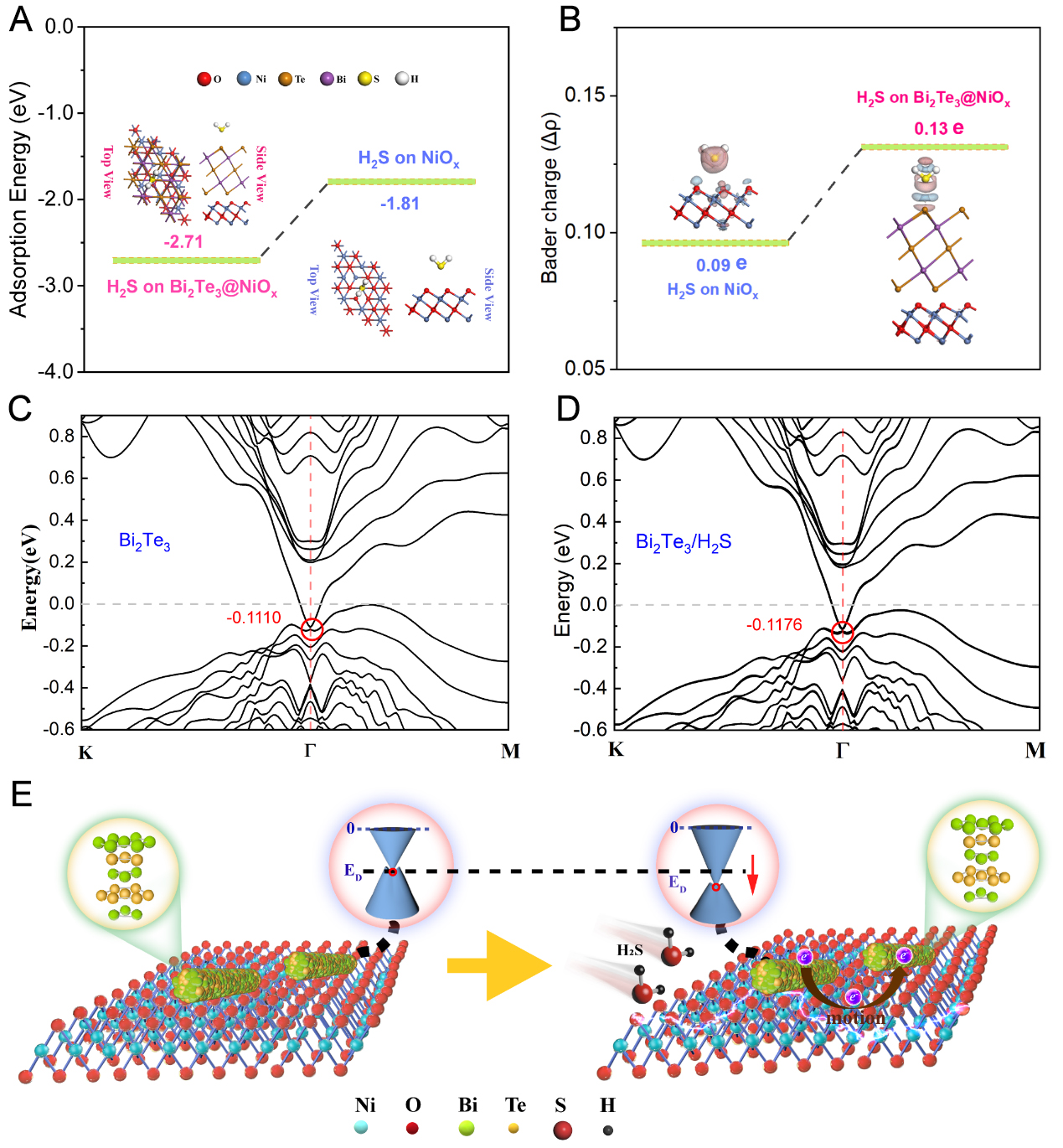
Figure 5. (A) H2S adsorption configurations and energies on NiOx(200) and Bi2Te3 (110)/NiOx(200); (B) Charge density difference and Bader charges (Δq) for H2S adsorption (pink/blue: charge accumulation/depletion); (C and D) DFT-calculated band structures of Bi2Te3 before (C) and after (D) H2S-adsorption (Dirac points in red); (E) Proposed H2S sensing mechanism for Bi2Te3@NiOx. DFT: Density functional theory.
where Δρ denotes the differential charge density; ρtotal signifies the total charge density of the adsorption system; and ρlayer and ρgas represent the charge densities of the isolated substrate and gas molecule under identical conditions, respectively. The charge transfer between Bi2Te3@NiOx and H2S increased to 0.13 e [Figure 5B], enhancing adsorption and amplifying the sensing response.
Bi2Te3, a 3D topological insulator, exhibits Dirac points in its band structure. To investigate the impact of H2S adsorption on its energy band, we calculated the band structures of pristine Bi2Te3 and H2S-adsorbed Bi2Te3 using DFT on the (111) surface. Consistent with previous findings that reducing gas adsorption induces n-type doping in topological insulators, shifting Dirac points downward and raising the Fermi level[15], our calculations reveal analogous behavior for H2S on Bi2Te3.
Our DFT calculations [Figure 5C and D] exhibit a Dirac point at -0.1110 eV for pristine Bi2Te3, which downshifts to -0.1176 eV (Δ = -0.007 eV) upon H2S physisorption, confirming n-type surface doping. However, at the 90 °C operating temperature, bulk bands are expected to dominate the electronic transport of Bi2Te3, rather than the topological surface state alone. This subtle surface-state shift is nonetheless critical, as gas sensing is fundamentally interface-dominated. By analogy with chemical doping (e.g., Sb-doping) that alters the electronic structure of Bi2Te3[26], H2S physisorption locally perturbs surface states and catalytically lowers the activation energy for electron transfer. Upon H2S exposure, the enhanced response is driven synergistically by charge transfer across the p-NiOx/n-Bi2Te3 heterojunctions, responsible for the primary resistance modulation, and Bi2Te3’s exceptionally high carrier mobility[20]. Uniform heating of the ultra-thin film on the micro-ceramic substrate further ensures a macroscopic isothermal condition throughout. The accelerated electron transfer is thus attributable solely to the interfacial p-n junction effect and surface state modulation, with no thermoelectric contributions from thermal gradients.
N2 adsorption-desorption measurements were performed on pristine NiOx and the 10% Bi2Te3@NiOx composite to ascertain whether performance enhancement stems simply from increased surface area. Both samples display type IV isotherms, confirming slit-like mesoporous structures. BET results [Supplementary Figure 2] yield specific surface areas of 12.81 m2/g for pristine NiOx and 12.98 m2/g for the 10% Bi2Te3@NiOx composite. The marginal difference demonstrates that the incorporation of Bi2Te3 exerts minimal influence on the physical surface area of the sensing material.
A plausible H2S-sensing mechanism for Bi2Te3@NiOx is illustrated in Figure 5E. Upon exposure to H2S, the majority charge carriers (holes) on the NiOx surface interact with H2S gas molecules:
Upon H2S exposure, hole carriers at the NiOx surface are neutralized, resulting in a reduced carrier concentration and increased resistance. Concurrently, H2S adsorption on Bi2Te3 induces a downward shift of its Dirac point, implying that the composite experiences both hole depletion on NiOx and n-type surface doping on Bi2Te3[16]. This electron excitation further reduces the hole concentration in Bi2Te3@NiOx, leading to higher resistance (
Furthermore, Bi2Te3’s topologically protected surface states, safeguarded by time-reversal symmetry during gas doping[14,15], suppress carrier backscattering from internal defects and thus significantly enhance carrier mobility in Bi2Te3@NiOx. This enhanced mobility promotes efficient charge transfer with H2S molecules, further improving sensing performance.
CONCLUSIONS
This work synthesized non-stoichiometric NiOx for low-temperature H2S detection, contributing to the advancement of low-power detection. Bi2Te3 loading modulated carrier properties, lowering initial resistance and promoting charge transfer with H2S. The 10% Bi2Te3 sensor exhibited optimal performance, including excellent H2S selectivity. The response was 11.81 to 10 ppm H2S at 90 °C and 30% RH, with a 0.2 ppm detection limit and good long-term stability. The work not only clarifies the sensing mechanism of Bi2Te3@NiOx, but also opens new avenues for applying the topological material Bi2Te3 in gas sensors, contributing to the advancement of low-power, high-performance detection technologies.
DECLARATIONS
Authors’ contributions
Conception and design of the work: Wang, M.; Ding, W.
Data acquisition and analysis: Ding, W.; Fan, R.; Han, C.; Cheng, Z.
Data interpretation: Wu, C.; Yan, R.; Zou, W.; Yang, H.
Manuscript writing and revising: Wang, M.; Ding, W.; Fan, R.
Supervision: Cheng, Z.; Ma, X.; Li, L.; Pan, M.
Availability of data and materials
The raw data supporting the findings of this study are available within this Article and its Supplementary Materials. Further data is available from the corresponding authors upon reasonable request.
AI and AI-assisted tools statement
Not applicable.
Financial support and sponsorship
This work was supported in part by the National Nature Science Foundation of China under Grant 22372096, in part by the Key Research and Development Program of Wuhan City under Grants 2024050702030113 and 2024050702030134, in part by the Key Research and Development of the Hubei Provincial Technology Innovation Program (2025BAB043) and in part by the Wenzhou Basic Research Project (G20240043).
Conflicts of interest
All authors declared that there are no conflicts of interest.
Ethical approval and consent to participate
Not applicable.
Consent for publication
Not applicable.
Copyright
©The Author(s) 2026.
Supplementary Materials
REFERENCES
1. Zhu, L.; Yuan, K.; Yang, J.; et al. Fabrication of heterostructured p-CuO/n-SnO2 core-shell nanowires for enhanced sensitive and selective formaldehyde detection. Sens. Actuators. B. Chem. 2019, 290, 233-41.
2. Wu, K.; Debliquy, M.; Zhang, C. Room temperature gas sensors based on Ce doped TiO2 nanocrystals for highly sensitive NH3 detection. Chem. Eng. J. 2022, 444, 136449.
3. Karnati, P.; Akbar, S.; Morris, P. A. Conduction mechanisms in one dimensional core-shell nanostructures for gas sensing: a review. Sens. Actuators. B. Chem. 2019, 295, 127-43.
4. Zhang, Y.; Xiong, H.; Chen, Q.; et al. Hollow-sphere NiO/Ti3C2Tx-based gas sensor for CO sensing. ACS. Appl. Nano. Mater. 2025, 8, 4832-40.
5. Cheng, Z.; Fan, R.; Liao, J.; et al. Sensing properties and mechanism of gas sensors based on room-temperature solution processed NiO-Niv nanoparticles. Cryst. Growth. Des. 2024, 24, 2900-8.
6. Pai, S. H. S.; Mondal, A.; Barathy, T. R.; Ajitha, B.; Samuel, E. J. J.; Reddy, Y. A. K. Effect of calcination temperature on NiO for hydrogen gas sensor performance. Int. J. Hydrogen. Energy. 2024, 50, 928-41.
7. Dastan, D.; shan, K.; Jafari, A.; et al. Influence of heat treatment on H2S gas sensing features of NiO thin films deposited via thermal evaporation technique. Mater. Sci. Semicond. Process. 2023, 154, 107232.
8. Ganapathi, S. K.; Kaur, M.; Singh, R.; et al. Anomalous sensing response of NiO nanoparticulate films toward H2S. ACS. Appl. Nano. Mater. 2019, 2, 6726-37.
9. Zhang, J.; Zeng, D.; Zhu, Q.; Wu, J.; Huang, Q.; Xie, C. Effect of nickel vacancies on the room-temperature NO2 sensing properties of mesoporous NiO nanosheets. J. Phys. Chem. C. 2016, 120, 3936-45.
10. Mokoena, T. P.; Tshabalala, Z. P.; Hillie, K. T.; Swart, H. C.; Motaung, D. E. The blue luminescence of p-type NiO nanostructured material induced by defects: H2S gas sensing characteristics at a relatively low operating temperature. Appl. Surf. Sci. 2020, 525, 146002.
11. Amu-Darko, J. N. O.; Hussain, S.; Issaka, E.; et al. Nanosheet assembled NiO-doped-ZnO flower-like sensors for highly sensitive hydrogen sulfide gas detection. Ceram. Int. 2024, 50, 17681-90.
13. Chen, Y. L.; Analytis, J. G.; Chu, J. H.; et al. Experimental realization of a three-dimensional topological insulator, Bi2Te3. Science 2009, 325, 178-81.
15. Hsieh, D.; Xia, Y.; Qian, D.; et al. A tunable topological insulator in the spin helical Dirac transport regime. Nature 2009, 460, 1101-5.
16. Du, B.; Kang, W.; He, Y.; et al. Topological insulator Bi2Se3 for highly sensitive, selective and anti-humidity gas sensors. iScience 2023, 26, 106387.
18. Yamazoe, N. Toward innovations of gas sensor technology. Sens. Actuators. B. Chem. 2005, 108, 2-14.
19. Verma, S. K.; Maurya, G. K.; Kumar, S.; et al. Emerging vertically stacked n-Bi2Te2Se/p-Bi2Te3 topological insulator heterojunction for high-performance self-powered photosensor. J. Mater. Sci. Mater. Electron. 2024, 35, 13381.
20. Zhao, Z.; Su, Z.; Lv, Z.; Shi, P.; Jin, G.; Wu, L. Room temperature gas sensors for NH3 detection based on the heterojunction of 2D Ti3C2Tx MXenes and Bi2S3. Mikrochim. Acta. 2024, 191, 687.
21. Liu, J.; Liu, F.; Li, Y.; et al. High-performance near-room-temperature n-type Bi2Te3-based thermoelectric alloys with superior mechanical properties. Sci. China. Mater. 2025, 68, 920-7.
22. Yu, H.; Hu, Z.; He, J.; et al. Flexible temperature-pressure dual sensor based on 3D spiral thermoelectric Bi2Te3 films. Nat. Commun. 2024, 15, 2521.
23. Li, L.; Zhou, L.; Chen, Y.; et al. Precision hydrogen detection in mixed atmospheres using temperature-modulated PdAu-In2O3 sensor arrays and machine learning algorithms. Chem. Eng. J. 2025, 520, 165633.
24. Zhang, H.; Guo, S.; Zheng, W.; et al. Facile engineering of metal-organic framework derived SnO2-ZnO composite based gas sensor toward superior acetone sensing performance. Chem. Eng. J. 2023, 469, 143927.
25. Zhang, Y.; Zhang, H.; Han, W.; et al. Synergistic engineering of phase purity and Pd doping in CdSnO3 for enhancing acetone sensing. Sens. Actuators. B. Chem. 2026, 447, 138753.
Cite This Article
 Open Access
How to Cite
Download Citation
Export Citation File:
Type of Import
Tips on Downloading Citation
Citation Manager File Format
Type of Import
Direct Import: When the Direct Import option is selected (the default state), a dialogue box will give you the option to Save or Open the downloaded citation data. Choosing Open will either launch your citation manager or give you a choice of applications with which to use the metadata. The Save option saves the file locally for later use.
Indirect Import: When the Indirect Import option is selected, the metadata is displayed and may be copied and pasted as needed.
About This Article
Special Topic
Copyright

Data & Comments
Data
0










Comments
Comments must be written in English. Spam, offensive content, impersonation, and private information will not be permitted. If any comment is reported and identified as inappropriate content by OAE staff, the comment will be removed without notice. If you have any queries or need any help, please contact us at support@oaepublish.com.