

Breaking ionic-strength barriers in contact-electro-catalysis
 0
0 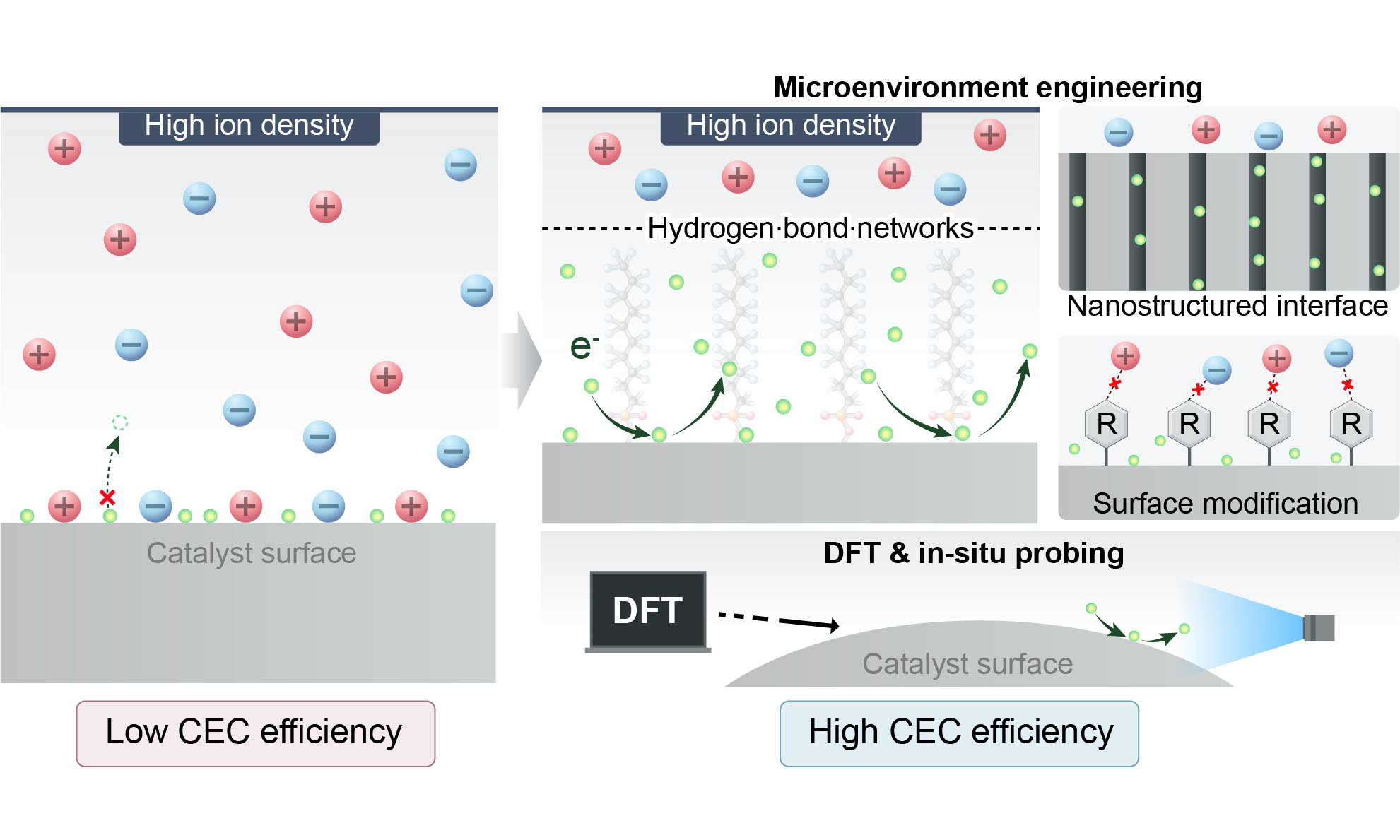
Contact-electrification (CE) is a ubiquitous surface phenomenon in which two surfaces become oppositely charged after repeated contact and separation[1,2]. Electrons have often been identified as the dominant charge carrier in the CE process[3-5], and an electron-cloud-potential-well model has been proposed for the CE-driven electron transfer[2,6]. Based on the CE effect under mechanical stimuli, contact-electro-catalysis (CEC) has emerged as a novel catalytic strategy to promote chemical reactions[7-9]. CEC has provided sustainable and effective means for environmental remediation[10,11], vital chemical synthesis[12,13], and resource recovery[14,15]. However, most reported CEC processes have been limited to low-ionic-strength media, largely because ion transfer competes with electron transfer during CE[16-18]. As a result, the electron transfer process can be significantly suppressed at high ion concentrations[19,20], leading to substantially reduced CEC efficiency. Given the abundance of mobile ions in realistic aqueous environments, it is highly desirable to develop efficient CEC platforms that can efficiently operate under high-ionic-strength conditions.
In this Perspective, we first analyze the competition between electron transfer and ion transfer during liquid-solid CE and discuss how this competition limits CEC under high-ionic-strength conditions. We then highlight microenvironment engineering as a promising strategy for regulating ion distributions at the contact interfaces to mitigate their adverse effects on CE and subsequent catalytic processes. Finally, we envision the opportunities enabled by CEC across a broader ionic-strength window. Specifically, integrating CEC with electrocatalysis in an electrolyte could generate synergistic effects to greatly enhance overall performance for many promising applications in realistic aqueous environments, including hydrogen production from seawater, and beyond. Besides, we expect that a deeper understanding of the roles of surface-bound ions and adsorbates may inspire future CEC systems in which ions become active participants in catalytic reactions. The overall framework is illustrated in Figure 1.
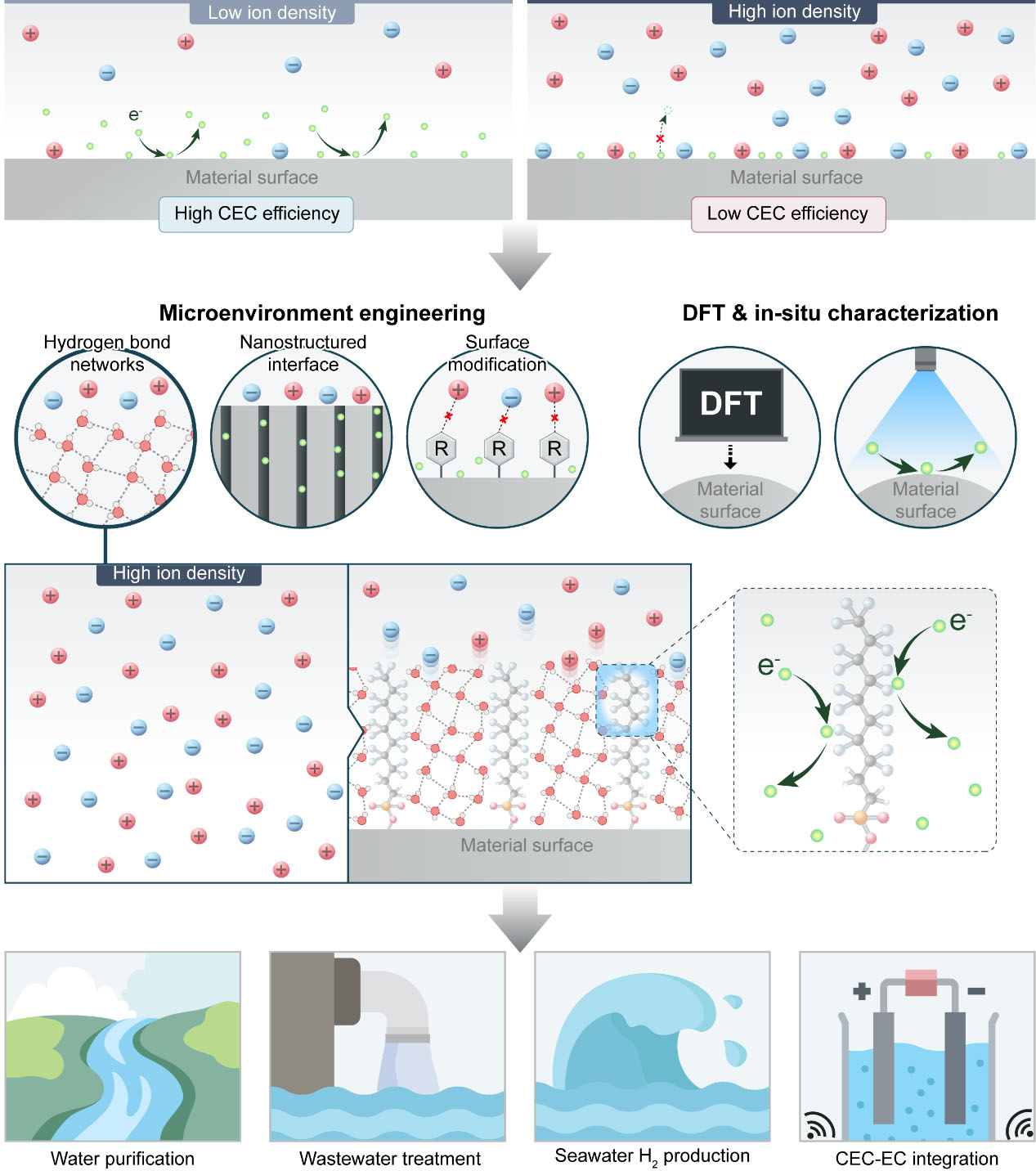
Figure 1. Contact-electro-catalysis across a broad ionic-strength window: challenges, solutions, and opportunities. CEC: Contact-electro-catalysis; DFT: density functional theory; EC: contact-electrification.
CHALLENGES IN HIGH IONIC STRENGTH CONDITIONS
Liquid-solid contact-electrification (L-S CE) occurs spontaneously when a solid contacts a liquid. Recent studies suggest that both electrons and ions participate in interfacial charge transfer during L-S CE[21-23], with electrons dominating in many cases, particularly at hydrophobic surfaces and under low-ionic-strength conditions[3,24]. An electron-cloud-potential-well model has been established to describe the CE-driven electron transfer process for redox reactions via CEC[2,7]. However, ion transfer arising from ion adsorption or ionization reactions could compete with electron transfer during L-S CE, thereby reducing the efficiency of CEC, especially in high-ionic-strength media.
In addition, CE-induced surface charging may also modify wetting behavior and other interfacial interactions, which could further influence subsequent CEC efficiencies[25,26]. For example, a charged solid surface formed after CE tends to attract oppositely charged species from the surrounding solutions. Such electrostatic adsorption has been visualized in previous CEC studies[7,27]. For example, positively charged powders (e.g., Nylon-66) would become yellowish after ultrasonicating in a methyl orange (MO) aqueous solution due to electrostatic adsorption of anionic methyl orange[9]. Such ion accumulation can negatively affect CEC in at least two ways: (1) it hinders further electron transfer during subsequent CE events, thereby reducing the number of electrons for catalytic reactions; and (2) its formation of an electrical double layer (EDL) would shield the charged surface, weakening the CE-derived electric field that facilitates substrate activation. Consequently, the overall CEC efficiency is substantially limited under high-ionic-strength conditions.
SOLUTIONS FOR ENHANCING CEC IN HIGH-IONIC-STRENGTH LIQUIDS
Given the decisive role of ion adsorption in limiting CEC performance, microenvironment engineering at the contact interface offers a promising route for enhancing CEC in high-ionic-strength liquids. The primary objective is to regulate the spatial distribution of ions and prevent their excessive accumulation in regions where CEC occurs. A representative example is the construction of hydrogen bond networks (HBNs) at the contact surface. Recent studies have suggested that HBN could limit the negative impact of ion accumulation on the CEC efficiency by regulating the ion spatial distribution near the contact region[14]. Specifically, hydrophobic fluorinated functional groups were first introduced on the hydrophilic surface of SiO2 via a self-assembly strategy[28]. The synergetic interaction between the grafted fluorinated groups and surface hydroxyl groups then generated an HBN. This HBN remained stable under high-ionic-strength conditions (e.g., 0.5 M NaCl aqueous solution) and could prevent excessive accumulation of Na+ and Cl- ions near contact surfaces[16]. As a result, ion-induced interference with CE-driven interfacial electron transfer was alleviated, while the shield effect of the CE-derived electric field was reduced, significantly improving the CEC efficiency even in ion-rich media.
Surface modulation may also provide a feasible approach to regulate interfacial ion distribution, as certain ion species could be selectively repelled by tailored functional groups. Similarly, confinement using nanopores, nanochannels, or specific surface morphologies may reshape local ion distribution by creating low-ion buffering regions. Consequently, CE-driven electron transfer near the contact interface may be maintained even when the bulk solution is highly concentrated with ions.
At a more fundamental level, it is essential to gain a deeper mechanistic understanding of how the nature of ions, ion concentration, and surface chemistry regulate CE at contact interfaces. In particular, ion adsorption is a dynamic and time-dependent process, and kinetic studies may inspire the development of ultrafast CEC strategies that minimize ion access to CE-active regions, thereby eliminating ion accumulation and the associated performance degradation. We expect in-situ characterization and density functional theory (DFT) calculations will facilitate such kinetic studies and help establish general design rules for CEC in high-ionic-strength environments.
OPPORTUNITIES IN REALISTIC AQUEOUS ENVIRONMENTS
The development of CEC systems that maintain high efficiencies across a wide range of ionic strength could substantially broaden the practical applicability of CEC. In particular, industrial wastewater, environmental sewage, and municipal water streams often contain high concentrations of dissolved salts and charged pollutants. A CEC platform that remains effective under such conditions could therefore open new possibilities for direct industrial wastewater remediation, environmental water purification, tap water treatment, and many more.
Covering more than 70% of the Earth’s surface, seawater represents another abundant and inherently ion-rich medium[29,30]. One particularly attractive application is its use as a feedstock for hydrogen production[31,32]. Compared with the increasing shortage of freshwater resources[33], seawater is far more abundant and readily accessible, making it an appealing alternative for sustainable hydrogen generation. However, conventional polymer-based CEC catalysts often suffer an apparent decline in CE performance in saline solutions rich in Na+ and Cl- due to the shielding effect of ions[33]. We anticipate that advanced CEC-based seawater hydrogen evolution platforms could not only reduce the reliance on scarce freshwater but also offer a sustainable route for in situ hydrogen production by converting unlimited mechanical energy from marine environments into electron transfer to drive the CEC process.
The development of highly efficient CEC systems for high-salinity conditions could also enable their integration with electrocatalysis. More importantly, previous studies have demonstrated that the CE-derived high-intensity electric field on dielectric surfaces can polarize adjacent metallic catalysts, and thereby selectively promote their redox reactivities for certain reactions[34-35]. However, this CE-derived electric field would be significantly shielded by ions, especially in electrolytes with high ion concentrations essential for electrocatalysis. Consequently, the effective coupling of CEC and electrocatalysis remains challenging unless strategies are developed to suppress ion adsorption and interfacial screening. Once these challenges are addressed, this combination should render a significant improvement in both catalytic efficiency and selectivity, breaking the scaling rule in catalysis.
OUTLOOK
High-ionic-strength media represent both a major challenge and a new opportunity for CEC. The challenge arises mainly from the coexistence of competitive electron transfer and ion transfer during L-S CE. While CE-driven electron transfer can accelerate target reactions, ion transfer can inhibit electron transfer without contributing to catalysis. Therefore, a key requirement for enhancing CEC under high-ionic-strength conditions is restricting ion transfer and accumulation at adjacent contact surfaces.
Microenvironment engineering offers a promising strategy for regulating ion distribution and preventing excessive ion accumulation in regions where CE occurs. Recent studies have suggested that hydrogen bond networks (HBNs) can minimize the negative impact of ions by confining them to regions away from the contact interface. As ion transport and accumulation are dynamic processes, advanced in-situ characterization and DFT calculations are expected to facilitate kinetic studies to gain in-depth mechanistic understanding for developing novel strategies and establishing general design rules to improve CEC performance in high-ionic-strength environments.
We envision that, once these challenges are addressed, CEC can be extended to realistic aqueous systems that are inherently rich in ions. This advancement would not only broaden the application scope of CEC, but also enable its integration with electrocatalysis in high-ionic-strength media. Such integration could generate synergistic effects for CEC and electrocatalysis to cooperatively enhance both the selectivity and efficiency of important chemical reactions, potentially breaking the scaling rule in catalysis.
DECLARATIONS
Authors’ contributions
Conceptualization and writing: Wang, Z.; Jiang, D.; Dai, Q.
Supervision: Xia, Z.; Wang, Z.
Critical revision of the manuscript: Xia, Z.; Wang, Z.
Availability of data and materials
Not applicable.
AI and AI-assisted tools statement
Not applicable.
Financial support and sponsorship
Not applicable.
Conflicts of interest
The authors declared that there are no conflicts of interest.
Ethical approval and consent to participate
Not applicable.
Consent for publication
Not applicable.
Copyright
© The Author(s) 2026.
REFERENCES
1. Wang, Z. L.; Wang, A. C. On the origin of contact-electrification. Mater. Today. 2019, 30, 34-51.
2. Lin, S.; Chen, X.; Wang, Z. L. Contact Electrification at the liquid-solid interface. Chem. Rev. 2022, 122, 5209-32.
3. Lin, S.; Xu, L.; Wang, A. C.; Wang, Z. L. Quantifying electron-transfer in liquid-solid contact electrification and the formation of electric double-layer. Nat. Commun. 2020, 11, 399.
4. Nie, J.; Ren, Z.; Xu, L.; et al. Probing contact-electrification-induced electron and ion transfers at a liquid-solid interface. Adv. Mater. 2020, 32, 1905696.
5. Zhang, J.; Gu, G.; Liu, Q.; Wang, Z. L. Triboelectric nanogenerator as a probe for investigating charge transfer at liquid-solid interfaces. Chem. Rev. 2026, 126, 5490-517.
6. Lin, S.; Xu, C.; Xu, L.; Wang, Z. L. The overlapped electron-cloud model for electron transfer in contact electrification. Adv. Funct. Mater. 2020, 30, 1909724.
7. Wang, Z.; Berbille, A.; Feng, Y.; et al. Contact-electro-catalysis for the degradation of organic pollutants using pristine dielectric powders. Nat. Commun. 2022, 13, 130.
8. Wang, Z.; Dong, X. Li, X.-F.; et al. A contact-electro-catalysis process for producing reactive oxygen species by ball milling of triboelectric materials. Nat. Commun. 2024, 15, 757.
9. Wang, Z.; Dong, X.; Tang, W.; Wang, Z. L. Contact-electro-catalysis (CEC). Chem. Soc. Rev. 2024, 53, 4349-73.
10. Cao, D.-Q.; Fang, R.-K.; Song, Y.-X.; et al. Contact-electro-catalysis for degradation of trace antibiotics in wastewater. Chem. Eng. J. 2024, 487, 150531.
11. Chen, Z.; Lu, Y.; Liu, X.; Li, J.; Liu, Q. Novel magnetic catalysts for organic pollutant degradation via contact electro-catalysis. Nano. Energy. 2023, 108, 108198.
12. Zhao, J.; Zhang, X.; Xu, J.; Tang, W.; Wang, Z. L.; Fan, F. R. Contact-electro-catalysis for direct synthesis of H2O2 under ambient conditions. Angew. Chem. Int. Ed. 2023, 62, e202300604.
13. He, M.; Yang, X.; Jiang, D.; Dong, X.; Wang, Z.; Wang, Z. L. Direct conversion of atmospheric nitrogen via contact-electro-catalysis for sustainable agriculture. Nano. Energy. 2026, 151, 111825.
14. Wang, Z.; Dong, X.; Wu, N.; et al. A generalized approach for enhancing contact-electro-catalysis of oxides in a broad temperature range by fluorination. Nat. Commun. 2025, 16, 11035.
15. Li, H.; Berbille, A.; Zhao, X.; Wang, Z.; Tang, W.; Wang, Z. L. A contact-electro-catalytic cathode recycling method for spent lithium-ion batteries. Nat. Energy. 2023, 8, 1137-44.
16. Liu, J.; Yang, Z.; Li, S.; et al. Nonaqueous contact-electro-chemistry via triboelectric charge. J. Am. Chem. Soc. 2024, 146, 31574-84.
17. Gan, T.; Yang, Z.; Li, S.; et al. Unveiling janus chemical processes in contact-electro-chemistry through oxygen reduction reactions. J. Am. Chem. Soc. 2025, 147, 25407-16.
18. Li, W.; Sun, J.; Wang, M.; et al. Contact-electro-catalysis for direct oxidation of methane under ambient conditions. Angew. Chem. Int. Ed. 2024, 63, e202403114.
19. Zhang, J.; Lin, S.; Zheng, M.; Wang, Z. L. Triboelectric nanogenerator as a probe for measuring the charge transfer between liquid and solid surfaces. ACS. Nano. 2021, 15, 14830-7.
20. Zhang, J.; Wang, X.; Zhang, L.; Lin, S.; Ciampi, S.; Wang, Z. L. Triboelectric spectroscopy for in situ chemical analysis of liquids. J. Am. Chem. Soc. 2024, 146, 6125-33.
21. Li, S.; Nie, J.; Shi, Y.; et al. Contributions of different functional groups to contact electrification of polymers. Adv. Mater. 2020, 32, 2001307.
22. Wei, Y.; Li, X.; Yang, Z.; Shao, J.; Wang, Z. L.; Wei, D. Contact electrification at the solid-liquid transition interface. Mater. Today. 2024, 74, 2-11.
23. Wang, Z.; Kulikov, I.; Mustafa, T.; et al. Electrically detected magnetic resonance in ambipolar polymer field-effect transistors. Phys. Rev. Lett. 2025, 135, 166301.
24. Lin, S.; Zhu, L.; Tang, Z.; Wang, Z. L. Spin-selected electron transfer in liquid-solid contact electrification. Nat. Commun. 2022, 13, 5230.
25. Chen, S.; Leon, R. T.; Qambari, R.; et al. Irreversible charging caused by energy dissipation from depinning of droplets on polymer surfaces. Phys. Rev. Lett. 2025, 134, 104002.
26. Hinduja, C.; Leibauer, B.; Chaurasia, R.; et al. How spontaneous electrowetting and surface charge affect drop motion. Phys. Rev. Lett. 2026, 136, 194001.
27. Dong, X.; Wang, Z.; Berbille, A.; Zhao, X.; Tang, W.; Wang, Z. L. Investigations on the contact-electro-catalysis under various ultrasonic conditions and using different electrification particles. Nano. Energy. 2022, 99, 107346.
28. Zhang, H.; Wang, K.; Li, J.; Li, J.; Zhang, R.; Zheng, Y. Liquid-based nanogenerator fabricated by a self-assembled fluoroalkyl monolayer with high charge density for energy harvesting. Matter 2022, 5, 1466-80.
29. Kuang, Y.; Kenney, M. J.; Meng, Y.; et al. Solar-driven, highly sustained splitting of seawater into hydrogen and oxygen fuels. Proc. Natl. Acad. Sci. 2019, 116, 6624-9.
30. Li, Y.; Zhou, H.; Cai, S.; et al. Electrolyte-assisted polarization leading to enhanced charge separation and solar-to-hydrogen conversion efficiency of seawater splitting. Nat. Catal. 2024, 7, 77-88.
31. Xie, H.; Zhao, Z.; Liu, T.; et al. A membrane-based seawater electrolyser for hydrogen generation. Nature 2022, 612, 673-678.
32. Jin, H.; Xu, J.; Liu, H.; et al. Emerging materials and technologies for electrocatalytic seawater splitting. Sci. Adv. 2023, 9, eadi7755.
33. Wang, Z.; Yang, X.; Li, H.; et al. Hydrogen bond networks for stable and sustainable production of hydrogen from seawater via contact-electro-catalysis. Adv. Mater. 2026, e74017.
34. Shi, L.; LaCour, R. A.; Qian, N.; et al. Water structure and electric fields at the interface of oil droplets. Nature 2025, 640, 87-93.
35. Li, S.; Wang, Z. L.; Wei, D. Hidden interfacial electric fields in chemistry: contact electrification and beyond. Chem. Soc. Rev. 2026, 55, 4756-82.
Cite This Article
 Open Access
How to Cite
Download Citation
Export Citation File:
Type of Import
Tips on Downloading Citation
Citation Manager File Format
Type of Import
Direct Import: When the Direct Import option is selected (the default state), a dialogue box will give you the option to Save or Open the downloaded citation data. Choosing Open will either launch your citation manager or give you a choice of applications with which to use the metadata. The Save option saves the file locally for later use.
Indirect Import: When the Indirect Import option is selected, the metadata is displayed and may be copied and pasted as needed.
About This Article
Copyright

Data & Comments
Data
0







Comments
Comments must be written in English. Spam, offensive content, impersonation, and private information will not be permitted. If any comment is reported and identified as inappropriate content by OAE staff, the comment will be removed without notice. If you have any queries or need any help, please contact us at support@oaepublish.com.