

Iontronics for adaptive and flexible pressure sensing
 0
0 
Abstract
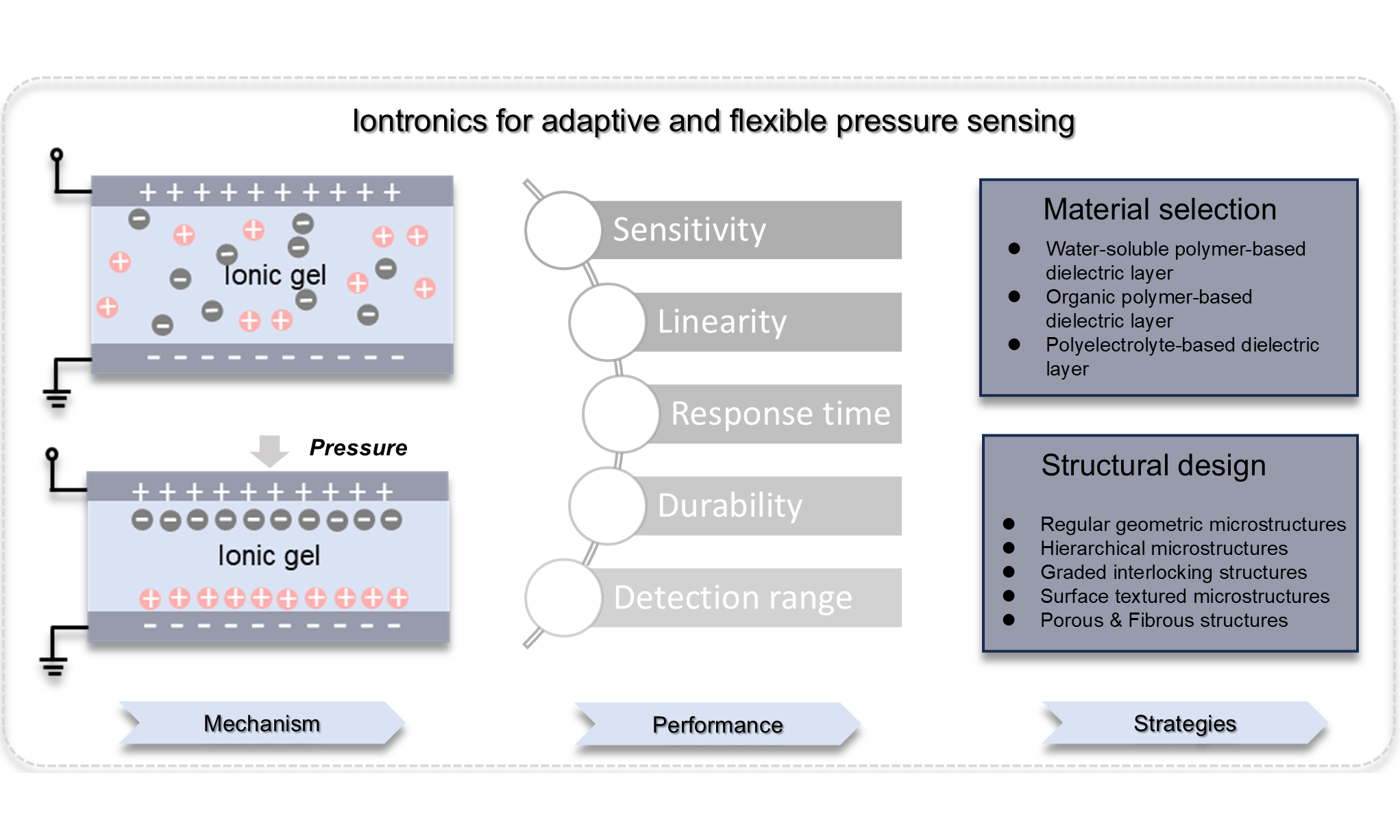
Flexible pressure sensors are vital for electronic skin, wearable electronics, and soft robotics. However, conventional electronic pressure sensors based on solid-state dielectrics suffer from limited dielectric tunability, mechanical instability, and static-dynamic response crosstalk, constraining their overall sensitivity and adaptability. Iontronics overcomes these constraints by introducing ionic dielectrics that form nanoscale electrical double layers (EDLs), where interfacial ion migration and polarization yield ultrahigh capacitance, high sensitivity, and dynamic adaptability. This iontronics mechanism not only enhances sensitivity and durability but also offers intrinsic biocompatibility and resistance to electromagnetic interference. Here, we systematically analyze the working principles, key performance determinants, and enhancement strategies of flexible iontronic pressure sensors, emphasizing the roles of EDL formation, ion migration, and interfacial capacitance in determining sensitivity, dynamic response, and long-term stability. Mechanistic insights and materials-structure-mechanism integration are discussed to provide guidance for rational device design and performance optimization in advanced tactile, wearable, and soft electronic systems.
Keywords
INTRODUCTION
Flexible pressure sensors constitute the fundamental perceptual elements of wearable electronics, bionic robotics, intelligent human-machine interfaces, and precision health monitoring systems[1-3]. Their primary function is to transduce mechanical stimuli into electrical signals with high fidelity, emulating the mechanosensory behavior of human skin, hence the term electronic skin (e-skin)[4-6]. The performance of these sensors dictates the perceptual accuracy and reliability of downstream systems, positioning them at the forefront of research in flexible electronics[7]. Among various sensing technologies, electronic flexible pressure sensors hold a central position owing to their distinct advantages. In contrast to optical sensors[8,9], which require precise optical path calibration and are prone to interference, and electrochemical sensors, which depend on electrolytes with limited environmental adaptability, electronic pressure sensors, including resistive[10], capacitive[11,12], piezoelectric[13,14], and triboelectric[15,16] types, offer superior system integration, simplified signal processing, and excellent conformability to complex surfaces such as human skin or soft robots through flexible substrate design. By transducing mechanical stimuli into measurable electrical signals (resistance, capacitance, or voltage variations), these sensors effectively emulate human skin mechanoreceptors, providing indispensable functionality for dynamic tactile feedback and long-term physiological monitoring[17]. However, despite significant progress in conventional electronic pressure sensors, their advancement remains fundamentally constrained by the intrinsic limitations of materials and device architectures. Low dielectric tunability, mechanical instability under deformation, and intrinsic coupling between static and dynamic signal responses collectively impede the attainment of high sensitivity, long-term stability, and multimodal perception within a unified platform.
Among various e-skin sensing modalities, capacitive sensors have garnered particular attention for their structural simplicity and low signal drift. These sensors operate via parallel electrodes separated by a compressible dielectric layer, where applied pressure reduces the separation distance and thus increases capacitance. However, their finite dielectric constant and limited layer thickness constrain capacitance density to tens or hundreds of picofarads per square centimeter, leaving them vulnerable to parasitic charges and electromagnetic interference. To address these limitations, Nie et al. (2011) introduced interfacial iontronic sensing[18]. In contrast to conventional capacitive sensors, flexible iontronic pressure sensors (FIPS) employ an ionic film as the dielectric layer[19,20]. Upon contact with a conductive electrode, oppositely charged ions accumulate at the electrode-ionic interface, forming an electrical double layer (EDL) only ~ 1 nm thick[21]. This nanoscale charge separation yields ultrahigh capacitance and offers two principal advantages. First, the dramatically reduced separation distance boosts unit-area capacitance (UAC) by several orders of magnitude under applied pressure, greatly enhancing sensitivity. Second, capacitance becomes predominantly governed by contact area rather than distance, allowing further tunability through microstructural engineering. The EDL configuration also mitigates parasitic and electromagnetic interference, improving signal fidelity. Notably, EDL-based sensors deliver high spatial resolution and robust responsiveness to both static and dynamic mechanical stimuli.
In this Perspective, we systematically analyze the working mechanisms of FIPS, highlighting the decisive roles of EDL formation, ion migration, and interfacial capacitance modulation in determining sensor performance. Key factors affecting sensitivity, response speed, linear range, and long-term stability are thoroughly evaluated. Performance enhancement strategies are then summarized, including material selection, structural design, and mechanism-driven interface engineering. Finally, future development of FIPS is discussed from the integrated perspective of materials, structural design, and mechanistic understanding, emphasizing the importance of EDL dynamics and interface control for achieving high sensitivity, wide pressure range, and long-term reliability, thereby providing guidance for rational device design and performance optimization.
MAIN TEXT
Mechanism of FIPS
Conventional parallel-plate capacitive pressure sensors detect external pressure by monitoring changes in capacitance, which can be expressed by the classical parallel-plate capacitor model:
where C is the capacitance, ε0 is the vacuum permittivity, εr is the relative permittivity of the dielectric material, A is the effective overlapping area of the electrodes, and d is the distance between the two electrodes. Upon the application of external pressure, the compressible dielectric layer deforms, leading to a reduction in electrode spacing and/or an increase in the effective electrode area, thereby inducing a change in capacitance, as illustrated in Figure 1A. Based on this mechanism, the performance of conventional capacitive pressure sensors is typically enhanced by employing dielectric materials with higher permittivity, adjusting the dielectric thickness, or reducing the dielectric stiffness to increase deformation-induced changes in electrode spacing. However, the limited compressibility of the dielectric layer intrinsically restricts the achievable capacitance variation and sensor sensitivity.
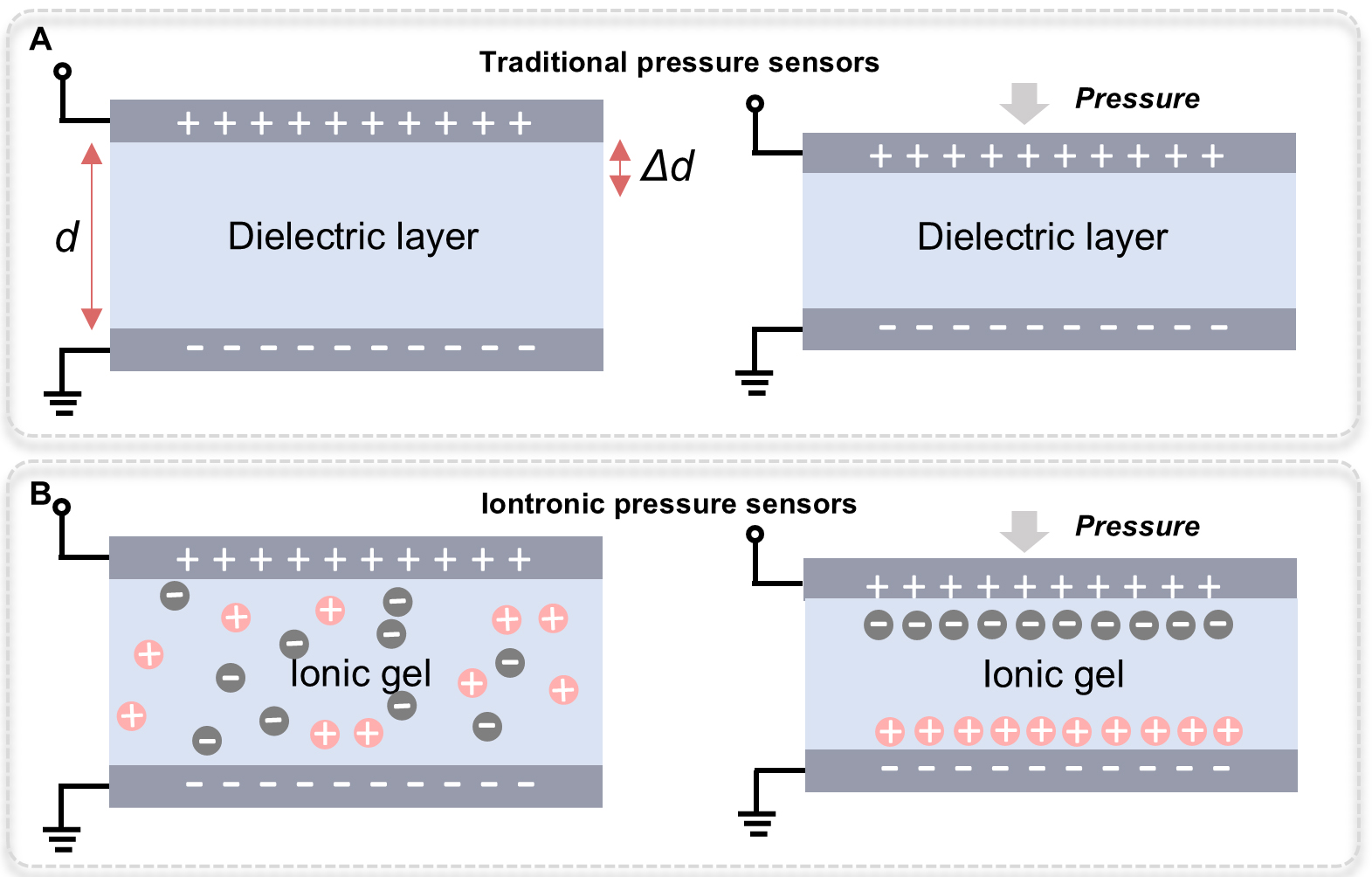
Figure 1. Operating principles of pressure sensors. (A) Traditional pressure sensors; (B) FIPS. FIPS: Flexible iontronic pressure sensors.
To overcome these limitations, Pan et al. proposed FIPS in 2011 based on the working principle of supercapacitors. In such sensors, ion-conductive materials are employed as the active dielectric layer. When the ionic dielectric comes into contact with the electrode, strong electrostatic interactions between electronic charge carriers on the electrode surface and mobile ions in the dielectric drive ion accumulation at the interface, resulting in the formation of EDL. The EDL typically consists of a compact Helmholtz layer and an adjacent diffuse layer, which can be modeled as two capacitors connected in series:
where CH and CD denote the capacitances of the Helmholtz layer and the diffuse layer, respectively. Owing to the nanometer-scale effective thickness of the EDL, the interfacial capacitance is orders of magnitude higher than that of conventional bulk dielectrics, endowing FIPS with an ultrahigh areal capacitance.
As illustrated in Figure 1B, external pressure induces deformation at the electrode-ionic dielectric interface, resulting in a substantial variation in the effective contact area, while the EDL thickness remains nearly constant. As a result, interfacial area modulation A dominates the capacitance behavior of FIPS.
This interface-dominated sensing mechanism enables FIPS to generate significant capacitance changes under minimal mechanical deformation, thereby achieving high sensitivity and excellent low-pressure detection capability.
Performance of FIPS
The performance of FIPS is commonly assessed using parameters including sensitivity, linearity, response time, durability, and detection range, which collectively reflect different aspects of device accuracy, dynamic behavior, and operational stability. Sensitivity, defined as the relative change in capacitance with respect to applied pressure, is a key parameter describing the sensor’s capability to resolve small mechanical stimuli. In FIPS, capacitance modulation is dominated by EDL formation at the electrode-ionic dielectric interface instead of bulk dielectric compression. As a result, large capacitance variations can be achieved with minimal deformation, leading to high sensitivity and excellent low-pressure detection capability [Figure 2A].
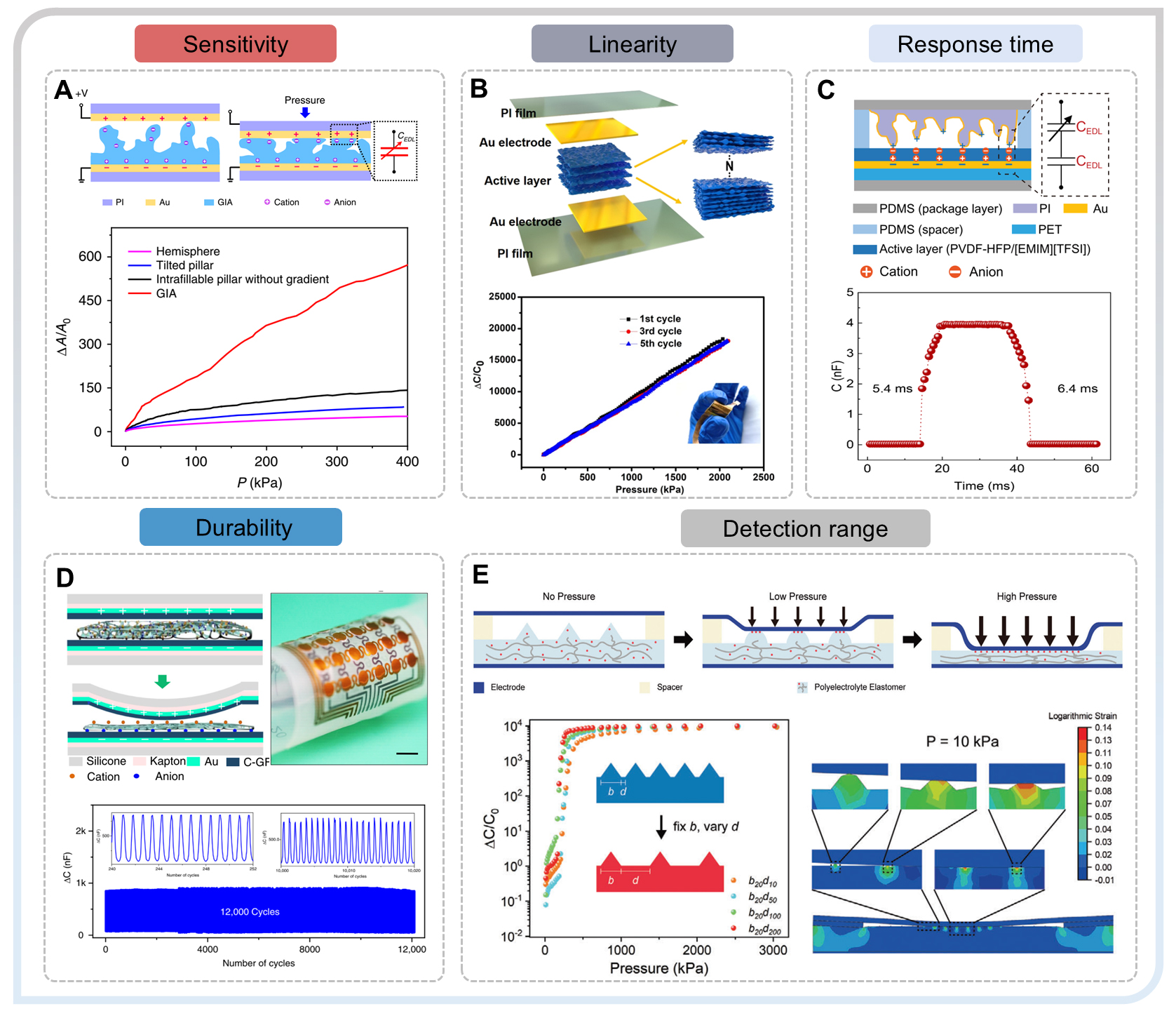
Figure 2. Performance Characteristics of FIPS. (A) Sensitivity. This figure is quoted with permission from the authors[22]; (B) Linearity. This figure is quoted with permission from the American Chemical Society[23]; (C) Response time. This figure is quoted with permission from the authors[24]; (D) Durability. This figure is quoted with permission from the authors[25]; (E) Detection range. This figure is quoted with permission from Wiley-VCH GmbH[26]. PI: Polyimide; GIA: graded intrafillable architecture; PDMS: polydimethylsiloxane; PVDF-HFP: poly (vinylidene fluoride-co-hexafluoropropylene); [EMIM][TFSI]: 1-Ethyl-3-methylimidazolium bis(trifluoromethylsulfonyl) imide; EDL: electrical double layer; FIPS: flexible iontronic pressure sensors.
Linearity refers to the degree to which the output capacitance scales proportionally with applied pressure and is essential for accurate and stable signal interpretation. By carefully selecting materials and optimizing device architecture, the contact area between the electrode and the ionic dielectric layer can be modulated under applied pressure, resulting in an almost linear capacitance response [Figure 2B]. Response time and recovery time characterize the sensor’s dynamic behavior under loading and unloading conditions, directly affecting its ability to track transient signals. In general, electrode conductivity, interfacial structure, and the sensing area are the primary factors governing the dynamic performance [Figure 2C]. Durability reflects the sensor’s capacity to sustain stable output during long-term cyclic loading and under complex environmental conditions, relying on both material mechanical robustness and sound structural design [Figure 2D]. The detection range defines the pressure interval over which the sensor can accurately respond, which is primarily determined by the properties of the materials and structural parameters, and thus dictates the sensor’s applicability across different operational scenarios.
Strategies for enhancing the sensing performance of FIPS
A systematic approach to improving FIPS performance requires linking key material and structural challenges to strategies in materials innovation, structural engineering, and mechanism-driven optimization. The dielectric layer is the core determinant of sensor sensitivity and low-pressure responsiveness, serving as a central target for optimization and requiring a high density of mobile ions. Typical dielectric materials include water-soluble polymers, organic polymers, and polyelectrolytes, each with distinct challenges and optimization pathways. Water-soluble polymers [e.g., polyvinyl alcohol (PVA), poly(ethylene glycol) (PEG), and polyacrylic acid (PAA)] offer high ionic mobility but are sensitive to humidity and pH, which may induce output drift [Figure 3A], indicating materials innovation should improve stability while retaining mobility. Organic polymer-based ion gels with ionic liquids [e.g., poly (vinylidene fluoride-co-hexafluoropropylene) (PVDF-HFP) and thermoplastic polyurethane (TPU)] combine high conductivity with mechanical stability [Figure 3B], highlighting structural engineering of polymer networks as an effective route. Polyelectrolytes (e.g., polystyrene sulfonate and quaternary ammonium polymers) stabilize ions, minimizing leakage and enhancing reliability [Figure 3C], allowing mechanism-driven tuning of sensitivity–stability trade-offs. Ion type, concentration, and mobility govern EDL capacitance and response: high-mobility ions reduce response time, higher concentration enhances sensitivity but may cause EDL saturation or leakage. Ion size and polarity also affect EDL thickness and linearity; small, highly polar ions form thinner Helmholtz layers, increasing capacitance and low-pressure sensitivity, providing mechanistic guidance for rational ion selection.
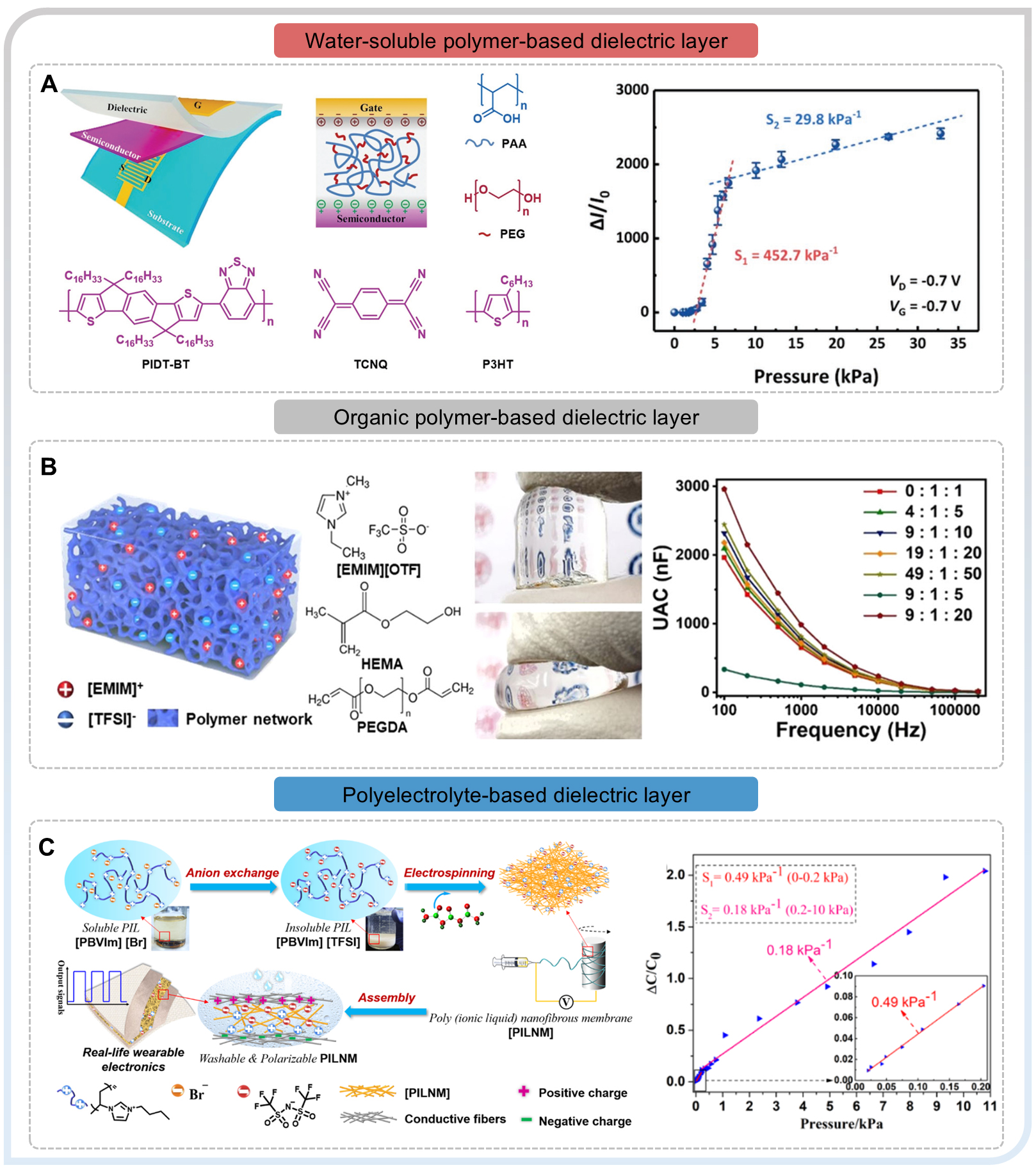
Figure 3. Strategies for dielectric material selection to enhance sensing performance. (A) Water-soluble polymer-based dielectric layer. This figure is quoted with permission from Wiley-VCH GmbH[27]; (B) Organic polymer-based dielectric layer. This figure is quoted with permission from the authors[28]; (C) Polyelectrolyte-based dielectric layer. This figure is quoted with permission from the American Chemical Society[29]. PEG: Poly(ethylene glycol); PAA: polyacrylic acid; PIDT-BT: poly(indacenodithiophene-co-benzothiadiazole); P3HT: poly(3-hexylthiophene); TCNQ: tetracyanoquinodimethane; PILNM: poly(ionic liquid) nanofibrous membrane; UAC: unit-area capacitance; HEMA: 2-Hydroxyethyl methacrylate; PEGDA: poly (ethylene glycol) diacrylate; [EMIM]: 1-Ethyl-3-methylimidazolium; [TFSI]: bis (trifluoromethanesulfonyl) imide; [OTF]: trifluoromethanesulfonate.
Structural design plays a complementary role in modulating the electrode–dielectric interfacial contact area and elastic deformation. Low-modulus materials undergo significant compression under small pressures, improving low-pressure sensitivity, but may saturate early and limit the detectable pressure range. Introducing microstructures on the electrode or dielectric surfaces (e.g., protrusions, pores, or textures) allows the interfacial area to expand proportionally with applied pressure, extending the detection range while preserving high sensitivity. Moreover, optimized microstructures can enhance response speed, recovery time, and durability [Table 1][28,30-40], offering a mechanism-driven strategy for dynamic and long-term performance optimization.
Performance comparison of microstructured FIPS
| Microstructure | Sensitivity (kPa-1) | Linearity | Response (ms) | Durability (cycles) | Detection range (kPa) | Ref. |
| Bimodal pyramid pattern | 655.3 | - | 11.2/16.8 | 10,000 | < 150 | [30] |
| Hemispherical microfeatures | 83.9 | - | 61/50 | 5,000 | < 100 | [28] |
| Micro-pillared structure | 33.16 | 0.999 | 9/9 | 6,000 | < 180 | [31] |
| Hierarchical microstructure | 36,000 | - | 40/70 | 5,000 | 53 | [32] |
| Graded interlocking architecture | 33.7 | 0.99 | 6/11 | 4,500 | < 3,000 | [33] |
| Wrinkled microstructure | 56.91 | - | 60/50 | 10,000 | 80 | [34] |
| Graded interlocks structure | 49.4 | 0.999 | 0.61/3.63 | 5,000 | 485 | [35] |
| Rose-inspired surface morphology | 480.7 | - | 10/29 | 2,000 | 25 | [36] |
| Foam structure | 105.77 | - | 30/40 | 15,000 | ~ 80 | [37] |
| All-nanofiber structure | 6.21 | - | 170/135 | 6,000 | 120 | [38] |
| Hierarchical spinous morphology | 2,593 | - | 26/13 | 2,700 | < 3,360 | [39] |
| Wavy structure | 986.8 | - | 10/16 | 2,500 | 200 | [40] |
Outlooks and challenges
FIPS exploit an EDL-dominated sensing mechanism at the electrode-dielectric interface, offering ultrahigh sensitivity, low-pressure responsiveness, and fast dynamic performance, which are attractive for wearable electronics, e-skin, and health monitoring. However, optimizing performance remains challenging. Material-wise, high-mobility or concentrated ions enhance interfacial capacitance but risk premature EDL saturation or leakage, while water-soluble and organic polymers face environmental sensitivity or complex fabrication. Structurally, low-modulus materials and microstructured surfaces improve low-pressure sensitivity but may compromise linearity and durability under excessive deformation. Mechanistically, the precise modulation of interfacial capacitance and EDL dynamics under pressure is still not fully understood, limiting linear response, distributed sensing, and high-precision measurements.
Future development should pursue a synergistic approach integrating materials, structural design, and mechanistic understanding. Materials should combine high ionic conductivity, mechanical flexibility, and environmental stability to enhance response speed, low-pressure sensitivity, and long-term reliability. Structural design should employ microstructural optimization to achieve controllable modulation of the electrode-dielectric contact area, balancing sensitivity and pressure range. Mechanistic studies should aim to elucidate EDL formation, ion migration, and the coupling between interfacial capacitance and applied stress, as well as the dynamic evolution of EDL thickness and ion distribution under pressure, providing guidance for multi-scale optimization and rational device design. Through the combined strategy of materials innovation, structural engineering, and mechanism-driven optimization, FIPS are expected to achieve high performance and controllable operation in advanced applications such as wearable electronics, robotic tactile sensing, and human-machine interfaces.
DECLARATIONS
Authors’ contributions
Conceptualized the idea and led the project: Wei, D.; Wang, Z. L.; Chu, D.; Amaratunga, G.
Made substantial contributions to writing the paper: Wei, D.; Du, Y.
Availability of data and materials
Not applicable.
Financial support and sponsorship
This work was supported by the National Natural Science Foundation (Grant No. 22479016).
Conflicts of interest
Wei, D. is the Editor-in-Chief of Iontronics. Wang, Z. L. is the Honorary Editor-in-Chief of Iontronics. Amaratunga, G. is an Associate Editor of Iontronics. Wei, D., Wang, Z. L. and Amaratunga, G. were not involved in any steps of the editorial process, including reviewer selection, manuscript handling, or decision making. The other authors declare that there are no conflicts of interest.
Ethical approval and consent to participate
Not applicable.
Consent for publication
Not applicable.
Copyright
© The Author(s) 2026.
REFERENCES
1. Ren, H.; Zheng, L.; Wang, G.; et al. Transfer-medium-free nanofiber-reinforced graphene film and applications in wearable transparent pressure sensors. ACS. Nano. 2019, 13, 5541-8.
2. Mishra, R. B.; El-Atab, N.; Hussain, A. M.Hussain, M. M. Recent progress on flexible capacitive pressure sensors: from design and materials to applications. Adv. Mater. Technol. 2021, 6, 2001023.
3. Zhou, P.-E.; Li, J.-G.; He, W.-Y.; et al. Real-time mapping of high-degree-of-freedom and high-fidelity gestures based on piezoelectric sensor clusters. SmartSys. 2025, 1, e70014.
4. Du, Y.; Shen, P.; Liu, H.; et al. Multi-receptor skin with highly sensitive tele-perception somatosensory. Sci. Adv. 2024, 10, eadp8681.
5. Larson, C.; Peele, B.; Li, S.; et al. Highly stretchable electroluminescent skin for optical signaling and tactile sensing. Science 2016, 351, 1071-4.
6. Du, Y.; Shen, P.; Liu, H.; et al. Meta-structured electret heterointerface for resilient and adaptive tele-perception in embodied intelligence. Matter. 2025, 8, 102363.
7. Guo, P.; Jia, M.; Guo, D.; Ren, T.; Wang, Z. L.; Zhai, J. Progress in flexoelectric effect research and related applications. SmartSys. 2025, 1, e1.
8. Hou, B.; Yi, L.; Li, C.; et al. An interactive mouthguard based on mechanoluminescence-powered optical fibre sensors for bite-controlled device operation. Nat. Electron. 2022, 5, 682-93.
10. Pan, L.; Chortos, A.; Yu, G.; et al. An ultra-sensitive resistive pressure sensor based on hollow-sphere microstructure induced elasticity in conducting polymer film. Nat. Commun. 2014, 5, 3002.
11. He, X.; Zhang, B.; Liu, Q.; et al. Highly conductive and stretchable nanostructured ionogels for 3D printing capacitive sensors with superior performance. Nat. Commun. 2024, 15, 6431.
12. Nie, B.; Li, R.; Cao, J.; Brandt, J. D.; Pan, T. Flexible transparent iontronic film for interfacial capacitive pressure sensing. Adv. Mater. 2015, 27, 6055-62.
13. Fan, W.; Lei, R.; Dou, H.; et al. Sweat permeable and ultrahigh strength 3D PVDF piezoelectric nanoyarn fabric strain sensor. Nat. Commun. 2024, 15, 3509.
14. Qiao, L.; Gao, X.; Ren, K.; et al. Designing transparent piezoelectric metasurfaces for adaptive optics. Nat. Commun. 2024, 15, 805.
15. Fan, F.-R.; Tian, Z.-Q.; Lin Wang, Z. Flexible triboelectric generator. Nano. Energy. 2012, 1, 328-34.
16. Lu, X.; Xia, H.; Zhu, L.; et al. A high-precision triboelectric rotational sensor for enhanced low-speed monitoring via magnetic modulation in smart fitness systems. SmartSys. 2025, 1, e70011.
17. Hong, S. J.; Lee, Y. R.; Bag, A.; et al. Bio-inspired artificial mechanoreceptors with built-in synaptic functions for intelligent tactile skin. Nat. Mater. 2025, 24, 1100-8.
18. Nie, B.; Xing, S.; Brandt, J. D.; Pan, T. Droplet-based interfacial capacitive sensing. Lab. Chip. 2012, 12, 1110-8.
19. Wang, X.; Guo, C.; Su, Z.; et al. Flexible iontronic pressure sensing technology: advanced structural ionic layer. Iontronics 2026, 2, 1.
20. Zhang, N.; He, Y.; Wang, L. Designing FIPS: a perspective from multiscale mechanics. Iontronics. 2025, 1, 5.
21. Li, X.; Wang, Z. L.Wei, D. Iontronic logic control driven by dynamic electrical double layer regulation. Iontronics. 2025, 1, 2.
22. Bai, N.; Wang, L.; Wang, Q.; et al. Graded intrafillable architecture-based iontronic pressure sensor with ultra-broad-range high sensitivity. Nat. Commun. 2020, 11, 209.
23. Xiao, Y.; Duan, Y.; Li, N.; et al. Multilayer double-sided microstructured flexible iontronic pressure sensor with a record-wide linear working range. ACS. Sens. 2021, 6, 1785-95.
24. Cheng, Y.; Zhan, Y.; Guan, F.; et al. Displacement-pressure biparametrically regulated softness sensory system for intraocular pressure monitoring. Natl. Sci. Rev. 2024, 11, nwae050.
25. Xu, H.; Gao, L.; Zhao, H.; et al. Stretchable and anti-impact iontronic pressure sensor with an ultrabroad linear range for biophysical monitoring and deep learning-aided knee rehabilitation. Microsyst. Nanoeng. 2021, 7, 92.
26. Yuan, Y. M.; Liu, B.; Adibeig, M. R.; et al. Microstructured polyelectrolyte elastomer-based ionotronic sensors with high sensitivities and excellent stability for artificial skins. Adv. Mater. 2024, 36, e2310429.
27. Liu, Z.; Yin, Z. Wang, J.Zheng, Q. Polyelectrolyte dielectrics for flexible low-voltage organic thin-film transistors in highly sensitive pressure sensing. Adv. Funct. Mater. 2018, 29, 1806092.
28. Tang, J.; Zhao, C.; Luo, Q.; Chang, Y.; Yang, Z.; Pan, T. Ultrahigh-transparency and pressure-sensitive iontronic device for tactile intelligence. NPJ Flex. Electron. 2022, 6, 54.
29. Wang, Z.; Si, Y.; Zhao, C.; Yu, D.; Wang, W.; Sun, G. Flexible and washable poly(ionic liquid) nanofibrous membrane with moisture proof pressure sensing for real-life wearable electronics. ACS. Appl. Mater. Interfaces. 2019, 11, 27200-9.
30. Niu, H.; Wei, X.; Li, H.; et al. Micropyramid array bimodal electronic skin for intelligent material and surface shape perception based on capacitive sensing. Adv. Sci. (Weinh). 2024, 11, e2305528.
31. Lu, P.; Wang, L.; Zhu, P.; et al. Iontronic pressure sensor with high sensitivity and linear response over a wide pressure range based on soft micropillared electrodes. Sci. Bull. (Beijing). 2021, 66, 1091-100.
32. Luo, Y.; Chen, X.; Tian, H.; et al. Gecko-inspired slant hierarchical microstructure-based ultrasensitive iontronic pressure sensor for intelligent interaction. Research. (Wash. D. C). 2022, 2022, 9852138.
33. Yang, R.; Dutta, A.; Li, B.; et al. Iontronic pressure sensor with high sensitivity over ultra-broad linear range enabled by laser-induced gradient micro-pyramids. Nat. Commun. 2023, 14, 2907.
34. Cho, C.; Kim, D.; Lee, C.; Oh, J. H. Ultrasensitive ionic liquid polymer composites with a convex and wrinkled microstructure and their application as wearable pressure sensors. ACS. Appl. Mater. Interfaces. 2023, 15, 13625-36.
35. Bai, N.; Wang, L.; Xue, Y.; et al. Graded interlocks for iontronic pressure sensors with high sensitivity and high linearity over a broad range. ACS. Nano. 2022, 16, 4338-47.
36. Liu, Y.; Wang, J.; Chen, J. Yuan, Q.Zhu, Y. Ultrasensitive iontronic pressure sensor based on rose-structured ionogel dielectric layer and compressively porous electrodes. Adv. Compos. Hybrid. Mater. 2023, 6, 210.
37. Sun, G. Wang, P.Meng, C. Flexible and breathable iontronic tactile sensor with personal thermal management ability for a comfortable skin-attached sensing application. Nano. Energy. 2023, 118, 109006.
38. Cui, X.; Chen, J.; Wu, W.; et al. Flexible and breathable all-nanofiber FIPS with ultraviolet shielding and antibacterial performances for wearable electronics. Nano. Energy. 2022, 95, 107022.
39. Ding, Z.; Li, W.; Wang, W.; et al. Highly sensitive iontronic pressure sensor with side-by-side package based on alveoli and arch structure. Adv. Sci. (Weinh). 2024, 11, e2309407.
Cite This Article
 Open Access
How to Cite
Download Citation
Export Citation File:
Type of Import
Tips on Downloading Citation
Citation Manager File Format
Type of Import
Direct Import: When the Direct Import option is selected (the default state), a dialogue box will give you the option to Save or Open the downloaded citation data. Choosing Open will either launch your citation manager or give you a choice of applications with which to use the metadata. The Save option saves the file locally for later use.
Indirect Import: When the Indirect Import option is selected, the metadata is displayed and may be copied and pasted as needed.
About This Article
Copyright

Data & Comments
Data
0







Comments
Comments must be written in English. Spam, offensive content, impersonation, and private information will not be permitted. If any comment is reported and identified as inappropriate content by OAE staff, the comment will be removed without notice. If you have any queries or need any help, please contact us at support@oaepublish.com.