



Robust CoRuOx oxide catalysts with broad electrolyte compatibility toward superior hydrogen evolution
 0
0 Abstract
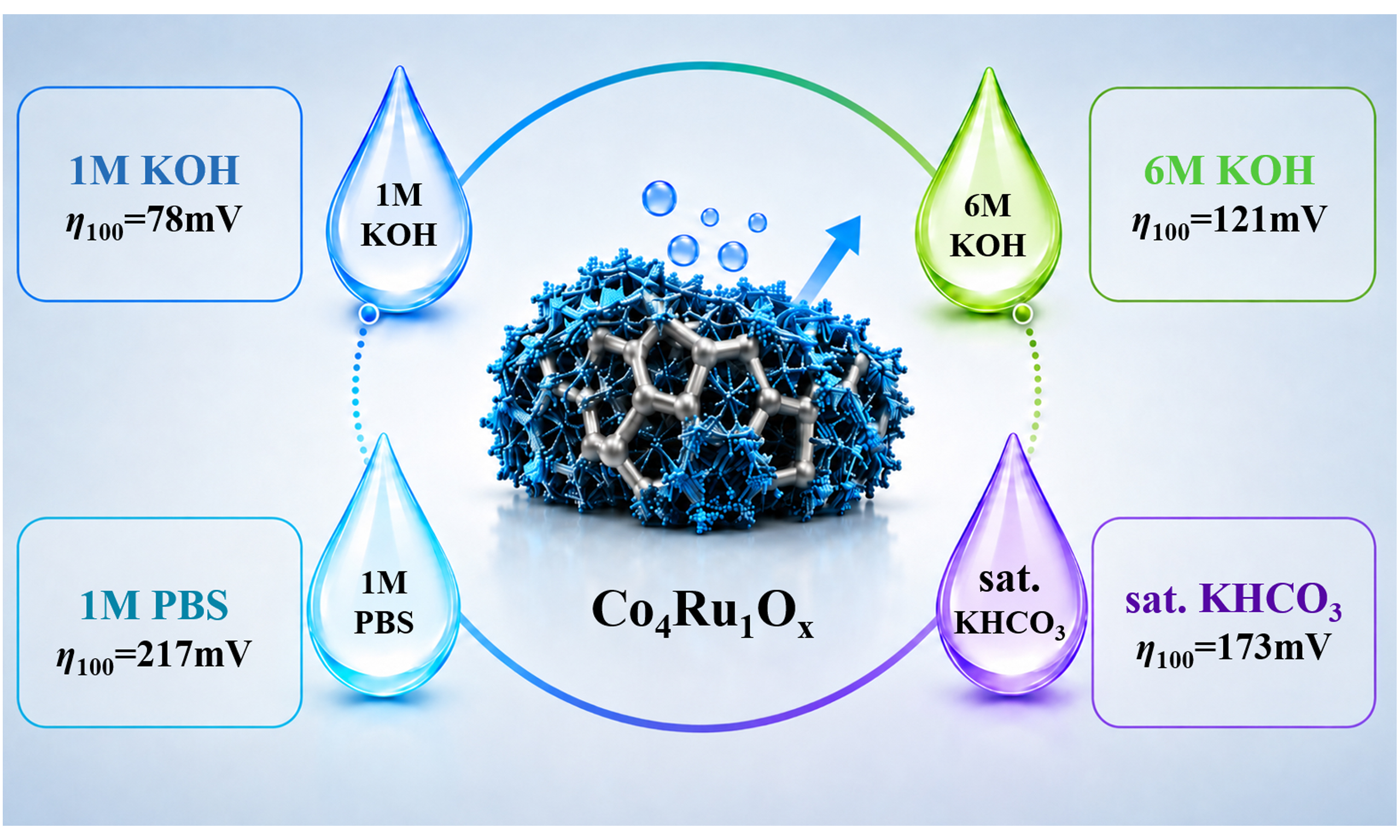
Developing hydrogen evolution reaction (HER) electrocatalysts that combine high activity with reliable operation in different electrolytes remains important for clean-hydrogen and electrochemical-energy technologies. In this study, CoRu composite oxides with adjustable Co/Ru molar ratios were formed in situ on nickel foam through co-precipitation and subsequent high-temperature calcination, and their HER behavior was examined in alkaline, neutral, and near-neutral media. Co4Ru1Ox showed the good activity and durability. In 1 M KOH, current densities of 100, 300, and 700 mA cm-2 were obtained at overpotentials of 78, 127, and 196 mV, respectively; the corresponding Tafel slope was 21.64 mV dec-1. The electrode also operated for 200 h in both 1 and 6 M KOH. When incorporated into a membrane electrode assembly electrolyzer, Co4Ru1Ox||NF sustained overall water splitting at 100 mA cm-2 for 200 h. In 1 M phosphate buffer solution, only 16 mV was needed to deliver 10 mA cm-2, and stable operation was again maintained for 200 h. High-current HER activity was also obtained in saturated KHCO3, while a Zn-CO2 cell using this catalyst reached a maximum power density of 9.6 mW cm-2. Collectively, these findings identify
Keywords
INTRODUCTION
Rising energy consumption and worsening environmental pollution have intensified interest in hydrogen as a clean energy vector because it has a high mass-specific energy content and produces only water upon combustion[1-3]. Water electrolysis powered by renewable electricity can generate high-purity hydrogen through a sustainable pathway[4]. During the hydrogen evolution reaction (HER), water adsorbs and dissociates before hydrogen intermediates form and subsequently desorb. Catalysts that retain both activity and stability across dissimilar electrolytes are therefore required for efficient hydrogen production and practical energy-conversion systems[5].
Platinum catalysts provide fast HER kinetics at small overpotentials, but their broader use is limited by the scarcity and high cost of Pt[4,6]. Prolonged operation can also promote particle agglomeration and the loss of active sites, thereby compromising durability and impeding large-scale electrochemical hydrogen production[7,8]. Ruthenium is a less expensive platinum-group metal with considerable HER activity and has consequently been studied as an alkaline-media substitute for Pt[9,10]. Even so, single-phase Ru catalysts may use the noble metal inefficiently and may lack structural robustness. Combining Ru with cobalt oxides offers a route to lower Ru loading while exploiting cooperative effects to improve activity and stability[11-13]. The benefits of such Ru-Co oxides in alkaline HER have been demonstrated previously. Zhang et al., for example, derived the Ru-Co3O4-NiO-NF heterostructure from a metal-organic framework[12]. In 1 M KOH, this catalyst required 44 mV at 10 mA cm-2 and 115 mV at 100 mA cm-2. It outperformed most reported Ru-Co catalysts and commercial Pt/C in that study and remained stable during a 60 h test at high current density. Ren et al. later prepared a MOF-derived RuO2-Co3O4 bimetallic oxide in which interactions between the two oxide components modified the local electronic structure and promoted interfacial charge redistribution[13].
Although Ru-Co-based oxides have demonstrated promising HER performance in alkaline media[13], recent studies have begun to explore their activity under broader pH conditions, highlighting the additional kinetic challenges posed by neutral and near-neutral electrolytes[14,15]. Nevertheless, systematic investigations of Ru-Co-based oxides across distinct electrolyte environments, particularly buffered and bicarbonate-containing media, remain limited. In neutral or buffered media, HER kinetics are governed by water dissociation, buffer-assisted proton transfer, local pH variation, and interfacial mass transport and differ markedly from those in strongly alkaline electrolytes[16-18]. Therefore, evaluating catalysts beyond conventional alkaline KOH is essential for clarifying their adaptability to different proton-transfer and interfacial reaction environments[18,19]. Kim et al. proposed aqueous Zn/Al-CO2 systems that exploit CO2-induced acidity to achieve simultaneous electricity generation and H2 production, using a separated alkaline anodic compartment and a saturated KHCO3 cathodic environment[20]. In this metal-CO2 configuration, a saturated KHCO3 electrolyte creates a bicarbonate-rich cathodic environment, where local acidity is generated by continuous CO2 feeding. The HER catalyst at the cathode must not only accelerate proton reduction for efficient H2 generation but also maintain catalytic activity and interfacial stability during the accompanying CO2 mineralization process. This process involves HCO3-/CO32- interconversion, local pH fluctuation, competitive adsorption, and carbonate precipitation at the reactive interface. Therefore, the half-cell tests in saturated KHCO3 provide a more realistic assessment of the catalyst under metal-CO2 cathodic conditions. Integration into a full metal-CO2 cell further verifies the catalyst's ability to promote hydrogen production and enhance the overall power output.
Here, a multifunctional Ru-Co oxide catalyst was fabricated on nickel foam (NF) by co-precipitation and heat treatment. We then assessed its electrochemical response in 1 M KOH, 6 M KOH, saturated KHCO3, and 1 M phosphate buffer solution (PBS). The catalyst showed strong and durable HER activity in both KOH concentrations; it also performed well in PBS and showed utility for a metal-CO2 configuration in saturated KHCO3. These properties reflect cooperation between the Ru and Co oxide components, rapid mass and charge transfer through the three-dimensional conductive NF scaffold, and the availability of numerous surface sites. Beyond alkaline testing, the study establishes how the HER behavior of Ru-Co oxides changes with electrolyte environment. Relating activity to interfacial water activation, charge-transfer behavior, and electrolyte-controlled proton delivery provides a basis for designing durable HER catalysts with broad electrolyte tolerance.
EXPERIMENTAL
Chemicals
Analytical-grade ruthenium chloride hydrate (RuCl3·xH2O), cobalt(II) chloride hexahydrate (CoCl2·6H2O), potassium bicarbonate (KHCO3), anhydrous ethanol (C2H5OH), urea (CO(NH2)2), 1 M PBS (pH 7.0), ethylene glycol (C2H6O2), hydrochloric acid (HCl, 36-38 wt%), and potassium hydroxide (KOH) were obtained from Aladdin. NF was obtained from Shanghai Jiaqingyuan Co., Ltd. Each chemical was employed as received, without an additional purification step.
Synthesis of CoRuOx
CoRuOx electrocatalysts were deposited directly on NF by co-precipitation and then calcined. Before deposition, a 1 cm × 2 cm NF piece was sonicated for 10 min in 40 mL of 3 M HCl to strip the native oxide layer. It was subsequently sonicated in 40 mL of anhydrous ethanol for 3 min, washed repeatedly with deionized water until neutral, and dried at ambient temperature.
RuCl3·xH2O and CoCl2·6H2O were used as the Ru and Co sources, respectively. To prepare Co1Ru1(OH)x, 0.0414 g (0.2 mmol) of RuCl3·xH2O, 0.0476 g (0.2 mmol) of CoCl2·6H2O, and 0.012 g (0.2 mmol) of urea were dispersed in 40 mL of ethylene glycol by sonication. The same protocol was applied to
The cleaned NF was placed vertically in each precursor solution, which was maintained at 95 °C for 12 h. The recovered specimens were alternately rinsed three times with anhydrous ethanol and deionized water to eliminate residual ions and weakly adsorbed material, followed by air drying at room temperature. The hydroxide intermediates were labeled Co1Ru1(OH)x, Co2Ru1(OH)x, Co3Ru1(OH)x, Co4Ru1(OH)x, Co5Ru1(OH)x, Co(OH)x, and Ru(OH)x. They were placed in a crucible, heated at 2 °C min-1 to 300 °C, and calcined for 2 h. The products were denoted Co1Ru1Ox, Co2Ru1Ox, Co3Ru1Ox, Co4Ru1Ox, Co5Ru1Ox, CoOx, and RuOx, respectively. For electrochemical testing, a 1 cm × 1 cm catalyst-coated region was exposed to the electrolyte; the other 1 cm × 1 cm region was insulated and attached to the electrode clip. Reported current densities were normalized to the 1.0 cm2 exposed geometric area.
Material characterizations
Sample morphology was examined by scanning electron microscopy (SEM, JSM-6701F, JEOL, Japan) at
Electrocatalytic measurements
Electrochemical measurements were performed using a CS350M workstation from CH Instruments. Catalyst-coated NF with a 1 cm2 exposed area was the working electrode for HER testing in KOH; Hg/HgO and graphite were used as the reference and counter electrodes, respectively. Except for the potentials monitored directly during durability experiments, all measured potentials were converted to the reversible hydrogen electrode (RHE) scale. For a Hg/HgO electrode filled with 1 M KOH, the conversion followed Ref.[21]:
Potentials measured with an Ag/AgCl reference electrode containing saturated KCl were converted as described in Ref.[22]:
The measured pH values were 14, 7, and 8 for 1 M KOH, 1 M PBS, and saturated KHCO3, respectively.
Linear sweep voltammograms were collected at 5 mV s-1 with 90% iR compensation. To estimate the electrochemical double-layer capacitance (Cdl), cyclic voltammograms in 1 M KOH were obtained at 10, 20, 40, 60, 80, 100, and 120 mV s-1. The electrochemical surface area (ECSA) was then determined from Cdl using:
Here, S is the geometric area of the working electrode, and Cs is the specific capacitance assigned to an ideally smooth surface. A Cs value of 40 μF cm-2, selected from prior electrochemical reports, was used in this study[23]. For 1 M PBS and saturated KHCO3, CV data were collected at 20, 40, 60, 80, and 100 mV s-1.
The durability of Co4Ru1Ox was evaluated using a direct-current power supply for 200 h. The starting current density was -100 mA cm-2 in 1 and 6 M KOH and -10 mA cm-2 in 1 M PBS. Overall water splitting was evaluated in a membrane electrode assembly (MEA) containing Co4Ru1Ox as the cathode and NF as the anode; its linear sweep voltammetry (LSV) curve was recorded at 50 mV s-1. For Zn-CO2 testing, Zn foil and Co4Ru1Ox served as the anode and cathode, respectively, under continuous CO2 supply. Polarization data were acquired at 50 mV s-1, and the overpotentials were derived from RHE-converted potentials.
RESULTS AND DISCUSSION
Evaluation of HER performance
Alkaline HER activity was first compared for the prepared CoRuOx electrodes in 1 M KOH. Co4Ru1Ox was the most active composition: overpotentials of 78, 127, and 196 mV produced 100, 300, and 700 mA cm-2, respectively. At 100 and 300 mA cm-2, these values were lower than those of Co1Ru1Ox (262 and 340 mV), Co5Ru1Ox (127 and 225 mV), and commercial Pt/C (115 and 250 mV) [Figure 1A and B]. Its advantage over Pt/C increased further at 700 mA cm-2, supporting its suitability for high-current alkaline operation[9,24]. The Tafel plot in Figure 1C gave a slope of 21.64 mV dec-1 for Co4Ru1Ox, smaller than those of the other prepared electrodes and Pt/C, and therefore indicative of faster HER kinetics[25].
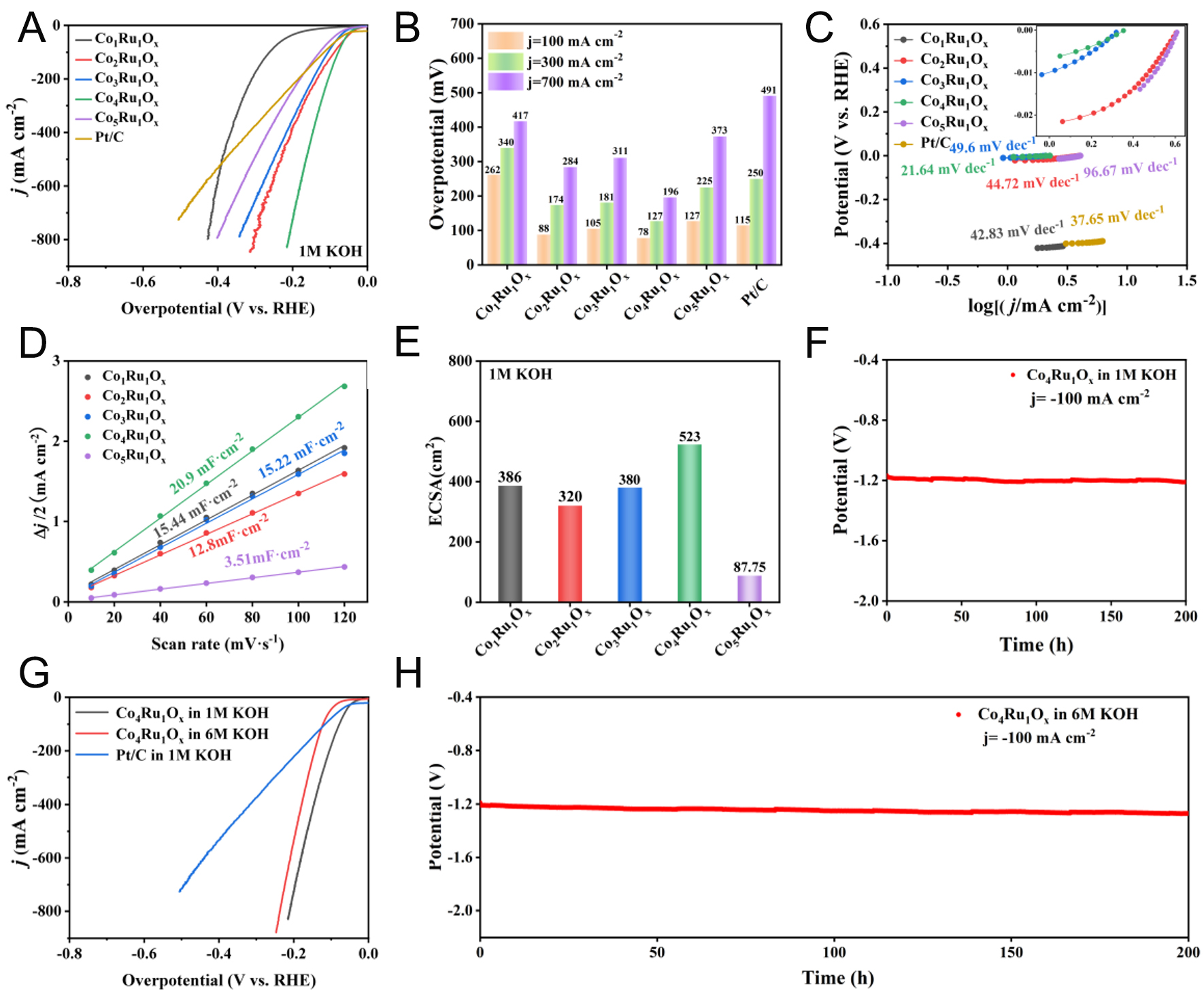
Figure 1. HER characterization of CoxRu1Ox and reference catalysts in 1 M KOH: (A) LSV responses; (B) overpotentials at selected current densities; (C) Tafel plots; (D) Cdl; (E) ECSA; and (F) 200 h chronopotentiometry of Co4Ru1Ox at -100 mA cm-2. (G) HER polarization of Co4Ru1Ox in 1 and 6 M KOH, together with Pt/C in 1 M KOH. (H) A 200 h stability trace for Co4Ru1Ox at -100 mA cm-2 in 6 M KOH.
Cyclic voltammetry was used to probe the origin of the high HER activity. Co1Ru1Ox, Co2Ru1Ox, Co3Ru1Ox, Co4Ru1Ox, Co5Ru1Ox, and Pt/C were scanned from 10 to 120 mV s-1 [Supplementary Figure 1]. As presented in Figure 1D, the Cdl of Co4Ru1Ox was 20.9 mF cm-2, exceeding the values for Co5Ru1Ox (3.51 mF cm-2), Co1Ru1Ox (15.44 mF cm-2), and Pt/C (13.2 mF cm-2; Supplementary Figure 2). The calculated ECSA values are summarized in Figure 1E. Co4Ru1Ox reached 523 cm2, compared with 330 cm2 for Pt/C, consistent with a larger number of accessible sites. Chronopotentiometry in 1 M KOH was then used to assess durability. At -100 mA cm-2, the potential of Co4Ru1Ox changed negligibly over 200 h [Figure 1F], demonstrating robust alkaline stability.
The polarization response in 6 M KOH was compared with that in 1 M KOH in Figure 1G. Larger overpotentials, especially at high current, were observed in the more concentrated electrolyte. The greater viscosity and lower water activity of 6 M KOH can impede ion diffusion, transport near the electrode, and detachment of gas bubbles[26,27]. A smaller population of free water molecules may also slow water dissociation, an important kinetic step in alkaline HER[28,29]. Thus, any conductivity gain at higher KOH concentration is offset by less favorable mass transfer and interfacial reaction conditions. Nevertheless, Co4Ru1Ox needed only 121, 162, and 223 mV to reach 100, 300, and 700 mA cm-2 in 6 M KOH. In addition, operation at
Morphologies and structures of CoRuOx
Morphological, structural, and elemental data for Co4Ru1Ox are compiled in Figure 2. Before the durability experiment, the SEM image in Figure 2A shows an interconnected, comparatively uniform porous network. This architecture increases access to reaction sites and supports electrolyte infiltration and reactant transport, which benefit HER[30]. The pre-test EDS maps [Supplementary Figure 3] show broadly even distributions of Co, Ru, Ni, and O. After 200 h of HER operation, most of the porous skeleton remains visible, although limited reconstruction and small surface particles appear [Figure 2B]. The post-test maps in
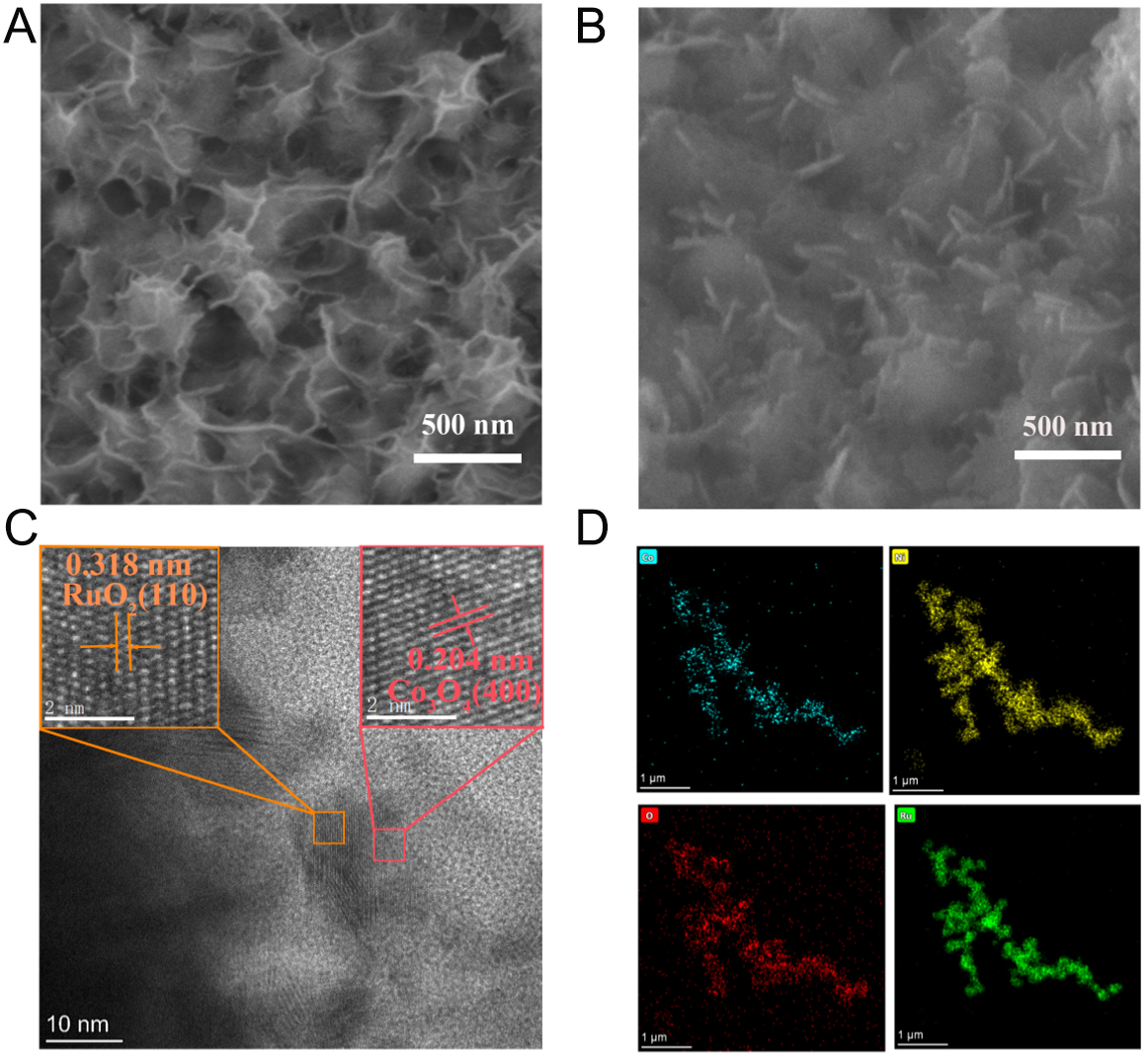
Figure 2. Morphology and elemental distribution of Co4Ru1Ox: SEM images obtained (A) before and (B) after a 200 h HER durability experiment in 1 M KOH; (C) TEM image with magnified HRTEM regions; and (D) associated EDS maps.
XPS was used to compare the surface states of Co4Ru1Ox before and after the 200 h HER test in 1 M KOH [Supplementary Figure 6]. The survey spectra in Supplementary Figure 6A contain signals from Co, Ru, O, C, and Ni in both specimens, showing that the principal surface elements persist after extended operation. In the Co 2p spectra [Supplementary Figure 6B], the initial Co 2p3/2 and Co 2p1/2 components occur at 780.9 and 796.9 eV, with satellites at 789.5 and 801.2 eV[33,34]. Following the durability test, the principal components were observed at 781.1 and 797.3 eV, and the satellites at 787.6 and 801.6 eV. The modest changes in position and line shape indicate that the Co-containing surface species remain largely intact. The O 1s spectra in Supplementary Figure 6C contain surface-oxygen and lattice-oxygen contributions. Their initial positions, 531.9 and 530.9 eV, shift to 531.4 and 530.7 eV after testing[34,35], while the two-component profile is preserved. This response is consistent with a stable oxygen environment and oxide framework. Supplementary Figure 6D covers the overlapping C 1s/Ru 3d region. Before testing, the 284.8 eV feature arises from C-C/C=C bonds, and the 280.2 and 286.6 eV components are associated with Ru 3d[36]. Ru-related signals remain readily observable after 200 h without an obvious loss in overall intensity, confirming retention of surface Ru.
The electronic states and short-range coordination of Co and Ru were probed by XPS and XAFS to understand the superior HER activity of Co4Ru1Ox. The high-resolution spectra indicate appreciable Co-Ru electronic coupling [Supplementary Figure 7]. Relative to RuOx, the Ru 3d5/2 component shifts by about
Differences between the Co K-edge XANES spectra of Co4Ru1Ox and CoOx [Supplementary Figure 8] provide further evidence that the electronic environment of Co is altered. Fourier-transformed EXAFS also reveals a change in local coordination. CoOx displays a principal contribution near 2.6 Å that is assigned to Co-O-Co coordination[39], whereas Co4Ru1Ox has a feature near 1.9 Å associated with Co-M (M = Co or Ru) scattering and a weaker Co-O-Co signal. Ru addition therefore reconstructs the local environment of Co and electronically tunes the cobalt-oxide framework. Taken together, the XPS and XAFS data show that Ru changes both the electronic state and coordination of Co, producing catalytic centers with favorable interfacial electronic properties. This reconstruction promotes interfacial electron transfer and regulates the interaction between the active sites and hydrogen intermediates, which helps explain the high HER activity of Co4Ru1Ox.
Evaluation of MEA performance
Practical HER behavior was examined in a MEA electrolyzer[40,41]. The cathode consisted of Co4Ru1Ox on NF, and uncoated NF was used as the anode; this device is denoted Co4Ru1Ox||NF. Figure 3A depicts its cathode-membrane-anode arrangement. Figure 3B shows polarization curves for a 1 × 1 cm2||1 × 1 cm2 cell at several temperatures. Increasing the temperature from 30 to 70 °C continuously increased current density, consistent with accelerated interfacial kinetics, ion transport, and gas-bubble removal. At 2.0 V, the current density rose from 0.43 A cm-2 at 30 °C to 1.59 A cm-2 at 70 °C [Figure 3C]. During a
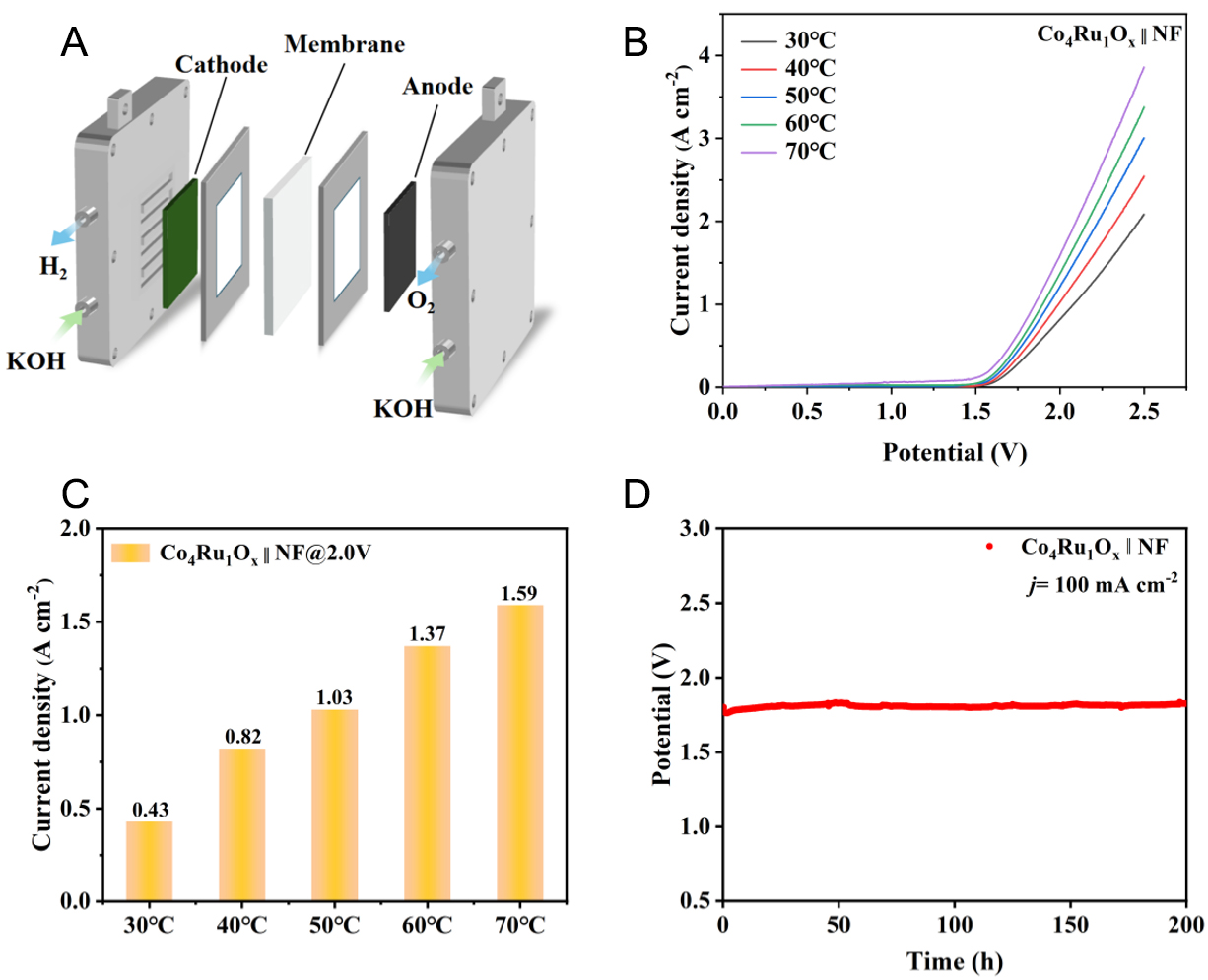
Figure 3. Performance of a Co4Ru1Ox||NF membrane electrolyzer: (A) device configuration; (B) polarization at 30-70 °C; (C) current density at 2.0 V as a function of temperature; and (D) a 200 h chronopotentiometric trace collected at 100 mA cm-2.
Electrochemical performance in neutral and near-neutral electrolytes
Catalyst response in neutral and near-neutral media was assessed in 1 M PBS and saturated KHCO3
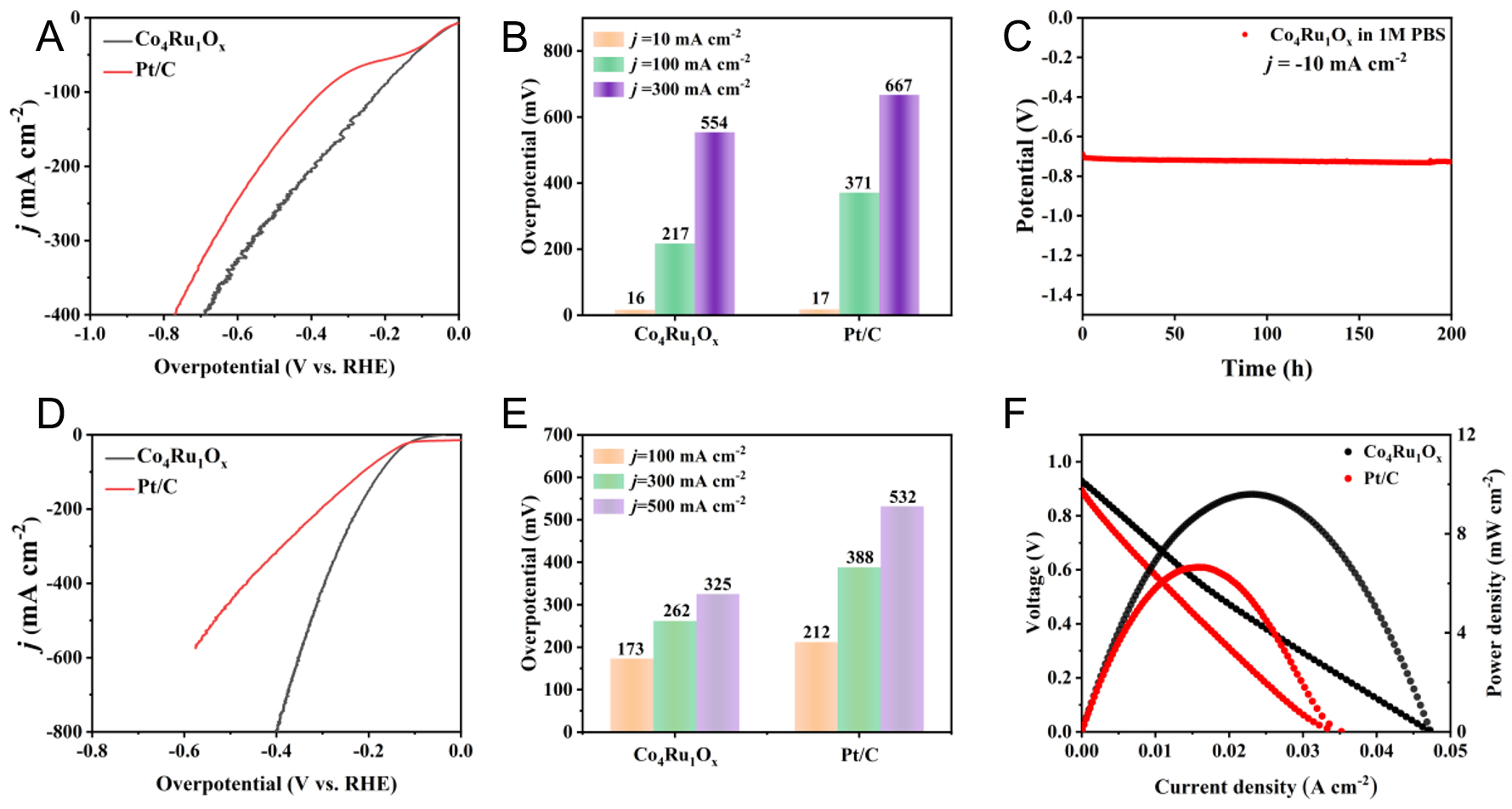
Figure 4. Neutral and near-neutral electrochemical behavior of Co4Ru1Ox: (A) HER polarization, (B) selected overpotentials, and (C) a 200 h stability trace at -10 mA cm-2 in 1 M PBS; (D) polarization and (E) selected overpotentials in saturated KHCO3; and (F) discharge polarization/power-density profiles for Zn-CO2 cells containing Co4Ru1Ox or Pt/C cathodes.
Saturated KHCO3 was also examined in a three-electrode cell using graphite as the counter electrode and Hg/HgO as the reference. In this electrolyte, Co4Ru1Ox again outperformed Pt/C. The oxide catalyst required 173, 262, and 325 mV to produce 100, 300, and 500 mA cm-2, respectively, compared with 212, 388, and
Device-level utility was investigated by using Co4Ru1Ox as the cathode catalyst in a Zn-CO2 cell[42,43]. In the mechanism described by Kim et al.[20], hydration of dissolved CO2 generates carbonic acid and produces a mildly acidic cathodic environment favorable for HER. Simultaneously, Zn oxidation at the anode supplies electrons, allowing hydrogen and electricity to be generated together. The Co4Ru1Ox-based cell attained
Table 1 benchmarks Co4Ru1Ox against recent Ru- and Ru-Co-containing HER electrocatalysts in terms of overpotential, Tafel slope, electrolyte, test current, and durability. In 1 M KOH, Co4Ru1Ox combines an overpotential of 78 mV at -100 mA cm-2, a 21.64 mV dec-1 Tafel slope, and 200 h of continuous operation. This balance of activity and durability compares favorably with many reported Ru-based and Ru-Co-based materials and is consistent with cooperative Co/Ru oxide effects and a tuned surface electronic environment. Unlike most alkaline-centered reports, the present catalyst also remains active in neutral PBS and bicarbonate media, demonstrating compatibility with distinct proton-transfer environments.
Comparison of HER performance of Co4Ru1Ox with representative Ru-based and Co-Ru-based electrocatalysts
| Electrocatalysts | Overpotential | Tafel slope | Stability | Reference |
| Co4Ru1Ox | ղ100 = 78 mV (1 M KOH) | 21.64 mV dec-1 | @-100 mA cm-2 200 h | This work |
| RuCo3O4-NiO-NF | ղ100 = 115 mV (1 M KOH) | 53.9 mV dec-1 | @-100 mA cm-2 60 h | [12] |
| Ru/Co4N/NF | ղ100 = 145 mV (1 M KOH) | 25 mV dec-1 | @-100 mA cm-2 120 h | [44] |
| Ru-Co@Ti2AlC | ղ100 = 95 mV (1 M KOH) | 105 mV dec-1 | @-20 mA cm-2 48 h | [45] |
| Ru-O-Ru clusters | ղ100 = 86 mV (1 M KOH) | 29.2 mV dec-1 | @-100 mA cm-2 50 h | [46] |
| NiRuOx-Ar | ղ100 = 94 mV (1 M KOH) | 52.73 mV dec-1 | @-50 mA cm-2 100 h | [47] |
| Ru/Ni3N-Ni | ղ100 = 135 mV (1 M KOH) | 32.4 mV dec-1 | 1,000 cycles | [48] |
| Ru-NiO/CNTs | ղ100 = 98 mV (1 M KOH) | 56.5 mV dec-1 | @-10 mA cm-2 100 h | [49] |
| RuO2−Ti3C2/NF | ղ100 = 85 mV (1 M KOH) | 127.5 mV dec-1 | @-20 mA cm-2 40 h | [50] |
| cRu-Ni3N/NF | ղ100 = 99 mV (1 M KOH) | 26.2 mV dec-1 | 5,000 cycles | [51] |
| Ru-Ni3N@NC | ղ50 = 101 mV (1 M KOH) | 70 mV dec-1 | @-10 mA cm-2 10 h | [52] |
| Ru NRs/TiN | ղ100 = 150 mV (1 M KOH) | 27.08 mV dec-1 | 1,000 cycles | [53] |
| Co4Ru1Ox | ղ10 = 16 mV ղ100 = 217 mV (1 M PBS) | 99.51 mV dec-1 | @-10 mA cm-2 200 h | This work |
| Ru-WO3-x/CP | ղ10 = 19 mV (1 M PBS) | 41 mV dec-1 | @-20 mA cm-2 30 h | [54] |
| CoRu/CoRuP | ղ10 = 31 mV (1 M PBS) | 53.09 mV dec-1 | @-10 mA cm-2 40 h | [55] |
Electrochemical impedance spectroscopy was used to clarify why Co4Ru1Ox remains highly active even though its Cdl is lower than that of Pt/C in PBS and saturated KHCO3 (Nyquist plots,
Operando Raman spectra were next collected in 1 M KOH, 1 M PBS, and saturated KHCO3 to probe the HER interface [Supplementary Figure 19]. Similar potential-dependent changes in the broad O-H stretching envelope near 3,500 cm-1 appear in all three media, showing that interfacial water activation is retained. The elementary HER sequence is comparable, but its rate is shaped by electrolyte-specific proton donors, conductivity, and interfacial solvation. In KOH, water dissociation precedes formation of adsorbed hydrogen. The near-neutral PBS environment supplies fewer protons and normally slows proton transfer; nevertheless, effective water activation at Co4Ru1Ox supports proton delivery and HER[54]. In saturated KHCO3, bands near 1,015 and 1,064 cm-1 are assigned to HCO3- and CO32-, respectively[56,57], evidencing a dynamic interfacial bicarbonate/carbonate equilibrium that buffers local proton transfer. The absence of new bands associated with heavy carbonate or bicarbonate accumulation suggests that these species do not substantially obstruct the active interface. FTIR spectra in Supplementary Figure 20 show hydroxyl-stretching and water-bending bands near 3,404 and 1,630 cm-1, respectively, for both RuOx and
CONCLUSIONS
A porous Co4Ru1Ox electrode was prepared on three-dimensional NF by co-precipitation and calcination and evaluated under several HER conditions. Tuning the Co/Ru ratio enhanced activity, kinetics, and durability through cooperative Co/Ru oxide chemistry, efficient electron and ion transport within the NF network, and ready access to surface sites. After prolonged electrolysis, the porous architecture and homogeneous elemental distribution were largely retained, demonstrating structural and compositional resilience. A MEA containing Co4Ru1Ox||NF operated continuously for 200 h at 100 mA cm-2, supporting its use in practical water splitting. In addition to strong alkaline performance, the catalyst responded effectively and stably in PBS and saturated KHCO3, confirming adaptability to neutral and near-neutral media. Its promising power output in a Zn-CO2 cell further broadens the potential applications beyond water electrolysis. Overall, the findings connect composition control and porous-electrode design with multi-environment operation and provide a route toward versatile, high-performance Ru-Co oxide electrocatalysts.
DECLARATIONS
Authors' contributions
Investigation, formal analysis, writing - original draft: Zheng, Q.
Data curation, investigation: Li, Y.
Validation, formal analysis: Lu, C.
Writing - review & editing: Maubane-Nkadimeng, M. S.
Supervision, funding acquisition, writing - review & editing: Feng, T.
Conceptualization, project administration, resources: Niu, B.
All authors read and approved the final manuscript.
Availability of data and materials
The data supporting the findings of this study are available in the article and its Supplementary Materials. Additional raw data are available from the corresponding author upon reasonable request.
AI and AI-assisted tools statement
During the preparation of this manuscript, the AI tool ChatGPT (GPT-5.5 Instant, released 2026-05-05) was used to assist with language editing and manuscript refinement. In addition, ChatGPT Images 2.0 (released 2026-04-21) was used to assist in creating the graphical abstract. After using this tool/service, the authors carefully reviewed and edited the generated content as needed and take full responsibility for the content of the published article.
Financial support and sponsorship
This work was supported by the National Natural Science Foundation of China (No. W2441008) and the Natural Science Foundation of Liaoning (LJ212510146025).
Conflicts of interest
All authors declared that there are no conflicts of interest.
Ethical approval and consent to participate
Not applicable.
Consent for publication
Not applicable.
Copyright
© The Author(s) 2026.
Supplementary Materials
REFERENCES
1. Shi, J.; Wang, M.; Peng, L.; et al. Engineered Mo-O-Fe active centers for Efficient and stable overall water splitting along the lattice-oxygen mechanism. Green. Energy. Environ. 2026, S2468025726000464.
2. Sazali, N. Emerging technologies by hydrogen: a review. Int. J. Hydrogen. Energy. 2020, 45, 18753-71.
3. Yang, X.; Luo, X.; Zhou, Y.; et al. Synergistic optimization of pore structure and hydrophilicity for an ultrathin, high-safety composite diaphragm toward high-current, durable alkaline water electrolysis. Sci. Bull. 2026, 71, 3937-50.
4. He, J.; He, Y.; Liu, X.; et al. Beyond oxygen evolution: recent progress in hydrogen production via anodic substitution reactions. Mater. Rep. Energy. 2026, 6, 100426.
5. Zhao, C.; Li, H.; Li, F. Diverging maturity and converging challenges of water and CO2 electrolysis in 2025. Nat. Rev. Clean. Technol. 2026, 2, 8-10.
6. Lee, Y.; Theerthagiri, J.; Sahu, B. K.; Jeon, I.; Shin, H.; Choi, M. Y. Pulsed laser-engineered single-atom Pt sites on MoC for unprecedented alkaline hydrogen evolution over acidic media. Mater. Rep. Energy. 2026, 6, 100403.
7. Hou, L.; Jang, H.; Gu, X.; et al. Design strategies of ruthenium‐based materials toward alkaline hydrogen evolution reaction. EcoEnergy 2023, 1, 16-44.
8. Wu, L.; Wang, Q.; Li, W.; Tang, M.; An, L. Multi-scale modeling of the multi-phase flow in water electrolyzers for green hydrogen production. Mater. Rep. Energy. 2025, 5, 100356.
9. Zhu, Y.; Klingenhof, M.; Gao, C.; et al. Facilitating alkaline hydrogen evolution reaction on the hetero-interfaced Ru/RuO2 through Pt single atoms doping. Nat. Commun. 2024, 15, 1447.
10. Lin, B.; Chen, X.; Niu, B.; Lin, Y.; Chen, Y.; Lin, X. The research progress of ruthenium-based catalysts for the alkaline hydrogen evolution reaction in water electrolysis. Catalysts 2024, 14, 671.
11. Yu, X.; Qi, R.; Zhang, L.; et al. Ruthenium-cobalt oxide solid solution nanofiber: a robust bifunctional electrocatalyst for overall water splitting with superior ampere-grade-current-density electrocatalytic performance. Acta. Mater. 2025, 294, 121165.
12. Zhang, H.; Guo, H.; Ren, J.; Jin, X.; Li, X.; Song, R. Synergistic engineering of morphology and electronic structure in constructing metal-organic framework-derived Ru doped cobalt-nickel oxide heterostructure towards efficient alkaline hydrogen evolution reaction. Chem. Eng. J. 2021, 426, 131300.
13. Ren, F.; Xu, J.; Feng, L. An effective bimetallic oxide catalyst of RuO2-Co3O4 for alkaline overall water splitting. Nano. Res. 2023, 17, 3785-93.
14. Hu, L.; Han, Z.; Chen, Y.; et al. Constructing the confined RuCo nanoalloys with modulated d-band centers for efficient pH-robust hydrogen evolution. J. Energy. Chem. 2026, 116, 58-68.
15. Zhou, Y.; Mao, Y.; Ye, C.; et al. Ru single atoms anchored on Co3O4 nanorods for efficient overall water splitting under pH‐universal conditions. Adv. Energy. Mater. 2025, 15, 2500700.
16. Kityk, A.; Sadeghi, B.; Pavlik, V.; Hnatko, M.; Balog, M. Unveiling structure-performance relationships in HER catalysts for sustainable and scalable hydrogen production. Mater. Rep. Energy. 2026, 6, 100407.
17. Luo, J.; Zheng, J.; Wu, M.; et al. Local microenvironment reactive zone engineering promotes water activation. Mater. Rep. Energy. 2025, 5, 100327.
18. Zhang, Y.; Feng, B.; Tian, J.; et al. Lattice-hydrogen cycling mechanism enables pH-universal hydrogen evolution at ampere-level current densities. Nat. Commun. 2025, 16, 10863.
19. Gupta, D.; Mao, J.; Guo, Z. Bifunctional catalysts for CO2 reduction and O2 evolution: a pivotal for aqueous rechargeable Zn-CO2 batteries. Adv. Mater. 2024, 36, 2407099.
20. Kim, C.; Kim, J.; Joo, S.; et al. Highly efficient CO2 utilization via aqueous zinc- or aluminum-CO2 systems for hydrogen gas evolution and electricity production. Angew. Chem. Int. Ed. 2019, 58, 9506-11.
21. Kawashima, K.; Márquez, R. A.; Son, Y. J.; et al. Accurate potentials of Hg/HgO electrodes: practical parameters for reporting alkaline water electrolysis overpotentials. ACS. Catal. 2023, 13, 1893-8.
22. Li, Y.; Wang, S.; Yuan, M.; et al. Piezoelectric activation of dual lattice-oxygen mechanism through OH- Grotthuss transport in water electrolysis. Nat. Commun. 2026, 17, 4346.
23. Mccrory, C. C. L.; Jung, S.; Peters, J. C.; Jaramillo, T. F. Benchmarking heterogeneous electrocatalysts for the oxygen evolution reaction. J. Am. Chem. Soc. 2013, 135, 16977-87.
24. Yao, R.; Sun, K.; Zhang, K.; et al. Stable hydrogen evolution reaction at high current densities via designing the Ni single atoms and Ru nanoparticles linked by carbon bridges. Nat. Commun. 2024, 15, 2218.
25. Der Zalm JM, Quintal J, Hira SA, Chen S, Chen A. Recent trends in electrochemical catalyst design for hydrogen evolution, oxygen evolution, and overall water splitting. Electrochim. Acta. 2023, 439, 141715.
26. Deng, L.; Jin, L.; Yang, L.; et al. Bubble evolution dynamics in alkaline water electrolysis. eScience 2025, 5, 100353.
27. Araújo, F.; Neto, R. C.; Moita, A. S. Alkaline water electrolysis: ultrasonic field and hydrogen bubble formation. Int. J. Hydrogen. Energy. 2024, 78, 594-603.
28. Chang, B.; Liu, X.; Zuo, S.; et al. Dynamic construction of a durable epitaxial catalytic layer for industrial alkaline water splitting. Nat. Commun. 2025, 16, 7959.
29. Zhou, S.; Cao, W.; Shang, L.; et al. Facilitating alkaline hydrogen evolution kinetics via interfacial modulation of hydrogen-bond networks by porous amine cages. Nat. Commun. 2025, 16, 1849.
30. Jiang, X.; Kyriakou, V.; Song, C.; et al. A novel multi-channel porous structure facilitating mass transport towards highly efficient alkaline water electrolysis. J. Energy. Chem. 2024, 93, 511-8.
31. Ping, X.; Liu, Y.; Zheng, L.; et al. Locking the lattice oxygen in RuO2 to stabilize highly active Ru sites in acidic water oxidation. Nat. Commun. 2024, 15, 2501.
32. Yao, T.; Guo, X.; Qin, S.; et al. Effect of rGO coating on interconnected Co3O4 nanosheets and improved supercapacitive behavior of Co3O4/rGO/NF architecture. Nano. Micro. Lett. 2017, 9, 38.
33. Laïk, B.; Richet, M.; Emery, N.; et al. XPS investigation of Co-Ni oxidized compounds surface using peak-on-satellite ratio. Application to Co20Ni80 passive layer structure and composition. ACS. Omega. 2024, 9, 40707-22.
34. Thomas, B.; Peng, B.; Huang, X.; Asefa, T. Improving the electrocatalytic activity of cobalt oxide with bismuth for acidic oxygen evolution reaction. J. Mater. Chem. A. 2024, 12, 22528-38.
35. Yang, Y.; Xu, Y.; Liu, H.; et al. Unraveling the modulation essence of p bands in Co-based oxide stability on acidic oxygen evolution reaction. Nano. Res. 2024, 17, 5922-9.
36. Wang, Z.; Song, C.; Shen, H.; Ma, S.; Li, G.; Li, Y. RuOx quantum dots loaded on graphdiyne for high‐performance lithium-sulfur batteries. Adv. Mater. 2023, 36, 2307786.
37. Yang, Y.; Wang, L.; Ma, M.; et al. Synergistic interface engineering of RuO2/Co3O4 heterostructures for enhanced overall water splitting in acidic media. Adv. Energy. Sustain. Res. 2023, 4, 2300057.
38. Tan, L.; Zhang, A.; Liu, Z.; et al. Nanostructured RuO2-Co3O4@RuCo-EO with low Ru loading as a high-efficiency electrochemical oxygen evolution catalyst. RSC. Adv. 2021, 11, 11779-85.
39. Jiao, J.; Zhang, N. N.; Zhang, C.; et al. Doping ruthenium into metal matrix for promoted pH‐universal hydrogen evolution. Adv. Sci. 2022, 9, 2200010.
40. Lee, J. K.; Seo, J. H.; Lim, J.; Park, S.; Jang, H. W. Best practices in membrane electrode assembly for water electrolysis. ACS. Mater. Lett. 2024, 6, 2757-86.
41. Jeon, S. S.; Lee, W.; Jeon, H.; Lee, H. Developing catalysts for membrane electrode assemblies in high performance polymer electrolyte membrane water electrolyzers. ChemSusChem 2024, 17, e202301827.
42. Liu, Y.; An, Y.; Zhu, J.; et al. Integrated energy storage and CO2 conversion using an aqueous battery with tamed asymmetric reactions. Nat. Commun. 2024, 15, 977.
43. Wang, H.; Aslam, M. K.; Nie, Z.; et al. Dual‐anion regulation for reversible and energetic aqueous Zn-CO2 batteries. Small. Methods. 2023, 8, 2300867.
44. Xing, M.; Guo, X.; Yuan, W.; et al. Realization of electron-deficient Ru sites via Co4N coupling for synergistically enhanced alkaline hydrogen evolution. J. Mater. Chem. A. 2023, 11, 22147-53.
45. Kutyła, D.; Krstajić, Pajić. M. N.; Lačnjevac, UČ.; Marzec, M. M.; Elezović, N. R.; Żabiński, P. Ru-Co alloy coatings electrodeposited on a MAX phase substrate as efficient catalysts for the hydrogen evolution reaction. Int. J. Hydrogen. Energy. 2024, 56, 28-40.
46. Liu, D.; Xu, L.; Li, S.; et al. Atomically precise Ru-O-Ru clusters for enhanced water dissociation in alkaline hydrogen evolution. Nano. Res. 2024, 17, 6993-7000.
47. Xu, N.; Li, M.; Sun, H.; et al. Atmosphere-driven oriental regulation of Ru valence for boosting alkaline water electrolysis. Chem. Eng. J. 2024, 502, 158051.
48. Liu, Z.; Zha, M.; Wang, Q.; Hu, G.; Feng, L. Overall water-splitting reaction efficiently catalyzed by a novel bi-functional Ru/Ni3 N-Ni electrode. Chem. Commun. 2020, 56, 2352-5.
49. Chen, Y.; Lee, Y.; Chu, W.; Li, J. Trace Ru-tuned NiO/CNT electrocatalysts outperform benchmark Pt for alkaline hydrogen evolution with superior mass activity. Chem. Eng. J. 2023, 472, 144922.
50. Zhang, Y.; Zhang, Z.; Yu, Z.; et al. Ruthenium oxide nanoparticles immobilized on Ti3C2 MXene nanosheets for boosting seawater electrolysis. ACS. Appl. Mater. Interfaces. 2023, 15, 58345-55.
51. Zhu, J.; Lu, R.; Shi, W.; et al. Epitaxially grown Ru clusters-nickel nitride heterostructure advances water electrolysis kinetics in alkaline and seawater media. Energy. Environ. Mater. 2022, 6, e12318.
52. Liu, Y.; Zheng, D.; Zhao, Y.; et al. Ru-doped 3D porous Ni3N sphere as efficient Bi-functional electrocatalysts toward urea assisted water-splitting. Int. J. Hydrogen. Energy. 2022, 47, 25081-9.
53. Yang, Y.; Wu, D.; Li, R.; et al. Engineering the strong metal support interaction of titanium nitride and ruthenium nanorods for effective hydrogen evolution reaction. Appl. Catal. B. Environ. 2022, 317, 121796.
54. Chen, J.; Chen, C.; Qin, M.; et al. Reversible hydrogen spillover in Ru-WO3-x enhances hydrogen evolution activity in neutral pH water splitting. Nat. Commun. 2022, 13, 5382.
55. Yao, R.; Wu, Y.; Zhang, K.; et al. Construction of a CoRu/CoRuP heterogeneous electrocatalyst for efficient pH-universal hydrogen production. ACS. Sustain. Chem. Eng. 2023, 12, 291-9.
56. Wu, Q.; Yang, N.; Xiao, M.; Wang, W.; Cui, C. Bicarbonate-mediated proton transfer requires cations. Nat. Commun. 2024, 15, 9145.
57. Zhang, Y.; Pan, B.; Li, Y.; Wang, Y. Electrochemical pH‐swing CO2 capture facilitated by suppressed bubble accumulation at electrode/electrolyte interfaces. Angew. Chem. Int. Ed. 2025, 65, e13456.
Cite This Article
 Open Access
How to Cite
Download Citation
Export Citation File:
Type of Import
Tips on Downloading Citation
Citation Manager File Format
Type of Import
Direct Import: When the Direct Import option is selected (the default state), a dialogue box will give you the option to Save or Open the downloaded citation data. Choosing Open will either launch your citation manager or give you a choice of applications with which to use the metadata. The Save option saves the file locally for later use.
Indirect Import: When the Indirect Import option is selected, the metadata is displayed and may be copied and pasted as needed.
About This Article
Special Topic
Copyright

Data & Comments
Data
0











Comments
Comments must be written in English. Spam, offensive content, impersonation, and private information will not be permitted. If any comment is reported and identified as inappropriate content by OAE staff, the comment will be removed without notice. If you have any queries or need any help, please contact us at support@oaepublish.com.