



Room temperature synthesis of perovskite for stable light-emitting diodes by tin doping and organic ligand
 0
Abstract
Halide perovskites have attracted great attention for optoelectronic applications owing to their high photoluminescence quantum yield (PLQY), tunable bandgap, and simple processing. However, poor stability and defect-induced nonradiative recombination hinder their practical use in perovskite light-emitting diodes (PeLEDs). Here, we demonstrate a synergistic strategy combining tin (Sn) doping and dopamine hydrochloride (DH) incorporation via a ligand-assisted reprecipitation (LARP) process to achieve stable perovskite films under ambient conditions. Coordination between the amine and carbonyl groups in DH and metal ions effectively suppresses Sn2+ oxidation and Pb° formation, leading to controlled surface defect densities and enhanced crystallinity. The optimized Sn:DH perovskite showed an improved average photoluminescence (PL) lifetime and retained 63% PLQY after 144 h, which is close to the initial value of 65%. PeLEDs fabricated with Sn:DH films exhibit a maximum luminance of 9,522 cd m-2, approximately twice that of the pristine devices, and an extended operational T50 of 123 min. This dual-additive-assisted approach offers a simple and scalable pathway to produce defect-stable perovskite emitters with improved durability and optoelectronic performance for next-generation PeLED technologies.
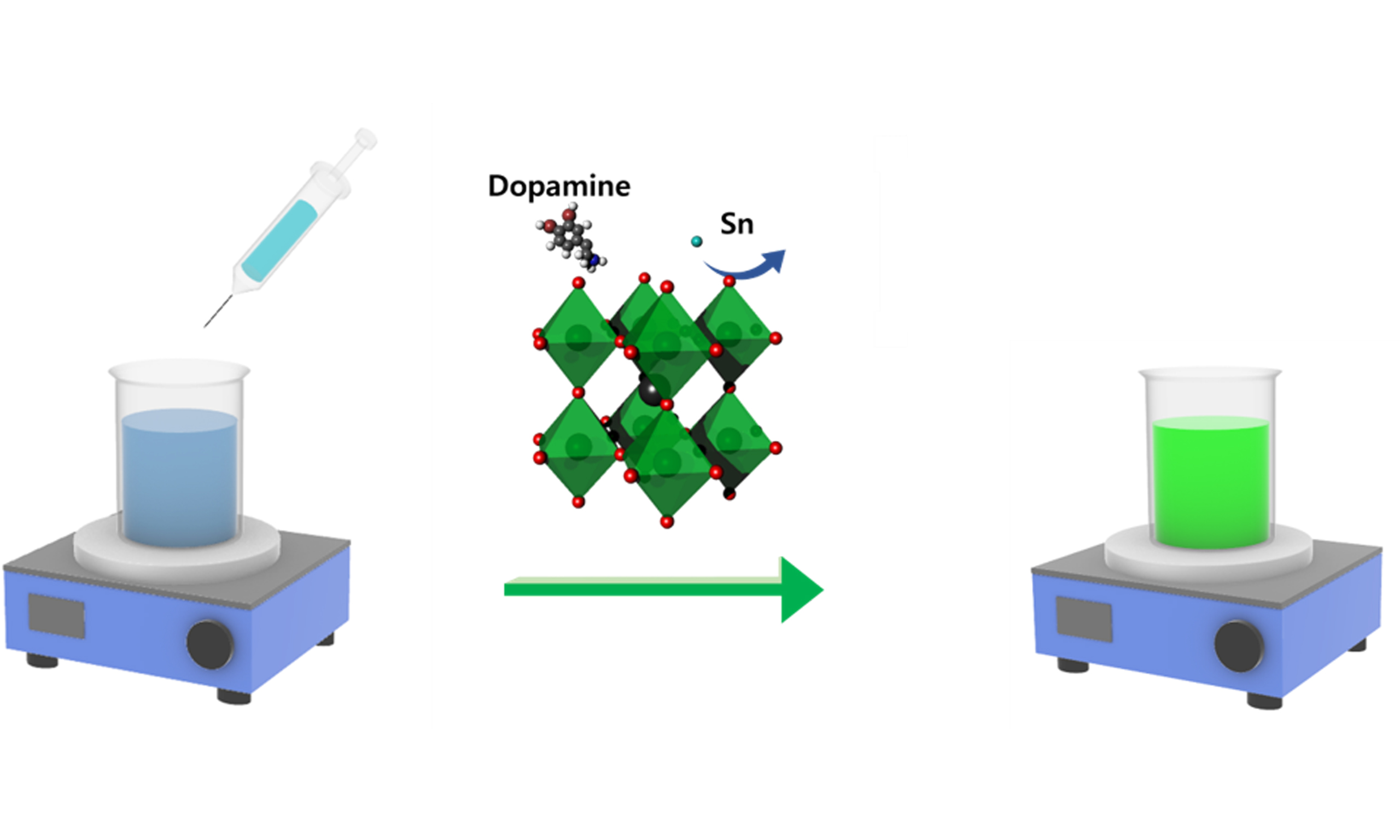
Keywords
INTRODUCTION
Halide perovskites are promising materials for various optoelectronic applications due to their high photoluminescence quantum yield (PLQY), narrow full width at half maximum (FWHM), low turn-on voltage, tunable bandgap, and long carrier lifetime and mobility[1-4]. These properties have attracted much attention for their application in devices such as photovoltaics[5-7], detectors[8-10], light-emitting diodes (LEDs)[11-13], and lasers[14,15]. Perovskite LEDs (PeLEDs) based on organometal halide perovskites were first demonstrated in 2014 using room-temperature solution processing[16]. Since then, considerable efforts have been devoted to achieving highly efficient and highly stable PeLEDs using various synthesis methods, including the hot-injection method for quantum-dot perovskites[17] and spin coating for perovskite nanocrystal thin films[18]. More recently, PeLEDs employing core-shell structures and organic additives have achieved external quantum efficiencies close to the theoretical limit[19]. In addition, thermal evaporation, which is commonly used for depositing electron transport layers and electrodes, has also been explored for perovskite film fabrication[20-22]. However, these synthesis approaches generally require processing under a nitrogen atmosphere or high-vacuum conditions, demanding significantly greater effort compared to processes carried out under ambient conditions.
To realize facile synthesis without the need for a nitrogen atmosphere or vacuum environment, the ligand-assisted reprecipitation (LARP) process has been widely employed. In a typical LARP process, CsPbX3 (X = Cl, Br, I) perovskite nanocrystals are synthesized by dissolving CsX and PbX2 precursors together with organic ligands in a good solvent such as N,N-dimethylformamide (DMF) or dimethyl sulfoxide (DMSO), followed by injecting this precursor solution into a poor solvent such as toluene or ethyl acetate to induce rapid nucleation and crystallization[23,24]. Although this method offers advantages in terms of simplicity, room-temperature processing, and scalability, the resulting films often suffer from reduced crystallinity, lower device efficiency, and poor stability due to degradation triggered by ambient oxygen and moisture.
To overcome these limitations, previous studies have sought to enhance the stability of halide perovskites through metal-ion doping and ligand engineering[25-28]. The incorporation of lead (Pb) in halide perovskites ensures excellent defect tolerance; however, the reduction of Pb2+ to metallic Pb° introduces deep trap states and promotes nonradiative recombination, while the inherent toxicity of Pb also poses challenges for commercialization[29]. To address these issues, researchers have explored reducing the Pb content and introducing alternative cations. Tin-based perovskites have been investigated as promising candidates for improved environmental compatibility, yet the facile oxidation of Sn2+ and associated redox instability often result in severe efficiency losses[30,31]. Recently, dopamine hydrochloride (DH) has been employed in Sn-based perovskite solar cells to suppress Sn2+ oxidation, enhance interfacial adhesion, and facilitate efficient hole extraction[32]. However, its application in colloidal perovskite synthesis and PeLED emitters remains largely unexplored.
In this work, we demonstrate the synthesis of highly stable perovskite emitters by incorporating DH as an additive into the LARP precursor solution, in combination with Sn doping. DH effectively mitigates defects arising from Pb° formation and suppresses Sn2+ oxidation, thereby improving crystallization and enhancing photoluminescence properties. [Figure 1A] illustrates the incorporation of DH and the doping of Sn. When dopamine and Sn are introduced simultaneously, the incorporation of Sn into the perovskite is facilitated, while DH can also interact more extensively with the perovskite, leading to enhanced optical stability. As a result, the improved perovskite showed a PLQY of 63% after 144 h under ambient conditions. Furthermore, PeLEDs based on Sn:DH perovskite films exhibited an operational lifetime approximately twice that of pristine PeLEDs.
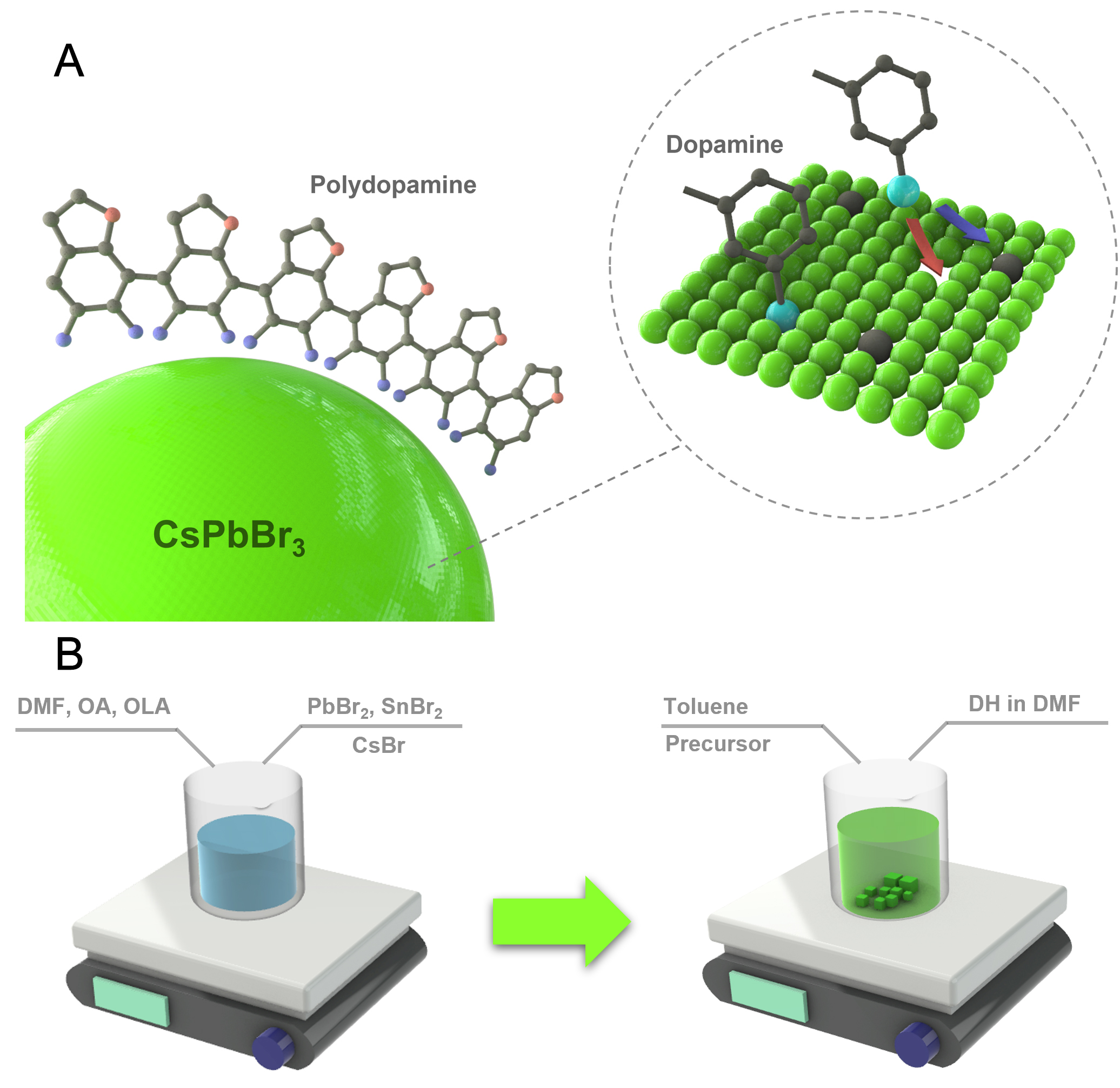
Figure 1. (A) Scheme of DH and Sn passivating the surface of CsPbBr3, (B) The synthesis process of Sn:DH. DH: Dopamine hydrochloride; DMF: N,N-dimethylformamide; OA: oleic acid; OLA: oleylamine.
EXPERIMENTAL
Synthesis and purification of perovskite solutions
PbBr2 powder (147 mg, 0.4 mmol), CsBr powder (85 mg, 0.4 mmol), oleic acid (OA, 1 mL), and oleylamine (OLA, 0.5 mL) were added to 10 mL of DMF or DMF/DMSO (mixed solvent) and stirred for 40 min at room-temperature. For Sn-doped CsPbBr3 synthesis, PbBr2 was partially substituted with SnBr2 at the desired ratio. To induce quantum dot formation, 1 mL of the precursor solution was injected dropwise into 10 mL of toluene under vigorous stirring. For DH introduction, 0.1 mL of DH solution (0.2 M in DMF) was injected following precursor addition. After stirring, the resulting mixture was centrifuged for 5 min at 9,000 rpm. The supernatant was discarded, and the precipitate was dispersed in hexane. The CsPbBr3 product was collected by centrifuging the dispersion for 5 min at 3,000 rpm.
Device fabrication
Indium tin oxide (ITO)-patterned substrates were washed by sonication with deionized water, acetone, and isopropyl alcohol (IPA) for 20 min each, and the remaining solvent was dried with nitrogen gas. After washing, ultraviolet (UV)/ozone treatment was conducted for 10 min. [2-(9H-Carbazol-9-yl)ethyl]phosphonic acid (2PACz) solution [0.4 mg/mL in chlorobenzene (CB)] was deposited by spin-coating at 8,000 rpm for 30 s, followed by annealing at 120 °C for 30 min. The perovskite solution was spin-coated on the 2PACz layer at 2,000 rpm for 40 s under a nitrogen atmosphere. The substrates were transported to the thermal evaporator, and 2,2’,2”-(1,3,5-Benzinetriyl)-tris(1-phenyl-1-H-benzimidazole) (TPBi) (40 nm), LiF (1 nm), and Al (100 nm) were deposited successively by thermal evaporation.
Details of the materials and characterization are provided in the Supplementary Materials.
RESULTS AND DISCUSSION
To synthesize perovskite with superior stability, DH treatment and Sn doping were performed during the LARP synthesis process. The -OH functional groups of DH were oxidized to form =O groups, facilitating polydopamine formation, and DH solution was injected after precursor injection. Sn doping was achieved by adding SnBr2 to the precursor solution, as illustrated in [Figure 1B]. While an appropriate amount of Sn doping enhances exciton recombination, excessive Sn content leads to defect formation due to Sn2+ oxidation, resulting in degraded optical properties[33]. Previous studies on perovskite solar cells have shown that amine-containing cations effectively suppress Sn2+ oxidation[32,34]. Similarly, the incorporation of DH, which contains amine groups, together with Sn doping, effectively prevents the deterioration of optical characteristics, enabling improved performance even with Sn doping.
To elucidate the performance enhancement mechanism in Sn-doped and DH-treated perovskites (Sn:DH), transmission electron microscopy (TEM) analysis was conducted on the synthesized materials [Figure 2]. Immediately after synthesis [Figure 2A and C], black dots attributed to Pb° clusters were observed in both pristine and Sn:DH perovskites. However, after 24 h under ambient conditions [Figure 2B and D], Pb° formation was significantly suppressed in the Sn:DH sample. This indicates that DH-perovskite interactions, which require approximately 24 h for complete dispersion and coordination within the solution, effectively inhibit surface defects and Pb° formation.
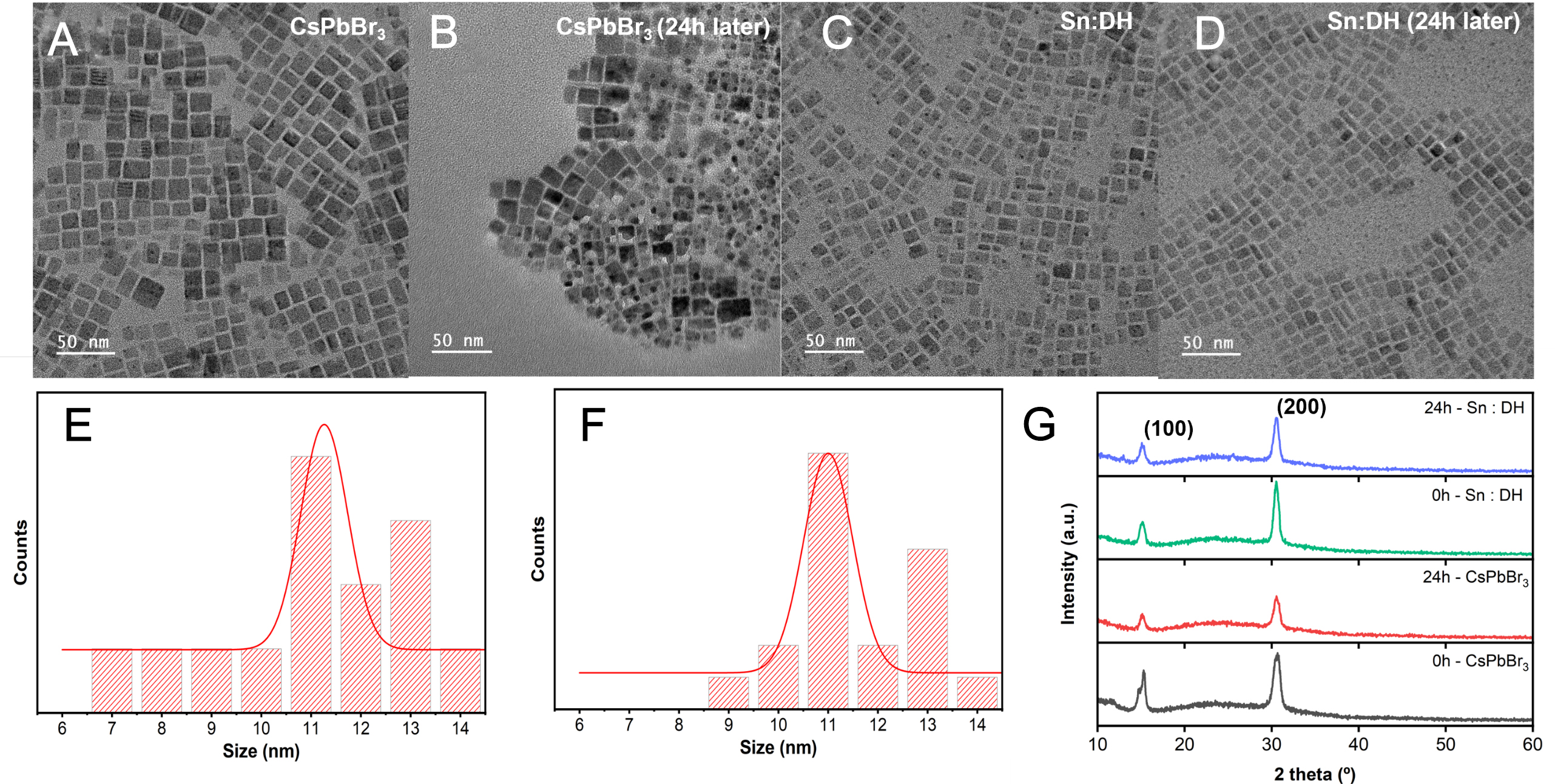
Figure 2. Crystallization analysis of CsPbBr3 and Sn:DH as fresh and after 24 h. The TEM images of as-prepared (A) CsPbBr3, and (C) Sn:DH, and after 24 h (B) CsPbBr3, and (D) Sn:DH. The size distribution of (E) CsPbBr3, and (F) Sn:DH after 24 h; (G) XRD patterns of fresh and 24 h later CsPbBr3 and Sn:DH. TEM: Transmission electron microscopy; DH: dopamine hydrochloride; XRD: X-ray diffraction.
Further insights into the individual contributions of Sn and DH were obtained from TEM analysis of perovskites treated separately [Supplementary Figure 1]. DH-treated perovskites showed effective Pb° suppression immediately after synthesis and after 24 h [Supplementary Figure 1A and B], although slight decomposition was observed over time. In contrast, Sn-treated perovskites exhibited rapid decomposition due to Sn oxidation [Supplementary Figure 1C and D]. These results demonstrate that DH treatment is primarily responsible for suppressing agglomeration and decomposition.
The particle size distributions of pristine and Sn:DH perovskites were analyzed after 24 h [Figure 2E and F] and immediately after synthesis [Supplementary Figure 2A and B]. The average particle size of pristine perovskites increased from 10.5 nm to 11.6 nm, consistent with defect-induced decomposition and agglomeration over time. In contrast, the average size of Sn:DH perovskites decreased from 12.2 nm to 11.6 nm, indicating that Sn ions and DH effectively passivate uncoordinated Pb2+ defects and suppress degradation. To determine the Sn content in the Sn:DH sample, transmission electron microscope-energy dispersive X-ray spectroscopy (TEM-EDS) mapping was performed, as shown in [Supplementary Figure 3]. The results confirmed that Sn was incorporated into the perovskite at approximately 10% relative to Pb, as shown in Supplementary Table 1.
To evaluate the effects of Sn doping and DH treatment on perovskite crystallinity, X-ray diffraction (XRD) patterns were measured [Figure 2G]. Both the CsPbBr3 and Sn:DH samples exhibited diffraction peaks consistent with JCPDS No. 54-0752, confirming that the cubic CsPbBr3 phase was maintained both immediately after synthesis and after 24 h. Notably, no additional diffraction peaks were observed during this period. The crystallite size, lattice strain, and d-spacing were calculated using the Scherrer equation, Williamson-Hall plot, and Bragg’s law, respectively, as summarized in Supplementary Table 2. The changes in the calculated crystallite size were inconsistent with the size variations observed in the TEM images, which can be attributed to the broadened FWHM caused by inadequate defect suppression in CsPbBr3. In contrast, for Sn:DH, the crystallinity stabilizes after 24 h, resulting in a narrowed FWHM. These results confirm that neither Sn doping nor DH treatment induces phase impurities or secondary phases, maintaining the structural integrity of the perovskite crystal lattice[35].
To verify the incorporation of Sn and DH into the perovskite lattice, Fourier transform infrared (FT-IR) spectroscopy and X-ray photoelectron spectroscopy (XPS) analyses were performed [Figure 3]. Representative FT-IR spectra are shown in [Figure 3A], with key regions magnified for detailed comparison. The N-H stretching vibrations, highlighted in yellow in [Figure 3B], exhibited significantly enhanced intensity in both DH-treated and Sn:DH perovskites compared to the pristine sample. This confirms successful coordination of amine groups from DH with the perovskite surface. Notably, the Sn:DH sample showed even stronger N-H signals than the DH-only sample, suggesting enhanced Sn-N coordination within the perovskite lattice[36]. We calculated the integrated peak areas associated with the N-H stretching vibrations in the four perovskite samples. The integrated areas for CsPbBr3, DH, Sn, and Sn:DH were 65.39, 73.34, 67.88, and 77.49, respectively. The increased integrated peak area indicates a greater contribution of DH to the perovskites. As shown in [Supplementary Figure 4], the normalized FT-IR spectra exhibit an increased peak intensity attributed to N-H stretching vibrations upon the incorporation of Sn or DH. A more pronounced increase in intensity was observed when Sn and DH were simultaneously introduced because the simultaneous injection of Sn and DH showed a synergistic effect when incorporated into perovskites. DH treatment led to increased peak intensities in the yellow-shaded region of [Figure 3B] and the cyan-shaded region of [Figure 3C]. The C=C stretching peak in the violet-marked region of [Figure 3D] was also enhanced[37]. These spectral changes collectively demonstrate that the benzene ring and functional groups of DH are effectively incorporated into the perovskite structure. Furthermore, the enhanced peak intensities observed in the Sn:DH system compared to DH-only treatment confirm that mixed Pb/Sn perovskites provide a more favorable environment for DH incorporation than pure Pb-based perovskites.
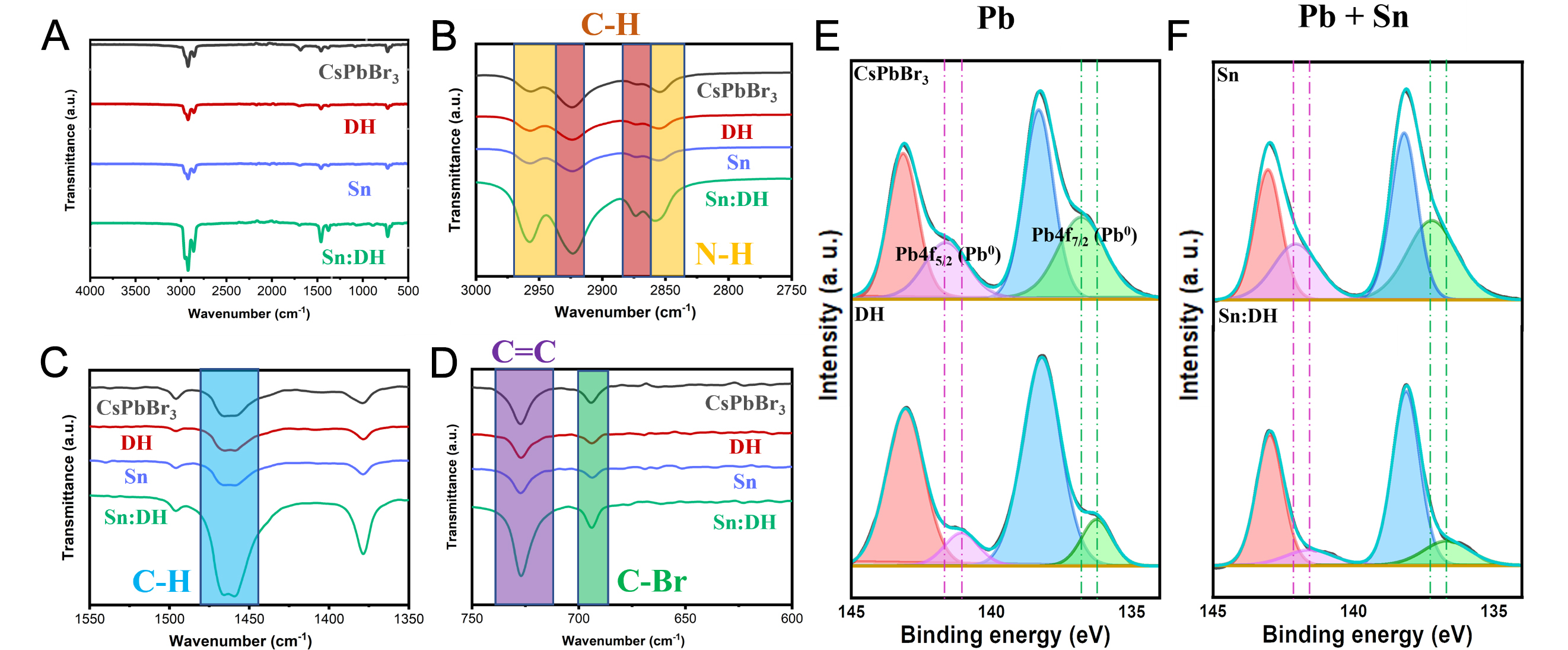
Figure 3. Chemical analysis depending on Sn doping and DH injection. (A) FT-IR spectra of CsPbBr3, Sn, DH, and Sn:DH. Magnified FT-IR spectra showing (B) C-H, N-H, (C) C-H, and (D) C=C, C-Br; (E and F) Pb 4f XPS spectra of perovskites with/without Sn, DH, and both. DH: Dopamine hydrochloride; FT-IR: Fourier transform infrared; XPS: X-ray photoelectron spectroscopy.
The Pb 4f XPS spectra as a function of Sn doping and DH treatment are shown in [Figure 3E and F]. For the pristine perovskite [Figure 3E], Pb°-related peaks were observed at 141.6 eV and 136.8 eV, corresponding to a Pb° fraction of 44.7%[38]. DH treatment alone shifted these peaks to 141.1 eV and 136.2 eV, reducing the Pb° content to 18.2%, indicating effective suppression of metallic Pb formation. Similarly, Sn doping [Figure 3F] resulted in Pb° peaks at 142.0 eV and 137.2 eV, with a reduced Pb° fraction of 39.3% compared to the pristine sample. The Sn:DH perovskite exhibited the lowest Pb° peaks at 141.5 eV and 136.6 eV, with only 15.4% Pb° content. These results are consistent with the TEM observations, confirming that the synergistic Sn:DH treatment most effectively suppresses metallic Pb° formation. For stoichiometric analysis, XPS spectra of the remaining constituent elements in each perovskite sample were also collected, as shown in [Supplementary Figure 5], and the calculated elemental compositions are summarized in Supplementary Table 3. Comparison of the TEM-EDS and XPS results indicates that the overall Sn content within the perovskite is approximately 10%, whereas the Sn concentration at the surface is substantially higher. These findings indicate that not all of the introduced Sn is incorporated into the perovskite lattice; rather, only approximately half of the added Sn is successfully doped into the lattice. This suppression can be attributed to Lewis acid-base interactions between the C=O groups of DH and uncoordinated Pb2+ ions, as well as between Sn2+ ions and DH amine groups, which collectively stabilize the perovskite lattice. Given that the Sn:DH perovskite demonstrated the highest structural quality among all samples, subsequent comparative analyses focused primarily on pristine versus Sn:DH perovskites.
To investigate the optical properties of pristine and Sn:DH perovskites, ultraviolet-visible (UV-vis) absorption and photoluminescence (PL) spectra were measured immediately after synthesis and after 24 h [Figure 4A and B, Supplementary Figure 6A and B]. The optimized Sn concentration was determined by PL spectra under different doping conditions, as shown in [Supplementary Figure 7]. No additional absorption features indicative of secondary phases were observed upon Sn:DH incorporation or after the 24 h stabilization period, confirming that the additive treatments did not induce phase impurities. The apparent optical bandgaps were estimated from Tauc plots for a direct allowed transition as shown in [Supplementary Figure 8]. The extracted values were 2.495 eV for pristine CsPbBr3, 2.477 eV for CsPbBr3 after 24 h, 2.470 eV for Sn:DH, and 2.461 eV for Sn:DH after 24 h. Thus, Sn:DH treatment produced a modest reduction in the apparent optical bandgap of 25 meV relative to the as-prepared CsPbBr3, whereas the 24 h changes were limited to 18 meV for pristine CsPbBr3 and 9 meV for Sn:DH. The red-shift and PL-intensity loss observed for the pristine sample after 24 h are therefore more conservatively attributed to the evolution of the local electronic/defect environment and the associated increase in non-radiative recombination, rather than being assigned solely to metallic Pb formation. In contrast, the Sn:DH sample maintained a nearly unchanged PL peak position of 514 nm and FWHM of 20 nm after 24 h, while exhibiting an increase in PLQY from 65% to 73%. This behavior indicates that dual-additive treatment suppresses the formation of non-radiative recombination pathways during the initial stabilization period. Key optical parameters, including PL peak position, FWHM, and initial PLQY, are summarized in Supplementary Table 4.
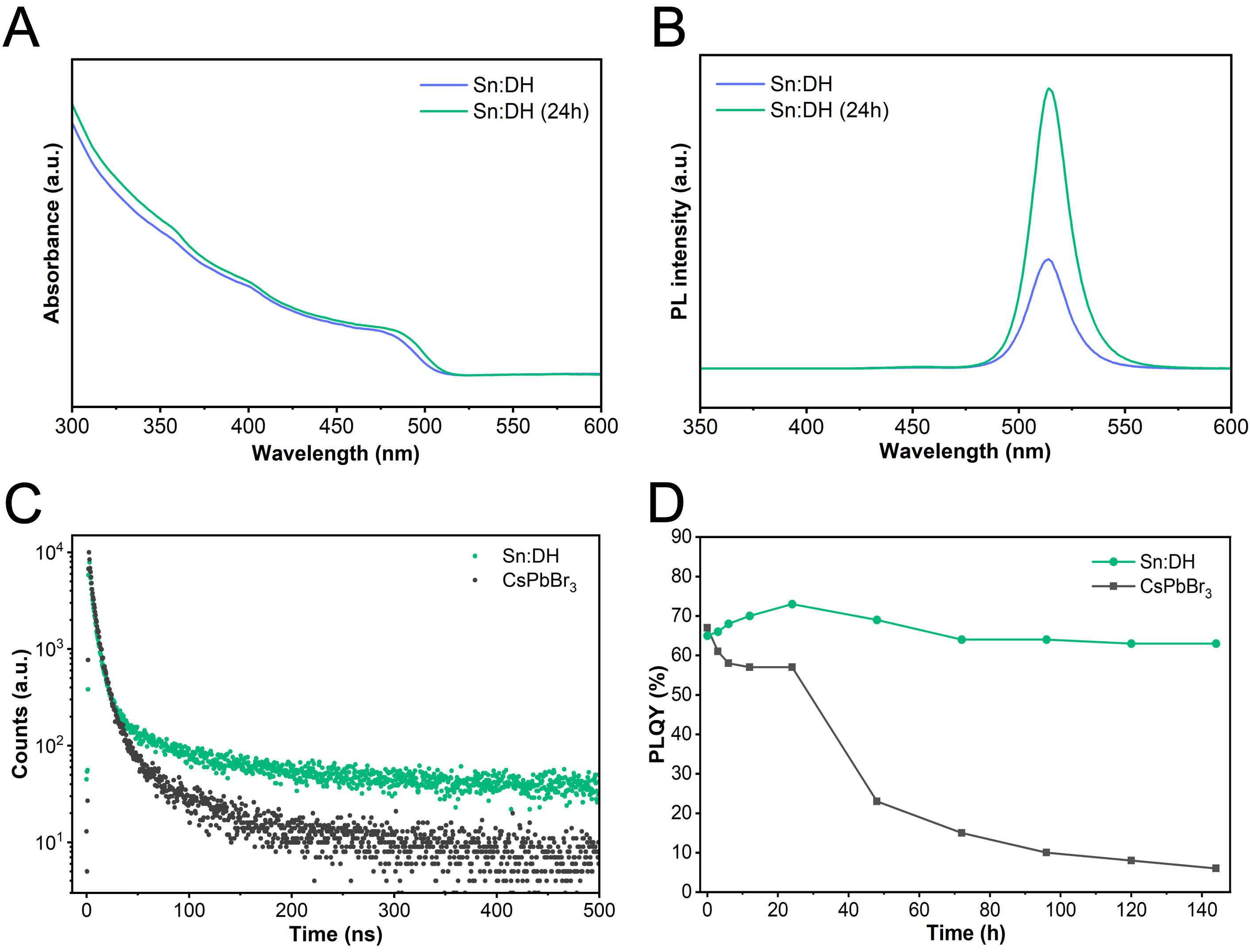
Figure 4. Optical properties of CsPbBr3 (pristine) and Sn:DH. (A) UV-vis absorption spectra and (B) PL spectra of Sn:DH as-prepared and after 24 h. (C) TRPL curves of pristine and Sn:DH. (D) Time-dependent PLQY of pristine and Sn:DH over 144 h. DH: Dopamine hydrochloride; PL: photoluminescence; TRPL: time-resolved PL; PLQY: photoluminescence quantum yield; UV-vis: ultraviolet-visible.
Time-resolved PL (TRPL) measurements further elucidated the recombination dynamics [Figure 4C]. The average PL lifetime increased from 5.74 ns to 10.75 ns upon Sn:DH treatment, indicating effective suppression of defect-mediated nonradiative recombination. To assess the individual contributions of each additive, TRPL spectra of Sn-only and DH-only treated perovskites were also measured [Supplementary Figure 9]. The DH-treated perovskite showed a slightly reduced lifetime of 5.61 ns, while the Sn-treated perovskite exhibited an extended lifetime of 8.41 ns. The Sn:DH system demonstrated the longest lifetime, confirming a synergistic effect between the two additives. The average PL lifetimes for all four perovskite systems are summarized in Supplementary Table 5.
For comparison, well-passivated CsPbBr3 of approximately 7-15 nm commonly exhibits a peak position of 505-517 nm, a narrow FWHM of 17-19 nm, and PLQYs approaching unity. CsPbBr3 of approximately 11 nm has also been reported to exhibit PLQY values above 80% with an emission linewidth of approximately 18 nm[39,40]. Although these studies provide useful optical properties, direct comparison should be made cautiously because the present samples have different synthesis conditions, particle morphology, and film/colloidal environments. Nanocrystals observed by TEM in the present research range from 10.5 to
To identify long-term photostability, the evolution of PLQY was monitored from immediately after synthesis up to 144 h under ambient conditions [Figure 4D]. Initially, the pristine perovskite exhibited slightly higher PLQY (67%) than the Sn:DH perovskite (65%). However, after 24 h, the pristine PLQY decreased to 57%, and only 6% after 144 h, reflecting poor intrinsic stability. In contrast, the Sn:DH perovskite showed an increase to 73% PLQY after 24 h, attributed to gradual DH dispersion and surface passivation in the colloidal solution. Remarkably, the Sn:DH perovskite retained 63% of its PLQY, demonstrating exceptional stability conferred by the additive treatment. The time-dependent PLQY evolution for Sn-only and DH-only treated perovskites is shown in [Supplementary Figure 10]. The Sn-treated perovskite exhibited the highest initial PLQY (70%) but experienced rapid degradation after 72 h due to Sn2+ oxidation-induced instability. The DH-treated sample displayed stabilization behavior similar to Sn:DH, with a temporary PLQY increase during the initial stabilization phase, although its absolute PLQY remained lower than that of Sn:DH after 144 h.
To investigate the electroluminescent performance of perovskite films with different additives, PeLEDs with the structure ITO/2PACz/perovskite/TPBi/LiF/Al were fabricated using pristine and Sn:DH perovskites [Figure 5A, inset]. As shown in the current density-voltage curves in [Figure 5A], the Sn:DH-based device exhibited a lower current density than the CsPbBr3 device at voltages below their respective turn-on voltages of 3.2 V and 3.6 V. This result indicates that the incorporation of the additives effectively suppresses leakage current, consistent with improved film quality and reduced defect states. The luminance-voltage (L-V) characteristics [Figure 5B] demonstrate a substantial enhancement, with the pristine device reaching a maximum luminance of 4,032 cd m-2 compared to 9,522 cd m-2 for the Sn:DH PeLED - a more than twofold increase. The inset photograph shows bright green emission from the Sn:DH device.
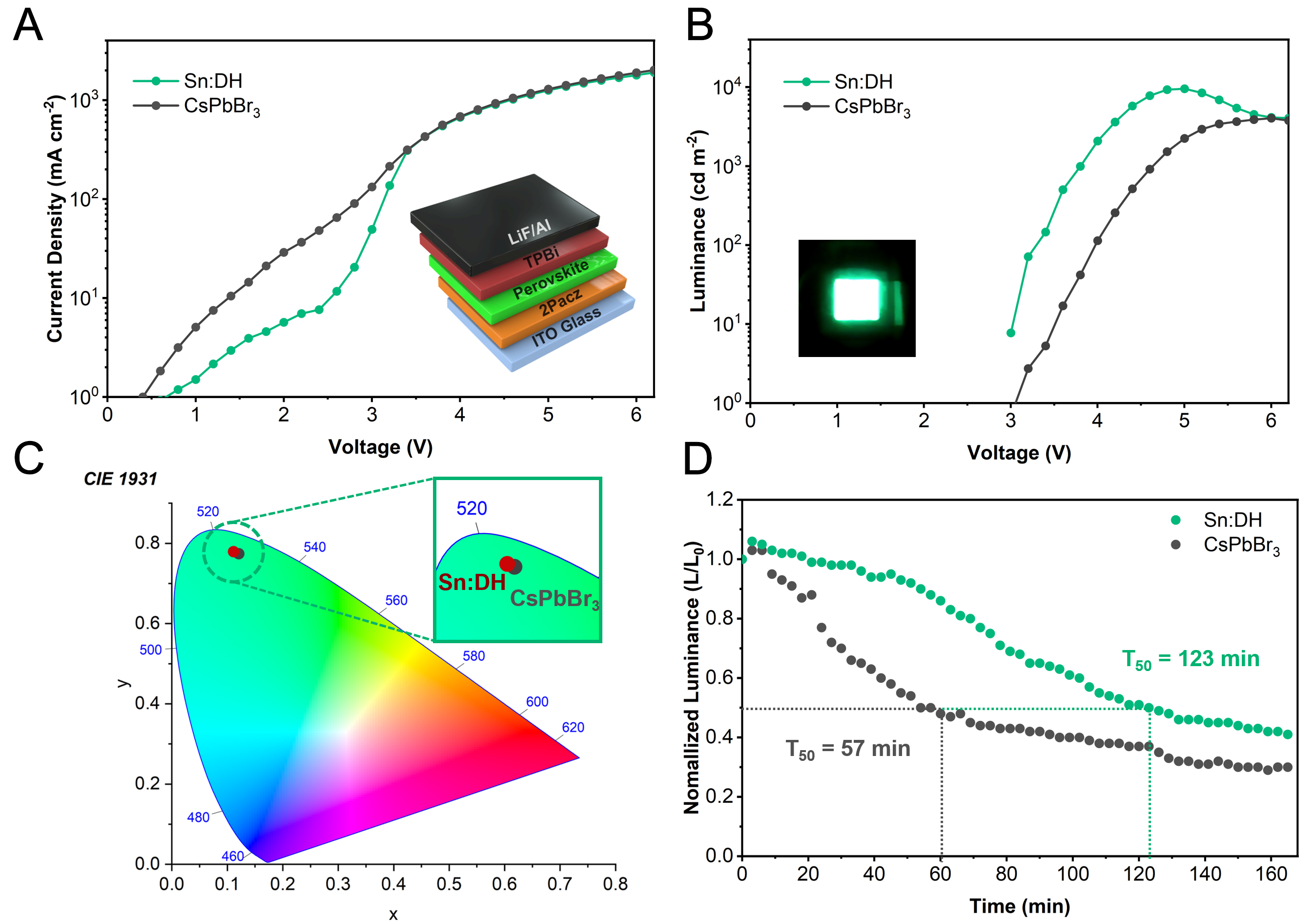
Figure 5. Electrical properties of pristine and Sn:DH-based PeLED. (A) Current density-voltage characteristics of two devices. Inset shows the PeLED structure; (B) Luminance-voltage characteristics of pristine and Sn:DH, with an inset image of the Sn:DH-based PeLED; (C) CIE diagram showing the green emission of the two PeLEDs; (D) Operational stability at 100 cd m-2 until the luminance decreased to 50% of its initial value. DH: Dopamine hydrochloride; PeLEDs: perovskite light-emitting diodes; CIE: Commission Internationale de l'éclairage.
The emission color purity was assessed using Commission Internationale de l'éclairage (CIE) 1931 chromaticity coordinates [Figure 5C]. The Sn:DH device exhibited coordinates of (0.11, 0.78), slightly broader than the pristine device (0.12, 0.77), with both emissions closely matching the Rec. 2020 green standard. To further elucidate the electrical characteristics, we measured the current efficiency (CE) and external quantum efficiency (EQE), as shown in [Supplementary Figure 11A and B]. The CsPbBr3-based device exhibited a current efficiency of 2.21 cd A-1 and an EQE of 0.62%, whereas the Sn:DH-based device achieved a current efficiency of 8.15 cd A-1 and an EQE of 2.29%. Furthermore, the electroluminescence (EL) spectra of CsPbBr3 and Sn:DH measured at 4 V [Supplementary Figure 11C] displayed a trend consistent with the PL spectra.
To assess operational stability, we measured the time required for the initial luminance of 100 cd m-2 to decrease to half its value, as shown in [Figure 5D]. The pristine device exhibited a lifetime of 57 min, while the Sn:DH device showed 123 min, confirming that defect control through the dual-additive treatment plays a crucial role in enhancing stability. The discrepancy arises from additional degradation pathways in operating devices, including interfacial reactions at TPBi/perovskite and 2PACz/perovskite interfaces, and Joule heating[42,43]. To ensure confidence in operational stability, the performance of eight devices was measured as shown in [Supplementary Figure 12]. Key electrical parameters are summarized in Supplementary Table 6.
CONCLUSION
In summary, we developed a facile dual-additive strategy combining Sn doping and DH treatment during LARP synthesis to simultaneously enhance the stability and efficiency of PeLEDs. The synergistic Lewis acid-base interactions between DH functional groups (amine and carbonyl) and metal ions (Pb2+, Sn2+) effectively suppressed Pb° formation and Sn2+ oxidation, yielding perovskite films with controlled surface defects and superior structural integrity. The optimized Sn:DH perovskite demonstrated exceptional optical stability, retaining a PLQY of 63% after 144 h, with a reduction of only 2%.
When incorporated into PeLEDs, the Sn:DH films achieved a maximum luminance of 9,522 cd m-2 and more than doubled the operational lifetime (T50 = 123 min at 100 cd m-2) compared to pristine devices, while maintaining emission color purity aligned with Rec. 2020 green standard. This simple, scalable solution-processing approach addresses critical stability challenges in perovskite emitters, paving the way for environmentally robust, high-performance PeLEDs suitable for next-generation display applications.
DECLARATIONS
Authors’ contributions
Made substantial contributions to conception and design of the study and performed data analysis and interpretation: Seol, M. J.; Han, J. W.
Performed data preparation: Jang, S.
Proposed the topic of this article: Kim, S. Y.
Availability of data and materials
The data supporting the findings of this study are available within this Article and its Supplementary Materials. Further data are available from the corresponding authors upon request.
AI and AI-assisted tools statement
Not applicable.
Financial support and sponsorship
This work was supported by the National Research Foundation (NRF) of Korea (Grant numbers RS-2022-NR068226 and RS-2025-00558945).
Conflicts of interest
Kim, S. Y. is an Associate Editor of the journal Energy Materials and was not involved in any part of the editorial process, including reviewer selection, manuscript handling, or decision-making. The other authors declare no conflicts of interest.
Ethical approval and consent to participate
Not applicable.
Consent for publication
Not applicable.
Copyright
© The Author(s) 2026.
Supplementary Materials
REFERENCES
1. Fakharuddin, A.; Gangishetty, M. K.; Abdi-jalebi, M.; et al. Perovskite light-emitting diodes. Nat. Electron. 2022, 5, 203-16.
2. Yang, D.; Zhao, B.; Yang, T.; et al. Toward stable and efficient perovskite light-emitting diodes. Adv. Funct. Mater. 2022, 32, 2109495.
3. Yao, Z.; Bi, C.; Xu, R.; Zhang, X.; Qian, L.; Xiang, C. Decoupling the exciton-carrier interaction for highly efficient pure blue perovskite light-emitting diodes exceeding 20. Adv. Mater. 2025, 37, e20131.
4. Adhikari, G. C.; Zhu, H.; Vargas, P. A.; Zhu, P. UV-green emission from organolead bromide perovskite nanocrystals. J. Phys. Chem. C. 2018, 122, 15041-6.
5. Jang, W. J.; Kim, E. H.; Cho, J. H.; Lee, D.; Kim, S. Y. Elucidating the role of alkali metal carbonates in impact on oxygen vacancies for efficient and stable perovskite solar cells. Adv. Sci. 2024, 11, e2406657.
6. Gil, B.; Kim, J.; Park, B. Phenyltrimethylammonium as an interlayer spacer for stable formamidinium-based quasi-2D perovskite solar cells. Electron. Mater. Lett. 2024, 20, 791-8.
7. Ali, S.; Javed, S.; Akram, M. A.; et al. Investigating the electrical and optical properties of nickle and strontium Co-doped CsPbBr3 nanocrystals: potential absorber material for perovskite solar cells. Trans. Electr. Electron. Mater. 2024, 25, 422-33.
8. Pathak, A. K.; Mukherjee, S.; Batabyal, S. K. 2D layered (CH3NH3)3Sb2ClxI9-x lead-free perovskite for weak light detection. Electron. Mater. Lett. 2024, 20, 425-31.
9. He, X.; Deng, Y.; Ouyang, D.; et al. Recent development of halide perovskite materials and devices for ionizing radiation detection. Chem. Rev. , 2023, 1207-61.
10. Sun, L.; Li, W.; Zhu, W.; Chen, Z. Single-crystal perovskite detectors: development and perspectives. J. Mater. Chem. C. 2020, 8, 11664-74.
11. Shin, G.; Yun, D.; Ha, Y.; et al. Enhancing performance of perovskite nanocrystal light-emitting diodes with perfluorinated ionomer and PEDOT:PSS. Trans. Electr. Electron. Mater. 2024, 25, 40-7.
12. Pang, P.; Zhang, Z.; Wang, B.; Sheng, T.; Xing, G. Efficient and color stable blue perovskite light-emitting diodes achieved via dual-additive phase modulation. Nanoscale 2025, 17, 15223-30.
13. Lee, S.; Kim, J.; Kim, H.; et al. Brightening deep-blue perovskite light-emitting diodes: a path to Rec. 2020. Sci. Adv. 2024, 10, eadn8465.
14. Shi, Y.; Deng, X.; Gan, Y.; Xu, L.; Zhang, Q.; Xiong, Q. Ten years of perovskite lasers. Adv. Mater. 2025, 37, e2413559.
15. Moon, J.; Mehta, Y.; Gundogdu, K.; So, F.; Gu, Q. Metal-halide perovskite lasers: cavity formation and emission characteristics. Adv. Mater. 2024, 36, e2211284.
16. Tan, Z. K.; Moghaddam, R. S.; Lai, M. L.; et al. Bright light-emitting diodes based on organometal halide perovskite. Nat. Nanotechnol. 2014, 9, 687-92.
17. Protesescu, L.; Yakunin, S.; Bodnarchuk, M. I.; et al. Nanocrystals of cesium lead halide perovskites (CsPbX3, X = Cl, Br, and I): novel optoelectronic materials showing bright emission with wide color gamut. Nano. Lett. 2015, 15, 3692-6.
18. Song, L.; Guo, X.; Hu, Y.; et al. Improved performance of CsPbBr3 perovskite light-emitting devices by both boundary and interface defects passivation. Nanoscale 2018, 10, 18315-22.
19. Kim, J. S.; Heo, J. M.; Park, G. S.; et al. Ultra-bright, efficient and stable perovskite light-emitting diodes. Nature 2022, 611, 688-94.
20. Ji, S.; Bae, S. R.; Hu, L.; et al. Perovskite light-emitting diode display based on MoS2 backplane thin-film transistors. Adv. Mater. 2024, 36, e2309531.
21. Kim, N.; Kim, Y.; Kwon, J.; et al. Improving the performance of vacuum-deposited perovskite light-emitting diodes via a tailored sequential deposition strategy. ACS. Appl. Mater. Interfaces. 2025, 17, 56289-98.
22. Chen, J.; Yang, J.; Wang, J.; et al. Intriguing electroplex system based on all-thermally evaporated organic small molecule donor and 0D Perovskite acceptor. Adv. Funct. Mater. 2026, 36, e12684.
23. Ruby, E.; Levy-Falk, H.; Trippé-Allard, G.; et al. Influence of arylalkyl amines on the formation of hybrid CsPbBr3 nanocrystals via a modified LARP method. Nanoscale. Adv. 2024, 6, 1704-19.
24. Nair, G. B.; Tamboli, S.; Kroon, R.; Dhoble, S.; Swart, H. Facile room-temperature colloidal synthesis of CsPbBr3 perovskite nanocrystals by the emulsion-based ligand-assisted reprecipitation approach: Tuning the color-emission by the demulsification process. J. Alloys. Compd. 2022, 928, 167249.
25. Hou, S.; Gangishetty, M. K.; Quan, Q.; Congreve, D. N. Efficient blue and white perovskite light-emitting diodes via manganese doping. Joule 2018, 2, 2421-33.
26. Shi, Y.; Xi, J.; Lei, T.; et al. Rubidium doping for enhanced performance of highly efficient formamidinium-based perovskite light-emitting diodes. ACS. Appl. Mater. Interfaces. 2018, 10, 9849-57.
27. Sun, S.; Huang, P.; Wu, X.; et al. Ligand exchange-induced shape transformation of CsPbBr3 nanocrystals boosts the efficiency of perovskite light-emitting diodes. J. Phys. Chem. C. 2024, 128, 3602-8.
28. Bi, C.; Yao, Z.; Sun, X.; Wei, X.; Wang, J.; Tian, J. Perovskite quantum dots with ultralow trap density by acid etching-driven ligand exchange for high luminance and stable pure-blue light-emitting diodes. Adv. Mater. 2021, 33, e2006722.
29. Zhou, Y.; Zhao, Y. Chemical stability and instability of inorganic halide perovskites. Energy. Environ. Sci. 2019, 12, 1495-511.
30. Wang, H.; Wang, W.; Tang, A.; et al. High-performance CsPb1-xSnxBr3 perovskite quantum dots for light-emitting diodes. Angew. Chem. Int. Ed. 2017, 56, 13650-4.
31. Deng, J.; Wang, H.; Xun, J.; et al. Room-temperature synthesis of excellent-performance CsPb1-Sn Br3 perovskite quantum dots and application in light emitting diodes. Mater. Des. 2020, 185, 108246.
32. Jia, W.; Wei, Z.; Liu, B.; et al. Dopamine hydrochloride-assisted synergistic modulation of perovskite crystallization and Sn2+ oxidation for efficient and stable lead-free solar cells. ACS. Appl. Mater. Interfaces. 2022, 14, 46801-8.
33. Yu, H.; Chen, W.; Fang, Z.; Ding, L.; Cao, B.; Xiao, Z. Alkalis-doping of mixed tin-lead perovskites for efficient near-infrared light-emitting diodes. Sci. Bull. 2022, 67, 54-60.
34. Ansari, F.; Zheng, L.; Pfeifer, L.; et al. Dopamine dopes the performance of perovskite solar cells. Adv. Mater. 2025, 37, e2501075.
35. Huang, Q.; He, M.; Yang, Y.; et al. Moisture-stable CsSnBr3 quantum dots and SnO2 glass-ceramics for broadband white-emitting diodes. ACS. Appl. Nano. Mater. 2024, 7, 17967-77.
36. Ahmed, M. T.; Islam, S.; Ahmed, F.; Nayak, M. Comparative study on the crystallite size and bandgap of perovskite by diverse methods. Adv. Condens. Matter. Phys. 2022, 2022, 1-7.
37. Chen, H.; Guo, A.; Zhu, J.; Cheng, L.; Wang, Q. Tunable photoluminescence of CsPbBr3 perovskite quantum dots for their physical research. Appl. Surf. Sci. 2019, 465, 656-64.
38. Aktas, E.; Jiménez-López, J.; Rodríguez-Seco, C.; et al. Supramolecular coordination of Pb2+ defects in hybrid lead halide perovskite films using truxene derivatives as lewis base interlayers. Chemphyschem 2019, 20, 2702-11.
39. Ravi, V. K.; Swarnkar, A.; Chakraborty, R.; Nag, A. Excellent green but less impressive blue luminescence from CsPbBr3 perovskite nanocubes and nanoplatelets. Nanotechnology 2016, 27, 325708.
40. Grisorio, R.; Conelli, D.; Fanizza, E.; et al. Size-tunable and stable cesium lead-bromide perovskite nanocubes with near-unity photoluminescence quantum yield. Nanoscale. Adv. 2021, 3, 3918-28.
41. Qin, Z.; Zhu, Y.; Wang, S.; Li, X.; Liu, H. Aromatic lewis-base-assisted ligand cleaning strategy enables suppression of nonradiative recombination in blue perovskite quantum dot light-emitting diodes. J. Phys. Chem. Lett. 2025, 16, 11535-41.
42. Ge, C.; Deng, C.; Zhu, J.; et al. A near-infrared Sn-Pb perovskite imager with monolithic integration. Light. Sci. Appl. 2026, 15, 73.
Cite This Article
 Open Access
How to Cite
Download Citation
Export Citation File:
Type of Import
Tips on Downloading Citation
Citation Manager File Format
Type of Import
Direct Import: When the Direct Import option is selected (the default state), a dialogue box will give you the option to Save or Open the downloaded citation data. Choosing Open will either launch your citation manager or give you a choice of applications with which to use the metadata. The Save option saves the file locally for later use.
Indirect Import: When the Indirect Import option is selected, the metadata is displayed and may be copied and pasted as needed.
About This Article
Copyright

Data & Comments
Data
0








Comments
Comments must be written in English. Spam, offensive content, impersonation, and private information will not be permitted. If any comment is reported and identified as inappropriate content by OAE staff, the comment will be removed without notice. If you have any queries or need any help, please contact us at support@oaepublish.com.