


Chitosan as a biomass-based bridge: integrating CO2 capture and electrochemical upgrading
 0
0 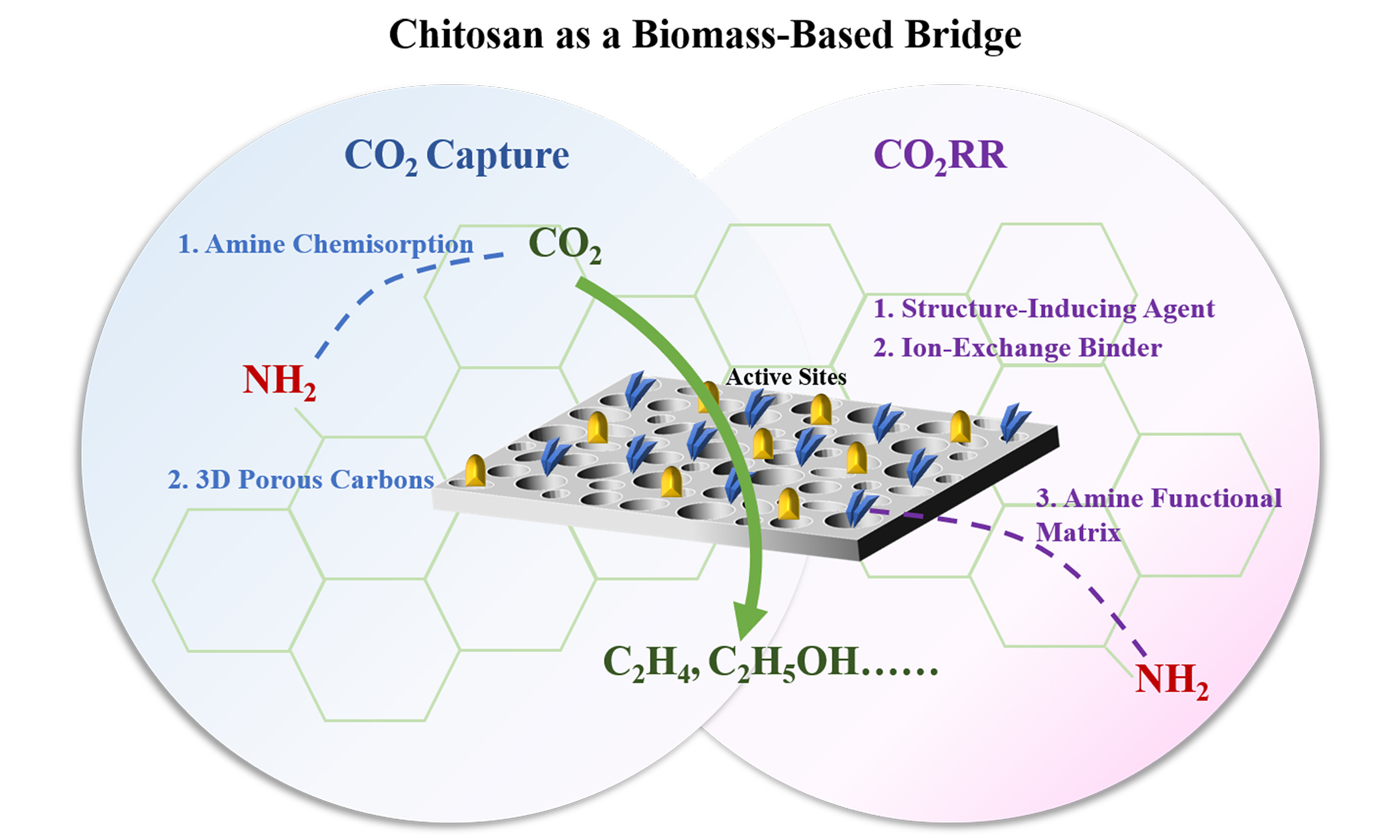
INTRODUCTION
Electrochemical CO2 reduction reaction (CO2RR) can convert waste CO2 into fuels and chemicals. However, its industrial viability is limited by poor CO2 solubility, sluggish mass diffusion, and low selectivity toward multi-carbon (C2+) product[1,2]. It is urgently needed to design innovative electrode, which can enhance local CO2 concentration, stabilize intermediates, and facilitate mass/electron transfer[2,3]. Chitosan is a natural polysaccharide rich in -NH2 and -OH. Chitosan-derived amine-functionalized foams achieve efficient CO2 capture via hydrogen bonding and acid–base interactions[4]. In CO2RR, chitosan serves as a C/N source, a structure-inducing agent, and an ion-conductive binder[1-3,5]. Therefore, chitosan can act as a “biomass bridge” integrating upstream CO2 capture with downstream electroreduction.
In this article, a brief summary of the key characteristics of chitosan-derived materials applied in CO2 capture and CO2RR is presented. Based on this, an integrated electrode is proposed: 3D macroporous chitosan foam is used as the CO2 capture trap, chitosan-derived mesoporous material is used as the CO2 enrichment area and mass transfer pathway, and active sites close to this layer are used as the main interface for CO2RR, resulting in product upgrading. This design concept provides new insights into creating CO2-rich microenvironments for enhanced kinetics and selectivity. We hope this perspective can inspire further research into biomass-derived multifunctional materials for carbon capture and utilization, accelerating the transition toward a circular carbon economy.
CHITOSAN-DERIVED MATERIALS FOR CO2RR OR CO2 CAPTURE
Chitosan-derived electrocatalysts play multiple unifying roles through constructing rich mass transfer pathways and regulating the microenvironment of active sites, achieving efficient or highly selective generation of various products [Supplementary Table 1]. Firstly, chitosan is an excellent source of carbon and nitrogen. Upon pyrolysis, chitosan forms 3D porous carbon that stabilizes metal nanoparticles via strong metal–support interactions[1]. Its amino groups like pyridinic-N, can activate CO2 to enhance CO2RR performance[2]. Secondly, chitosan is a structure-inducing agent. It chelates metal ions and directs the growth of vertically aligned 3D structure on gas diffusion layers, which increases electrochemical surface area (ECSA), facilitates CO2 diffusion, and protects the hydrophobic layer[3]. Finally, Chitosan is an ion-exchange binder. In the latest report, chitosan was coated on the surface of Cu NPs, reducing the oxidation rate of Cu, while its hydrophilic, ion-conductive nature can increase the local CO2/CO concentration [Figure 1A][5].
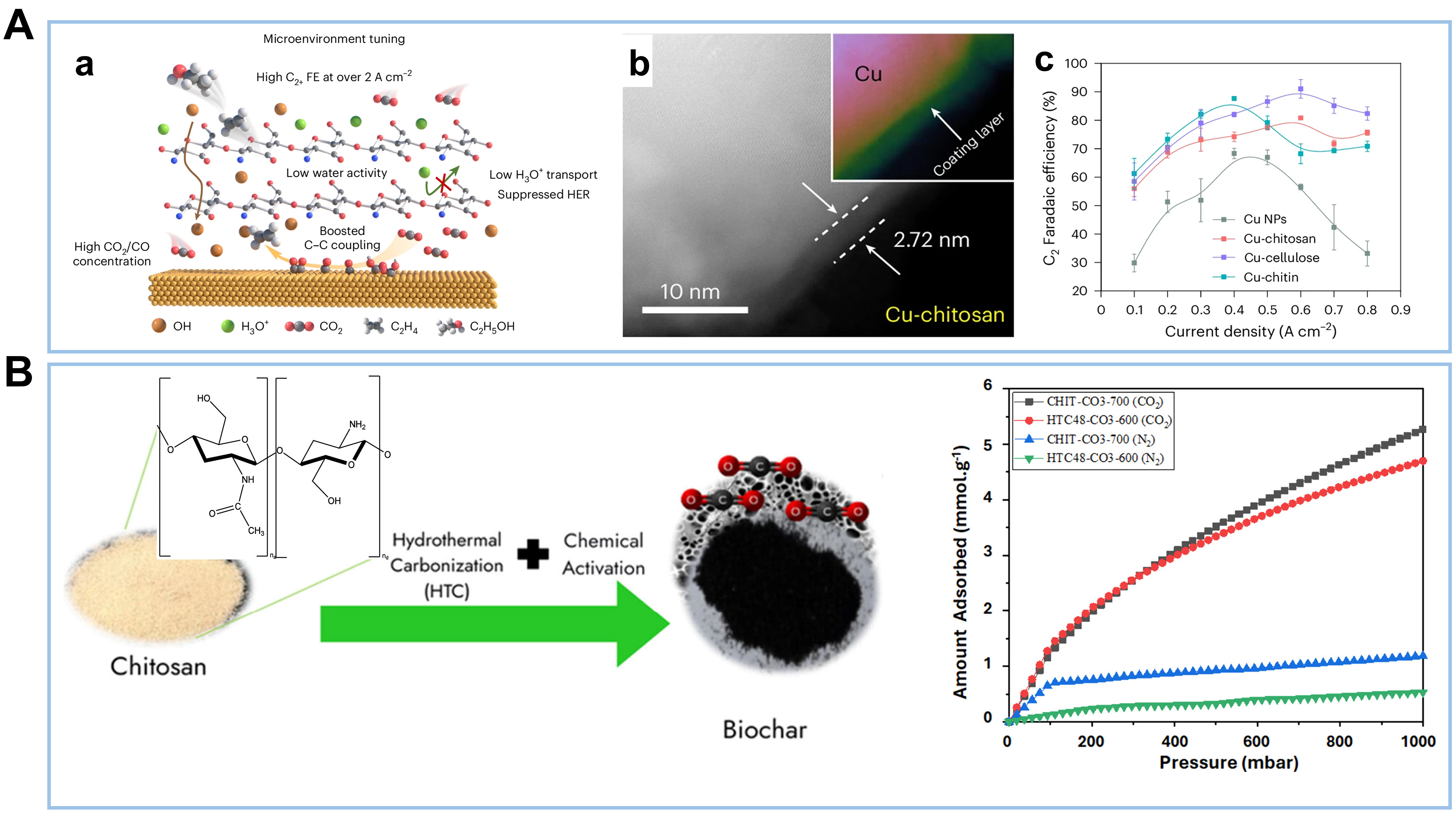
Figure 1. (A) Cu-chitosan, Cu-cellulose and Cu-chitin electro-catalyze the transformation of CO2 into C2+ products. Reproduced from Ref.[5], Copyright 2026, Springer Nature; (B) N-functionalized chitosan biochars have high CO2 adsorption capacity. Reproduced from Ref.[6], Copyright 2025, ACS Publications. FE: Faradaic efficiency; HER: hydrogen evolution reaction; NPs: nanoparticles.
Chitosan-based adsorbents exhibit efficient, reversible CO2 capture ability due to high surface area, nitrogen functionality, and amine-rich surfaces [Supplementary Table 2]. On the one hand, chitosan can prepare 3D hierarchically porous adsorbents combined with other materials via hydrothermal treatment and carbonization[4]. It acts as a renewable C/N source, creating micro/mesopores during decomposition, and residual N-groups serve as basic adsorption sites, which make adsorbents possess excellent stability and selectivity. On the other hand, amine-functionalized chitosan-based composites can further enhance CO2 capture ability. In general, chitosan serves as a structural scaffold, provides initial amine sites, and acts as a matrix for additional amines [polyethylenimine (PEI), dopamine], boosting uptake via carbamate formation [Figure 1B][6].
FUTURE PERSPECTIVES: TOWARD INTEGRATED CO2 CAPTURE AND CONVERSION
The above content reveals striking commonalities: chitosan is a renewable C/N source, a structural scaffold for hierarchical porosity, and a functional matrix with abundant amine groups. Thus, an integrated platform for CO2 capture and CO2RR upgrading can be constructed by fully leveraging the chelating ability, porous network formation and electron-donating amines of chitosan.
We propose a conceptual bifunctional gas diffusion electrode (GDE) with three hierarchical components [Figure 2]: (i) a macroporous chitosan foam or carbonized network for capturing CO2 via amine-mediated chemisorption; (ii) a meso-/microporous N-doped carbon matrix for further concentrating CO2; (iii) embedded metallic sites to transform CO2 to C2+ products. This design eliminates separate capture/compression steps, feeding concentrated CO2 directly to catalytic sites. In the actual operating device, the saturation state of capture layer and the continuous consumption of CO2 at metallic active sites, both under the guidance of the electric field, facilitate the directional transport of CO2.
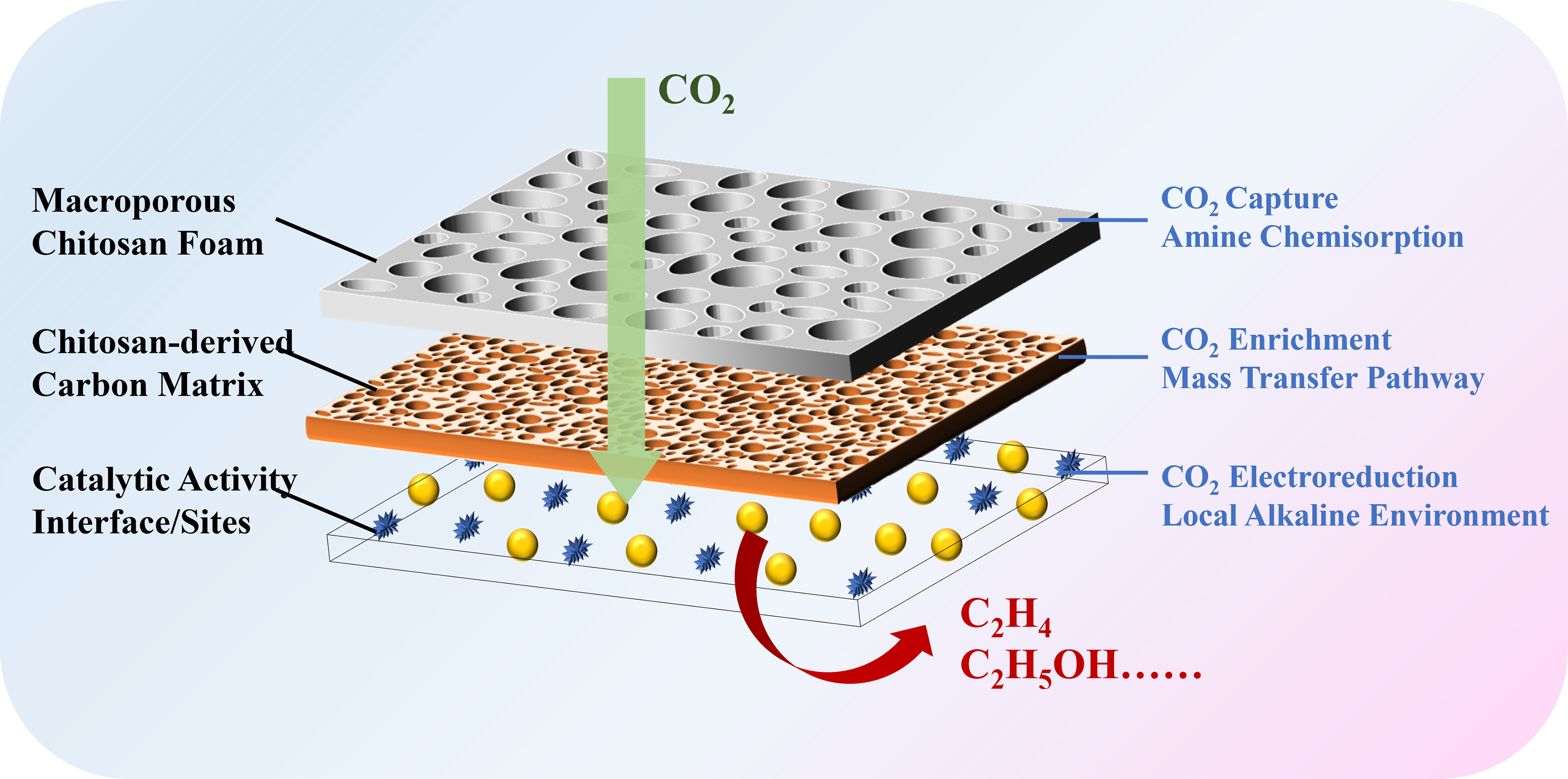
Figure 2. The integrated platform for CO2 capture and CO2RR upgrading. CO2RR: CO2 reduction reaction.
In mechanism, the intrinsic properties of chitosan create a localized CO2-rich microenvironment at catalytic interface. First of all, tunable porosity balances adsorption capacity with rapid diffusion, and chelation allows precise anchoring of metal active sites. Moreover, the amine groups bind CO2 reversibly and generate a local alkaline environment upon quaternization, and nitrogen functionalities stabilize intermediates via hydrogen bonding, lowering asymmetric C–C coupling barriers, which suppresses hydrogen evolution reaction (HER) and steers selectivity toward C2+ products[2]. Comparing amine-functionalized electrodes, ionic-liquid/polymer-modified electrodes, or metal–organic framework (MOF)/covalent organic framework (COF)-derived capture–conversion materials, chitosan-derived electrodes have remarkable multifunctionality, low cost and environmental friendliness, and are expected to achieve cost reduction and efficiency improvement while integrating capture and conversion[7-9].
The integrated platform bypasses CO2 solubility/diffusion limitations, shortens diffusion paths, opening a new paradigm for sustainable CO2 valorization. However, there are several challenges and opportunities remaining:
1. The trade-off between capture capacity and catalytic activity needs optimization. The high amine loading may block active sites or alter hydrophilicity. Systematic studies on amine density, porosity, and performance are needed.
2. A thorough study is required for the long-term stability under the simultaneous capture/reduction conditions. For instance, when CO2 chemisorption and cathodic potential act simultaneously, amine groups may undergo degradation. In-situ characterization methods [Raman, Fourier-transform infrared spectroscopy (FTIR), X-ray photoelectron spectroscopy (XPS)] and solid-state 13C nuclear magnetic resonance (NMR) techniques should be used to verify whether chitosan exists stably in the catalytic electrode[5,10].
3. The scalability to larger electrode areas and industrially relevant current densities (> 500 mA·cm-2) must be demonstrated, along with techno-economic and life-cycle assessments.
4. The design concept of the integrated platform should be extended to the utilization of other biomass polymers (such as cellulose, alginate) and other technical routes of CO2 conversion (such as photocatalysis, thermal catalysis).
CONCLUSION
Chitosan is a multifunctional carbon-nitrogen framework rich in amino groups. It leads us to propose an integrated bifunctional GDE that combines efficient capture with direct electrochemical upgrading, which can build a CO2-rich microenvironment with stabilized intermediates, enhancing kinetics and selectivity. While challenges in optimization, stability, and scale-up remain, this integrated platform represents a promising pathway toward sustainable CO2 valorization and a circular carbon economy.
DECLARATIONS
Acknowledgments
This work was supported by the State Key Laboratory of Chemical Safety, College of Chemistry and Chemical Engineering, China University of Petroleum (East China).
Authors’ contributions
Manuscript preparation: Bi, J.
Manuscript correction: Zhang, J.; Lin, S.
Availability of data and materials
Not applicable.
AI and AI-assisted tools statement
Not applicable.
Financial support and sponsorship
The work was supported by the National Natural Science Foundation of China (22503113), the Shandong Provincial Natural Science Foundation (ZR2024QB077), the Shandong Provincial Taishan Scholar Youth Expert Program (tsqn202408097), the Qingdao Municipal Natural Science Foundation (24-4-4-zrjj-12-jch), and the Fundamental Research Funds for the Central Universities (24CX06025A).
Conflicts of interest
All authors declared that there are no conflicts of interest.
Ethical approval and consent to participate
Not applicable.
Consent for publication
Not applicable.
Copyright
© The Author(s) 2026.
Supplementary Materials
REFERENCES
1. Lu, B.; Liu, T.; Li, J. Porous nickel-based catalyst doped with fluorine can efficiently electrocatalyze the reduction of CO2 to CO. J. Alloys. Compd. 2024, 1008, 176771.
2. Wu, B.; Lao, Y.; He, L.; et al. Ternary N, P, B-doped wood-derived carbon electrocatalyst for selective CO2 reduction to methane. Mater. Sci. Eng. B. 2026, 324, 119041.
3. Xie, G.; Zhu, Z.; Liu, D.; et al. 3D gas diffusion layer with dual-metal sites for enhanced CO2 electrolysis to C2+ products. Angew. Chem. Int. Ed. Engl. 2025, 64, e202510167.
4. Yang, C.; Luo, L.; Zhao, T.; Cao, J.; Lin, Q. Chitosan-based porous carbon material with lamellar stacking structure for efficient CO2 adsorption and catalytic conversion. Chem. Eng. J. 2025, 512, 162597.
5. Wei, C.; Yoo, S.; Li, Y.; et al. A scalable, biopolymer-based microenvironment for electrochemical CO2 conversion to multicarbon products with current densities over 2 A cm-2. Nat. Energy. 2026, 11, 889-903.
6. Chagas, J. A. O.; Pinto, B. P.; de Lima, A. L.; Mota, C. J. A. CO2 capture over chitosan biochars: tailoring the properties for highly efficient adsorbents. Energy. Fuels. 2025, 39, 15039-50.
7. Li, M.; Yang, K.; Abdinejad, M.; Zhao, C.; Burdyny, T. Advancing integrated CO2 electrochemical conversion with amine-based CO2 capture: a review. Nanoscale 2022, 14, 11892-908.
8. Qiu, L.; Mokhtarinori, N.; Liu, H.; Jiang, D.; Yang, Z.; Dai, S. The carbon challenge: design, synthesis, and chemisorption behavior of solid sorbents in direct air capture of carbon dioxide. Mater. Today. Energy. 2025, 47, 101740.
9. Abudeeb, A. M.; Almakhadmeh, M. N.; Onaizi, S. A. CO2 capture using functionalized metal organic frameworks: a review. Surf. Interfaces. 2025, 72, 107381.
Cite This Article
 Open Access
How to Cite
Download Citation
Export Citation File:
Type of Import
Tips on Downloading Citation
Citation Manager File Format
Type of Import
Direct Import: When the Direct Import option is selected (the default state), a dialogue box will give you the option to Save or Open the downloaded citation data. Choosing Open will either launch your citation manager or give you a choice of applications with which to use the metadata. The Save option saves the file locally for later use.
Indirect Import: When the Indirect Import option is selected, the metadata is displayed and may be copied and pasted as needed.
About This Article
Special Topic
Copyright

Data & Comments
Data
0











Comments
Comments must be written in English. Spam, offensive content, impersonation, and private information will not be permitted. If any comment is reported and identified as inappropriate content by OAE staff, the comment will be removed without notice. If you have any queries or need any help, please contact us at support@oaepublish.com.