


In situ growth of B, N-doped Fe3C-encapsulated carbon nanotubes on wood-derived carbon for high-performance Zn-air battery electrocatalysts
 0
0 
Abstract
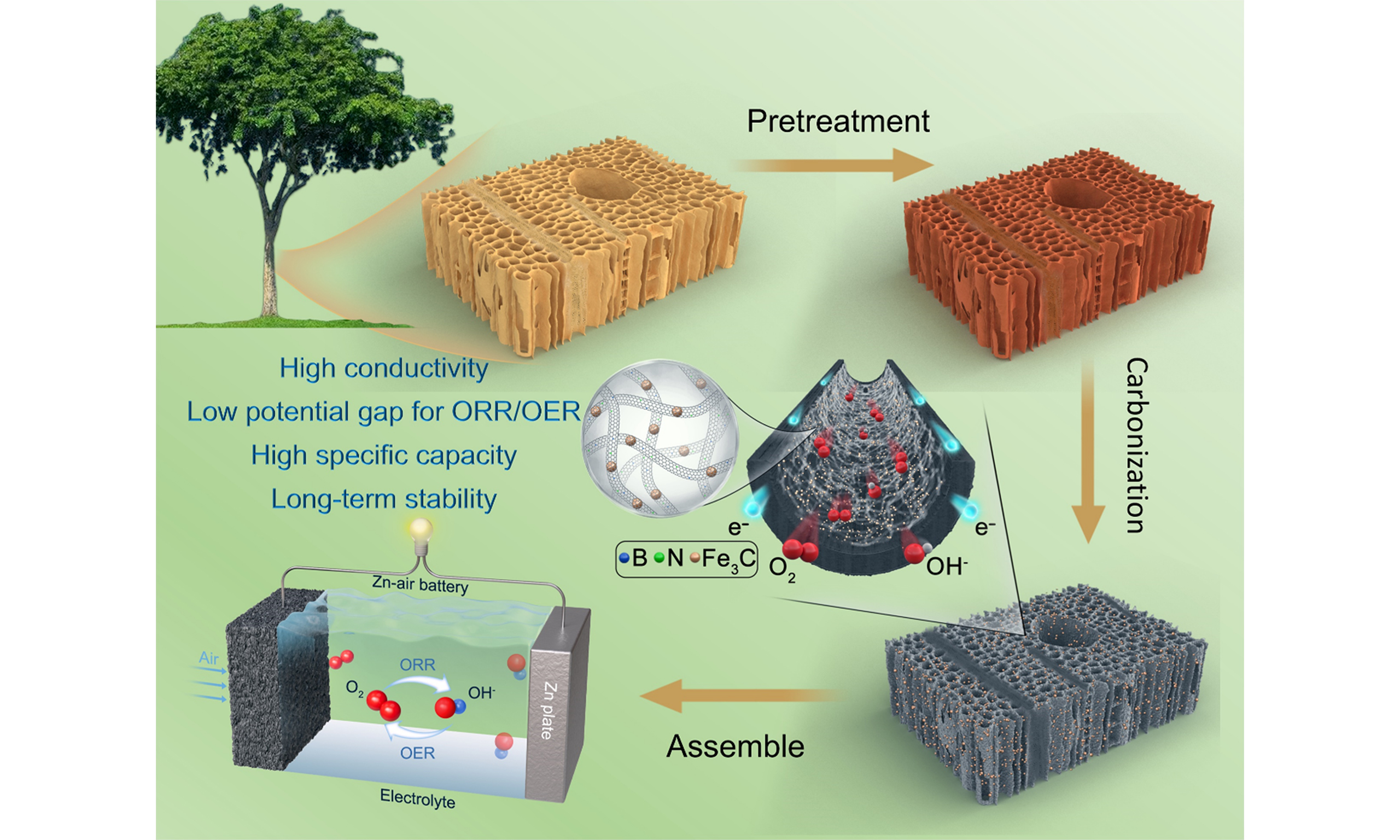
The use of wood-derived porous carbon as an electrocatalyst in metal-air batteries has received significant attention. Although efforts have focused on developing and optimizing active sites, the insufficient electrical conductivity of wood-derived carbon as a catalytic electrode is often overlooked. This study presents the in situ growth of heteroatom-doped carbon nanotubes (CNTs) encapsulating Fe3C nanoparticles (Fe3C@BNC) within wood-derived carbon. Iron carbide possesses an electronic configuration similar to that of noble metals and exhibits high catalytic activity. The addition of CNTs enhances the conductivity of the wood-derived carbon, achieving a cross-sectional conductivity of
Keywords
INTRODUCTION
The excessive use of fossil fuels has caused severe environmental pollution and potential energy shortages, highlighting the urgent need for green and renewable energy sources[1,2]. The development of modern energy storage and conversion systems has garnered significant interest from researchers. Zn-air batteries (ZABs), an emerging sustainable energy technology, have received significant attention owing to their high energy density, low cost, inherent safety, and environmental friendliness[3-7]. However, the slow electron transfer kinetics during the oxygen reduction reaction (ORR) and oxygen evolution reaction (OER) at the air cathode significantly reduce energy efficiency and hinder the large-scale commercialization of ZABs[8-11]. Although noble metal-based catalysts such as Pt/C, Ru, and Ir exhibit excellent catalytic activity, their limited stability and high costs hinder widespread application. Therefore, developing low-cost, high-performance catalysts remains a key challenge[12-19]. In recent years, research on transition metals and their compounds has become increasingly in-depth. Transition metal carbides, in particular, have attracted special interest due to their electronic configurations and catalytic behaviors that resemble those of noble metals[20,21]. Additionally, wood-derived carbon hybridized with metals or their compounds has been widely used as an oxygen electrocatalyst owing to its low cost, renewability, and tunable hierarchical porous structure[22-24]. For example, Zhong et al. utilized a Lewis acid treatment to simultaneously generate a porous structure and facilitate the in situ growth of single-atom Fe within the hierarchical wood framework for ZABs[25]. Similarly, Chen et al. developed Fe cluster-enhanced asymmetric single-atom catalysts on wood-derived carbon, enabling flexible ZABs to operate efficiently across a wide temperature range[26].
Unlike traditional carbon-supported catalysts, core@shell carbon materials encapsulating metals or metal compound nanoparticles (NPs) exhibit tunable electronic properties and excellent chemical stability, making them highly attractive for various electrocatalytic reactions[27-31]. This design enhances electronic interactions between the carbon shell and the encapsulated metal/compound, thereby promoting orbital overlap. The Mott-Schottky effect at the interface facilitates charge flow, driving the metal and carbon toward Fermi level equilibrium[32-35]. This process redistributes electrons at the metal–carbon interface, thereby modulating the electronic structure of catalytic active sites. Consequently, the activity and selectivity of the catalyst are significantly enhanced, making carbon-encapsulated metal/compound catalysts highly promising for small organic molecule conversion[36-38]. Most research on carbon encapsulation has focused on designing the internal metal component, with relatively limited attention to tuning the properties of the carbon shell[39,40]. Zhou et al. developed a B- and N co-doped carbon layer encapsulating Mo2C nanocrystals (Mo2C@BNC) to enhance electrocatalytic activity for the hydrogen evolution reaction[41]. The incorporated B atoms served as optimal adsorption sites for H2O during the water-splitting step. Electronic interactions between the Mo2C nanocrystals and the multi-doped carbon layer create a nearly zero-energy barrier for key intermediate adsorption on the carbon shell. However, in carbon-based shells or substrates formed via simple pyrolysis, the lack of an ordered graphite structure hinders rapid electron transport during electrocatalysis, thereby significantly limiting intrinsic catalytic activity.
In this study, we designed a three-dimensional wood-derived carbon composite embedded with Fe3C and B, N co-doped carbon nanotubes (Fe3C@BNC) as an efficient bifunctional electrocatalyst for both ORR and OER. To facilitate Fe3+ anchoring, lignin was first removed from balsa wood. During pyrolysis in a tube furnace, melamine served as a hydrocarbon source for carbon nanotube (CNT) growth, enabling the in situ formation of N-doped CNTs encapsulating Fe3C NPs. Additionally, B atoms were introduced to modulate the electronic structure of the carbon layer, which improved oxygen adsorption and desorption. The
EXPERIMENTAL
Pretreated wood
First, natural balsa wood was cut into thin slices (2.5 cm × 2.5 cm × 0.15 cm for the tangential, radial, and longitudinal directions, respectively). The thin slices were subjected to ultrasonic treatment for 30 min, followed by drying in an oven at 40 °C. The dried wood slices were then immersed in 300 mL sodium chlorite-acetate solution with a concentration of 2 wt% and pH of 4.6, and reacted in an oven at 80 °C for
Preparation of Fe3C@BNC, Fe3C@NC, and U-Fe3C@BNC
Initially, the obtained PW was immersed in a solution containing 60 mg of ferric chloride tetrahydrate that dissolved in 35 mL deionized water, and heated at 80 °C for 12 h, with the wood slices removed every 2 h for vacuum drying. After 12 h, the wood slices were freeze-dried, yielding PW loaded with ferric chloride, referred to as FeCl3-PW. It was then placed in a tube furnace, where 0.5 g boric acid and 3 g melamine were added into a ceramic boat at the upstream. The temperature was increased to 700, 800, and 900 °C at a rate of 5 °C·min-1 and held for 2 h under Ar atmosphere. After cooling to room temperature, the catalyst was placed in 1M HCl and reacted at 80 °C for 2 h. It was then rinsed with deionized water until neutral and vacuum-dried to obtain Fe3C@BNC-700, Fe3C@BNC-800, and Fe3C@BNC, respectively. The preparation of Fe3C@NC was performed by omitting the addition of boric acid during the calcination in the tube furnace, while keeping all other processes unchanged. The preparation of U-Fe3C@BNC involved using natural balsa wood that did not undergo lignin removal, with all other processes remaining the same.
Preparation of B, N-doped porous carbon
PW was directly placed in a tube furnace, with 0.5 g boric acid and 3 g melamine into a ceramic boat at the upstream. The furnace was heated at a rate of 5 °C·min-1 to 900 °C and maintained for 2 h to obtain the B, N-doped porous carbon (BNC).
More detailed information, including materials characterization and electrochemical measurements, is presented in the Supplementary Materials.
RESULTS AND DISCUSSION
Catalyst characterization
Figure 1A illustrates the preparation process of the Fe3C@BNC catalyst and the optical images of each stage [Supplementary Figure 1]. Firstly, 1.5 mm thick cross-sectional wood slices were pretreated with sodium chlorite to partially remove lignin. Scanning electron microscopy (SEM) images [Supplementary Figure 2] confirm that the wood slices retain their layered porous structure, including vessels, tracheids, and pits. However, parts of the middle lamellae in the cell corners disappear [Supplementary Figure 2B], and the cell walls become rough and uneven. Quantitative analysis revealed a significant reduction in lignin content within the balsa wood, decreasing from 22% to 4.3% after treatment [Supplementary Figure 3]. The significant removal of lignin in the wood cell wall increases the mesoporosity of the derived carbon; this mesoporosity enhancement improves overall carbon porosity, thereby promoting efficient mass transport. Moreover, this pretreatment exposes more cellulose on the wood surface, which may promote a higher degree of graphitization during carbonization, thereby enhancing material conductivity. The abundant hydroxyl groups in cellulose effectively anchor Fe3+, which serves as catalytic species and nucleation sites for CNT growth. CNTs are uniformly distributed across the porous carbon matrix, further enhancing material conductivity [Figure 1B and C]. Transmission electron microscopy (TEM) images [Figure 1D] confirm the microstructure of the Fe3C@BNC catalyst, indicating the in situ formation of CNTs integrated with wood-derived carbon, consistent with the SEM results. Fe3C NPs are uniformly distributed within CNTs, which extend outward, thereby enhancing electron transport and providing additional active sites. High-resolution TEM (HRTEM) images [Figure 1E] confirm a lattice spacing of 0.21 nm, corresponding to the (121) plane of Fe3C. Notably, Fe3C NPs are fully encapsulated by a ~3 nm thick CNT layer. High-angle annular dark-field scanning TEM (HAADF-STEM), energy-dispersive X-ray spectroscopy (EDS) elemental mapping images [Figure 1F] and EDS spectra [Supplementary Figure 4] indicate the uniform distribution of Fe, C, N, and B elements within Fe3C@BNC. This synthesis strategy effectively prevents metal aggregation, which maximizes active site availability and enhances catalytic activity. For comparison, the SEM images of
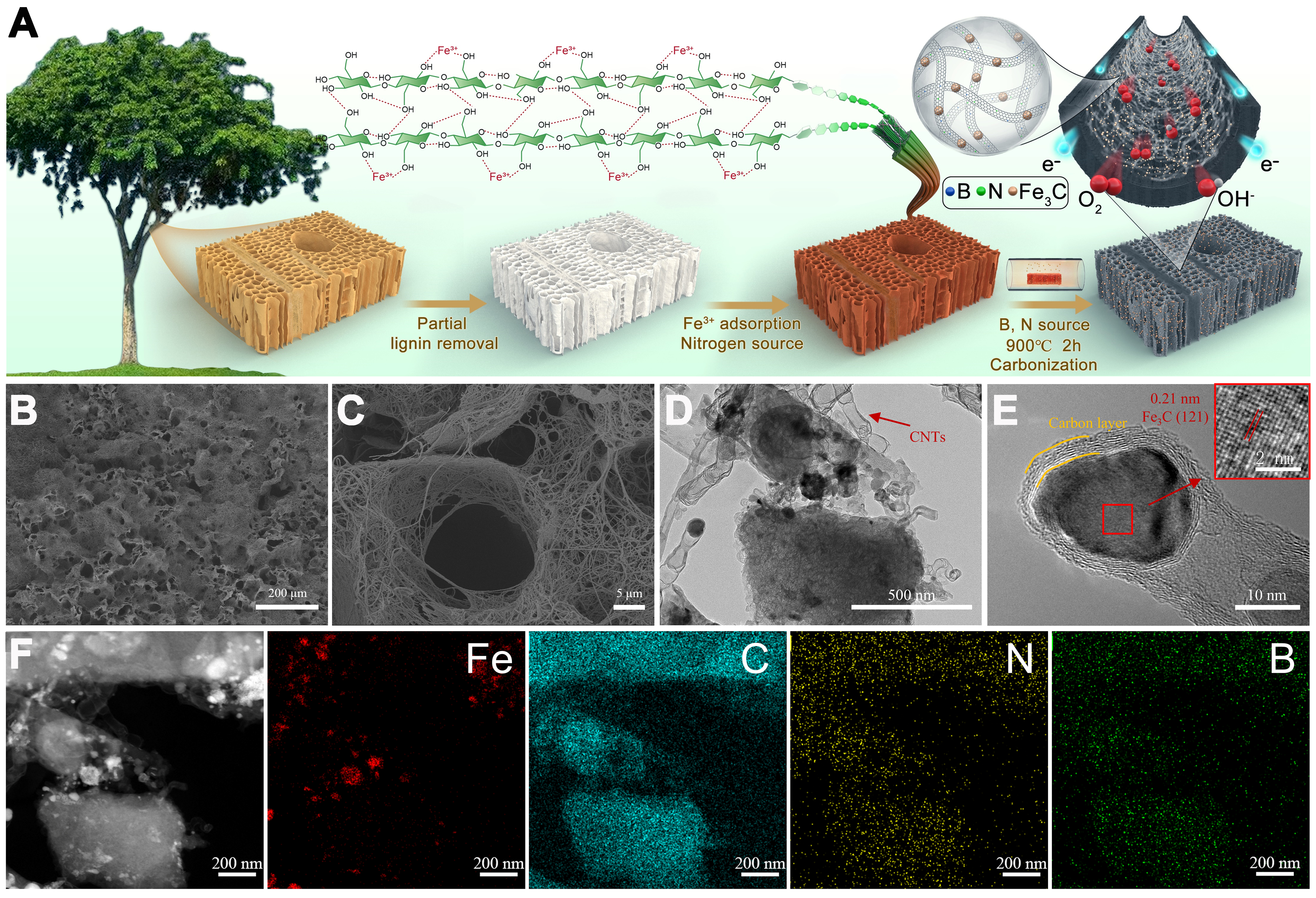
Figure 1. (A) Schematic of the preparation process of wood-derived Fe3C@BNC catalysts; (B and C) Top-view SEM images; (D) TEM images; (E) HRTEM and (F) EDS mapping images of Fe3C@BNC catalysts. SEM: Scanning electron microscopy; TEM: transmission electron microscopy; HRTEM: high-resolution TEM; EDS: energy-dispersive X-ray spectroscopy.
To further investigate the structure and composition of Fe3C@BNC, X-ray diffraction (XRD) patterns on
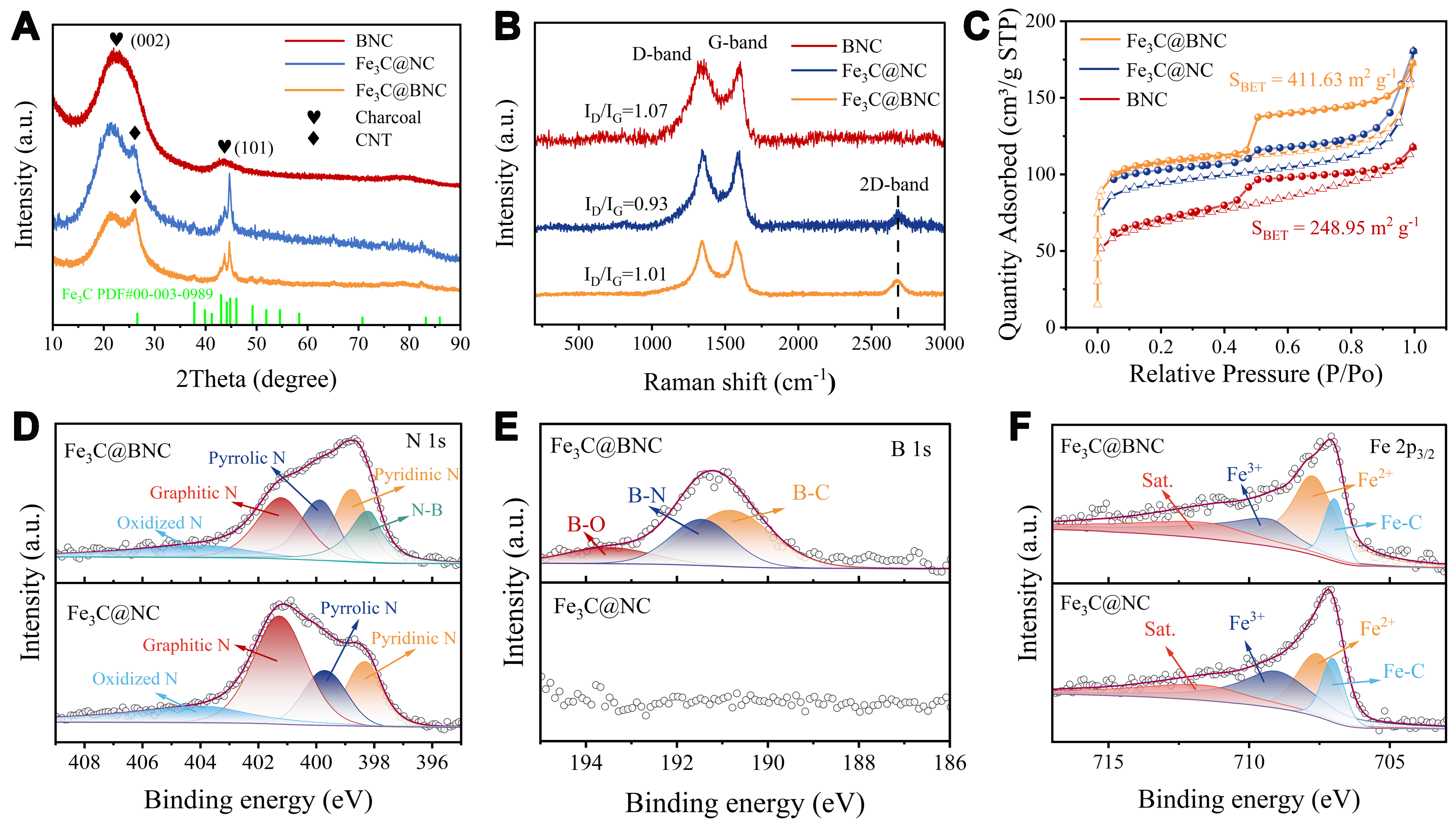
Figure 2. (A) XRD patterns, (B) Raman spectra, and (C) BET analysis surface area of Fe3C@BNC, Fe3C@NC, and BNC; High-resolution XPS spectra of (D) N 1s, (E) B 1s, and (F) Fe 2p3/2 for the three samples. XRD: X-ray diffraction; BET: Brunauer-Emmett-Teller; BNC: B, N-doped porous carbon; XPS: X-ray photoelectron spectroscopy.
The specific surface area and pore structure are crucial for reactant adsorption and mass transportation during catalysis. To evaluate these properties, Brunauer-Emmett-Teller (BET) specific surface area analysis was conducted. The Fe3C@BNC catalyst exhibits a surface area of 411.6 m2·g-1, which surpassed those of the other samples [Figure 2C], with a predominant pore size of ~4 nm [Supplementary Figure 7]. A comparison of Fe3C@BNC with a sample without lignin removal [Supplementary Figure 8] further confirms that lignin removal contributes to an increased surface area. Cross-sectional conductivity measurements of the wood-derived carbon materials indicate improved conductivity with increasing carbonization temperature
To further investigate the chemical states and bonding configurations of Fe3C and B, N-doped CNTs, X-ray photoelectron spectroscopy (XPS) analysis was performed. The XPS survey spectrum of Fe3C@BNC confirms the presence of B, O, N, C, and Fe elements [Supplementary Figure 10A]. High-resolution peaks were analyzed to determine the chemical states of the as-prepared samples. The peaks at 284.8, 286.0, and
Electrochemical activity measurements of Fe3C@BNC
To investigate the electrocatalytic activity of the as-prepared Fe3C@BNC, linear sweep voltammetry (LSV) was performed to evaluate its ORR performance. The LSV curves [Figure 3A] recorded using a rotating disk electrode at 1,600 rpm indicate that Fe3C@BNC exhibits an onset potential (Eonset = 0.90 V) and a half-wave potential (E1/2 = 0.83 V) comparable to those of commercial Pt/C. Moreover, Fe3C@BNC achieves a higher limiting current density (JL = 6.1 mA·cm-2). The excellent catalytic performance of Fe3C@BNC is mainly attributed to the regulatory effect of internal Fe3C NPs on the carbon shell, which significantly alters the electron density of the carbon layer[41,48]. The interfacial hybridization between the carbon shell and the metallic core enhances the electrochemical activity of the carbon surface. Additionally, boron doping plays a crucial role in further improving catalytic activity. A comparative analysis reveals that Fe3C@BNC outperforms Fe3C@NC, highlighting the critical role of the tailored electronic structure in the carbon layer and Fe3C for catalytic reactions. The study examined the impact of precursor concentration and wood structure regulation on the performance of the catalyst, identifying 0.01 M Fe3+ as the optimal concentration [Supplementary Figure 11]. Excessively high concentrations lead to the formation of larger metal aggregates, which are unfavorable for the formation of catalytic CNTs. On the other hand, too low concentration results in an insufficient number of catalytic sites, thereby reducing activity. Furthermore, the removal of lignin aids in anchoring more Fe3+, which in turn promotes uniform growth of CNTs and enhances conductivity [Supplementary Figure 12]. The impact of synthesis temperature on Fe3C@BNC performance was investigated [Supplementary Figures 13 and 14]. The results reveal that electrocatalysts carbonized at 900 °C exhibit a significantly higher activity than those carbonized at 800 and 700 °C. This improvement is likely due to higher temperatures promoting the graphitization of wood-derived carbon with CNTs, which enhances electrical conductivity and facilitates electron transfer. CNTs exhibit a greater tendency to interact with Fe3C NPs, further promoting the catalytic reaction. Figure 3B displays the Tafel plots of different samples. Fe3C@BNC exhibits a Tafel slope of 108 mV·dec-1, which is closely similar to that of Pt/C
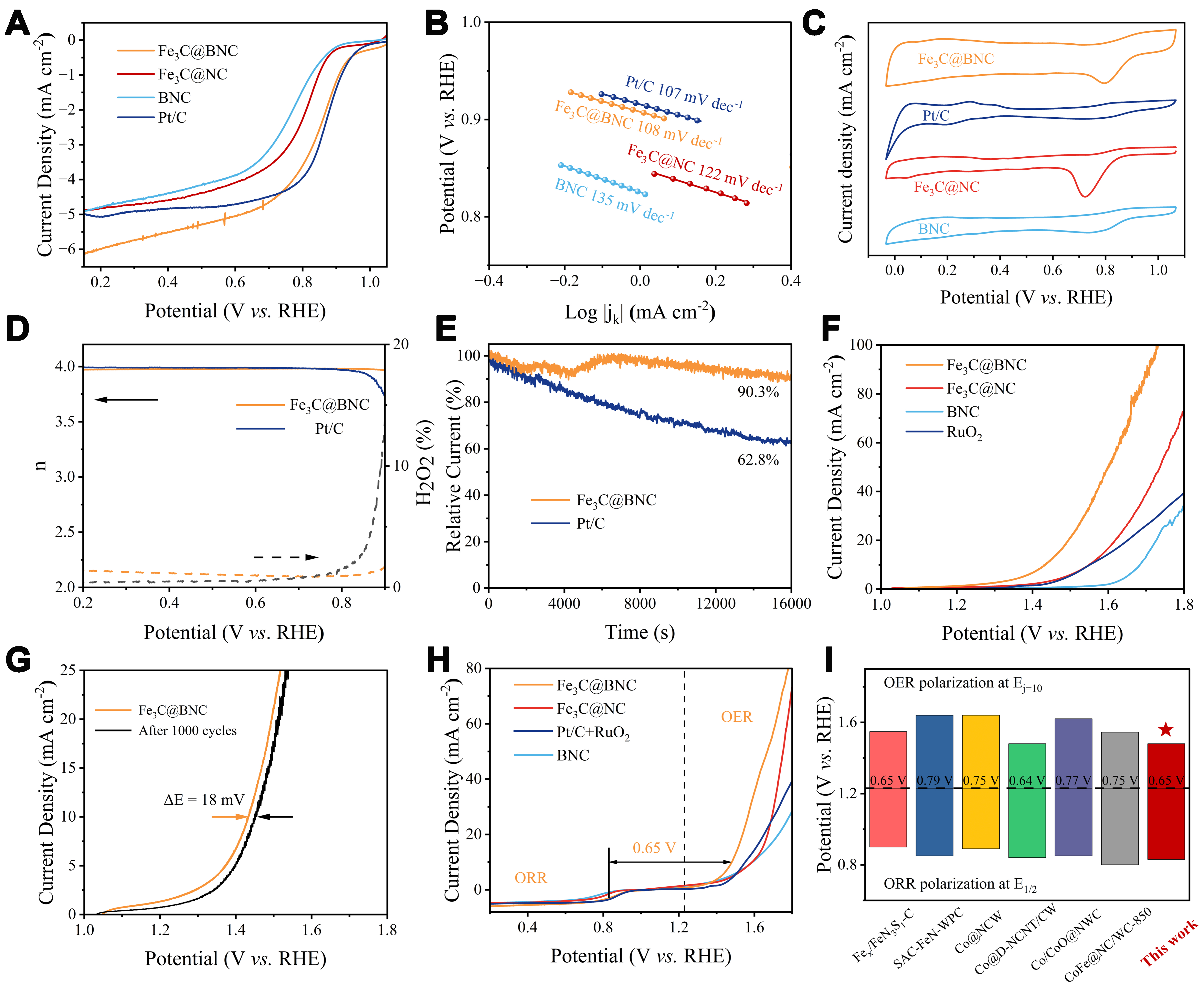
Figure 3. (A) ORR LSV curves, (B) Tafel curves, and (C) CV curves of Fe3C@BNC, Fe3C@NC, BNC, and Pt/C; (D) Electron transfer number and hydrogen peroxide yield of Fe3C@BNC and Pt/C; (E) Chronoamperometric curves of Fe3C@BNC and Pt/C; (F) OER LSV curves of Fe3C@BNC, Fe3C@NC, BNC, and RuO2 in 1 M KOH electrolyte; (G) LSV curves of Fe3C@BNC before and after 1,000 CV cycles; (H) LSV curves of ORR and OER of the catalysts in 0.1 M KOH electrolyte; (I) ΔE values of the catalysts. ORR: Oxygen reduction reaction; LSV: linear sweep voltammetry; CV: cyclic voltammetry; BNC: B, N-doped porous carbon; OER: oxygen evolution reaction.
OER is a crucial electrode process during the charging of ZABs. To evaluate the OER Fe3C@BNC, polarization curves were recorded using a 1 × 1 cm2 wood-derived carbon electrode as a self-supporting substrate, with a scan rate of 1 mV·s-1. Fe3C@BNC achieves a current density of 10 mA·cm-2 at a low overpotential of 200 mV [Figure 3F], which is significantly lower than that of RuO2. In contrast, the reference sample of Fe3C@NC exhibits an overpotential of 320 mV, similar to that of RuO2. When the catalyst operates in a 0.1 M KOH electrolyte, the overpotential of Fe3C@BNC is 250 mV [Supplementary Figure 19]. Durability analysis further confirms the excellent stability of Fe3C@BNC, with only an 18 mV decrease in overpotential after 1,000 CV cycles [Figure 3G]. This remarkable stability for both ORR and ORE is attributed to the protective CNT outer layer, which prevents electrolyte-induced etching of the internal Fe3C, thereby enhancing its potential for ZAB applications. To investigate the structural stability of Fe3C@BNC, various characterizations were performed. The XRD pattern of the post-reaction catalyst
To evaluate the dual-functional oxygen electrocatalytic performance, the potential gap (ΔE) between ORR E1/2 and OER Ej=10 was calculated from LSV curves. The Fe3C@BNC electrode exhibits a ΔE of 0.65 V, which is significantly lower than that of Pt/C+RuO2 [Figure 3H]. Additionally, the ΔE values of wood-derived dual-functional oxygen electrocatalysts were summarized to assess the activity of Fe3C@BNC [Figure 3I and Supplementary Table 3][22,25,26,49-51]. Among other samples, Fe3C@BNC exhibits the lowest ΔE value. Beyond heteroatom doping, the enriched CNTs on the wood-derived carbon play a crucial role in enhancing material conductivity, facilitating efficient electron transfer, and accelerating reaction kinetics. These features establish a strong basis for the application of Fe3C@BNC in ZABs.
Application of Fe3C@BNC as the air electrode in ZABs
To illustrate the practicality of Fe3C@BNC, liquid ZABs were assembled using Fe3C@BNC as the air cathode. The schematic of the ZAB system is shown in Figure 4A. For comparison, a ZAB with commercial Pt/C and RuO2 catalyst was constructed. Fe3C@BNC-based ZABs exhibit an open-circuit voltage (OCV) of 1.46 V [Figure 4B]. Additionally, the LAND testing system confirms that ZABs maintain an OCV of 1.46 V for over 80 min, consistent with multimeter measurements and close to the theoretical value. The Pt/C+RuO2 ZABs exhibit a lower OCV of 1.35 V. Polarization curves and corresponding power density measurements reveal that Fe3C@BNC ZABs achieve a peak power density of 114 mW·cm-2, which exceeds the 98 mW·cm-2 of Pt/C-based ZABs [Figure 4C]. This superior performance can be attributed to the abundant active sites generated by heteroatom doping and the enhanced electron transport facilitated by CNTs within the wood-derived carbon.
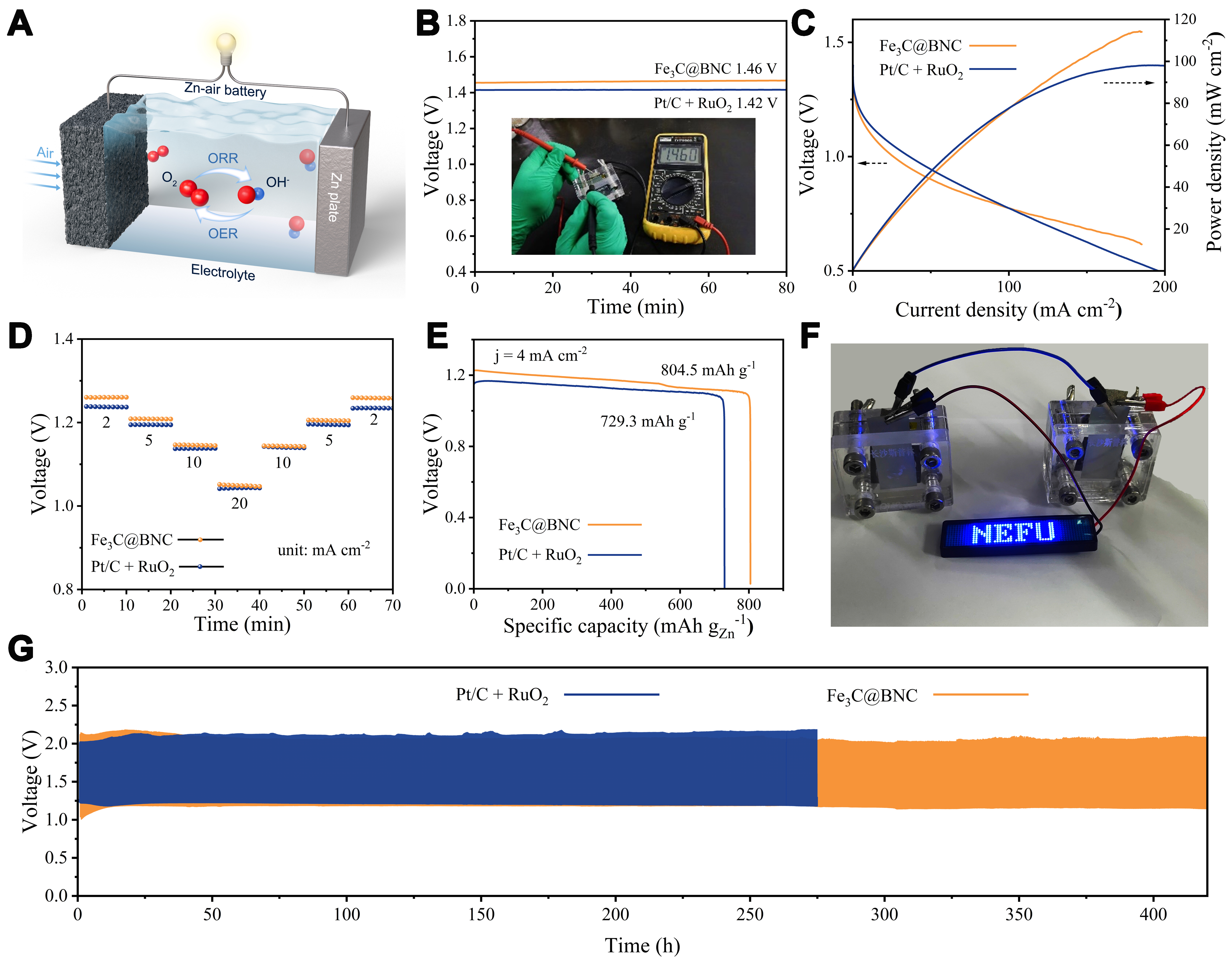
Figure 4. (A) Schematic of aqueous ZABs; (B) OCV of ZABs based on Fe3C@BNC and 20% Pt/C+RuO2; the inset displays a photograph of the as-assembled ZABs; (C) Discharge polarization curves and corresponding power density plots of ZABs with Fe3C@BNC and 20% Pt/C+RuO2 electrodes; (D) Discharge voltage profiles of Fe3C@BNC and 20% Pt/C+RuO2 ZABs at various current densities; (E) Specific capacity comparison of ZABs with Fe3C@BNC and 20% Pt/C+RuO2; (F) Photograph of light-emitting diodes (≈3.0 V) powered by two liquid ZABs connected in series; (G) Cyclic stability of ZABs with Fe3C@BNC and 20% Pt/C+RuO2 electrodes. ZABs: Zn-air batteries; OCV: open-circuit voltage; BNC: B, N-doped porous carbon.
To assess the rate performance of Fe3C@BNC ZABs, the battery voltage was monitored at varying current densities. Even as the current density increases from 2 to 20 mA·cm-2, Fe3C@BNC ZABs maintain higher discharge voltage than Pt/C+RuO2 ZABs. As the current density decreases to 2 mA·cm-2, the voltage successfully recovers to its initial value [Figure 4D]. Moreover, Fe3C@BNC ZABs exhibit a specific capacity of 804.5 mA·h·g-1 at 4 mA·cm-2 [Figure 4E], exceeding the 729.3 mA·h·g-1 of Pt/C+RuO2 ZABs, indicating superior discharge capacity. In practical applications, this high performance enables Fe3C@BNC ZABs to power a light-emitting diode light, with two batteries connected in series [Figure 4F]. To assess the cycling stability of ZABs, constant current charge and discharge tests were conducted at 2 mA·cm-2 [Figure 4G]. Notably, Fe3C@BNC ZABs maintain stable operation for over 420 h. A comparison of the discharge voltage gap at ~50 and 420 h [Supplementary Figure 22] reveals only a slight increase from 0.91 to 0.93 V, indicating a stable discharge platform even after 400 h. In contrast, the charge–discharge curve of Pt/C+RuO2 ZABs indicates a diffusion trend after only 270 h. The designed Fe3C@BNC exhibits excellent stability, similar to other carbon-coated catalysts, and benefits from electronic modulation between Fe3C NPs and the B, N co-doped carbon shell. This synergy effectively optimizes the charging and discharging processes in ZABs, highlighting Fe3C@BNC as a promising air electrode for ZAB applications.
CONCLUSION
This study designed a wood-derived carbon-based catalytic electrode that promotes the uniform growth of CNTs throughout the materials and incorporates abundant heteroatom doping. The high graphitization of CNTs enhances the conductivity of wood carbon, which facilitates rapid electron transfer and electrocatalytic reactions. Moreover, the interaction between Fe3C NPs and the B, N-doped carbon interface alters the electron density of the carbon layer, while abundant defect sites enhance its intrinsic activity. CNT encapsulation protects Fe3C NPs from corrosion under harsh alkaline reaction conditions. The resulting
DECLARATIONS
Authors’ contributions
Experiments and data analysis: Li, M.
Discussion on the results: Li, M.; Zhu, W.; Wang, C.; Fan, J.; Liu, Y.; Xia, Q.; Yu, H.; Dou, S.
Design of the study: Dou, S.
Availability of data and materials
The data supporting the findings of this study are available within the article and its Supplementary Materials. Further data is available from the corresponding authors upon reasonable request.
AI and AI-assisted tools statement
Not applicable.
Financial support and sponsorship
The authors are grateful for the financial support from the National Key Research and Development Program of China (No. 2023YFD2200505), the Joint Funds of the National Natural Science Foundation of China (Grant No. U24A20498), and the Fundamental Research Funds for the Central Universities (Grant No. 2572023CT04-04).
Conflicts of interest
All authors declared that there are no conflicts of interest.
Ethical approval and consent to participate
Not applicable.
Consent for publication
Not applicable.
Copyright
© The Author(s) 2026.
Supplementary Materials
REFERENCES
1. Seh, Z. W.; Kibsgaard, J.; Dickens, C. F.; Chorkendorff, I.; Nørskov, J. K.; Jaramillo, T. F. Combining theory and experiment in electrocatalysis: insights into materials design. Science 2017, 355, eaad4998.
2. Cano, Z. P.; Banham, D.; Ye, S.; et al. Batteries and fuel cells for emerging electric vehicle markets. Nat. Energy. 2018, 3, 279-89.
4. Wang, Q.; Kaushik, S.; Xiao, X.; Xu, Q. Sustainable zinc-air battery chemistry: advances, challenges and prospects. Chem. Soc. Rev. 2023, 52, 6139-90.
5. Zou, X.; Tang, M.; Lu, Q.; Wang, Y.; Shao, Z.; An, L. Carbon-based electrocatalysts for rechargeable Zn–air batteries: design concepts, recent progress and future perspectives. Energy. Environ. Sci. 2024, 17, 386-424.
6. Liu, Y.; Feng, S.; Shan, L.; et al. Localized negatively charged interfaces for seawater electrolyte-based zinc-air batteries. Adv. Funct. Mater. 2025, 2422874.
7. Wang, W.; Wang, J.; Pan, S.; et al. Crafting of photothermal cobalt/sulfur doped manganese selenide for extreme-temperature-tolerant flexible zinc-air batteries. Adv. Funct. Mater. 2025, 2425430.
8. Dou, S.; Tao, L.; Huo, J.; Wang, S.; Dai, L. Etched and doped Co9S8/graphene hybrid for oxygen electrocatalysis. Energy. Environ. Sci. 2016, 9, 1320-6.
9. Dou, S.; Tao, L.; Wang, R.; El Hankari, S.; Chen, R.; Wang, S. Plasma-assisted synthesis and surface modification of electrode materials for renewable energy. Adv. Mater. 2018, 30, e1705850.
10. Tang, B.; Zhou, Y.; Ji, Q.; et al. A Janus dual-atom catalyst for electrocatalytic oxygen reduction and evolution. Nat. Synth. 2024, 3, 878-90.
11. Zhang, Q.; Zheng, Z.; Gao, R.; et al. Constructing bipolar dual-active sites through high-entropy-induced electric dipole transition for decoupling oxygen redox. Adv. Mater. 2024, 36, e2401018.
12. Kang, D.; Zhang, C.; Wang, X.; et al. Efficient atomically dispersed Fe catalysts with robust three-phase interface for stable seawater-based zinc-air batteries. Green. Carbon. 2025, 3, 1-10.
13. Shin, Y.; Lee, Y.; Jo, C.; Kim, Y. H.; Park, S. Co(O)4(N)-type single-atom-based catalysts and ligand-driven modulation of electrocatalytic properties for reducing oxygen molecules. EcoEnergy 2024, 2, 154-68.
14. Yin, L.; Sun, M.; Zhang, S.; Huang, Y.; Huang, B.; Du, Y. Chlorine axial coordination activated lanthanum single atoms for efficient oxygen electroreduction with maximum utilization. Adv. Mater. 2025, 37, e2416387.
15. Karthikeyan, S.; Sidra, S.; Ramakrishnan, S.; et al. Heterostructured NiO/IrO2 synergistic pair as durable trifunctional electrocatalysts towards water splitting and rechargeable zinc-air batteries: an experimental and theoretical study. Appl. Catal. B. Environ. Energy. 2024, 355, 124196.
16. Kumar, R. S.; Tamilarasi, S.; Stephan, A. M.; Kim, A. R.; Yoo, D. J. CrS doped MOF-derived carbon implanted CoNi particles as exceedingly effectual oxygen electrocatalysts in sustainable zinc-air batteries. Small. Methods. 2025, 9, e2401515.
17. Kim, A. A.; Yoo, D. J.; Poudel, M. B. CuxOy assisted metal organic frameworks derived CuSe2 on porous nitrogen doped carbon as free standing electrocatalysts for electrochemical hydrogen evolution reaction. Int. J. Hydrogen. Energy. 2025, 98, 441-7.
18. Zhao, B.; Luo, H.; Liu, J.; et al. S-doped carbonized wood fiber decorated with sulfide heterojunction-embedded S, N-doped carbon microleaf arrays for efficient high-current-density oxygen evolution. Chin. Chem. Lett. 2025, 36, 109919.
19. Lu, X. F.; Zhang, S. L.; Shangguan, E.; Zhang, P.; Gao, S.; Lou, X. W. D. Nitrogen-doped cobalt pyrite yolk-shell hollow spheres for long-life rechargeable Zn-air batteries. Adv. Sci. 2020, 7, 2001178.
20. Esmaeilirad, M.; Baskin, A.; Kondori, A.; et al. Gold-like activity copper-like selectivity of heteroatomic transition metal carbides for electrocatalytic carbon dioxide reduction reaction. Nat. Commun. 2021, 12, 5067.
21. Wang, M.; Wang, Y.; Mao, S. S.; Shen, S. Transition-metal alloy electrocatalysts with active sites modulated by metal-carbide heterophases for efficient oxygen evolution. Nano. Energy. 2021, 88, 106216.
22. Ao, K.; Zhang, X.; Nazmutdinov, R. R.; et al. Hierarchical CoFe@N-doped carbon decorated wood carbon as bifunctional cathode in wearable Zn-air battery. Energy. Environ. Mater. 2024, 7, e12499.
23. Wang, F.; Lee, J.; Chen, L.; et al. Inspired by wood: thick electrodes for supercapacitors. ACS. Nano. 2023, 17, 8866-98.
24. Chen, Z.; Wei, W.; Xu, X.; et al. Reconstructed anti-corrosive and active surface on hierarchically porous carbonized wood for efficient overall seawater electrolysis. Sci. Bull. 2024, 69, 2337-41.
25. Zhong, L.; Jiang, C.; Zheng, M.; et al. Wood carbon based single-atom catalyst for rechargeable Zn–air batteries. ACS. Energy. Lett. 2021, 6, 3624-33.
26. Chen, J.; Qiu, C.; Zhang, L.; et al. Wood-derived Fe cluster-reinforced asymmetric single-atom catalysts and weather-resistant organohydrogel for wide-temperature flexible Zn–air batteries. Energy. Environ. Sci. 2024, 17, 4746-57.
27. Liu, L.; Ma, T.; Fang, W.; et al. Facile fabrication of Ag nanocrystals encapsulated in nitrogen-doped fibrous carbon as an efficient catalyst for lithium oxygen batteries. Energy. Environ. Mater. 2021, 4, 239-45.
28. Peng, Y.; Chen, S. Electrocatalysts based on metal@carbon core@shell nanocomposites: an overview. Green. Energy. Environ. 2018, 3, 335-51.
29. Sun, Z.; Li, C.; Lin, J.; et al. Lattice strain and Mott-Schottky effect of the charge-asymmetry Pd1Fe single-atom alloy catalyst for semi-hydrogenation of alkynes with high efficiency. ACS. Nano. 2024, 18, 13286-97.
30. Tan, C.; Chen, J.; Wu, X.; Zhang, H. Epitaxial growth of hybrid nanostructures. Nat. Rev. Mater. 2018, 3, 17089.
31. Yoo, J. M.; Shin, H.; Chung, D. Y.; Sung, Y. E. Carbon shell on active nanocatalyst for stable electrocatalysis. Acc. Chem. Res. 2022, 55, 1278-89.
32. Cheng, R.; Li, K.; Li, H.; et al. In-situ transformed Mott-Schottky heterointerface in silver/manganese oxide nanorods boosting oxygen reduction, oxygen evolution, and hydrogen evolution reactions. Nano. Res. 2024, 17, 3622-32.
33. Hao, Y. R.; Xue, H.; Sun, J.; et al. Synergetic of built-in electric field and sulfur defects in Co@Co9S8 Mott-Schottky to achieve high-efficiency zinc-air battery performance. ACS. Appl. Mater. Interfaces. 2023, 15, 30964-74.
34. Liu, J.; Yang, X.; Si, F.; et al. Interfacial component coupling effects towards precise heterostructure design for efficient electrocatalytic water splitting. Nano. Energy. 2022, 103, 107753.
35. Li, M.; Sun, H.; Wang, C.; et al. Balancing competitive adsorption on Co3O4@P, N-doped porous carbon to enhance the electrocatalytic upgrading of biomass derivatives. Small 2025, 21, 2409765.
36. Chen, Z.; Han, N.; Wei, W.; Chu, D.; Ni, B. Dual doping: an emerging strategy to construct efficient metal catalysts for water electrolysis. EcoEnergy 2024, 2, 114-40.
37. Zang, Y.; Liu, T.; Wei, P.; et al. Selective CO2 electroreduction to ethanol over a carbon-coated CuOx catalyst. Angew. Chem. Int. Ed. Engl. 2022, 61, e202209629.
38. Zhang, N.; Zou, Y.; Tao, L.; et al. Electrochemical oxidation of 5-hydroxymethylfurfural on nickel nitride/carbon nanosheets: reaction pathway determined by in situ sum frequency generation vibrational spectroscopy. Angew. Chem. Int. Ed. Engl. 2019, 58, 15895-903.
39. Yoo, T. Y.; Yoo, J. M.; Sinha, A. K.; et al. Direct synthesis of intermetallic platinum-alloy nanoparticles highly loaded on carbon supports for efficient electrocatalysis. J. Am. Chem. Soc. 2020, 142, 14190-200.
40. Chung, D. Y.; Jun, S. W.; Yoon, G.; et al. Large-scale synthesis of carbon-shell-coated FeP nanoparticles for robust hydrogen evolution reaction electrocatalyst. J. Am. Chem. Soc. 2017, 139, 6669-74.
41. Zhou, M.; Jiang, X.; Kong, W.; et al. Synergistic effect of dual-doped carbon on Mo2C nanocrystals facilitates alkaline hydrogen evolution. Nanomicro. Lett. 2023, 15, 166.
42. Li, M.; Song, Y.; Zhang, C.; et al. Robust carbon nanotube composite fibers: strong resistivities to protonation, oxidation, and ultrasonication. Carbon 2019, 146, 627-35.
43. Meng, J.; Liu, H.; Xu, J.; et al. Nanocarbon catalysts with co-active S−P−C sites enhance metal-free direct oxidation of alcohols. SusMat 2024, 4, e221.
44. Meng, J.; Liu, Y.; Xia, Q.; et al. High-loading, well-dispersed phosphorus confined on nanoporous carbon surfaces with enhanced catalytic activity and cyclic stability. Small. Methods. 2021, 5, 2100964.
45. Meng, J.; Tong, Z.; Sun, H.; et al. Metal-free boron/phosphorus Co-doped nanoporous carbon for highly efficient benzyl alcohol oxidation. Adv. Sci. 2022, 9, e2200518.
46. Fan, M.; Yuan, Q.; Zhao, Y.; et al. A facile “double-catalysts” approach to directionally fabricate pyridinic N−B-pair-doped crystal graphene nanoribbons/amorphous carbon hybrid electrocatalysts for efficient oxygen reduction reaction. Adv. Mater. 2022, 34, e2107040.
47. Liang, H.; Gai, Z.; Chen, F.; et al. Fe3C decorated wood-derived integral N-doped C cathode for rechargeable Li-O2 batteries. Appl. Catal. B. Environ. 2023, 324, 122203.
48. Wang, B.; Srinivas, K.; Liu, Y.; et al. N-doped CNTs capped with carbon layer armored CoFe alloy as highly stable bifunctional catalyst for oxygen electrocatalysis. Nano. Res. 2022, 15, 3971-9.
49. Chen, Z.; Chen, H.; Li, T.; et al. Defective wood-based chainmail electrocatalysts boost performances of seawater-medium Zn-air batteries. J. Energy. Chem. 2025, 102, 134-43.
50. Cui, X.; Liu, Y.; Han, G.; et al. Wood-derived integral air electrode for enhanced interfacial electrocatalysis in rechargeable zinc-air battery. Small 2021, 17, e2101607.
Cite This Article
 Open Access
How to Cite
Download Citation
Export Citation File:
Type of Import
Tips on Downloading Citation
Citation Manager File Format
Type of Import
Direct Import: When the Direct Import option is selected (the default state), a dialogue box will give you the option to Save or Open the downloaded citation data. Choosing Open will either launch your citation manager or give you a choice of applications with which to use the metadata. The Save option saves the file locally for later use.
Indirect Import: When the Indirect Import option is selected, the metadata is displayed and may be copied and pasted as needed.
About This Article
Copyright

Data & Comments
Data
0











Comments
Comments must be written in English. Spam, offensive content, impersonation, and private information will not be permitted. If any comment is reported and identified as inappropriate content by OAE staff, the comment will be removed without notice. If you have any queries or need any help, please contact us at support@oaepublish.com.