



Deep carbon in agricultural soils: considerations for its treatment in soil carbon studies
 0
0 
Abstract
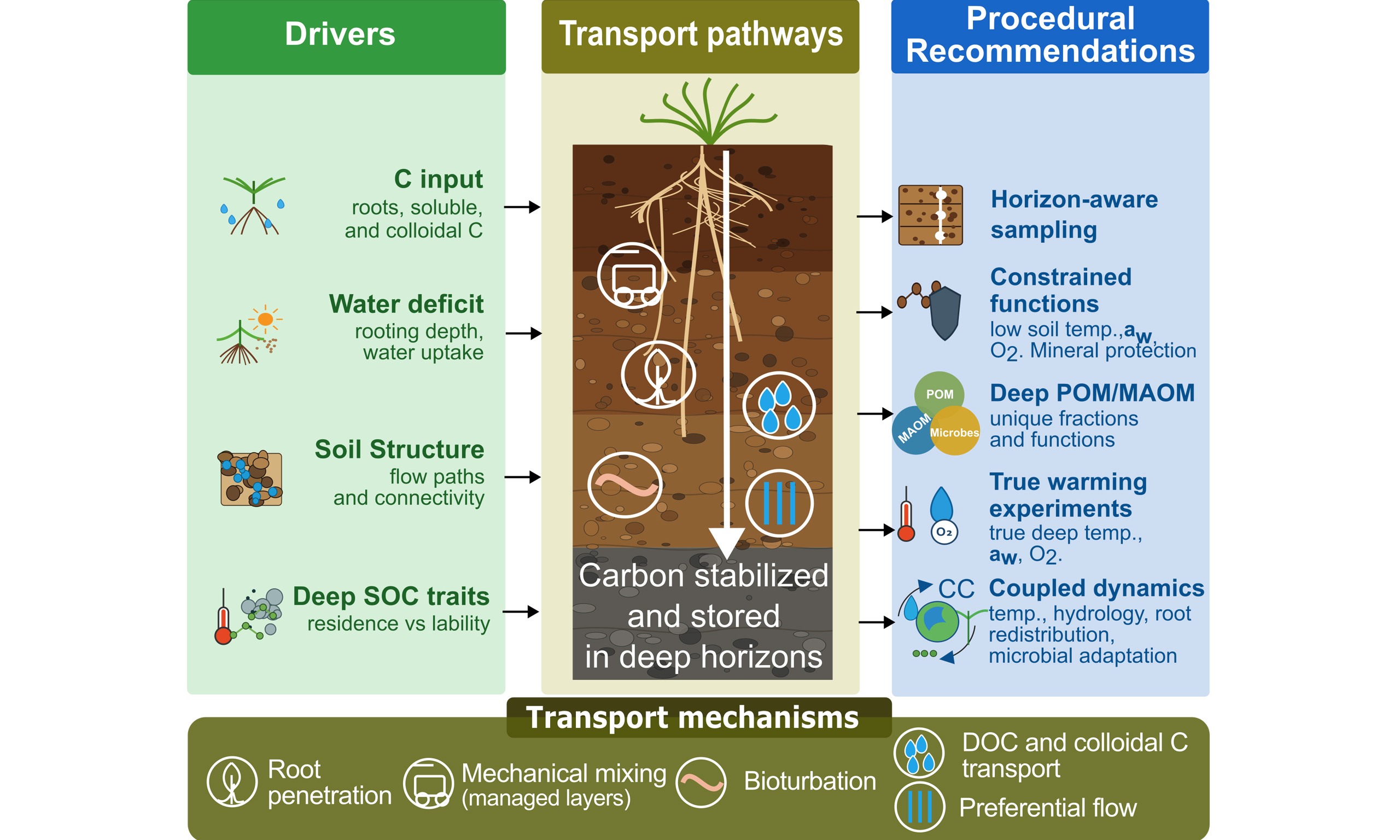
Carbon reaches deep soil via roots, dissolved and colloidal transport, preferential flow, bioturbation, and soil mixing. Droughts may promote deep rooting but also suppress microbial activity. At depth, carbon persistence and vulnerability are regulated by interacting constraints that differ fundamentally from those operating near the surface. Hence, its study must acknowledge the unique carbon inputs and environmental constraints. This review offers a perspective on the utility and potential shortcomings of current approaches to studying deep soil organic carbon (dSOC) in the context of sources, transport pathways, stabilization and vulnerability across depth and their interactions with pedogenic horizonation, climate and environmental change. Evidence suggests that dSOC functions as a distinct component of the soil carbon cycle rather than a slow-cycling reflection of surface SOC. Persistence of dSOC cannot be solely explained by the chemical recalcitrance of SOC. Instead, dSOC stability is a composite of the hydrological, gaseous, mineralogical and biological constraints controlling microbial functions and access to SOC. Importantly, these are more accurately described as horizon-dependent rather than strictly depth-dependent. Although the particulate/mineral-associated organic matter framework remains useful, its interpretation may become ambiguous in deep soils. Hence, a mechanistic understanding of dSOC persistence requires coupling changes to C inputs, transfer pathways, mineral interactions, hydrological connectivity and biological constraints across pedogenic horizons. As soil horizon-dependent heterogeneity governs the persistence of chemically labile C compounds, horizon-aware sampling and testing would avoid misrepresenting mechanisms controlling dSOC. Incubation and warming studies imposing ecologically implausible conditions may measure short-term microbial physiological stress responses rather than climate-relevant SOC vulnerability.
Keywords
INTRODUCTION
Soil organic carbon (SOC) is the largest terrestrial carbon pool, exceeding the combined carbon stored in vegetation and the atmosphere[1]. Agricultural soils have lost substantial SOC under long-term land use and intensive management, creating a large SOC debt[2]. Rebuilding this carbon stock through sequestration is widely viewed as an effective climate-change mitigation opportunity[3-6], particularly if added carbon can persist over timescales relevant to mitigation.
However, increasing SOC storage does not automatically constitute C sequestration[7]. The term “sequestration” should be reserved for SOC increases resulting from net atmosphere to soil C flow that are durable, additional and climate-relevant, rather than for any short-term increase in SOC stocks[8]. This distinction is especially important in deeper layers where slower apparent turnover, older radiocarbon ages and greater mineral-associated storage capacity[9,10] have led to growing interest in subsoil C as a sequestration target. These attributes, when combined with higher C variability in deeper layers[11] risk misrepresenting SOC storage change.
Most agricultural SOC studies focus on the upper 0-30 cm, despite deeper layers storing more than half of global SOC stocks[12-14]. This shallow focus risks underestimating SOC stocks and misrepresenting management effects when carbon is redistributed with depth[15]. For example, extensive literature indicates that apparent SOC gains under no-till in surface layers may partly reflect vertical redistribution rather than whole-profile increased sequestration[16]. While deep SOC (dSOC) research has expanded, studies focusing on agricultural systems are less represented [Supplementary Materials], supporting the need for agricultural perspectives that integrate soil physics, hydrology, pedology, microbial ecology and C-fraction frameworks.
Several reviews have addressed dSOC formation, cycling, response to global change and management strategies for enhancing subsoil C storage[9,17-22]. Rather than repeat that content, in this review we aim to identify and discuss overlooked considerations while offering recommendations that should guide future dSOC studies on the potential impacts of agriculture and climate change.
Roots dominate vertical carbon inputs and depth distribution
Carbon inputs originate from photosynthetically fixed C that reaches soil either as aboveground litter or as belowground root-derived C. The relative importance of these pathways varies among vegetation types and environmental conditions. Root-to-shoot ratios are strongly influenced by potential water deficit, with greater deficits generally increasing belowground allocation[23]. Absolute root-to-shoot ratios also vary by plant functional type, tending to be larger in grasslands, lower in shrublands and lowest in forests[24].
Roots exert a disproportionate effect on soil organic matter (SOM) formation[25] through growth, exudation, fragmentation and turnover. Root distribution is therefore a major determinant of vertical C allocation[12]. In wetter and colder systems, C inputs are often concentrated near the surface. In warmer or drier systems, roots may penetrate deeper into the vadose zone, promoting deeper C deposition and rhizosphere-driven microbial activity. Under drought conditions, roots redistribute preferentially into deeper horizons, increasing overlap with retention zones and microbial activity, thereby enhancing the potential for subsoil C stabilization [Figure 1A]. This pattern is also relevant to annual crops. For example, drought can increase maize root biomass and rooting depth, potentially contributing to climate-change adaptation and deeper C inputs[26]. Water deficit may therefore favor proportionally deeper C deposition, but its effects are context-dependent.
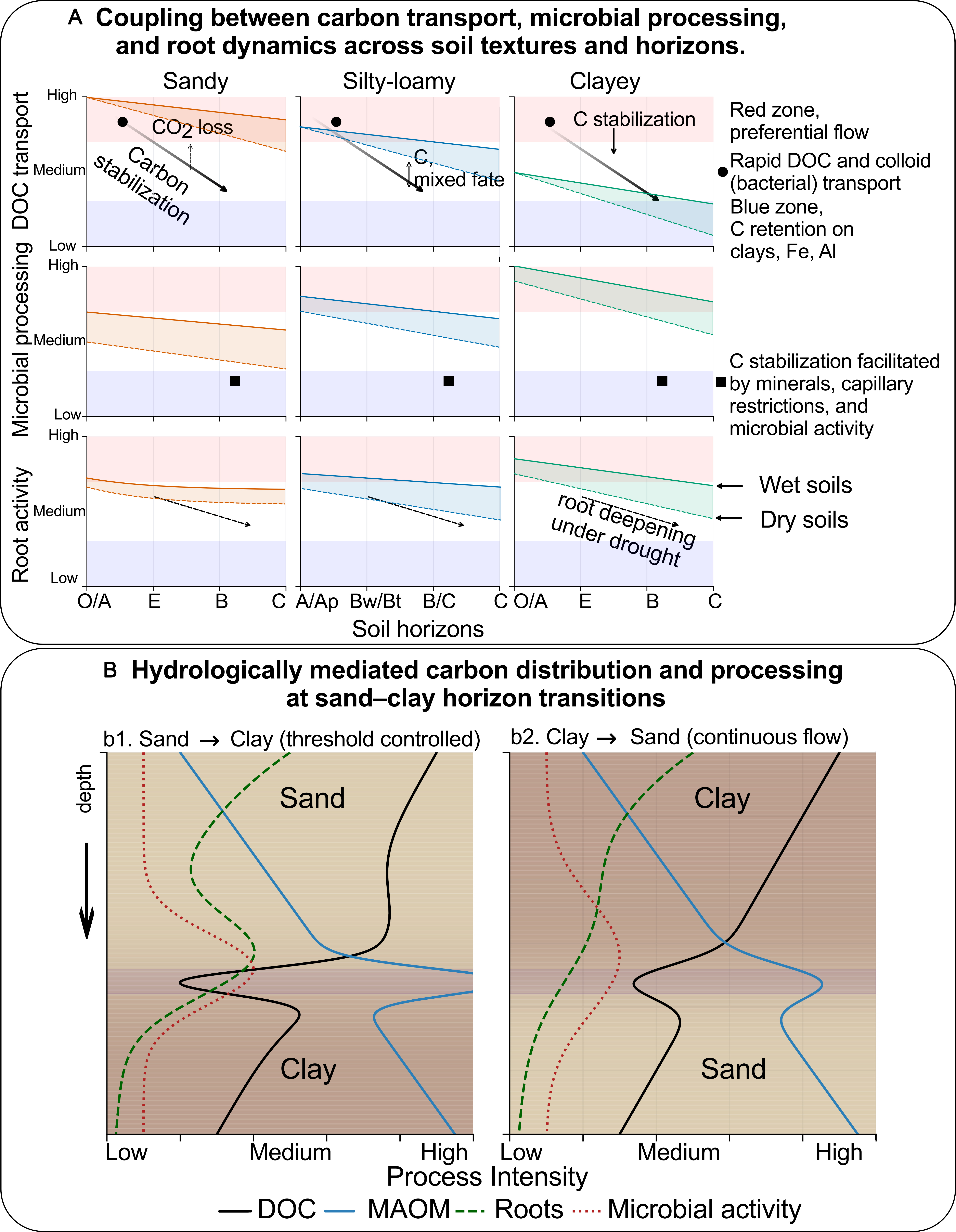
Figure 1. Illustration of transport and processing of carbon to soil depth: texture and horizonation. (A) Soil profiles partition into a preferential flow domain (red shading) and a retention domain (blue shading), which regulate dissolved organic carbon (DOC) mobility, microbial processing, and root activity; (B) Hydraulically mediated carbon distribution and processing at horizon textural boundary transitions for (b1) coarse-over-fine (sand → clay) systems and (b2) fine-over-coarse (clay → sand) systems. Across both panels, horizon transitions are represented as continuous, while variably diverging, gradients rather than discrete boundaries, emphasizing their role as biogeochemical zones where hydrologic, biological, and geochemical processes converge to regulate carbon persistence[44]. MAOM: Mineral-associated organic matter.
Short-term drought can sometimes be tolerated without yield loss in perennial grasses[27], and the effect of wetting or drying on rooting depth depends on the initial wetness or aridity of the system[28]. The yield sensitivity to drought is non-linear and depends on the interplay between drought length, timing and temperature[29]. This can lead to reduced but variable available litter to be deposited on or tilled into the superficial soil layers.
The balance between gross primary productivity and microbial decomposition ultimately governs net SOC accumulation. Systems with high productivity, such as tropical biomes, or with very low decomposition rates, such as tundra, can accumulate large SOC stocks. By contrast, croplands often combine variable productivity with relatively high decomposition rates, limiting long-term SOC accumulation.
Transport of soluble and suspended SOC
Besides through roots, SOC reaches deep soil horizons through several interacting pathways including:
• Downward movement of dissolved organic matter through matrix flow and preferential flow paths;
• Transport of colloidal organic carbon;
• Bioturbation;
• Redistribution caused by tillage, deep plowing or other management operations.
As nature’s solvent, water enables advective and diffusive transport[30] of soluble C (i.e., dissolved organic carbon; DOC) and suspended colloidal (1-1,000 nm) particles[31], including microbial cells. The magnitude and depth of this transport depend on infiltration rate and timing, soil structure, pore architecture, extant water potential and hysteretic behavior, mineralogy and the properties of the soil solution, which ultimately impacts C availability along gradients of these factors [Figure 1A].
Dissolved organic matter (DOM) moving along infiltration pathways undergoes repeated adsorption, microbial processing and desorption. During this process, plant-derived compounds deposited in upper layers can displace, or be progressively transformed into, smaller microbially derived compounds with depth, contributing to vertical chemical gradients in SOM composition and radiocarbon age[32,33]. Thus, structurally complex aromatic compounds often dominate upper layers, whereas more processed, microbially derived compounds may become relatively more important in deeper layers[34,35].
In coarse-textured soils, rapid piston and finger flows lead to weak coupling between DOC transport and microbial activity, promoting carbon export, CO2 losses, and lower mineral stabilization of organic matter[32,36]. In fine-textured soils (clay), slower, matrix-dominated flow enhances DOC retention and promotes microbial processing zones, resulting in carbon stabilization via mineral associations[37-39]. Intermediate textures (silt) exhibit partial coupling between transport and processing [Figure 1A].
Colloidal organic matter may also contribute substantially to dSOC transfer, although its formation, mobility, reactivity and functional role in dSOC storage remain less well understood. Colloids can transport organic matter, clay minerals, Fe and Al oxides, enzymes and microbial cells. This means that preferential flow paths may not only transport C but also deliver microbial cells and extracellular enzymes to deeper microsites contributing to the deep soil communities and functions[40]. Significant deep transfer of larger colloids and suspended particulates (> 0.45 µm and up to 75 µm) may occur during pronounced infiltration events across different soil structures and land use types, but its contribution is often neglected[41].
Preferential flow through macropores[42] is especially important in structured soils [Figure 1A]. Large, continuous pores and cracks, such as those found in some fine-textured and shrink-swell clay soils, can promote rapid but spatially uneven transport of dissolved and colloidal organic matter. This may generate deep hotspots with elevated C availability and turnover[43], whose quality might differ, as it largely bypasses close mineral-surface interactions during matrix flow. However, the biological expression of these hotspots depends on whether temperature, water activity and oxygen availability support microbial activity.
SOC STABILITY: CHEMISTRY, MINERAL PROTECTION AND ENVIRONMENTAL LIMITATION
Historically, SOM persistence was often attributed to inherent chemical recalcitrance, especially in humic fractions. This view has been challenged by the recognition that all SOM is potentially subject to microbial processing, and that persistence often reflects environmental and physicochemical protection rather than intrinsic molecular resistance[39,44].
Current frameworks emphasize physical inaccessibility and mineral protection[45], particularly through the distinction between particulate organic matter (POM) and mineral-associated organic matter (MAOM)[46]. These fractions differ in residence time and sensitivity to disturbance, but their functional interpretation remains imperfect. POM may, under some conditions, contribute to long-term storage[47], whereas some MAOM can also cycle relatively rapidly[48].
This ambiguity is amplified in deep soils. Compounds that are biochemically labile may be functionally persistent because they are mineral-associated, spatially inaccessible, oxygen limited or present under conditions of low water activity and low microbial activity. Conversely, operationally defined MAOM may not always represent slow-cycling C, especially if changing hydrology or redox conditions alter organo-mineral associations.
The permanence of deep MAOM therefore depends on mineralogy, pH, redox status, ionic strength, microbial community structure and water-flow dynamics. Acidic solutions may promote dissociation of C from low-charge minerals such as silica oxides, while favoring ligand-exchange complexation of aromatic DOC with Fe and Al oxides, as seen in Podzols[49-51]. Thus, the same organic compound may differ in persistence depending on where it is located in the profile.
SOIL HORIZONS AS FUNCTIONAL COMPARTMENTS
Soils are vertically structured systems composed of horizons with distinct physical, chemical and biological properties. During soil formation, weathering, fragmentation, thermal expansion, crystal growth, colloidal movement and hydrological redistribution produce layered profiles. Each horizon has its own boundary conditions, affecting mass and heat transfer across the profile.
Horizons can therefore be conceptualized as interconnected compartments or bioreactors, each with specific inputs, outputs and internal transformations[52,53] [Figure 1B]. Carbon derived from litter, roots and fauna is transferred and transformed within these horizon-specific microenvironments. Soil temperature, water content and gas regimes reflect atmospheric forcing at the soil surface but are mediated by horizon-to-horizon dependent differences in texture, structure, porosity, mineralogy and organic matter content, emerging from the soil-specific set of processes that characterize its development, which will control cross-horizon transfer of mass and energy, root penetration and associated functions. However, the natural properties of these horizons can be significantly altered by farm practices[54]: tillage, compaction, differential fertilization, and rotating crops with distinct rooting patterns and depths.
In coarse-over-fine systems, capillary entry constraints might generate threshold-controlled flow that promotes DOC accumulation above the transition zone, consistent with established capillary barrier behavior in layered soils[53,55] [Figure 1B]. This accumulation coincides with increased root density[56] and microbial activity, leading to a sharply localized transformation of DOC into MAOM within a narrow depth interval, in line with conceptual and empirical models of mineral-organic associations and microbial processing[37,39]. In fine-over-coarse systems, continuous advection results in diffuse DOC transport with minimal accumulation, producing broader distributions of root activity and microbial processing and leading to more gradual and spatially distributed MAOM formation. Thus, at horizon boundaries, the likelihood of MAOM formation can be represented as:
where Ce is capillary retention efficiency (controls strength of interface barrier & flow divergence vs penetration) and RC is carbon retention rate (controls DOC residence time & probability of microbial processing).
Systems could accordingly be classified as being dominated by DOC transport or retention and processing.
HEAT TRANSFER ACROSS DEPTH AND HORIZONS
Heat transfer deep into soils occurs mainly through conduction and is influenced by porosity, bulk density, texture, mineralogy, organic matter and water content[57,58]. Surface temperature fluctuations are progressively attenuated with depth, producing vertical thermal gradients. Water filled pores increase thermal conductivity and volumetric heat capacity, allowing the soil to absorb, store, and release heat more effectively. When dry, heat conductivity depends on the conductivity of soil minerals: quartz-rich sandy soils are more conductive than compact clays[59]. Therefore, the same surface warming may produce different subsoil thermal responses depending on soil mineralogy, texture, structure, and water content.
The assumption that diurnal temperature variation has little effect at approximately 50 cm depth underlies the concept of soil temperature regimes[60]. At this depth, seasonal rather than diurnal variation typically dominates. If the difference between mean summer and winter soil temperature is less than approximately 5-6 °C, the regime is considered relatively isothermal and receives an “iso” prefix.
Still, these regimes are governed by differential thermal characteristics between horizons. Soils with less drastic cross-horizon textural differences might exhibit more uniform vertical temperature gradients and fluctuation dampening, while soils with coarser-grained overlying horizons might favor rapid heat transfer with more pronounced attenuation in clay-enriched underlying horizons. The heterogeneity of these gradients between soils and across the profile is, surprisingly, rarely discussed in the context of dSOC cycling.
SOIL MOISTURE AND GAS REGIMES AS MICROBIAL CONSTRAINTS
Deep SOC persistence cannot be explained by its composition and mineral stabilization alone. Microbial activity depends on the concurrence of suitable substrate, water activity, temperature, oxygen availability and nutrient balance. As depth increases, gas exchange with the atmosphere becomes increasingly restricted by pore tortuosity, discontinuity, compaction and water-filled porosity. This promotes microaerophilic or oxygen-limited conditions, particularly where pores are saturated.
Reduced gas diffusion can limit microbial respiration and contribute to the persistence of organic compounds otherwise considered chemically labile[61]. Increased macroporosity may enhance gas exchange and increase surface CO2 fluxes near the soil surface[62] but low porosity can also generate negative feedbacks between respiration, CO2 accumulation and microbial activity[63].
Water-table depth further modifies soil moisture, texture and structure-dependent capillary rise, oxygen availability and water-potential gradients. Depending on the depth, climate (e.g., net evaporation vs net infiltration climates), soil structure and texture, the water table can alter both the direction and rate of water movement, thereby influencing C transport, redox dynamics and microbial activity.
MANAGEMENT EFFECTS ON TRANSFER PROCESSES
Agricultural practices influence dSOC by altering both C inputs and soil parameters that control transfer processes. Management that changes surface structure and hydrology can affect mass and heat transfer to deeper layers.
Tillage can alter bulk density, pore continuity, thermal conductivity and hydrological flow paths. It may alter particle contact and heat transfer but can also reduce macroporosity or create compacted plow pans that restrict root penetration and density[64], gas diffusion and water movement. Deep tillage or inversion tillage can redistribute surface C into subsoil layers, where decomposition may slow because of abiotic constraints.
Irrigation affects heat and mass transfer by increasing water-filled porosity[65], modifying thermal buffering and changing the balance between matrix flow and preferential flow. Manure effects depend on manure type. Solid manure may buffer soil temperature and add organic matter near the surface, whereas liquid manure may alter hydraulic continuity and water flow pathways[66] and thus gas diffusion and the vertical distribution of organic substrates.
Crop rotations also matter: species with contrasting rooting depths and architectures differ in their ability to deliver C to deeper layers and form biopores. Drought-adapted or deep-rooting crops may enhance subsoil C inputs, but their effects will depend on productivity, soil water status, nutrient supply and microbial constraints.
EXPERIMENTAL CONSIDERATIONS FOR DEEP SOIL CARBON ASSESSMENTS
Does the POM/MAOM framework apply cleanly to deep soils?
As the most common fractionation technique, the POM/MAOM framework is valuable, but its interpretation in deep soils requires caution. In surface soils, POM is often treated as more accessible and faster-cycling, whereas MAOM is treated as more stabilized[46,47]. In deep soils, this mapping may break down. Outside of preferential flow paths where conditions may favor activity in hotspots, POM that is transferred to deep layers by, for example, deep tillage, effectively behaves like stable MAOM, with high radiocarbon ages[67]. Thus, the characteristics often attached to these operationally defined fractions used to infer functions and persistence may lead to misrepresentative conclusions in deep soils.
Because mineral-associated storage capacity tends to be greater in deeper horizons, mineralogy may play a proportionally larger role than biological factors in dSOC accumulation, compared with surface horizons[20]. However, mineral protection interacts with hydrology and microbial limitation. Therefore, deep MAOM should not be assumed to be universally stable, nor should deep POM be assumed to be rapidly decomposable.
Similarly, MAOM measured on dried and dispersed soils may not fully represent in-situ stabilization. As air-drying before fractionation may strengthen the organic matter-mineral interactions[68], some organic matter associated with clay minerals[69] that might be reversibly attached and mobile under field conditions[70] might be counted as MAOM by laboratory fractionation. The composition, mobility and organo-mineral interactions of larger colloidal size fractions normally included in DOC (i.e., < 0.45 µm) may differ from smaller fractions, and thus their contribution to C persistence[71]. While DOM contributes to profiles of MAOM storage with depth, similarly assessing the contribution of potentially mobile colloidal MAOM fractions may provide further insights into dSOC cycling.
While the SOM content is directly related to the soil’s mineral-dependent specific surface area (SSA), sorption of organic matter to soil minerals results in aggregation which lowers the SSA[49]. Thus, further accumulation of organic matter is independent of the SSA, hence the dominance of POM accumulation. Considering the depth distribution of organic matter, it can be reasonably inferred that, proportionally, the mineralogy of the deeper horizons is more important for MAOM-driven C accumulation. Carbohydrates can be reversibly adsorbed on soil minerals and easily lost or available to microbes, while lignin-derived aromatic DOM might be more strongly bound[72]. Consequently, reversibly attached C can be preferentially transported to depth and may be chemically labile C that becomes location-dependent MAOM that persists. For example, acidic soil solution favors C dissociation from low surface charge minerals, such as silica oxides, but favors ligand-exchange complexation of oxygen-poor aromatic DOC with aluminum and iron (hydr)oxides[50], leading to lower solubility and long-term C accumulation; this is most evident in Podzols.
Therefore, while production of MAOM is strongly governed by microbial activity, i.e., necromass[73], the permanence of MAOM storage is governed by mineralogy-driven[74] surface charge interactions which in the deep soil are altered by distinct redox potentials and soil solution ionic strengths. MAOM in deeper layers is generally exposed to less extreme/frequent redox fluctuations, except for horizons near a water table, likely experiencing less dynamic and superficial exchange than topsoils but this would depend on soil/mineral type. Yet, climate-driven rain distribution in combination with variable infiltration patterns-piston or macropore type flows-that depend on the structure and pore size distribution shift water activity and gas regimes, even if more attenuated than surface soils.
Microbial adaptation across soil depth
Microbial communities vary across depth because they experience different resource availability, water activity, temperature variability, oxygen status and physical connectivity [Figure 2A]. Surface horizons, especially Ap horizons, are richer in organic matter and nutrients, more strongly influenced by roots and more exposed to short-term fluctuations in moisture and temperature. These conditions favor faster-growing and diverse copiotrophic communities capable of rapid functional responses.
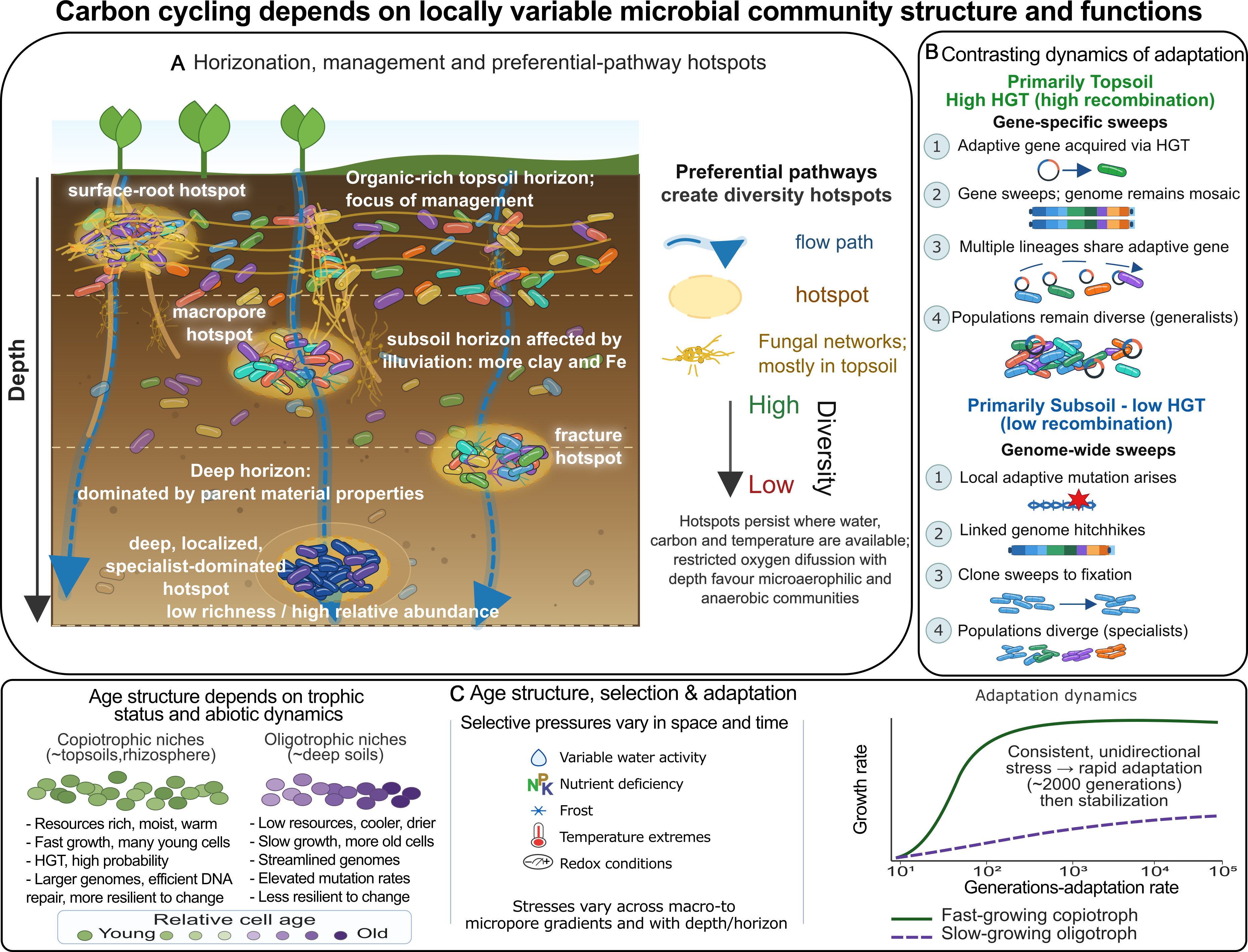
Figure 2. Contrasting key controls for top- and deep-soils carbon cycling. Illustrations created de novo based on information from refs[76,78,79,112-114]. (A) Vertical transport; (B) Contrasting adaptation dynamics across soil depth; Summary of microbial characteristics for topsoils vs. subsoils in (C) is expanded with associated refs found in Supplementary Table 1. Adaptation dynamics information from liquid cultures[78,79]; adaptation rates and patterns in soils would vary temporally and spatially. HGT: Horizontal gene transfer.
Deep horizons are typically more oligotrophic[75], less densely colonized and exposed to smaller fluctuations in temperature and water activity. Microbial communities in these layers may therefore be adapted to narrower environmental ranges and exhibit slower turnover. Laboratory estimates of microbial turnover under standardized conditions range from days to more than 100 days, and up to approximately 200 days in Antarctic soils[76] but estimates in deep soils are still lacking. In situ turnover in deep soils is likely longer and more variable.
Microbial adaptation depends on generation time, population size, resource availability and selection pressure [Figure 2B]. Soil microbial adaptation to stresses, e.g., drought, is primarily driven by historical exposure and the intensity of perturbations and might require months and years of consistent stress exposure to reach a steady functional state aligned with the new environmental conditions[77]. Consistent unidirectional stress can drive adaptation over thousands of generations, as shown in long-term bacterial evolution experiments[78,79]. Adaptation in deep soils may occur slowly because microbial growth rates are low [Figure 2C]. However, rhizosphere zones are an important exception, as root-derived substrates can support much faster microbial turnover and activity.
These considerations imply that short-term warming experiments may not capture long-term community adaptation. They may instead reveal the immediate physiological capacity of extant communities to acclimate, a more likely scenario in surface layers that commonly experience a wide range of environmental conditions. Climate warming, by contrast, will occur alongside shifts in moisture, vegetation, rooting depth and substrate inputs, potentially allowing gradual selection and community restructuring. Meaningful ecological or evolutionary timescales, allowing for long-term equilibrated ecosystem adaptation, might be best tested on climatic gradients, e.g., Bardelli et al.[80].
Fixed-depth versus horizon representation
As the need for understanding of dSOC response to management is becoming more evident, the foundational question to such inquiry of how to sample deep soils is worth rethinking. A decline in the studies using horizon-based sampling rooted in soil taxonomy is replaced by fixed-depth sampling[14]. This reflects the shift towards discipline-specific standardized sampling depths, but critically, also indicates a perceived recession of the practical utility of classical pedology for reasons that can only be speculated[81]. We argue that pedological knowledge and its application should remain foundational in all areas of soil science[82], including SOC research, as they consolidate the range of soil physical and chemical parameters that support processes within which SOC responses ought to be contextualized.
The importance of representing physical and hydrological properties associated with distinct soil horizons and geoengineered layer boundaries is recognized when measuring and modeling contaminant transport[83-85], reflected in the capability of common models allowing their integration[86]. Subsoil SOC models that attempt to project changes in stocks, turnover, and DOC remain limited. They use discrete depth increments that might not align with pedogenic horizons, sometimes assume uniform vertical advection rates or do not consider DOC transfer, as developed[87-90]. We acknowledge that these models are difficult to parameterize, given the lack of data on and understanding of how to represent the mechanisms of dSOC dynamics. However, if the goal is to use these tools to support dSOC sequestration strategies at the field scale as they are often employed, these real vertical heterogeneities should be considered, which will undoubtedly require collaboration with soil physicists.
The expression of physicochemical and morphological properties and thus taxonomic placement of a given soil results from a distinct combination of pedogenesis factors acting in tandem during development. This suite of factors can be reduced to functions of mass and energy transfer[91,92], with pedogenic trajectory occurring within a narrower range of each factor along a gradient. For example, warm tropical conditions with high precipitation favor weathering of reactive minerals, eluviation and deposition of organo-mineral complexes, leading to the formation of Spodosols (or Podzols in the World Reference Base[93]) several meters thick. In cooler and drier boreal climates, these same soils can be less than one meter deep but still exhibit distinct horizonation. The pedogenic mechanisms are similar, but their intensity differs, and thus the horizon thickness across which SOC governing functions vary. Even for similar textures, minute soil structure changes can alter significantly cross-horizon mass and energy transfer[53]. Thus, standardized fixed sampling depths like the Intergovernmental Panel on Climate Change (IPCC) minimum of 30 cm[94] or
Functional respiration parameters and incubation studies
Respiration-based parameters such as carbon use efficiency, priming responses and Q10 are often measured by incubating deep soils under standardized laboratory conditions[97,98]. These measurements are useful for comparing potential microbial activity and substrate use, but they should not be interpreted uncritically as in-situ deep-soil carbon kinetics.
Deep microbial communities function under narrower and often more constrained ranges of temperature, water activity and oxygen availability than surface communities. Incubating deep soils, especially when disturbed, under warm, moist and aerated conditions may reveal potential mineralization capacity, but not necessarily field-realized mineralization. In some cases, this may represent “unsatisfied mineralization” namely SOC that is biologically degradable but remains persistent in situ because environmental conditions suppress microbial activity.
This distinction is particularly important for warming experiments. A rapid temperature increase imposed on deep soil samples may test whether the existing microbial community can function at the edge of or outside its adapted range rather than whether climate warming will realistically accelerate dSOC loss. For example, exposing a subsoil from an isomesic regime to temperature increases of 7-15 °C may push a non-adapted community into conditions characteristic of a hyperthermic regime[60] [Figure 3].
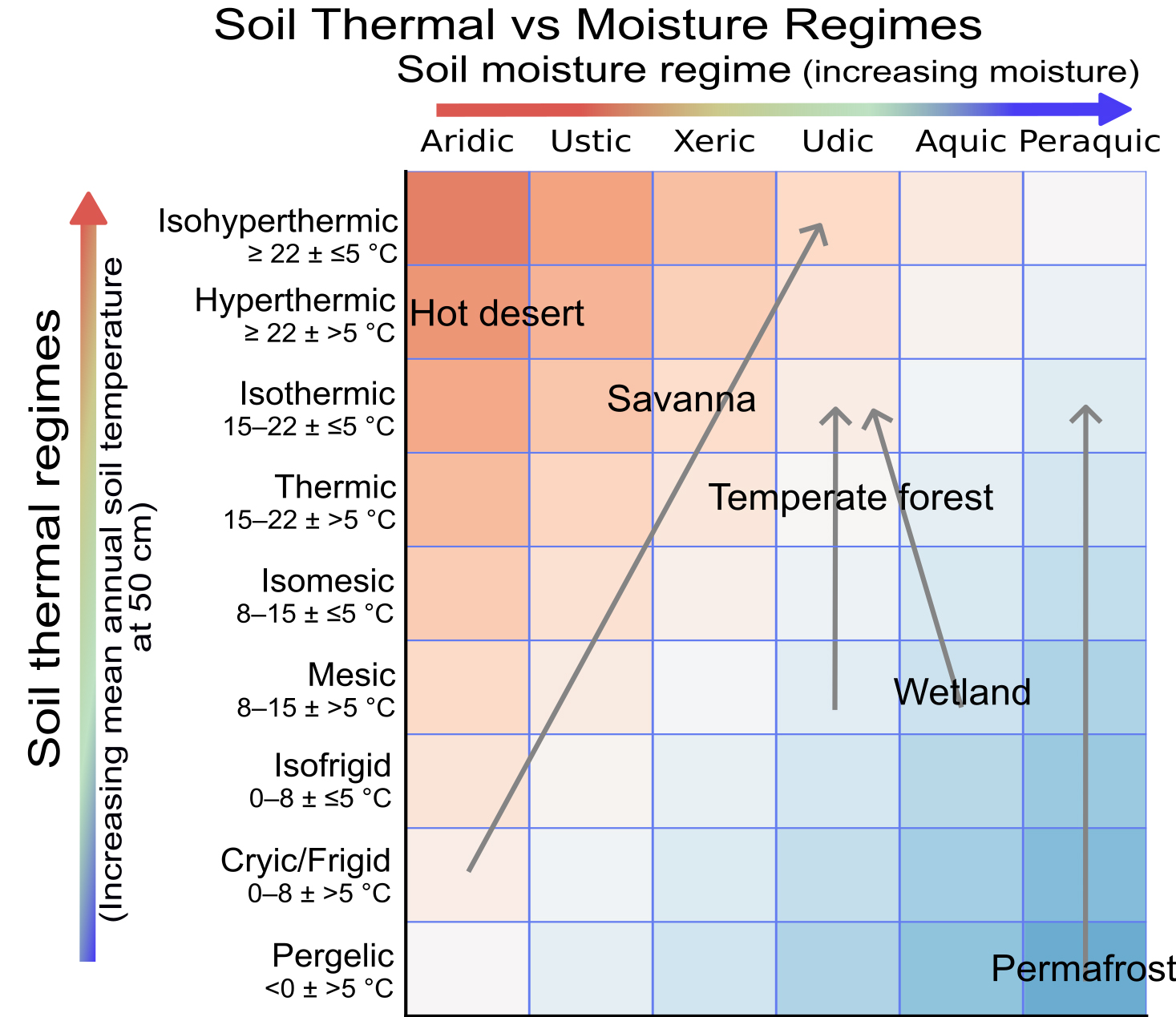
Figure 3. Soil taxonomic thermal and moisture regimes[60] with distinct ecosystems highlighted: Soil thermal regimes with their annual mean ± seasonal variation; Soil moisture regimes: Aridic, very dry water deficit most of year; Ustic, dry water deficit part of year; Xeric, dry to moist water deficit some years; Udic, moist no deficit most years; Aquic, very wet saturated part of year; Peraquic, saturated most of year (anaerobic). Overlaid arrows are examples of approximate regime shifts when deep soils are warmed during incubation studies[99-102] that assess SOC temperature sensitivity of decomposition [Supplementary Table 2]. SOC: Soil organic carbon.
Incubation experiments assessing dSOC sensitivity to warming might impose temperature increases ranging from 5 to 15 °C and run for periods as short as 20 h to as long as 150 days with depths ranging from 20 to
Experimental warming should therefore be scaled to soil depth and local soil temperature regimes. A warming treatment relevant to surface soil may be unrealistic for a deep horizon where seasonal and diurnal variability are strongly dampened. Length of incubation might need to be adapted to differential growth and adaptation rates of microorganisms. Reporting soil depth, thermal regime, water status and oxygen conditions should be standard practice.
Climate-change interpretation: temperature and moisture must be coupled
Climate-change impacts on dSOC cannot be inferred from warming alone. Most climate projections involve simultaneous changes in temperature and precipitation, creating new combinations of heat, moisture and hydrological regimes[103]. These coupled changes will affect root depth, litter inputs, DOC transport, water activity, oxygen diffusion, redox dynamics and microbial activity.
Drought may be especially important because it can develop faster than gradual warming. It can suppress microbial activity, alter rooting depth, reduce surface organic matter accumulation and change infiltration patterns. Rewetting after drought may mobilize DOC and colloids, stimulate microbial activity and create pulses of C transport or mineralization. Thus, drought patterns, length and intensity likelihood are important considerations when designing and interpreting warming experiments.
Soil hydrology must therefore be interpreted through texture and structure. The same water content can correspond to very different water potentials and microbial availability depending on pore-size distribution, clay and organic matter content, aggregation and compaction[104]. Future studies should report not only water content but also water potential or other indicators[105] of biological water availability.
Climate-gradient studies may complement, or rather be employed to justify, short-term manipulative experiments. Where soils are comparable but differ in long-term temperature or moisture regimes[106-108], they may provide insight into adapted microbial communities and SOC profiles under plausible future conditions. In this context, Q10 estimates, with all their limitations[109], from adapted communities across climate gradients may be more informative than quantification of short-term physiological responses of non-adapted communities exposed to abrupt warming in short incubations.
Soil profile warming studies: key limitations
Compared to studies that heat the soil surface, whole-profile warming studies impose a uniform temperature increase throughout the profile[110]. Such studies are valuable, but several limitations require attention. Even if warming is applied uniformly through the profile, deeper layers naturally have lower temperatures and fluctuations. Kinetic theory predicts higher apparent temperature sensitivity at lower baseline temperatures[111], which complicates interpretation of depth-dependent Q10 responses. It may be difficult to separate the role of SOC quality, substrate depletion and microbial community composition from the lower baseline temperature regimes in deeper layers.
Moreover, warming studies often do not pair temperature manipulation with realistic precipitation or soil-moisture change. This is problematic because moisture affects not only microbial activity but also thermal conductivity, gas diffusion, DOC transport and root growth dynamics. Changes in precipitation can therefore mediate, amplify or suppress the effect of warming on dSOC. Profile warming studies should therefore, at least, encompass realistic climate-change scenarios. Without these, they risk mischaracterizing microbial functions and dSOC vulnerability.
CONCLUSIONS AND RECOMMENDATIONS
Deep soil organic carbon studies should move beyond treating depth as a simple numeric coordinate. Depth alters transfer processes, microbial communities, water regimes, gas regimes, mineral surfaces and thermal environments, in manners corresponding to changing horizons. These factors jointly determine whether carbon is transferred, transformed, mineralized or stabilized. Functional adaptation of microbial communities across soil profiles is likely important in governing organic carbon stability with depth.
Future studies should:
1. Report soil depth together with horizon identity, texture, structure, bulk density, mineralogy and soil temperature regime.
2. Use horizon-aware sampling when mechanisms, rather than inventories alone, are the objective.
3. Measure or estimate water potential, not only gravimetric or volumetric water content.
4. Account for gas diffusion and oxygen constraints, especially in compacted, wet or fine-textured subsoils.
5. Interpret particulate and mineral-associated organic matter cautiously in deep soils, where operational fractions may not correspond directly to persistence or accessibility.
6. Design warming experiments around realistic depth-specific thermal regimes, rather than applying uniform or unrealistic warming across all layers.
7. Couple warming with moisture and hydrological change, reflecting realistic climate change trajectories.
8. Distinguish potential mineralization from in-situ mineralization, especially when incubating deep soils under optimal laboratory conditions.
9. Integrate soil physics, microbial ecology and biogeochemistry with pedology, to understand deep soil organic carbon dynamics mechanistically.
10. Use climate gradients and long-term studies to infer microbial adaptation and SOC responses under future conditions.
Deep soil organic carbon persistence is not merely a property of organic matter chemistry. It emerges from the interaction between organic matter form, mineral surfaces, hydrological transport, gas exchange, thermal regime, microbial adaptation and management-induced changes to the soil profile. Recognizing this complexity is essential for evaluating whether agricultural practices can meaningfully increase, and climate change meaningfully affect, durable soil organic carbon storage at depth.
DECLARATIONS
Authors’ contributions
Writing of original draft, review, editing and visualization: Locke, M.
Writing of original draft, review, editing, visualization and conceptualization: Unc, A.
Availability of data and materials
Not applicable.
AI and AI-assisted tools statement
During the preparation of this manuscript, MS Copilot was used to draft the first iteration of the soil profile graphic elements in the Graphical Abstract and Figure 2, Microsoft Copilot [Large language model]. Available at: https://copilot.microsoft.com (Accessed: between June and August 2026). However, All other graphs and graphic elements were manually edited and produced in Inkscape {Inkscape Project (2025) Inkscape [Version 1.4.3 (0d15f75)] https://inkscape.org}. No AI was used for the study design, data collection, analysis, interpretation, or the scientific content of the work. All authors take full responsibility for the accuracy, integrity, and final content of the manuscript.
Financial support and sponsorship
This work was supported by an NSERC grant (ALLRP 577151) awarded to Unc, A. Locke, M. has also received support from the School of Graduate Studies at Memorial University of Newfoundland.
Conflicts of interest
Unc, A. is an Editorial Board Member of the Carbon Footprints journal. He had no involvement in the review or editorial process of this manuscript, including but not limited to reviewer selection, evaluation, or the final decision, while the other authors have declared that they have no conflicts of interest.
Ethical approval and consent to participate
Not applicable.
Consent for publication
Not applicable.
Copyright
© The Author(s) 2026.
Supplementary Materials
REFERENCES
1. Friedlingstein, P.; O'sullivan, M.; Jones, M. W.; et al. Global carbon budget 2024. Earth. Syst. Sci. Data. 2025, 17, 965-1039.
2. Sanderman, J.; Hengl, T.; Fiske, G. J. Soil carbon debt of 12,000 years of human land use. Proc. Natl. Acad. Sci. U.S.A. 2017, 114, 9575-80.
3. Paustian, K.; Lehmann, J.; Ogle, S.; Reay, D.; Robertson, G. P.; Smith, P. Climate-smart soils. Nature 2016, 532, 49-57.
4. Bossio, D. A.; Cook-patton, S. C.; Ellis, P. W.; et al. The role of soil carbon in natural climate solutions. Nat. Sustain. 2020, 3, 391-8.
5. Minasny, B.; Malone, B. P.; Mcbratney, A. B.; et al. Soil carbon 4 per mille. Geoderma 2017, 292, 59-86.
6. Rumpel, C.; Amiraslani, F.; Chenu, C.; et al. The 4p1000 initiative: opportunities, limitations and challenges for implementing soil organic carbon sequestration as a sustainable development strategy. Ambio 2019, 49, 350-60.
7. Don, A.; Seidel, F.; Leifeld, J.; et al. Carbon sequestration in soils and climate change mitigation-definitions and pitfalls. Glob. Change. Biol. 2023, 30, e16983.
8. Olson, K. R.; Al-kaisi, M. M.; Lal, R.; Lowery, B. Experimental consideration, treatments, and methods in determining soil organic carbon sequestration rates. Soil. Sci. Soc. Am. J. 2014, 78, 348-60.
9. Rumpel, C.; Kögel-knabner, I. Deep soil organic matter-a key but poorly understood component of terrestrial C cycle. Plant. Soil. 2011, 338, 143-58.
10. Georgiou, K.; Jackson, R. B.; Vindušková, O.; et al. Global stocks and capacity of mineral-associated soil organic carbon. Nat. Commun. 2022, 13, 3797.
11. Syswerda, S.; Corbin, A.; Mokma, D.; Kravchenko, A.; Robertson, G. Agricultural management and soil carbon storage in surface vs. deep layers. Soil. Sci. Soc. Am. J. 2011, 75, 92-101.
12. Jobbágy, E. G.; Jackson, R. B. The vertical distribution of soil organic carbon and its relation to climate and vegetation. Ecol. Appl. 2000, 10, 423-36.
13. Lal, R. Digging deeper: a holistic perspective of factors affecting soil organic carbon sequestration in agroecosystems. Glob. Change. Biol. 2018, 24, 3285-301.
14. Yost, J. L.; Hartemink, A. E. How deep is the soil studied - an analysis of four soil science journals. Plant. Soil. 2020, 452, 5-18.
15. Emde, D.; Sakhaee, A.; Poeplau, C.; et al. Site-specific drivers of land-use change effects on organic carbon in german agriculture and forest soils. Glob. Change. Biol. 2025, 31, e70576.
16. Luo, Z.; Wang, E.; Sun, O. J. Can no-tillage stimulate carbon sequestration in agricultural soils? A meta-analysis of paired experiments. Agric. Ecosyst. Environ. 2010, 139, 224-31.
17. Sierra, C. A.; Ahrens, B.; Bolinder, M. A.; et al. Carbon sequestration in the subsoil and the time required to stabilize carbon for climate change mitigation. Glob. Change. Biol. 2024, 30, e17153.
18. Jones, D. L.; Cooledge, E. C.; Alston, D.; Chadwick, D. R. Agricultural management strategies to actively promote subsoil carbon storage. Soil. Tillage. Res. 2026, 256, 106846.
19. Dubeux Jr, J. C. B.; Lira Junior, M. A.; Simili, F. F.; et al. Deep soil organic carbon: a review. CABI. Rev. 2024, 19.
20. Hicks Pries, C. E.; Ryals, R.; Zhu, B.; et al. The deep soil organic carbon response to global change. Annu. Rev. Ecol. Evol. Syst. 2023, 54, 375-401.
21. Rumpel, C.; Chabbi, A.; Marschner, B. Carbon storage and sequestration in subsoil horizons: Knowledge, gaps and potentials. In Recarbonization of the biosphere: ecosystems and the global carbon cycle; Lal, R.; Lorenz, K.; Hüttl, R.; Schneider, B.; von Braun, J.; Eds.; Dordrecht: Springer Netherlands, 2012; pp 445-464.
22. Button, E. S.; Pett-ridge, J.; Murphy, D. V.; Kuzyakov, Y.; Chadwick, D. R.; Jones, D. L. Deep-C storage: biological, chemical and physical strategies to enhance carbon stocks in agricultural subsoils. Soil. Biol. Biochem. 2022, 170, 108697.
23. Wang, L.; Li, L.; Chen, X.; Tian, X.; Wang, X.; Luo, G. Biomass allocation patterns across China’s terrestrial biomes. PLoS. ONE. 2014, 9, e93566.
24. Ma, H.; Mo, L.; Crowther, T. W.; et al. The global distribution and environmental drivers of aboveground versus belowground plant biomass. Nat. Ecol. Evol. 2021, 5, 1110-22.
25. Yang, X.; Wang, B.; Fakher, A.; An, S.; Kuzyakov, Y. Contribution of roots to soil organic carbon: from growth to decomposition experiment. Catena 2023, 231, 107317.
26. Heinemann, H.; Seidel, F.; Hirte, J.; et al. Variability in maize root biomass distribution under drought can contribute to climate change adaptation. Plant. Soil. 2025, 519, 1025-44.
27. Kørup, K.; Lærke, P. E.; Baadsgaard, H.; et al. Biomass production and water use efficiency in perennial grasses during and after drought stress. GCB. Bioenergy. 2017, 10, 12-27.
28. Guswa, A. J. The influence of climate on root depth: a carbon cost-benefit analysis. Water. Resour. Res. 2008, 44, 2007WR006384.
29. Leng, G.; Hall, J. Crop yield sensitivity of global major agricultural countries to droughts and the projected changes in the future. Sci. Total. Environ. 2019, 654, 811-21.
30. Vanderborght, J.; Fetzer, T.; Mosthaf, K.; Smits, K. M.; Helmig, R. Heat and water transport in soils and across the soil-atmosphere interface: 1. Theory and different model concepts. Water. Resour. Res. 2017, 53, 1057-79.
31. Spielman-sun, E.; Boye, K.; Dwivedi, D.; et al. A critical look at colloid generation, stability, and transport in redox-dynamic environments: challenges and perspectives. ACS. Earth. Space. Chem. 2024, 8, 630-53.
32. Kaiser, K.; Kalbitz, K. Cycling downwards - dissolved organic matter in soils. Soil. Biol. Biochem. 2012, 52, 29-32.
33. Roth, V.; Lange, M.; Simon, C.; et al. Persistence of dissolved organic matter explained by molecular changes during its passage through soil. Nat. Geosci. 2019, 12, 755-61.
34. Angst, G.; Mueller, K. E.; Nierop, K. G.; Simpson, M. J. Plant- or microbial-derived? A review on the molecular composition of stabilized soil organic matter. Soil. Biol. Biochem. 2021, 156, 108189.
35. Lützow, M. V.; Kögel-knabner, I.; Ekschmitt, K.; et al. Stabilization of organic matter in temperate soils: mechanisms and their relevance under different soil conditions - a review. Eur. J. Soil. Sci. 2006, 57, 426-45.
36. Kalbitz, K.; Solinger, S.; Park, J. H.; Michalzik, B.; Matzner, E. Controls on the dynamics of dissolved organic matter in soils: a review. Soil. Sci. 2000, 165, 277-304.
37. Kleber, M.; Eusterhues, K.; Keiluweit, M.; Mikutta, C.; Mikutta, R.; Nico, P. S. Mineral-organic associations: formation, properties, and relevance in soil environments. In Advances in Agronomy; Sparks, D. L.; Ed.; Vol. 130; Elsevier, 2015. pp 1-140.
38. Six, J.; Conant, R. T.; Paul, E. A.; Paustian, K. Stabilization mechanisms of soil organic matter: implications for C-saturation of soils. Plant. Soil. 2002, 241, 155-76.
40. Bak, F.; Nybroe, O.; Zheng, B.; et al. Preferential flow paths shape the structure of bacterial communities in a clayey till depth profile. FEMS. Microbiol. Ecol. 2019, 95, fiz008.
41. Lehmann, K.; Lehmann, R.; Totsche, K. U. Event-driven dynamics of the total mobile inventory in undisturbed soil account for significant fluxes of particulate organic carbon. Sci. Total. Environ. 2021, 756, 143774.
42. Beven, K.; Germann, P. Macropores and water flow in soils revisited. Water. Resour. Res. 2013, 49, 3071-92.
43. Chabbi, A.; Kögel-knabner, I.; Rumpel, C. Stabilised carbon in subsoil horizons is located in spatially distinct parts of the soil profile. Soil. Biol. Biochem. 2009, 41, 256-61.
44. Schmidt, M. W. I.; Torn, M. S.; Abiven, S.; et al. Persistence of soil organic matter as an ecosystem property. Nature 2011, 478, 49-56.
45. Rocci, K. S.; Cotrufo, M. F.; Ernakovich, J.; et al. Bridging 20 years of soil organic matter frameworks: empirical support, model representation, and next steps. J. Geophys. Res. Biogeosci. 2024, 129, e2023JG007964.
46. Lavallee, J. M.; Soong, J. L.; Cotrufo, M. F. Conceptualizing soil organic matter into particulate and mineral-associated forms to address global change in the 21st century. Glob. Change. Biol. 2019, 26, 261-73.
47. Angst, G.; Mueller, K. E.; Castellano, M. J.; Vogel, C.; Wiesmeier, M.; Mueller, C. W. Unlocking complex soil systems as carbon sinks: multi-pool management as the key. Nat. Commun. 2023, 14, 2967.
48. Jilling, A.; Grandy, A. S.; Daly, A. B.; et al. Evidence for the existence and ecological relevance of fast-cycling mineral-associated organic matter. Commun. Earth. Environ. 2025, 6, 690.
49. Kaiser, K.; Guggenberger, G. Mineral surfaces and soil organic matter. Eur. J. Soil. Sci. 2003, 54, 219-36.
50. Li, Q.; Hu, W.; Li, L.; Li, Y. Interactions between organic matter and Fe oxides at soil micro-interfaces: quantification, associations, and influencing factors. Sci. Total. Environ. 2023, 855, 158710.
51. Krettek, A.; Herrmann, L.; Rennert, T. Podzolisation affects the spatial allocation and chemical composition of soil organic matter fractions. Soil. Res. 2020, 58, 713-25.
52. Başağaoğlu, H.; Ginn, T. R.; Mccoy, B. J. Formulation of a soil-pesticide transport model based on a compartmental approach. J. Contam. Hydrol. 2002, 56, 1-24.
53. Si, B.; Dyck, M.; Parkin, G. Flow and transport in layered soils: preface. Can. J. Soil. Sci. 2011, 91, 127-32.
54. Hartemink, A. E.; Zhang, Y.; Bockheim, J. G.; et al. Soil horizon variation: a review. In Advances in agronomy; Sparks, D. L.; Ed.; Vol. 160; Elsevier, 2020; pp 125-85.
55. Jarvis, N. J. A review of non-equilibrium water flow and solute transport in soil macropores: principles, controlling factors and consequences for water quality. Eur. J. Soil. Sci. 2007, 58, 523-46.
56. Correa, J.; Postma, J. A.; Watt, M.; Wojciechowski, T. Soil compaction and the architectural plasticity of root systems. J. Exp. Bot. 2019, 70, 6019-34.
57. Chen, T.; Fei, W.; Narsilio, G. A. Effective thermal conductivity of granular soils: a review of influencing factors and prediction models towards an investigation framework through multiscale characters. Can. Geotech. J. 2025, 62, 1-17.
58. Ma, P.; Sun, Q.; Liu, Y.; Li, P.; Duan, J.; Liu, S. Effect of organic matter and water content on the thermal conductivity of soil. Q. J. Eng. Geol. Hydrogeol. 2025, 58, qjegh2024-213.
59. An, J.; Kim, T.; Chong, S.; Cho, G. Effect of soil type on effective soil thermal conductivity for the full range of water saturation. Int. J. Heat. Mass. Transf. 2026, 254, 127677.
60. Buol, S. W. Soil moisture and temperature regimes in soil taxonomy. Transportation Research Board, Soil Taxonomy and Soil Properties, National Academy of Sciences. Published online 1977:9-12. http://onlinepubs.trb.org/Onlinepubs/trr/1977/642/642-003.pdf (accessed 2026-08-18).
61. Keiluweit, M.; Wanzek, T.; Kleber, M.; Nico, P.; Fendorf, S. Anaerobic microsites have an unaccounted role in soil carbon stabilization. Nat. Commun. 2017, 8, 1771.
62. Rickard, W.; Zhang, X.; Hossain, I.; et al. Change in soil macroporosity with land use and its effect on soil respiration. Soil. Use. Manag. 2025, 41, e70128.
63. Frouz, J.; Bujalský, L. Flow of CO2 from soil may not correspond with CO2 concentration in soil. Sci. Rep. 2018, 8, 10099.
64. Heinen, M.; Schneider, H.; Shan, K.; Bakker, G.; Bakema, G. The effect of a compacted subsoil layer on the development of the maize root system. Soil. Tillage. Res. 2025, 254, 106763.
65. Tong, B.; Gao, Z.; Horton, R.; Li, Y.; Wang, L. An empirical model for estimating soil thermal conductivity from soil water content and porosity. J. Hydrometeorol. 2016, 17, 601-13.
66. Unc, A.; Goss, M. J. Impact of organic waste amendments on soil hydraulic properties and on water partitioning. J. Environ. Eng. Sci. 2006, 5, 243-51.
67. Alcántara, V.; Don, A.; Vesterdal, L.; Well, R.; Nieder, R. Stability of buried carbon in deep-ploughed forest and cropland soils - implications for carbon stocks. Sci. Rep. 2017, 7, 5511.
68. Kaiser, M.; Kleber, M.; Berhe, A. A. How air-drying and rewetting modify soil organic matter characteristics: an assessment to improve data interpretation and inference. Soil. Biol. Biochem. 2015, 80, 324-40.
69. Kleber, M.; Bourg, I. C.; Coward, E. K.; Hansel, C. M.; Myneni, S. C. B.; Nunan, N. Dynamic interactions at the mineral-organic matter interface. Nat. Rev. Earth. Environ. 2021, 2, 402-21.
70. Yan, J.; Manelski, R.; Vasilas, B.; Jin, Y. Mobile colloidal organic carbon: an underestimated carbon pool in global carbon cycles? Front. Environ. Sci. 2018, 6, 148.
71. Afsar, M. Z.; Vasilas, B.; Jin, Y. Organo-mineral associations and size-fractionated colloidal organic carbon dynamics in a redox-controlled wetland. Geoderma. 2023, 439, 116667.
72. Kaiser, K.; Guggenberger, G. The role of DOM sorption to mineral surfaces in the preservation of organic matter in soils. Org. Geochem. 2000, 31, 711-25.
73. Kallenbach, C. M.; Frey, S. D.; Grandy, A. S. Direct evidence for microbial-derived soil organic matter formation and its ecophysiological controls. Nat. Commun. 2016, 7, 13630.
74. Wang, X.; Kallenbach, C. M.; Almaraz, M.; et al. Clay-organic matter interactions drive microbial necromass preservation in soils. Nat. Commun. 2026, 17, 3368.
75. Dragone, N. B.; Hoffert, M.; Strickland, M. S.; Fierer, N. Taxonomic and genomic attributes of oligotrophic soil bacteria. ISME. Commun. 2024, 4, ycae081.
76. Rousk, J.; Bååth, E. Growth of saprotrophic fungi and bacteria in soil. FEMS. Microbiol. Ecol. 2011, 78, 17-30.
77. Li, L.; Radujković, D.; Nijs, I.; et al. Effect of increasing persistence of alternating drought and rainfall events on grassland soil microbes intensifies over time. Commun. Earth. Environ. 2026, 7, 340.
78. Lenski, R. E.; Travisano, M. Dynamics of adaptation and diversification: a 10,000-generation experiment with bacterial populations. Proc. Natl. Acad. Sci. U.S.A. 1994, 91, 6808-14.
79. Lenski, R. E.; Wiser, M. J.; Ribeck, N.; et al. Sustained fitness gains and variability in fitness trajectories in the long-term evolution experiment with Escherichia coli. Proc. Biol. Sci. 2015, 282, 20152292.
80. Bardelli, T.; Gómez-Brandón, M.; Ascher-Jenull, J.; et al. Effects of slope exposure on soil physico-chemical and microbiological properties along an altitudinal climosequence in the Italian Alps. Sci. Total. Environ. 2017, 575, 1041-55.
81. Capra, G. F. Time to retire “pedology”? Reflecting on disciplinary terminology in soil science. Eur. J. Soil. Sci. 2025, 76, e70240.
82. Schillaci, C.; Alves, G. B.; Bayad, M.; et al. Soil profiles: a window into soil genesis and degradation. Eur. J. Soil. Sci. 2026, 77, e70322.
83. Bedmar, F.; Costa, J. L.; Giménez, D. Column tracer studies in surface and subsurface horizons of two typic argiudolls. Soil. Sci. 2008, 173, 237-47.
84. Seuntjens, P.; Mallants, D.; Cornelis, C.; Geuzens, P. Nonequilibrium cadmium leaching in layered sandy soils. Soil. Sci. 2001, 166, 507-19.
85. Bi, Y.; Sun, X.; Zou, Q.; Jiang, Z.; Fu, X. Contaminant migration in vadose zone beneath unregulated landfills with damaged geomembranes. Waste. Manag. 2026, 211, 115269.
86. Šimůnek, J.; Van Genuchten, M. T.; Šejna, M. Development and applications of the HYDRUS and STANMOD software packages and related codes. Vadose. Zone. J. 2008, 7, 587-600.
87. Jenkinson, D. S.; Coleman, K. The turnover of organic carbon in subsoils. Part 2. Modelling carbon turnover. Eur. J. Soil. Sci. 2008, 59, 400-13.
88. Taghizadeh-toosi, A.; Christensen, B. T.; Hutchings, N. J.; et al. C-TOOL: a simple model for simulating whole-profile carbon storage in temperate agricultural soils. Ecol. Model. 2014, 292, 11-25.
89. Braakhekke, M. C.; Beer, C.; Hoosbeek, M. R.; et al. SOMPROF: a vertically explicit soil organic matter model. Ecol. Model. 2011, 222, 1712-30.
90. Keyvanshokouhi, S.; Cornu, S.; Lafolie, F.; et al. Effects of soil process formalisms and forcing factors on simulated organic carbon depth-distributions in soils. Sci. Total. Environ. 2019, 652, 523-37.
91. Rasmussen, C.; Tabor, N. J. Applying a quantitative pedogenic energy model across a range of environmental gradients. Soil. Sci. Soc. Am. J. 2007, 71, 1719-29.
92. Shepard, C.; Schaap, M. G.; Pelletier, J. D.; Rasmussen, C. A probabilistic approach to quantifying soil physical properties via time-integrated energy and mass input. SOIL 2017, 3, 67-82.
93. IUSS Working Group WRB. World Reference Base for Soil Resources 2014: International Soil Classification System for Naming Soils and Creating Legends for Soil Maps-Update 2015. World Soil Resources Reports No. 106. FAO; 2015. https://openknowledge.fao.org/items/80a86a87-e01b-4cda-a8d7-09be79a127e5 (accessed 2026-08-18).
94. IPCC. Volume 4: Agriculture, Forestry and Other Land Use. 2006 IPCC guidelines for national greenhouse gas inventories. 2006. https://www.ipcc-nggip.iges.or.jp/public/2006gl/vol4.html (accessed 2026-08-18).
95. FAO. Measuring and Modelling Soil Carbon Stocks and Stock Changes in Livestock Production Systems - Guidelines for Assessment. Version 1. 2019. https://openknowledge.fao.org/items/4148cd2c-e08d-4022-ab3f-26dc2efe9312 (accessed 2026-08-18).
96. Premrov, A.; Cummins, T.; Byrne, K. A. Assessing fixed depth carbon stocks in soils with varying horizon depths and thicknesses, sampled by horizon. CATENA 2017, 150, 291-301.
97. Pei, J.; Li, J.; Luo, Y.; et al. Patterns and drivers of soil microbial carbon use efficiency across soil depths in forest ecosystems. Nat. Commun. 2025, 16, 5218.
98. Bernal, B.; Mckinley, D. C.; Hungate, B. A.; White, P. M.; Mozdzer, T. J.; Megonigal, J. P. Limits to soil carbon stability; deep, ancient soil carbon decomposition stimulated by new labile organic inputs. Soil. Biol. Biochem. 2016, 98, 85-94.
99. Tian, Q.; Wang, X.; Wang, D.; et al. Decoupled linkage between soil carbon and nitrogen mineralization among soil depths in a subtropical mixed forest. Soil. Biol. Biochem. 2017, 109, 135-44.
100. Bond-lamberty, B.; Smith, A. P.; Bailey, V. Temperature and moisture effects on greenhouse gas emissions from deep active-layer boreal soils. Biogeosciences. 2016, 13, 6669-81.
101. Schimmel, H.; Braun, M.; Subke, J.; Amelung, W.; Bol, R. Carbon stability in a Scottish lowland raised bog: potential legacy effects of historical land use and implications for global change. Soil. Biol. Biochem. 2021, 154, 108124.
102. Huang, G.; Su, Y. Microorganisms exert overriding impacts on the temperature sensitivity of soil C decomposition than substrate quality. Soil. Ecol. Lett. 2025, 7, 250303.
103. King, M.; Altdorff, D.; Li, P.; Galagedara, L.; Holden, J.; Unc, A. Northward shift of the agricultural climate zone under 21st-century global climate change. Sci. Rep. 2018, 8, 7904.
104. Franzluebbers, A. J. Holding water with capacity to target porosity. Agric. Environ. Lett. 2020, 5, e20029.
105. Widanagamage, N.; Santos, E.; Rice, C. W.; Patrignani, A. Study of soil heterotrophic respiration as a function of soil moisture under different land covers. Soil. Biol. Biochem. 2025, 200, 109593.
106. Wang, J.; Zhang, J.; Xie, D.; et al. Shifts in soil freeze-thaw cycle and their climate impacts along the alpine wetland-grassland continuum. Agric. For. Meteorol. 2025, 367, 110506.
107. Zhu, X.; Si, J.; Jia, B.; et al. Changes of soil carbon along precipitation gradients in three typical vegetation types in the Alxa desert region, China. Carbon. Balance. Manage. 2024, 19, 19.
108. Brown, J. H.; Valone, T. J.; Curtin, C. G. Reorganization of an arid ecosystem in response to recent climate change. Proc. Natl. Acad. Sci. U.S.A. 1997, 94, 9729-33.
109. Wu, Q.; Ye, R.; Bridgham, S. D.; Jin, Q. Limitations of the Q10 coefficient for quantifying temperature sensitivity of anaerobic organic matter decomposition: a modeling based assessment. J. Geophys. Res. Biogeosci. 2021, 126, e2021JG006264.
110. Pries CE, Castanha C, Porras RC, Torn MS. The whole-soil carbon flux in response to warming. Science. 2017, 355, 1420-3.
111. Davidson, E. A.; Janssens, I. A. Temperature sensitivity of soil carbon decomposition and feedbacks to climate change. Nature 2006, 440, 165-73.
112. Stone, B. W. G.; Dijkstra, P.; Finley, B. K.; et al. Life history strategies among soil bacteria-dichotomy for few, continuum for many. ISME. J. 2023, 17, 611-9.
113. Fierer, N. Embracing the unknown: disentangling the complexities of the soil microbiome. Nat. Rev. Microbiol. 2017, 15, 579-90.
Cite This Article
 Open Access
How to Cite
Download Citation
Export Citation File:
Type of Import
Tips on Downloading Citation
Citation Manager File Format
Type of Import
Direct Import: When the Direct Import option is selected (the default state), a dialogue box will give you the option to Save or Open the downloaded citation data. Choosing Open will either launch your citation manager or give you a choice of applications with which to use the metadata. The Save option saves the file locally for later use.
Indirect Import: When the Indirect Import option is selected, the metadata is displayed and may be copied and pasted as needed.
About This Article
Copyright

Data & Comments
Data
0











Comments
Comments must be written in English. Spam, offensive content, impersonation, and private information will not be permitted. If any comment is reported and identified as inappropriate content by OAE staff, the comment will be removed without notice. If you have any queries or need any help, please contact us at support@oaepublish.com.