



Carbon-aware battery disassembly for end-of-life management
 0
0 
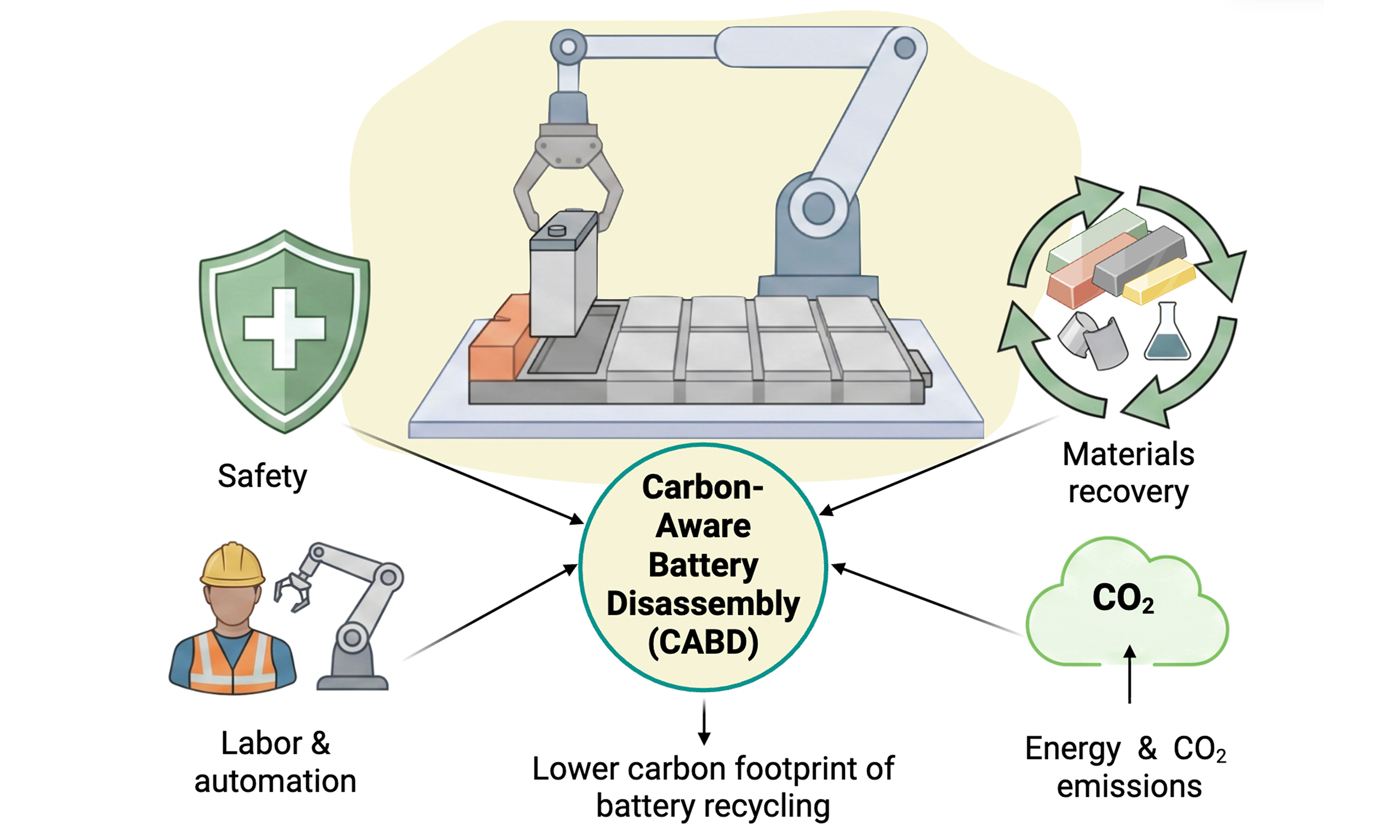
The transition towards carbon neutrality is driving an unprecedented deployment of lithium-ion batteries (LIBs) in electric vehicles and stationary energy storage systems. While this transition is essential for reducing greenhouse gas emissions from transport and electricity generation, it simultaneously creates an equally important challenge: managing millions of batteries reaching their end of life over the coming decades. Battery recycling is therefore an important component of a circular battery value chain, as it can recover selected raw materials, reduce demand for primary extraction, and mitigate some of the environmental impacts associated with battery production[1,2]. The carbon footprint of battery production varies considerably depending on battery chemistry and configuration, manufacturing conditions and location, and particularly the carbon intensity of the electricity mix assumed in the assessment. For example, under the system boundaries and production conditions considered in their study, Chen et al. reported production carbon footprints of 96.2, 76.6 and 92.9 kg CO2-eq/kWh for nickel cobalt manganese (NCM), lithium iron phosphate (LFP) and LFP–NCM hybrid battery packs, respectively, together with substantially different environmental-impact profiles and resource-supply risks[3]. These results illustrate that decarbonization of the battery value chain cannot be separated from material selection, battery architecture and resource circularity. Within the broader effort to reduce the life-cycle impacts of batteries, considerable scientific attention has also been devoted to improving end-of-life management, particularly pyrometallurgical, hydrometallurgical and direct recycling routes[4,5].
Battery disassembly representation varies across environmental assessments. For example, the original EverBatt model operated at the cell level and excluded battery-pack components from its system boundary[6], whereas Fridrich et al. included dismantling within an aggregated recycling-preprocessing chain[7]. Other studies have represented disassembly explicitly as a parameterized process[8]. These modeling choices are not inherently inconsistent with life cycle assessment (LCA) methodology, provided that they are appropriate for the stated goal and scope and that any excluded processes do not affect the comparison. However, the resulting conclusions are necessarily limited to the configurations represented by the system boundaries and inventory. The need to compare alternative configurations becomes increasingly relevant as battery recycling moves towards industrial-scale processing.
Because battery packs enter end-of-life streams only after several years of use, recycling facilities must handle products from different technological generations, chemistries, architectures, joining technologies, states of health, and damage conditions. This heterogeneity makes disassembly more than a technical prerequisite for recycling: it represents a significant bottleneck for the scalability, safety, and sustainability of battery-recycling systems[9]. Dismantling these battery packs exposes operators to multiple hazards, including electric shock, thermal runaway, toxic electrolyte leakage, fire, and explosion. These challenges are further amplified by the increasing diversity of battery pack designs, the absence of standardized architectures, and the growing number of batteries damaged during vehicle operation or traffic accidents[10]. Consequently, battery disassembly remains predominantly manual despite significant advances in automation, making worker safety, labor availability, and process standardization critical challenges for the future recycling industry[11].
Scaling predominantly manual battery disassembly to industrial throughput raises workforce and economic challenges. These operations require skilled personnel capable of handling high-voltage systems under demanding safety procedures[12], while manual dismantling constrains throughput, increases costs, and reduces process repeatability[13]. These considerations have motivated growing interest in robotic disassembly[14], primarily to increase productivity and reduce labor costs. However, such a perspective remains incomplete. Battery disassembly also affects environmental performance beyond its direct operational energy demand. Dismantling choices influence component integrity, the purity of separated material streams, and the requirements of downstream recycling processes. These upstream decisions can therefore affect the greenhouse gas emissions of the entire recycling chain.
For carbon-footprint assessments that compare alternative end-of-life strategies or support life-cycle management decisions, battery disassembly requires particular attention. Disassembly may appropriately be included within an aggregated preprocessing inventory when this representation is consistent with the recycling configuration being assessed. However, when alternative dismantling strategies change energy demand, the composition and quality of separated fractions, or the downstream processes made technically feasible, each coupled disassembly–recycling configuration constitutes a distinct scenario or product system and should be assessed accordingly. Comparative LCAs of such configurations are therefore needed, because assessments focused on recycling operations alone may obscure the environmental opportunities enabled by more selective disassembly technologies.
EverBatt, a techno-economic and environmental assessment framework developed by Argonne National Laboratory, illustrates how the representation of battery end-of-life processes has evolved as the model scope has expanded[6]. Later versions introduced a dedicated disassembly step, and EverBatt 2023 represents disassembly, preprocessing, and critical-material recovery as distinct modules. Nevertheless, the representation of disassembly and pretreatment often relies on simplified assumptions, including predominantly labor-based representations of pack-to-cell disassembly[15] or aggregated inventories that combine dismantling, crushing and material separation. These simplifications may therefore underrepresent route-specific energy use and the characteristics of emerging automated disassembly systems. Recent work has shown that disassembly has its own measurable environmental footprint. Huang et al. developed an energy-efficient human–robot collaborative disassembly framework in which disassembly energy consumption and disassembly carbon emissions are explicitly included among the optimization objectives[16]. More importantly, they demonstrated that relatively simple operational strategies, such as automatically switching workstations and robots on and off during idle periods, reduced disassembly energy consumption by approximately 26% and disassembly carbon emissions by 3.1% per production cycle[16]. These results demonstrate that disassembly has a measurable operational carbon footprint and offers mitigation opportunities before metallurgical recycling begins.
Environmental assessment of battery recycling may also need to consider consequences arising outside normal operating conditions. Process-safety incidents during battery handling, disassembly, storage, and downstream processing may generate additional emissions, contaminated wastewater, hazardous releases, material losses, and operational disruption[17-19]. A fire and explosion accident at a spent-battery recycling facility in China illustrates this point[18]. In that case, the fire and explosion were not attributed to thermal runaway of intact batteries, but to hydrogen accumulation generated by the reaction between residual sulfuric acid and aluminum-containing process residues under insufficient ventilation conditions. The case shows that hazards in battery-recycling facilities may arise from process residues, storage conditions, and interactions between unit operations. The accident’s environmental consequences extended beyond the immediate accident to include material losses, emergency response, plant reconstruction, and disruption of recycling activities.
This accident should be interpreted as an illustrative case rather than as evidence that the same failure mechanism is representative of battery-recycling facilities in general. Publicly available incident datasets are currently insufficient to establish the frequency of specific accident scenarios across recycling technologies and regions. Quantifying their expected environmental consequences would require broader incident statistics combined with probabilistic risk analysis.
Conventional LCA primarily evaluates potential environmental impacts under normal operating conditions and does not generally quantify the probability of accidental events[19]. Including accident-related consequences only for disassembly, while excluding comparable risks from transportation, storage and downstream recycling operations, would therefore produce an inconsistent comparison. Process-risk assessment should therefore remain methodologically distinct from LCA, although decision-making may consider the results of both assessments together. Scenario and sensitivity analyses can nevertheless be used to examine how battery chemistry, state of health, mechanical damage, residual charge and design affect disassembly time, energy requirements, separation quality and downstream material flows. Where robust incident statistics are available, accident-related consequences could be examined separately through probability-weighted scenarios or quantitative risk assessment and subsequently considered alongside the LCA results. Any such approach should be applied consistently across all relevant life-cycle processes. Another aspect that deserves considerably greater attention is the role of disassembly in determining material circularity. Battery recycling is often evaluated primarily through recovery efficiencies achieved during metallurgical processing. Yet these efficiencies are strongly conditioned by decisions taken much earlier in the recycling chain. The way a battery pack is opened, modules are separated, and individual components are removed determines whether components remain suitable for reuse, remanufacturing, or direct recycling, or whether they become irreversibly mixed waste requiring energy-intensive downstream separation. Even if this principle is not unique to batteries, disassembly does not simply precede recycling; it actively shapes the quality of the recycling process.
Comparable challenges occur in other circular-economy value chains, including waste electrical and electronic equipment and end-of-life vehicles, where product heterogeneity and disassembly or sorting quality influence the downstream recovery pathways that remain feasible[20]. Solutions developed in these sectors - including design for disassembly, product standardization, digital product information, sensor-based sorting and flexible automation - may inform battery recycling, although batteries introduce additional electrical, chemical and thermal hazards.
This influence of disassembly becomes particularly relevant when end-of-life strategies seek to retain the functional value of battery packs, modules or cells through reuse or remanufacturing, or to preserve material purity and structure for direct recycling[4,8]. Value retention does not inherently reduce the carbon footprint. A carbon benefit arises only when the avoided burdens of conventional recycling and equivalent virgin production exceed the additional impacts associated with selective disassembly, testing and reprocessing.
However, reuse should not be assumed to be technically or environmentally preferable for every returned battery[4]. Batteries reaching end of life may be more than a decade old, and their chemistry, cell format, interfaces and control electronics may no longer match contemporary applications. Reuse therefore depends on state of health, safety history, diagnostic reliability, remaining market demand and compatibility with second-life systems. A triage step is consequently necessary to determine whether a returned pack, module or cell should be reused, remanufactured or directed to material recycling. Because returned batteries may also belong to different technological generations, triage and disassembly systems must remain adaptable rather than rely on a single fixed dismantling sequence.
Direct recycling, component refurbishment and second-life applications require greater dismantling selectivity than conventional shredding. However, battery chemistry should be distinguished from mechanical disassembly complexity. At pack and module level, dismantling difficulty is governed primarily by architecture, cell format, joining technology, accessibility, the use of adhesives and fasteners, and the physical condition of the returned battery, rather than by cathode chemistry alone. Cathode chemistry nevertheless influences the economic value and preferred downstream pathway of the separated fractions. Whereas the nickel and cobalt content of NCM batteries can economically support conventional metallurgical recovery, the lower-value iron and phosphorus in LFP batteries may strengthen the case for selective dismantling followed by direct regeneration[3]. By preserving cathode purity and the structural integrity of cells or components, selective disassembly may enable downstream pathways that require less energy and fewer reagents or that avoid the production of equivalent virgin materials. Whether this produces a net carbon benefit must be determined by comparing the complete coupled disassembly–recycling configurations. In process-based LCA, the associated elementary flows should remain assigned to the downstream processes in which they physically occur. However, interpretation from a life-cycle-management perspective can make explicit how upstream disassembly decisions change the downstream processes and emissions represented in the assessed system.
From this perspective, robotic disassembly should no longer be viewed merely as a productivity-enhancing technology[21]. Its greatest contribution may instead lie in enabling environmentally preferable disassembly strategies that would otherwise be economically or operationally impractical. Robots equipped with advanced sensing systems, machine vision, force control, and artificial intelligence can execute selective dismantling operations with higher repeatability while reducing operator exposure to hazardous
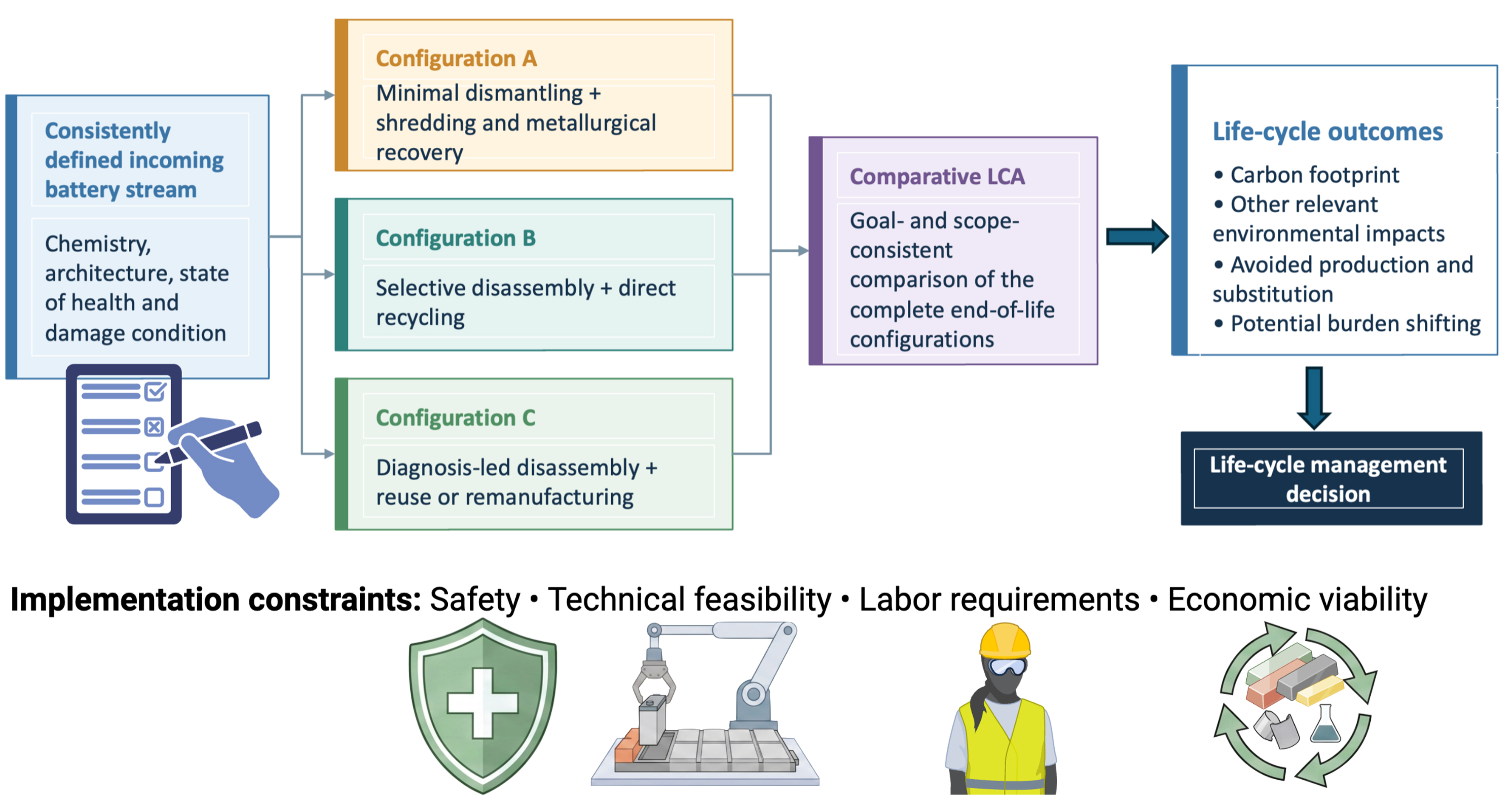
Figure 1. Conceptual framework for comparing disassembly-dependent end-of-life configurations. A consistently defined incoming battery stream is assigned to alternative configurations coupling a disassembly strategy with the reuse, remanufacturing, or recycling pathway that it enables. The complete configurations are compared using carbon-footprint and other relevant life-cycle indicators. Safety, technical feasibility, labor requirements, and economic viability are considered complementary implementation constraints informing life-cycle-management decisions. The figure was created in BioRender. Bontempi, E. (2026), https://BioRender.com/ocq56ow. LCA: Life cycle assessment.
Depending on the goal, scope, and decision context, coupled disassembly–recycling configurations may be compared using attributional, scenario-based, or consequential approaches. This framework may be described as Carbon-Aware Battery Disassembly (CABD). CABD is not a specific dismantling technology, but a decision framework in which disassembly strategies are selected by considering both their direct operational carbon burden and their system-level consequences. Direct contributions include electricity consumption, compressed air, auxiliary equipment and consumables, whereas system-level consequences include changes in material purity, downstream processing requirements, recovery yields, component reuse and avoided virgin-material production. CABD therefore seeks to minimize the life-cycle carbon consequences of disassembly decisions rather than simply the electricity consumed by disassembly equipment. Robotic and digitally supported systems can enable this framework by making alternative strategies more controllable, repeatable and measurable. CABD is deliberately carbon-focused. Occupational safety, labor conditions and economic feasibility are treated as implementation constraints, co-benefits and trade-offs, rather than as components of the carbon footprint. Their simultaneous quantitative assessment would require a broader life-cycle sustainability assessment framework, within which CABD could represent the carbon-focused environmental component. From a life-cycle-management perspective, CABD supports industrial decisions by identifying when greater dismantling selectivity enables alternative reuse, remanufacturing, or recycling pathways. It does not prescribe a universal LCA boundary, but helps determine which disassembly-dependent alternatives are relevant to the decision context. Implementing this vision will require substantial methodological advances. First, comparative studies of disassembly strategies should use harmonized functional units, system boundaries, and inventory-reporting metrics. These could include electricity and compressed-air consumption, consumable use, and greenhouse gas emissions per battery pack or unit mass processed, reported together with disassembly yield, component preservation, and the purity of separated material fractions. Such consistency would facilitate comparison among manual, semi-automated and robotic disassembly systems. Second, closer integration between battery designers, recycling engineers, robotics researchers and LCA practitioners will be essential to ensure that future battery packs are designed not only for manufacturing and performance but also for safe, efficient and low-carbon disassembly. Third, greater standardization of battery-pack architectures could facilitate safer, more automated and lower-carbon disassembly[22]. Finally, digital technologies - including battery passports, digital product twins and artificial intelligence - should be leveraged to support adaptive disassembly planning capable of improving environmental performance across highly heterogeneous end-of-life battery streams.
Battery disassembly shapes which end-of-life pathways remain feasible and should therefore be considered together with those pathways when alternative configurations are compared. CABD provides a carbon-focused framework for identifying these dependencies within life-cycle management, while safety, labor, technical feasibility and economic viability remain complementary implementation dimensions. By making the downstream consequences of disassembly decisions visible without prescribing universal LCA boundaries, this framework can help direct disassembly innovation towards configurations with demonstrable life-cycle benefits.
DECLARATIONS
Acknowledgments
The graphical abstract was created in BioRender. Bontempi, E. (2026) (https://BioRender.com/kq1436w).
Authors’ contributions
Conceptualization, investigation, formal analysis, writing - original draft, writing - review and editing: Adamini, R.
Conceptualization, investigation, writing - review and editing: Fang, Z.
Supervision, writing - review and editing: Wang, Q.; Sun, J.
Conceptualization, supervision, funding acquisition, writing - review and editing: Bontempi, E.
Availability of data and materials
Not applicable.
AI and AI-assisted tools statement
During the preparation of this manuscript, the AI tool ChatGPT (GPT-5, OpenAI, version released 2025-08-07) was used solely for language editing. The tool did not influence the study design, data collection, analysis, interpretation, or the scientific content of the work. All authors take full responsibility for the accuracy, integrity, and final content of the manuscript.
Financial support and sponsorship
The work was supported by MUR in the framework of the FISA 2022 call through the project CARAMEL (“New Carbothermic approaches to Recovery critical Metals from spent Lithium-ions batteries” - CUP D73C24000220001) and by Fondazione Cariplo through the grant “Tech4Lib–Spent Lithium-ion battery recovery” (CUP D73C23000170007).
Conflicts of interest
Bontempi E is the Guest Editor of the Special Topic “Carbon and Water Footprints of Emerging Energy and Material Systems: Global Transitions Toward 2050” in Carbon Footprints. She had no involvement in the review or editorial process of this manuscript, including but not limited to reviewer selection, evaluation, or the final decision, while the other authors declare no conflicts of interest.
Ethical approval and consent to participate
Not applicable.
Consent for publication
Not applicable.
Copyright
© The Author(s) 2026.
REFERENCES
1. Greim, P.; Solomon, A. A.; Breyer, C. Assessment of lithium criticality in the global energy transition and addressing policy gaps in transportation. Nat. Commun. 2020, 11, 4570.
2. Xu, Y.; Tao, S.; Hao, S.; Dong, R.; Pan, D. A review of electrochemical process-driven recycling and regeneration technologies for lithium-ion batteries. Appl. Energy. 2026, 421, 128174.
3. Chen, Q.; Lai, X.; Zhang, Y.; et al. Environmental impacts and supply risks for LiFePO4-LiCoxNiyMn1-x-yO2 hybrid battery pack in China. Process. Saf. Environ. Prot. 2025, 198, 107115.
4. Das, P.; Hewage, K.; Kotagodahetti, R.; Wanniarachchi, S.; Sadiq, R. Lithium-ion battery recycling: a critical review of techno-economical and socio-environmental impacts. Sep. Purif. Technol. 2026, 382, 135847.
5. Qin, Z.; Zhang, Y.; Luo, W.; et al. A universal molten salt method for direct upcycling of spent Ni-rich cathode towards single-crystalline Li-rich cathode. Angew. Chem. Int. Ed. Engl. 2023, 62, e202218672.
6. Dai, Q.; Spangenberger, J.; Ahmed, S.; Gaines, L.; Kelly, J. C.; Wang, M. EverBatt: a closed-loop battery recycling cost and environmental impacts model. 2019. https://publications.anl.gov/anlpubs/2019/07/153050.pdf. (accessed 2026-10-14).
7. Fridrich, M.; Pražanová, A.; Weinzettel, J.; Knap, V. Lithium-ion (LCO/NMC, NMC, LFP) battery recycling: partial LCA study. Monatsh. Chem. 2024, 155, 309-12.
8. Boutrouelle, M.; Panariello, R.; Reynier, Y.; Mayousse, E.; Martinet, S. Eco-design of EV battery packs: a parametric LCA model considering integration efficiency, compression system, and disassembly. Resour. Conserv. Recycl. 2026, 231, 108930.
9. Lander, L.; Tagnon, C.; Nguyen-Tien, V.; et al. Breaking it down: a techno-economic assessment of the impact of battery pack design on disassembly costs. Appl. Energy. 2023, 331, 120437.
10. Thompson, D. L.; Hartley, J. M.; Lambert, S. M.; et al. The importance of design in lithium ion battery recycling - a critical review. Green. Chem. 2020, 22, 7585-603.
11. Meng, K.; Xu, G.; Peng, X.; Youcef-Toumi, K.; Li, J. Intelligent disassembly of electric-vehicle batteries: a forward-looking overview. Resour. Conserv. Recycl. 2022, 182, 106207.
12. Bachler, L.; Rettenmeier, M. Disassembly of end-of-life automotive traction battery packs: a cost analysis and benchmark of distinct technological approaches. Prod. Eng. Res. Devel. 2026, 20, 1405.
13. Younas, T.; Shalchian, H.; Ullah, M.; Vegliò, F.; Innocenzi, V. Optimizing dismantling approaches for recycling of li-ion batteries: strategies, challenges and economic analysis. J. Energy. Storage. 2025, 132, 117918.
14. Asif, M. E.; Rastegarpanah, A.; Stolkin, R. Robotic disassembly for end-of-life products focusing on task and motion planning: a comprehensive survey. J. Manuf. Syst. 2024, 77, 483-524.
15. Schlott, L.; Gutsch, M.; Leker, J. Cost modelling and key drivers in lithium-ion battery recycling. Nat. Rev. Clean. Technol. 2025, 1, 656-70.
16. Huang, Z.; Zhang, H.; Tian, G.; Yang, M.; Wang, D.; Li, Z. Energy-efficient human-robot collaborative U-shaped disassembly line balancing problem considering turn on-off strategy: uncertain modeling and solution method. J. Manuf. Syst. 2025, 80, 38-69.
17. Fang, Z.; Wu, Z.; Zeng, W.; et al. Exploring the viability of cryogenic freezing for safe pretreatment in lithium-ion battery recycling. Renew. Energy. 2025, 252, 123481.
18. Fang, Z.; Wu, Z.; Bontempi, E.; Sun, J.; Wang, Q. Enhancing safety in spent lithium-ion battery recycling: a case study of a fire and explosion accident in China. J. Loss. Prev. Process. Ind. 2026, 104, 106112.
19. Hermansson, F.; Arvidsson, R.; Svanström, M. Black swans swimming in product streams: method for including unplanned events in life cycle assessment. Int. J. Life. Cycle. Assess. 2024, 29, 1818-26.
20. Poschmann, H.; Brüggemann, H.; Goldmann, D. Disassembly 4.0: a review on using robotics in disassembly tasks as a way of automation. Chem. Ing. Tech. 2020, 92, 341-59.
21. Choux, M.; Pripp, S. W.; Kvalnes, F.; Hellström, M. To shred or to disassemble - a techno-economic assessment of automated disassembly vs. shredding in lithium-ion battery module recycling. Resour. Conserv. Recycl. 2024, 203, 107430.
Cite This Article
 Open Access
How to Cite
Download Citation
Export Citation File:
Type of Import
Tips on Downloading Citation
Citation Manager File Format
Type of Import
Direct Import: When the Direct Import option is selected (the default state), a dialogue box will give you the option to Save or Open the downloaded citation data. Choosing Open will either launch your citation manager or give you a choice of applications with which to use the metadata. The Save option saves the file locally for later use.
Indirect Import: When the Indirect Import option is selected, the metadata is displayed and may be copied and pasted as needed.
About This Article
Special Topic
Copyright

Data & Comments
Data
0











Comments
Comments must be written in English. Spam, offensive content, impersonation, and private information will not be permitted. If any comment is reported and identified as inappropriate content by OAE staff, the comment will be removed without notice. If you have any queries or need any help, please contact us at support@oaepublish.com.