


Deep learning in real-time image-guided surgery: a systematic review of applications, methodologies, and clinical relevance
 0
0 
Abstract
Aim: Real-time image guidance using deep learning is being increasingly used in surgery. This systematic review aims to characterize intraoperative systems, mapping applications, performance and latency, validation practices, and the reported effects on workflow and patient-relevant outcomes.
Methods: A systematic review was conducted on PubMed, Embase, Scopus, ScienceDirect, IEEE Xplore, Google Scholar, and Directory of Open Access Journals from December 31, 2024. Eligible English-language, peer-reviewed diagnostic accuracy, cohort, quasi-experimental, or randomized studies (2017-2024) evaluated the learning for real-time intraoperative guidance. Two reviewers screened, applied the Joanna Briggs Institute checklists, and extracted the design, modality, architecture, training, validation, performance, and latency. Heterogeneity precluded the meta-analysis.
Results: Twenty-seven studies spanning laparoscopic, neurosurgical, breast, colorectal, cardiac, and other workflows met the criteria. The modalities included red-green-blue laparoscopy or endoscopy, ultrasound, optical coherence tomography, cone-beam computed tomography, and stimulated Raman histology. The architectures were mainly convolutional neural networks with frequent transfer learning. Reported performance was high, with classification accuracy commonly 90%-97% and segmentation Dice or intersection over union up to 0.95 at operating-room-compatible speeds of about 20-300 frames per second or sub-second per-frame latency; volumetric pipelines sometimes required up to 1 min. Several systems demonstrated intraoperative feasibility and high surgeon acceptance, yet fewer than one quarter reported external validation and only a small subset linked outputs to patient-important outcomes.
Conclusion: Deep-learning systems for real-time image guidance exhibit strong technical performance and emerging workflow benefits. Priorities include multicenter prospective evaluations, standardized reporting of latency and external validation, rigorous human factors assessment, and open benchmarking to demonstrate generalizability and patient impact.
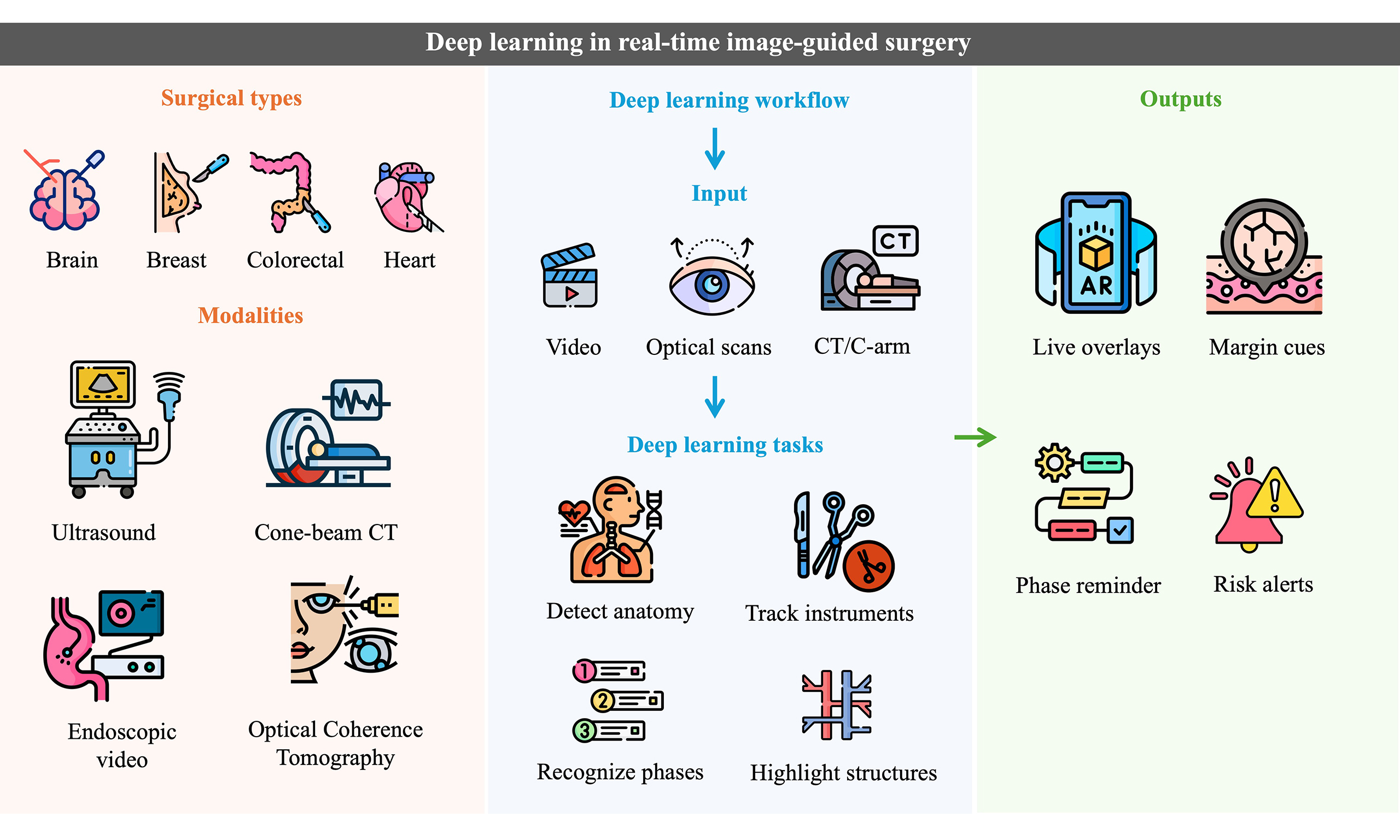
Keywords
INTRODUCTION
Surgery remains a cornerstone of modern healthcare, with approximately 313 million operations performed worldwide each year; paradoxically, only 6% of these are performed in the world’s poorest nations[1]. Postoperative mortality is now recognized as a major global health burden, with an estimated 4.2 million deaths within 30 days of surgery each year, accounting for 7.7% of all deaths[2]. Real-time image guidance has been shown to mitigate intraoperative errors; for instance, three-dimensional (3-D) imaging prompts a revision of surgical plans in roughly 20% of orthopedic cases[3], while augmented-reality overlays improve spatial orientation and usability in laparoscopic liver surgery[4]. Deep learning (DL) has accelerated these advances in recent years. High-resolution optical coherence tomography (OCT) has > 90% sensitivity and specificity for breast-margin assessment[5], and stimulated Raman histology matched board-certified pathologists with 94.6% diagnostic accuracy in a multicenter randomized trial[6]. In workflow analytics, DL models now recognize surgical phases with > 90% accuracy across millions of laparoscopic frames[7,8]. Regulatory activity mirrors this momentum: the United States Food and Drug Administration (FDA) has authorized more than 690 artificial intelligence (AI)/machine learning (ML)-enabled medical devices to date, although most target preoperative or diagnostic imaging rather than intraoperative support[9]. However, translating these capabilities into routine operating-room practice remains difficult: adoption typically requires high up-front capital expenditure (CAPEX) for operating room (OR)-grade imaging and computing, substantial staff training and credentialing, workflow redesign to meet real-time constraints, and organizational change management to overcome resistance; interoperability and data governance hurdles further slow integration[10,11].
Despite encouraging test-bench metrics, external validation, generalizability, and real-time integration remain under-reported. Critical reviews highlight small, single-center datasets, opaque “black-box” reasoning, and inconsistent latency reporting, which hamper bedside adoption[12]. Even mature interpretability techniques lack consensus guidelines for surgical imaging[13]. Regulatory frameworks and evidence standards are evolving, and forthcoming United States advisory committee hearings have only begun to address the safety of generative AI in surgical devices[14]. Consequently, surgeons, developers, and policymakers lack a consolidated view of where DL already works reliably in the OR, where the evidence is insufficient, and which methodological decisions influence its clinical relevance. Emerging directions, such as generative AI for synthetic intraoperative data and multimodal fusion that combines endoscopic video with ultrasound and preoperative computed tomography (CT), may enhance robustness and context awareness but will require rigorous clinical validation and governance[15,16]. Given the high stakes of intraoperative decision-making and the sheer pace of algorithmic innovation, a systematic synthesis is needed to map the applications, technical pipelines, and reported clinical impacts of real-time DL systems in image-guided surgery. By linking performance metrics to workflow context and annotation quality, this study aims to clarify whether impressive accuracies translate into tangible reductions in revision rates, operating time, or margin-positive resections.
METHODS
Reporting framework and protocol registration
This systematic review followed the Preferred Reporting Items for Systematic Reviews and Meta-Analyses (PRISMA) 2020 statement[17]. The protocol was prospectively registered in the International Prospective Register of Systematic Reviews (PROSPERO) database (registration ID: CRD420251012412).
Eligibility criteria
We included peer-reviewed original studies, diagnostic test accuracy, cohort, quasi-experimental, and randomized controlled trial designs that evaluated DL-based systems for real-time intraoperative image guidance in human surgical procedures and were published between January 1, 2015, and December 31, 2024. Studies were eligible regardless of surgical specialty, imaging modality, geographic setting, or sample size. We excluded reviews, editorials, commentaries, conference abstracts, letters, single-patient case reports, and non-English articles to ensure methodological consistency in reporting.
Information sources, search strategy, and study selection
A comprehensive search was conducted in seven electronic databases [PubMed, Embase, Scopus, ScienceDirect, IEEE Xplore, Google Scholar, and the Directory of Open Access Journals (DOAJ)] from inception to December 31, 2024. Controlled vocabulary [e.g., MeSH (Medical Subject Headings), Emtree (Excerpta Medica Tree)] and free-text terms for DL (“deep learning,” “neural network,” “machine learning,” “artificial intelligence”) were combined with real-time imaging (“real-time,” “live,” “immediate”) and surgical guidance (“image-guided,” “surgery,” “procedure,” “augmented reality”) using Boolean operators. All retrieved citations were imported into Rayyan systematic review software[17] for duplicate removal and screening. Two reviewers (MMA and OK) independently screened the titles and abstracts and then assessed the full texts for eligibility. Discrepancies were resolved through discussion, and the IA adjudicated the matter when necessary. The selection process is illustrated in Figure 1.

Figure 1. PRISMA flow chart of study selection. PRISMA: Preferred Reporting Items for Systematic Reviews and Meta-Analyses; DOAJ: Directory of Open Access Journals; IEEE: Institute of Electrical and Electronics Engineers. The PRISMA flowchart was created with Rayyan (https://www.rayyan.ai/).
Quality appraisal and data extraction
The methodological quality of the included studies was assessed by two reviewers (OK and ZKO) using the Joanna Briggs Institute critical appraisal checklists appropriate for each design (diagnostic test accuracy, cohort, and quasi-experimental studies)[18]. Disagreements were resolved by consensus or consultation with MMH. Data extraction was performed independently by IA and MMH using a standardized form to capture the study characteristics (authors, year, country), surgical context, imaging modality, DL architecture, training protocol, preprocessing/augmentation methods, validation approach, annotation procedures, performance metrics, real-time capability, and reported or inferred clinical relevance. Real-time performance was defined variably across studies, most commonly as ≥ 20 frames per second (FPS) or inference latency ≤ 1 s per frame; studies self-reporting “real-time” outside these bounds were still included but noted as such. The extracted data were cross-checked, and any inconsistencies were clarified through consultation with the MMA. No studies were excluded based on their risk of bias ratings, and the appraisal findings informed the narrative interpretation of the results.
Data synthesis
Substantial heterogeneity in study designs, imaging modalities, algorithmic architectures, training regimens, and outcome measures precluded quantitative meta-analysis. The findings were synthesized narratively as follows. We present tables detailing the study characteristics, technical pipelines, preprocessing strategies, annotation quality, core performance metrics, inference latencies, and real-time capabilities alongside the reported clinical impacts [Figure 2].
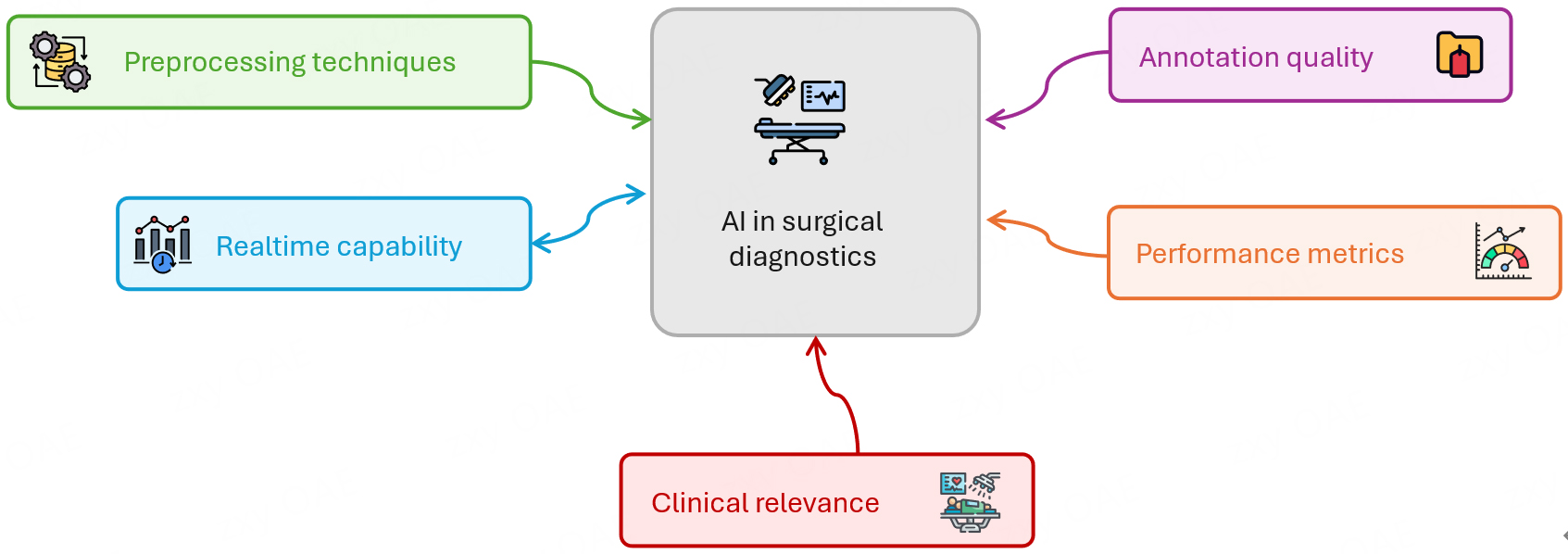
Figure 2. AI in surgical diagnostics: techniques and applications. AI: Artificial intelligence. The figure is available at this link: https://simadeduso-my.sharepoint.com/:p:/g/personal/momustafahmed_simad_edu_so/IQC6ZWrC08ocR4mCaevyYq6bAY8GGfRtkb42bPbiwSHFmtM?e=H9QjU2.
RESULTS
This systematic review synthesized data from 27 peer-reviewed studies published between 2017 and 2024, each evaluating the performance, training approaches, and clinical relevance of DL systems applied to surgical or image-guided interventions [Table 1]. The studies targeted a broad array of surgical procedures, with purely laparoscopic interventions being the most frequent (n = 7): laparoscopic hepatectomy[18], laparoscopic cholecystectomy[23,25,26,32], laparoscopic tubal sterilization[20], laparoscopic sigmoidectomy[8], and liver resection or staging laparoscopy with SmartLiver augmented reality (AR) guidance[15].
Study characteristics, datasets, and technical details
| Author(s) | Year | References | Study objective | Study design | Dataset (type & size) | Surgical context | Imaging modality | Deep-learning architecture | Training protocol |
| Padovan | 2022 | [19] | Develop real-time 3-D model registration from laparoscopic RGB video | Diagnostic test accuracy study | 971 real frames (segmentation) + 115,000 synthetic frames (rotation) + 96 evaluation frames | Robot-assisted radical prostatectomy & partial nephrectomy | RGB endoscopy | U-Net (segmentation); ResNet-50 (rotation) | 70%/15%/15% train/validation/test; synthetic rotation data |
| Boonkong | 2024 | [20] | Detect uterus and fallopian tubes (even when occluded) in laparoscopic sterilization | Diagnostic test accuracy study | 800 manually annotated frames + 5 cadaveric laparoscopic videos | Laparoscopic tubal sterilization | RGB laparoscopy | YOLOv10 with key-point & ellipse heads | 80%/10%/10% split; fine-tuned on YouTube data |
| Singla | 2018 | [5] | Distinguish malignant vs. healthy breast tissue using OCT | Diagnostic test accuracy study | 219,000 image patches from 48 specimens | Breast-conserving surgery margin assessment | Optical coherence tomography | Inception-v3 (transfer learning) | Fine-tuning with augmentation |
| Zeye Liu | 2023 | [21] | Identify, localize, and track cardiac structures during surgery | Diagnostic test accuracy study | 17,114 labeled ultrasound views (79 videos) | Structural-heart interventions | Transthoracic & transoesophageal ultrasound | ResNet-18 + spatial-channel attention; YOLOv5 + DeepSORT | Supervised learning |
| Kimimasa Sasaki | 2022 | [18] | Automatic recognition of surgical steps in laparoscopic hepatectomy | Diagnostic test accuracy study | 40 videos (~8.1 million frames) | Laparoscopic hepatectomy | RGB laparoscopy | Xception pretrained on ImageNet | Supervised learning |
| Marc Aubreville | 2017 | [22] | Classify oral squamous-cell carcinoma from CLE images | Diagnostic test accuracy study | 11,000 images from 12 patients (116 video sequences) | Oral cancer surgery | Confocal laser endomicroscopy | Custom CNN; Inception-v3 transfer learning baseline | From-scratch & transfer |
| Chinedu I. Nwoye | 2023 | [23] | Benchmark action-triplet detection (instrument + action + target) | Diagnostic test accuracy study | 100,900 frames from 50 laparoscopic cholecystectomies | Laparoscopic cholecystectomy | RGB laparoscopy | Eleven submitted architectures (CNNs, Transformers, MIL, GNNs) | Supervised + weak supervision |
| Xiaoxuan Zhang | 2023 | [24] | Improve intra-operative CBCT with uncertainty-guided DL synthesis | Diagnostic test accuracy study | 20 simulated CBCT cases + 7 patient cases | Image-guided neurosurgery (tumor, epilepsy, trauma) | Cone-beam CT | 3-D Bayesian conditional GAN | Supervised with Monte-Carlo dropout |
| Schneider | 2020 | [15] | Assess feasibility of SmartLiver AR navigation | Cohort study | 18 laparoscopic liver procedures | Liver resection or staging laparoscopy | 3-D laparoscopic video + CT | CNN liver-surface segmentation | Supervised learning |
| Caballas | 2020 | [25] | Visual guidance for motion-based laparoscopic palpation | Diagnostic test accuracy study | 428 polygon-annotated images | Laparoscopic cholecystectomy | RGB laparoscopy | YOLACT++ | Supervised learning |
| Smithmaitrie | 2024 | [26] | Detect anatomical landmarks and guide dissection line | Diagnostic test accuracy study | 3,200 frames from 40 videos | Laparoscopic cholecystectomy | RGB laparoscopy | YOLOv7 | Supervised learning |
| Török | 2018 | [27] | Segment submucous fibroids and dissection plane | Diagnostic test accuracy study | 6,288 images from 13 videos | Hysteroscopic fibroid resection | Hysteroscopic video | FCN-8s/16s/32s ensemble | Supervised learning |
| Lin | 2018 | [28] | Combine 3-D shape reconstruction and hyperspectral imaging | Diagnostic test accuracy study | Qualitative dataset (size not specified) | Minimally invasive laryngeal surgery | Structured-light RGB + hyperspectral imaging | CNN (shape); SSRNet (spectral super-resolution) | Supervised learning |
| Blokker | 2022 | [29] | Classify glioma vs. normal brain with THG microscopy | Diagnostic test accuracy study | 12,624 images (23 patients) | Brain tumor surgery | Third-harmonic-generation microscopy | Fully convolutional network | Monte-Carlo cross-validation |
| Mojahed | 2019 | [30] | Classify cancerous vs. non-cancerous breast OCT regions | Diagnostic test accuracy study | 36,800 B-scans (46 specimens) | Breast-conserving surgery | Optical coherence tomography | Custom 11-layer CNN | Five-fold cross-validation |
| Tai | 2021 | [31] | AR-haptic guidance for precise lung biopsy | Quasi-Experimental study | 341 COVID-19 patients + 1,598 controls + 24 surgeons | CT-guided lung biopsy | CT-based augmented reality | WPD-CNN-LSTM; ResNet | Five-fold cross-validation |
| Jalal | 2023 | [32] | Surgical phase and tool recognition in Cholec80 | Diagnostic test accuracy study | 80 laparoscopic cholecystectomy videos | Laparoscopic cholecystectomy | RGB laparoscopy | ResNet-50 + squeeze-excitation + LSTM | Supervised + weak supervision |
| Hollon | 2020 | [6] | Rapid brain-tumor diagnosis using SRH | Randomized control trial | 2.5 million SRH patches (415 patients) + 278 trial patients | Brain tumor resection | Stimulated Raman histology | Inception-ResNet-v2 | Supervised learning |
| Mao | 2024 | [33] | PitSurgRT: real-time localization in pituitary surgery | Diagnostic test accuracy study | 635 annotated frames from 64 surgeries | Endoscopic trans-sphenoidal pituitary surgery | RGB endoscopy | HRNet dual-task heads | Five-fold cross-validation; staged training |
| Kitaguchi | 2019 | [8] | Automatic phase recognition in sigmoidectomy | Diagnostic test accuracy study | 7.8 million frames (71 cases) | Laparoscopic sigmoidectomy | RGB laparoscopy | Inception-ResNet-v2 + LightGBM | Hold-out validation (63/8 cases) |
| Zeng | 2020 | [34] | PR-OCT classification of colorectal tissue | Diagnostic test accuracy study | 26,000 OCT images (24 patients) | Colorectal resection (ex-vivo) | Swept-source OCT | RetinaNet (ResNet-18 + feature pyramid) | Supervised learning |
| Tanzi | 2021 | [35] | Catheter segmentation and 3-D overlay in RARP | Diagnostic test accuracy study | 15,570 frames (five videos) | Robot-assisted radical prostatectomy | RGB laparoscopy | U-Net + MobileNet backbone | Supervised learning |
| Podlasek | 2020 | [36] | Real-time CNN polyp detection in colonoscopy | Diagnostic test accuracy study | 79,284 frames + 2,678 photos | Diagnostic colonoscopy | RGB endoscopy | RetinaNet + EfficientNet-B4 | Supervised learning |
| Sato | 2022 | [37] | Segment recurrent laryngeal nerve during oesophagectomy | Diagnostic test accuracy study | 3,040 images (28 patients) | Thoracoscopic oesophagectomy | RGB endoscopy | DeepLab v3+ | Transfer learning from PASCAL-VOC |
| Canalini | 2019 | [38] | Register intra-operative US volumes in glioma surgery | Diagnostic test accuracy study | 31 3-D ultrasound volumes (RESECT + BITE datasets) | Glioma neurosurgery | 3-D intra-operative ultrasound | 3-D U-Net | Supervised learning |
| Mekki | 2023 | [39] | 3-D localization of guidewires from two fluoroscopy views | Diagnostic test accuracy study | 10,000 simulated images + 36 CBCT sets (five cadavers) | Orthopedic trauma guidewire placement | Fluoroscopy + cone-beam CT | Mask R-CNN + Key-point R-CNN | Simulated supervised training |
| Geldof | 2023 | [40] | Real-time tumor segmentation in colorectal ultrasound | Diagnostic test accuracy study | 179 ultrasound images (74 patients) | Colorectal cancer surgery | Intra-operative ultrasound | Ensemble of MobileNetV2, ResNet-18/50, U-Net, Xception | Transfer learning; augmentation |
The imaging modalities were equally diverse. Red-green-blue (RGB) laparoscopy dominated minimally invasive workflows[8,18-20,25,26,32], while RGB endoscopy served endoscopic applications[19,33,36,37]. Ultrasound techniques, including transthoracic and transoesophageal ultrasound[21], 3-D intraoperative ultrasound[38], and intraoperative ultrasound[40], are prominent in cardiac and oncologic settings. OCT has enabled high-resolution tissue assessment in breast-conserving surgery[5,30] and ex vivo colorectal resection[34]. Cone-beam CT underpinned image-guided neurosurgery[24] and orthopedic procedures[39]. Confocal laser endomicroscopy provides in vivo histology[22], and stimulated Raman histology offers label-free intraoperative diagnosis[6].
Architecturally, convolutional neural networks (CNNs) and their variants form the backbone of studies. Segmentation tasks predominantly employed U-Net and its derivatives, U-Net for catheter and prostate segmentation[19] and U-Net+MobileNet for catheter overlays[35], with ensemble methods incorporating U-Net for colorectal tumor delineation[40]. Classification and margin assessment leveraged Inception-v3 for OCT-based breast margin evaluation[5] and Inception-Residual Network-v2 (ResNet) for stimulated Raman histology diagnosis[6]. Localization and tracking combined ResNet-18 with spatial-channel attention and You Only Look Once version 5 (YOLOv5) plus Deep Simple Online Real-Time Tracking (DeepSORT) in cardiac ultrasound[21]. Phase and instrument recognition utilized Xception pretrained on ImageNet for laparoscopic hepatectomy workflows[18] and ResNet-50 with squeeze-and-excitation plus long short-term memory (LSTM) for Cholec80 tool detection[32].
The performance metrics uniformly indicated high diagnostic quality [Table 2]. OCT-based margin assessment achieved 90% accuracy, 90% sensitivity, and 91.7% specificity[5], with follow-up studies reporting 94% accuracy and 96% sensitivity[30]. Colorectal optical biopsy models exceeded 99% specificity and reached 100% sensitivity[34]. Segmentation Intersection over Union (IoU) peaked at 0.95 for catheter overlays in urologic laparoscopy[19], and ultrasound-based tumor segmentation achieved a Dice coefficient of 0.84 in real-time colorectal workflows[40]. In pituitary surgery, landmark detection ran at 298 FPS with an IoU of 67% and 88.7% surgeon approval[33].
Preprocessing techniques, annotation quality, performance, and clinical relevance
| Author(s) | References | Preprocessing/augmentation | Core performance metrics | Real-time capability | Reported/inferred clinical relevance |
| Padovan | [19] | Manual frame selection; three-class masks; synthetic rotation augmentation | IoU: 0.95 (catheter), 0.73 (prostate), 0.86 (kidney); rotation error ≤ ± 5° | 25-30 FPS | Enables accurate intra-operative 3-D overlay for improved spatial orientation |
| Boonkong | [20] | Rotation, flip, blur, and colour adjustments (Albumentations) | Multi-class F1 > 0.90; ellipse fit error < 4 points | 30 FPS | Rapid identification of occluded reproductive anatomy, enhancing safety |
| Singla | [5] | Curvature flattening, intensity normalization, patch extraction (150 × 150 px) | Accuracy 90%, Sens 90%, Spec 91.7% | ≈ 1 s per B-scan | Promising for real-time margin status, potentially reducing re-excisions |
| Zeye Liu | [21] | Image cropping to 227 × 227 px; normalization | AUC ≥ 0.93, frame-accuracy ≥ 0.85 | < 40 ms inference | Matches specialist performance; streamlines workflow where echo expertise is scarce |
| Kimimasa Sasaki | [18] | 30 fps frame extraction; resizing; codec normalization | Accuracy 0.89-0.95; F1 up to 0.97 | 21 FPS | Provides context-aware phase display and potential automated alerts |
| Marc Aubreville | [22] | Patch extraction, zero-mean whitening, 2× rotation | Accuracy 88%, AUC 0.96 | 50 ms per frame (prototype) | Near-real-time tumor delineation during ablation |
| Chinedu I. Nwoye | [23] | Frame extraction; bounding-box and weak labels | Triplet AP 18.8%-35% | Not tested live | Establishes public benchmark for detailed OR analytics |
| Xiaoxuan Zhang | [24] | Metal-artefact correction, scatter in-painting, Gaussian smoothing | SSIM ↑ 15%-22%; lesion Dice ↑ ≤ 25% | < 1 min per volume (parallel pipeline) | Improves soft-tissue contrast and registration accuracy |
| Schneider | [15] | Stereo reconstruction, iterative closest point alignment, camera calibration | Registration error: manual 10.9 ± 4.2 mm; semi-auto 13.9 ± 4.4 mm | Setup 5-10 min then live overlay | Demonstrates feasibility and surgeon acceptance of AR navigation |
| Caballas | [25] | Polygon mask annotation | Box AP 92.2%, Mask AP 88.4% | 20.6 FPS | Proof-of-concept for real-time palpation cues |
| Smithmaitrie | [26] | Image resizing; Mosaic augmentation | Landmark mAP 0.85; precision 0.88 | Deployed live | 95.7% surgeon acceptance of guidance overlay |
| Török | [27] | 500 × 500 px tiles; ensemble prediction fusion | Pixel accuracy 86.2% | Offline | Could aid plane visualization though not yet live |
| Lin | [28] | Structured-light projection; RGB-HSI fusion | 3-D recon 12 FPS; HSI 2 FPS | Yes | Enables dual-modality AR overlay in theatre |
| Blokker | [29] | Frequency-domain noise filtering; normalization | Accuracy 79%, AUC 0.77, Spec 95.9% | 35 ms per 1 k×1 k image | Rapid histology-like feedback during resection |
| Mojahed | [30] | Down-sampling; z-score normalization; dropout | Accuracy 94%, Sens 96% | 0.1 s per B-scan | Could reduce re-excisions via immediate feedback |
| Tai | [31] | Wavelet-packet decomposition; normalization | AR-guided lung biopsy | Accuracy 97%, RMSE 0.013 | 900 Hz haptic loop |
| Jalal | [32] | Resizing to 375 × 300 px; spatiotemporal pooling | Tool mAP 95.6%; phase F1 70.1% | 32 FPS | OR decision support and automated video indexing |
| Hollon | [6] | 300 × 300 px sliding window; affine transforms | CNN accuracy 94.6% vs. pathologist 93.9% | ≤ 150 s per case | Pathologist-level diagnosis without on-site neuropathologist |
| Mao | [33] | Shift, zoom, rotation, brightness/contrast augmentation | IoU (sella) 67%; 298 FPS (TensorRT) | 298 FPS | 88.7% surgeons deem output clinically useful |
| Kitaguchi | [8] | Frame extraction every 1/30 s; manual phase labels | Phase accuracy 91.9%; action accuracy 82-89% | 32 FPS | Real-time phase display and coaching |
| Zeng | [34] | Resizing to 608 × 608 px; patient-wise split; Xavier initialisation | Sens 100%, Spec 99.7%, AUC 0.998 | Instant B-scan | Real-time neoplasia triage |
| Tanzi | [35] | Manual masks; resizing to 416 × 608 px | IoU 0.89 ± 0.08; overlay error ≈ 4 px | 8 FPS | Improves biopsy localization in robotic surgery |
| Podlasek | [36] | Resizing to 224 × 224 px; flips, rotations; class balance | Detection 94%; F1 0.73-0.94 | 24-57 FPS (GPU dependent) | Increases ADR on commodity hardware |
| Sato | [37] | Surgeon-annotated masks; data augmentation | Dice 0.58 (AI) vs. 0.62 (experts) | 30 FPS | Assists nerve preservation, especially for less experienced surgeons |
| Canalini | [38] | Manual sulci masks; 3-D patch training | mTRE reduced 3.5 → 1.4 mm | Offline (~2 min) | Low-cost alternative to intra-operative MRI |
| Mekki | [39] | Log transform; affine projection; noise injection | Tip error 1.8 mm; dir. error 2.7° | < 5 s per step-and-shoot | Reduces radiation and improves accuracy |
| Geldof | [40] | Cropping, normalization, rotation, gamma correction; gradient-weighted Dice loss | Dice 0.84; margin error 0.67 mm; AUC 0.97 | Near real-time | Potential to reduce positive margins intra-operatively |
Several tools supported real-time decision support in the OR. The dissection-line guidance overlay developed by Smithmaitrie et al. achieved 95.7% surgeon acceptance[26], and multitask model developed by Jalal et al. for simultaneous phase and instrument recognition ran at 32 FPS with a tool mean average precision (mAP) of 95.6% and a phase F1 score of 70.1%[32]. The real-time AR registration model reported by Padovan et al. registered 3-D overlays at 25-30 FPS with intersection-over-union up to 0.95 and rotation errors ≤ 5°, improving intraoperative spatial orientation[19]. The guide-wire navigation system developed by Mekki et al. in orthopedic trauma achieved tip and directional errors of 1.8 mm and 2.7° in under 5 s per step, reducing radiation exposure while enhancing placement accuracy[39]. Nwoye established a public benchmark for fine-grained instrument-action-target analytics in laparoscopic cholecystectomy, reporting triplet average precision (AP) of 18.8%-35% on over 100,000 frames[23]. OCT-based margin assessment is promising for real-time margin status, potentially reducing re-excisions[5]. Pathologist-level diagnosis without an on-site neuropathologist was achieved in less than 150 s per case[6]. Intraoperative OCT segmentation can reduce re-excision via immediate feedback[30]. The colorectal ultrasound model has the potential to reduce positive margins intraoperatively[40]. Real-time cardiac structure tracking matches specialist performance and streamlines the workflow in areas where echocardiography expertise is scarce[21]. SmartLiver AR navigation has demonstrated feasibility and high surgeon acceptance[15]. A summary linking the core metrics to the reported clinical/workflow outcomes is provided in Table 3.
Summary of model performance and reported clinical or workflow outcomes
| Clinical task and setting | Performance and runtime | Reported clinical or workflow outcome | References |
| Breast margin assessment during breast-conserving surgery using optical coherence tomography | Accuracy 90%, sensitivity 90%, specificity 91.7%; one second per cross-sectional scan | Supports intraoperative margin status, with potential to reduce re-excisions | [5] |
| Breast margin assessment follow-up using optical coherence tomography | Accuracy 94%, sensitivity 96%; 1/10 of a second per cross-sectional scan | Immediate margin feedback, with potential to reduce re-excisions | [30] |
| Intraoperative brain tumor diagnosis using stimulated Raman histology | Model accuracy comparable to pathologists; no more than 150 s per case | Enables pathologist-level diagnosis without an on-site neuropathologist | [6] |
| Landmark localization in endoscopic trans-sphenoidal pituitary surgery | Intersection over union 67% for the Sella; 298 frames per second | Deemed clinically useful by most surgeons in user assessment | [33] |
| Dissection guidance in laparoscopic cholecystectomy | High landmark detection performance; operated in real time | 95.7% surgeon acceptance of the guidance overlay | [26] |
| Phase and instrument recognition in laparoscopic cholecystectomy | Mean average precision for tools 95.6%; F1 score 70.1% for phases; 32 frames per second | Decision support and automated video indexing in the operating room | [32] |
| Three-dimensional registration for augmented reality overlays in urologic laparoscopy | Intersection over union as high as 0.95; rotation error not exceeding 5°; 25 to 30 frames per second | Improved intraoperative spatial orientation with stable overlays | [19] |
| Cardiac structure tracking during intraoperative ultrasound | Area under the receiver operating characteristic curve at least 0.93; frame-level accuracy at least 0.85; per-frame processing below 40 ms | Matches specialist performance and streamlines workflow where expertise is scarce | [21] |
| Tumor segmentation during colorectal surgery with intraoperative ultrasound | Dice coefficient 0.84; margin error 0.67 mm; operated near real time | Potential to reduce positive margins during surgery | [40] |
| Guidewire navigation in orthopedic trauma under fluoroscopy and cone-beam computed tomography | Tip error 1.8 mm; directional error 2.7°; per step under 5 s | Reduced radiation exposure and improved placement accuracy | [39] |
| Augmented reality navigation feasibility in laparoscopic liver surgery | Registration error around 11 to 14 mm; live overlay after a short setup period | Feasibility demonstrated with high surgeon acceptance | [15] |
| Optical biopsy for colorectal tissue using swept-source optical coherence tomography (ex vivo) | Sensitivity 100%; specificity 99.7%; instantaneous per scan | Real-time triage of neoplasia during specimen assessment | [34] |
| Catheter segmentation and overlay in robotic prostatectomy | Intersection over union 0.89 with a standard deviation of 0.08; overlay error 4 pixels; 8 frames per second | Improved biopsy localization during robotic surgery | [35] |
| Polyp detection during diagnostic colonoscopy | Detection accuracy 94%; F1 score from 0.73% to 0.94%; 24 to 57 frames per second depending on hardware | Real-time detection on common hardware, with potential to increase adenoma detection rate | [36] |
DISCUSSION
This systematic review synthesizes 27 peer-reviewed studies (2017-2024) encompassing laparoscopic, neurosurgical, breast, colorectal, cardiac, and other image-guided surgical workflows. The findings indicate that contemporary DL pipelines can achieve high diagnostic performance at clinically viable frame rates while also beginning to report task-level effects in the OR. This pattern aligns with a broader transition from isolated proofs-of-concept to context-aware assistants that integrate recognition of anatomy, instruments, and workflow, and begin to assess their effects on decision-making, ergonomics, and safety. Recent systematic reviews addressing DL applied to surgery have also emphasized that most applications are still early in the validation cycle, requiring more robust clinical evidence on which to ascertain real-world utility[41]. Simultaneously, developments can also be seen in surgical phase recognition, particularly in laparoscopic cholecystectomy where DL architectures had been able to reach robust frame-level classification and intraoperative usage[42]. Further studies have highlighted the need for and importance of harmonized evaluation schemes between institutions due to the effect of dataset splitting strategies and center-specific differences, which compromise the generalizability of models[43,44]. Contemporary syntheses in surgery and endoscopy similarly suggest that real-time feasibility is now common when models are engineered for throughput, although standardized reporting for end-to-end latency, human factors, and failure modes remains inconsistent across studies[45-47].
A central finding was the practical viability of video-rate inference in the OR. Many of the included systems paired lightweight backbones with task-specific pre- and post-processing, reflecting reports that one-stage detectors, efficient segmenters, and tracker stacks can sustain clinical frame rates on commodity hardware. External commentaries note that “FPS” claims are often hardware-dependent and rarely audited under OR load, complicating comparisons and necessitating shared measurement templates for total pipeline latency and integration overhead[48,49]. The task-level effects observed in this study are consistent with the growing evidence in several specialties. In neurosurgery, stimulated Raman histology combined with DL has repeatedly demonstrated near real-time intraoperative diagnosis with prospective clinical validation, supporting the feasibility claim without reiterating the metrics from our results[50].
Studies and meta-analyses of breast-conserving surgery indicate that intraoperative OCT can inform margin status and may reduce re-excisions when integrated into the live workflow, aligning with our interpretation of clinical utility rather than offline accuracy alone[51,52]. In hepatic surgery, recent clinical experiences and narrative reviews have reported high surgeon acceptance of AR navigation when registration quality and display ergonomics are adequate, echoing the acceptance signals in our model[49,50]. In comparative studies of surgical workflow and skill analysis ML algorithms, it has been found that benchmark standardization and multicentric validation are crucial, as performance can vary significantly depending on dataset design and institutional variability[53,54]. Cardiac imaging reviews similarly describe automated structure tracking and measurements that approach expert performance and can alleviate bottlenecks where echocardiography expertise is scarce, corresponding to the workflow benefits we noted for the intraoperative echocardiography[41,55].
However, the generalizability of these findings remains a limiting factor. Multicenter studies consistently show that models trained on single-center surgical videos degrade when tested elsewhere and that technique and camera heterogeneity drive performance variability. Comparative analyses and multicenter datasets of laparoscopic procedures quantify this gap and recommend explicit external validation and domain-robust training over reliance on pretraining alone. Our interpretation that per-site excellence does not guarantee portability is consistent with these results and broader reviews cataloging dataset biases and split pathologies in common benchmarks[56-58]. Human factors significantly influence the adoption of technology, comparable to the impact of accuracy. Reviews of automation bias and clinician trust underscore the importance of interface design, transparency regarding uncertainty, and the establishment of clear guidelines for enhancing team performance and safety, particularly under time constraints. These findings support our caution that explanation features should elucidate system limitations and that escalation and fallback mechanisms must be integrated into OR assistants rather than being assumed[59-61]. Equity considerations are also pertinent to the use of surgical AI. The United Kingdom independent review on equity in medical devices highlights the need to address differential performance across subgroups and the sociotechnical factors affecting access and outcomes, reinforcing the importance of subgroup reporting and post-deployment monitoring in surgical contexts[62].
Regulatory pathways are beginning to align with these considerations. In the United States, AI-enabled surgical software is generally regulated as software for medical devices under existing device frameworks. The FDA’s final guidance on Predetermined Change Control Plans outlines expectations for pre-specifying permissible model updates, verification and validation plans, and real-world monitoring, which is particularly relevant to video systems that will undergo iterations post-launch. The Good Machine Learning Practice (GMLP) principles, co-published by the FDA, Health Canada, and the Medicines and Healthcare products Regulatory Agency (MHRA), along with the International Medical Device Regulators Forum’s (IMDRF) 2025 final GMLP document, emphasize lifecycle quality, data governance, and transparency. In the European Union, the new Medical Device Coordination Group (MDCG) Document 2025-6 Frequently Ask Questions (FAQ) clarifies how the high-risk obligations of AI Act will be assessed alongside the Medical Device Regulation (MDR) or In Vitro Diagnostic Regulation (IVDR) during the conformity assessment, necessitating that teams plan technical documentation and post-market surveillance to satisfy both regulatory regimes[59-62].
This study has several limitations. The restriction to English-language sources may introduce language and publication bias by excluding pertinent non-English evidence, potentially skewing our conclusions. Additionally, the inclusion was limited to complete calendar years from January 1, 2017, to December 31, 2024, to ensure a consistent sampling frame. Although several studies from 2025 were discussed to contextualize current trajectories, they were not eligible for inclusion in the evidence synthesis and were cited narratively. We adopted a pragmatic operationalization in which real-time was most interpreted as at least 20 FPS or at most 1 s per frame; studies that self-described as real-time outside these bounds were retained and explicitly flagged. Frames-per-second and per-frame latencies were extracted when available and coded as not reported when absent. This variability introduces measurement noise that can affect cross-study comparability, underscoring the value of reporting frameworks for early clinical AI evaluations that emphasize the explicit documentation of technical performance and human-AI interaction during live use.
In conclusion, the evidence suggests that contemporary DL pipelines can meet OR constraints and are beginning to offer clinically significant support. However, their widespread applicability and accuracy are contingent on rigorous multicenter validation, explicit management of domain shifts, meticulous human factors engineering, and adherence to evolving regulatory frameworks that prioritize lifecycle quality. A revised version of this review should expand the search to include non-English sources and gray literature and extend the inclusion criteria to encompass the most recent calendar year, as several studies from 2025 have already expanded the evidence base for label-free pathology, AR navigation, and real-time workflow analysis.
DECLARATIONS
Acknowledgements
The icons used in the Graphical Abstract and Figure 2 were obtained from Flaticon (https://www.flaticon.com/).
Author contributions
Conceptualized and designed the review: Ahmed MM, Kasimieh O
Conducted the literature review, quality appraisal, and data extraction: Hassan MM, Ali I, Othman ZK
Led the methodology and drafted the manuscript: Ahmed MM
Supported data verification and synthesis: Maulion PM
Provided critical revisions for intellectual content: Okesanya OJ, Branda F, Kasimieh O, Babalola AE, Ukoaka BM
Supervised this work: Lucero-Prisno III DE
All authors read and approved the final manuscript.
Availability of data and materials
Not applicable.
Financial support and sponsorship
None.
Conflicts of interest
The authors declare that they have no conflicts of interest.
Ethical approval and consent to participate
Not applicable.
Consent for publication
Not applicable.
Copyright
© The Author(s) 2025.
REFERENCES
1. Meara JG, Leather AJ, Hagander L, et al. Global Surgery 2030: evidence and solutions for achieving health, welfare, and economic development. Lancet. 2015;386:569-624.
2. Nepogodiev D, Martin J, Biccard B, Makupe A, Bhangu A; National Institute for Health Research Global Health Research Unit on Global Surgery. Global burden of postoperative death. Lancet. 2019;393:401.
3. Keil H, Beisemann N, Swartman B, et al. Intraoperative revision rates due to three-dimensional imaging in orthopedic trauma surgery: results of a case series of 4721 patients. Eur J Trauma Emerg Surg. 2023;49:373-81.
4. Wang X, Yang J, Zhou B, Tang L, Liang Y. Integrating mixed reality, augmented reality, and artificial intelligence in complex liver surgeries: enhancing precision, safety, and outcomes. ILIVER. 2025;4:100167.
5. Singla N, Dubey K, Srivastava V. Automated assessment of breast cancer margin in optical coherence tomography images via pretrained convolutional neural network. J Biophotonics. 2019;12:e201800255.
6. Hollon TC, Pandian B, Adapa AR, et al. Near real-time intraoperative brain tumor diagnosis using stimulated Raman histology and deep neural networks. Nat Med. 2020;26:52-8.
7. Li Y, Zhao Z, Li R, Li F. Deep learning for surgical workflow analysis: a survey of progresses, limitations, and trends. Artif Intell Rev. 2024;57:10929.
8. Kitaguchi D, Takeshita N, Matsuzaki H, et al. Real-time automatic surgical phase recognition in laparoscopic sigmoidectomy using the convolutional neural network-based deep learning approach. Surg Endosc. 2020;34:4924-31.
9. Aboy M, Minssen T, Vayena E. Navigating the EU AI Act: implications for regulated digital medical products. NPJ Digit Med. 2024;7:237.
10. Magalhães R, Oliveira A, Terroso D, et al. Mixed reality in the operating room: a systematic review. J Med Syst. 2024;48:76.
11. Nair M, Svedberg P, Larsson I, Nygren JM. A comprehensive overview of barriers and strategies for AI implementation in healthcare: mixed-method design. PLoS One. 2024;19:e0305949.
12. Ennab M, Mcheick H. Enhancing interpretability and accuracy of AI models in healthcare: a comprehensive review on challenges and future directions. Front Robot AI. 2024;11:1444763.
13. Salahuddin Z, Woodruff HC, Chatterjee A, Lambin P. Transparency of deep neural networks for medical image analysis: a review of interpretability methods. Comput Biol Med. 2022;140:105111.
14. U. S. Food & Drug Administration. FDA Roundup: September 17, 2024. Available from: https://www.fda.gov/news-events/press-announcements/fda-roundup-september-17-2024?utm_source=chatgpt.com [accessed 16 December 2025].
15. Schneider C, Thompson S, Totz J, et al. Comparison of manual and semi-automatic registration in augmented reality image-guided liver surgery: a clinical feasibility study. Surg Endosc. 2020;34:4702-11.
16. Koetzier LR, Wu J, Mastrodicasa D, et al. Generating synthetic data for medical imaging. Radiology. 2024;312:e232471.
17. PRISMA 2020. PRISMA statement. Available from: https://www.prisma-statement.org/ [accessed 16 December 2025].
18. Sasaki K, Ito M, Kobayashi S, et al. Automated surgical workflow identification by artificial intelligence in laparoscopic hepatectomy: experimental research. Int J Surg. 2022;105:106856.
19. Padovan E, Marullo G, Tanzi L, et al. A deep learning framework for real-time 3D model registration in robot-assisted laparoscopic surgery. Int J Med Robot. 2022;18:e2387.
20. Boonkong A, Khampitak K, Kaewfoongrungsi P, Namkhun S, Hormdee D. Applying deep learning for occluded uterus and fallopian tube detection for laparoscopic tubal sterilization. IEEE Access. 2024;12:183182-94.
21. Liu Z, Li W, Li H, et al. Automated deep neural network-based identification, localization, and tracking of cardiac structures for ultrasound-guided interventional surgery. J Thorac Dis. 2023;15:2129-40.
22. Aubreville M, Knipfer C, Oetter N, et al. Automatic classification of cancerous tissue in laserendomicroscopy images of the oral cavity using deep learning. Sci Rep. 2017;7:11979.
23. Nwoye CI, Yu T, Sharma S, et al. CholecTriplet2022: Show me a tool and tell me the triplet - an endoscopic vision challenge for surgical action triplet detection. Med Image Anal. 2023;89:102888.
24. Zhang X, Sisniega A, Zbijewski WB, et al. Combining physics-based models with deep learning image synthesis and uncertainty in intraoperative cone-beam CT of the brain. Med Phys. 2023;50:2607-24.
25. Caballas KG, Bolingot HJM, Libatique NJC, Tangonan GL. Development of a visual guidance system for laparoscopic surgical palpation using computer vision. 2020 IEEE-EMBS Conference on Biomedical Engineering and Sciences (IECBES); 2021 Mar 1-3; Langkawi Island, Malaysia. New York: IEEE; 2021. pp. 88-93.
26. Smithmaitrie P, Khaonualsri M, Sae-Lim W, Wangkulangkul P, Jearanai S, Cheewatanakornkul S. Development of deep learning framework for anatomical landmark detection and guided dissection line during laparoscopic cholecystectomy. Heliyon. 2024;10:e25210.
27. Török P, Harangi B. Digital image analysis with fully connected convolutional neural network to facilitate hysteroscopic fibroid resection. Gynecol Obstet Invest. 2018;83:615-9.
28. Lin J, Clancy NT, Qi J, et al. Dual-modality endoscopic probe for tissue surface shape reconstruction and hyperspectral imaging enabled by deep neural networks. Med Image Anal. 2018;48:162-76.
29. Blokker M, Hamer PCW, Wesseling P, Groot ML, Veta M. Fast intraoperative histology-based diagnosis of gliomas with third harmonic generation microscopy and deep learning. Sci Rep. 2022;12:11334.
30. Mojahed D, Ha RS, Chang P, et al. Fully automated postlumpectomy breast margin assessment utilizing convolutional neural network based optical coherence tomography image classification method. Acad Radiol. 2020;27:e81-6.
31. Tai Y, Qian K, Huang X, Zhang J, Jan MA, Yu Z. Intelligent intraoperative haptic-AR navigation for COVID-19 lung biopsy using deep hybrid model. IEEE Trans Industr Inform. 2021;17:6519-27.
32. Jalal NA, Alshirbaji TA, Docherty PD, et al. Laparoscopic video analysis using temporal, attention, and multi-feature fusion based-approaches. Sensors. 2023;23:1958.
33. Mao Z, Das A, Islam M, et al. PitSurgRT: real-time localization of critical anatomical structures in endoscopic pituitary surgery. Int J Comput Assist Radiol Surg. 2024;19:1053-60.
34. Zeng Y, Xu S, Chapman WC Jr, et al. Real-time colorectal cancer diagnosis using PR-OCT with deep learning. Theranostics. 2020;10:2587-96.
35. Tanzi L, Piazzolla P, Porpiglia F, Vezzetti E. Real-time deep learning semantic segmentation during intra-operative surgery for 3D augmented reality assistance. Int J Comput Assist Radiol Surg. 2021;16:1435-45.
36. Podlasek J, Heesch M, Podlasek R, Kilisiński W, Filip R. Real-time deep learning-based colorectal polyp localization on clinical video footage achievable with a wide array of hardware configurations. Endosc Int Open. 2021;9:E741-8.
37. Sato K, Fujita T, Matsuzaki H, et al. Real-time detection of the recurrent laryngeal nerve in thoracoscopic esophagectomy using artificial intelligence. Surg Endosc. 2022;36:5531-9.
38. Canalini L, Klein J, Miller D, Kikinis R. Segmentation-based registration of ultrasound volumes for glioma resection in image-guided neurosurgery. Int J Comput Assist Radiol Surg. 2019;14:1697-713.
39. Mekki L, Sheth NM, Vijayan RC, et al. Surgical navigation for guidewire placement from intraoperative fluoroscopy in orthopedic surgery. Phys Med Biol. 2023;68:215001.
40. Geldof F, Pruijssers CWA, Jong LS, Veluponnar D, Ruers TJM, Dashtbozorg B. Tumor segmentation in colorectal ultrasound images using an ensemble transfer learning model: towards intra-operative margin assessment. Diagnostics. 2023;13:3595.
41. Kenig N, Monton Echeverria J, Muntaner Vives A. Artificial intelligence in surgery: a systematic review of use and validation. J Clin Med. 2024;13:7108.
42. Yang HY, Hong SS, Yoon J, et al. Deep learning-based surgical phase recognition in laparoscopic cholecystectomy. Ann Hepatobiliary Pancreat Surg. 2024;28:466-73.
43. Kostiuchik G, Sharan L, Mayer B, Wolf I, Preim B, Engelhardt S. Surgical phase and instrument recognition: how to identify appropriate dataset splits. Int J Comput Assist Radiol Surg. 2024;19:699-711.
44. Goyal A, Mendoza M, Munoz AE, et al. Artificial intelligence for real-time surgical phase recognition in minimal invasive inguinal hernia repair: a systematic review on behalf of TROGSS - the robotic global surgical society. Art Int Surg. 2025;5:450-64.
45. Bellini V, Russo M, Domenichetti T, Panizzi M, Allai S, Bignami EG. Artificial intelligence in operating room management. J Med Syst. 2024;48:19.
46. Hollon TC, Orringer DA. An automated tissue-to-diagnosis pipeline using intraoperative stimulated Raman histology and deep learning. Mol Cell Oncol. 2020;7:1736742.
47. Duan Y, Guo D, Zhang X, et al. Diagnostic accuracy of optical coherence tomography for margin assessment in breast-conserving surgery: a systematic review and meta-analysis. Photodiagnosis Photodyn Ther. 2023;43:103718.
48. Fan S, Zhang H, Meng Z, Li A, Luo Y, Liu Y. Comparing the diagnostic efficacy of optical coherence tomography and frozen section for margin assessment in breast-conserving surgery: a meta-analysis. J Clin Pathol. 2024;77:517-27.
49. Ramalhinho J, Bulathsinhala S, Gurusamy K, Davidson BR, Clarkson MJ. Assessing augmented reality displays in laparoscopic liver surgery - a clinical experience. Surg Endosc. 2025;39:5863-71.
50. Roman J, Sengul I, Němec M, et al. Augmented and mixed reality in liver surgery: a comprehensive narrative review of novel clinical implications on cohort studies. Rev Assoc Med Bras. 2025;71:e20250315.
51. Raissi-dehkordi N, Raissi-dehkordi N, Xu B. Contemporary applications of artificial intelligence and machine learning in echocardiography. npj Cardiovasc Health. 2025;2:64.
52. Hirata Y, Kusunose K. AI in echocardiography: state-of-the-art automated measurement techniques and clinical applications. JMA J. 2025;8:141-50.
53. Wagner M, Müller-Stich BP, Kisilenko A, et al. Comparative validation of machine learning algorithms for surgical workflow and skill analysis with the HeiChole benchmark. Med Image Anal. 2023;86:102770.
54. Lavanchy JL, Ramesh S, Dall’Alba D, et al. Challenges in multi-centric generalization: phase and step recognition in Roux-en-Y gastric bypass surgery. Int J Comput Assist Radiol Surg. 2024;19:2249-57.
55. Abdelwanis M, Alarafati HK, Tammam MMS, Simsekler MCE. Exploring the risks of automation bias in healthcare artificial intelligence applications: a Bowtie analysis. Journal of Safety Science and Resilience. 2024;5:460-9.
56. Tun HM, Rahman HA, Naing L, Malik OA. Trust in artificial intelligence-based clinical decision support systems among health care workers: systematic review. J Med Internet Res. 2025;27:e69678.
57. Sadeghi Z, Alizadehsani R, Cifci MA, et al. A review of Explainable Artificial Intelligence in healthcare. Comput Electr Eng. 2024;118:109370.
58. GOV.UK. Equity in medical devices: independent review - final report. Available from: https://www.gov.uk/government/publications/equity-in-medical-devices-independent-review-final-report [accessed 16 December 2025].
59. European Commission. MDCG 2025-6 - FAQ on interplay between the medical devices regulation & in vitro diagnostic medical devices regulation and the artificial intelligence act (June 2025). Available from: https://health.ec.europa.eu/latest-updates/mdcg-2025-6-faq-interplay-between-medical-devices-regulation-vitro-diagnostic-medical-devices-2025-06-19_en [accessed 16 December 2025].
60. US Food and Drug Administration. Marketing submission recommendations for a predetermined change control plan for artificial intelligence-enabled device software functions. Available from: https://www.fda.gov/regulatory-information/search-fda-guidance-documents/marketing-submission-recommendations-predetermined-change-control-plan-artificial-intelligence [accessed 16 December 2025].
61. US Food and Drug Administration. Good machine learning practice for medical device development: guiding principles. Available from: https://www.fda.gov/medical-devices/software-medical-device-samd/good-machine-learning-practice-medical-device-development-guiding-principles [accessed 16 December 2025].
62. International Medical Device Regulations Forum. Good machine learning practice for medical device development: guiding principles. AUTHORING GROUP: Artificial Intelligence/Machine Learning-enabled Working Group, 2025. Available from: https://www.imdrf.org/sites/default/files/2025-01/IMDRF_AIML%20WG_GMLP_N88%20Final_0.pdf [accessed 16 December 2025].
Cite This Article
 Open Access
How to Cite
Download Citation
Export Citation File:
Type of Import
Tips on Downloading Citation
Citation Manager File Format
Type of Import
Direct Import: When the Direct Import option is selected (the default state), a dialogue box will give you the option to Save or Open the downloaded citation data. Choosing Open will either launch your citation manager or give you a choice of applications with which to use the metadata. The Save option saves the file locally for later use.
Indirect Import: When the Indirect Import option is selected, the metadata is displayed and may be copied and pasted as needed.
About This Article
Copyright

Data & Comments
Data
0









Comments
Comments must be written in English. Spam, offensive content, impersonation, and private information will not be permitted. If any comment is reported and identified as inappropriate content by OAE staff, the comment will be removed without notice. If you have any queries or need any help, please contact us at support@oaepublish.com.