

AI agents as co-designers of catalysts: a paradigm shift for designing Cu-based single-atom alloy catalysts in CO2 electroreduction
 0
0 
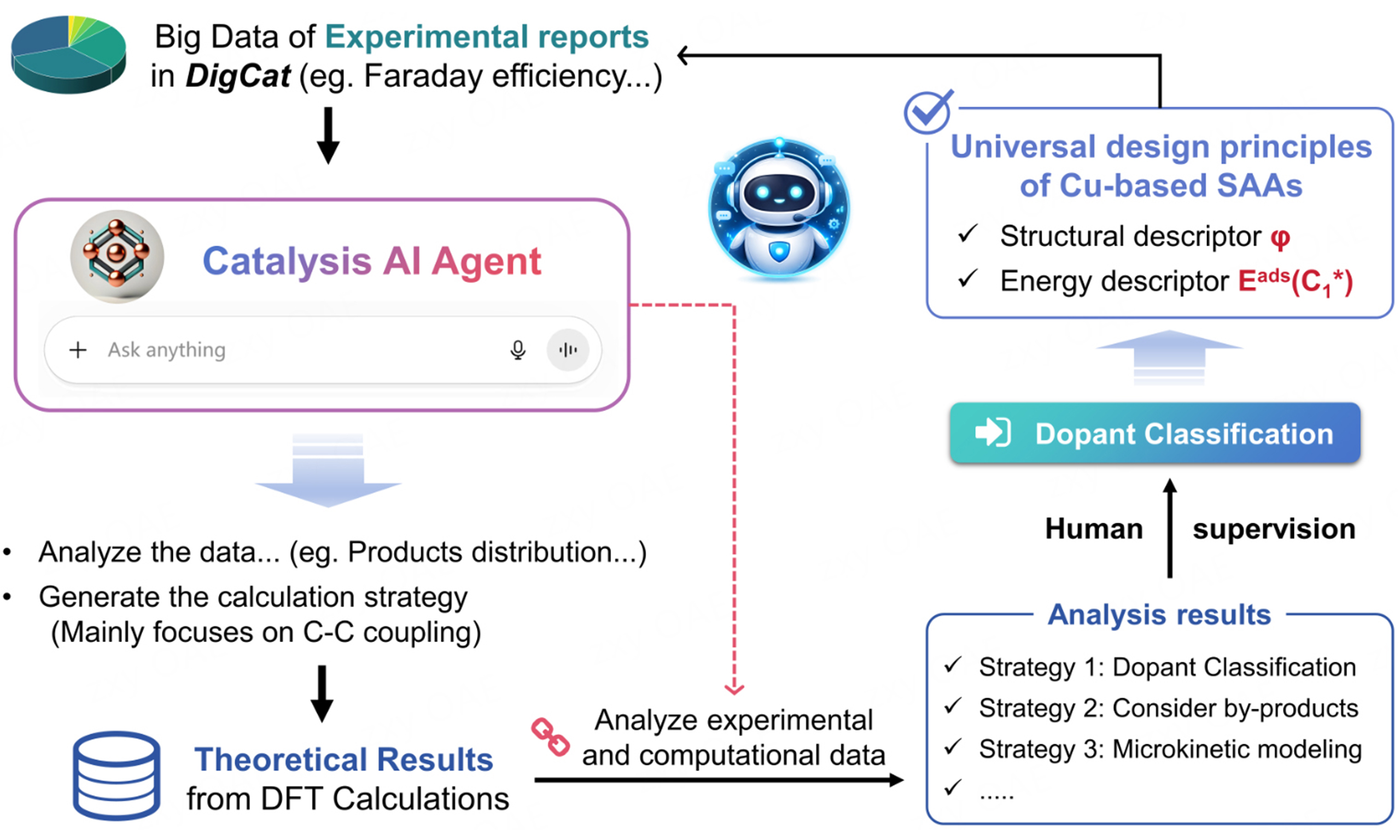
The electrochemical CO2 reduction reaction (CO2RR) offers a promising route toward carbon neutrality and the sustainable production of value-added chemicals. Copper is the only metal that intrinsically produces multi-carbon (C2+) products, yet its catalyst design is hindered by complex C–C coupling mechanisms and sluggish kinetics[1,2]. Recently, a team led by Prof. Daojian Cheng, Prof. Haoxiang Xu, and Prof. Hao Li reported an artificial intelligence (AI)-agent-guided catalyst design framework that integrates large-scale experimental and theoretical datasets with large language model (LLM) training to construct a Catalysis AI Agent [Figure 1][3]. This agent establishes universal design principles for C2+ production in Cu-based single-atom alloys (SAAs), demonstrating the capability of AI in research planning, mechanistic generalization, and materials screening.
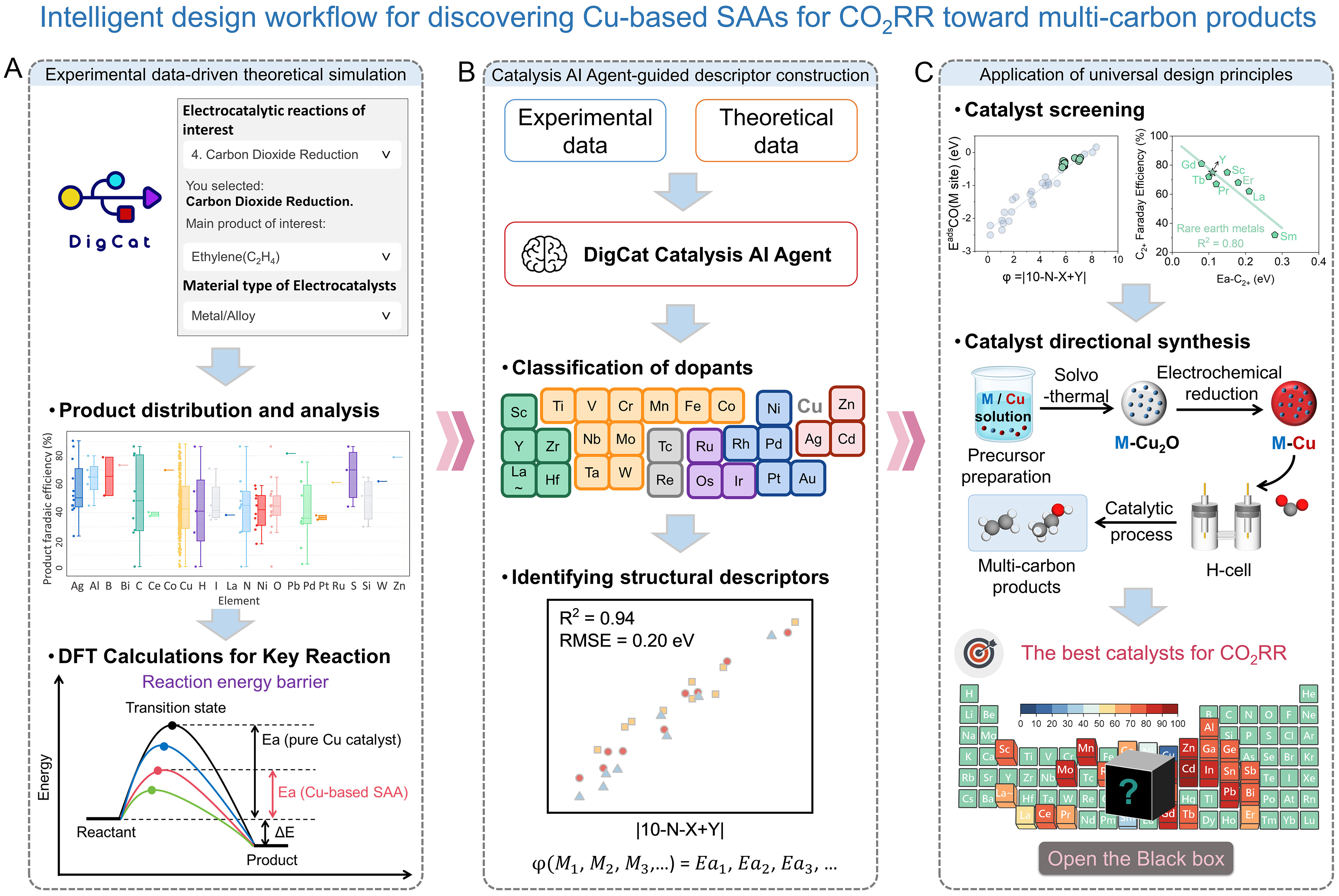
Figure 1. Intelligent design workflow for discovering Cu-based SAA electrocatalysts for CO2RR toward multi-carbon products. (A) Experimental data-driven theoretical simulations; (B) Catalysis AI Agent-aided descriptor construction; (C) Application of universal design principles. Reprinted with permission from [3]. Follow CC BY 4.0 protocol. SSA: Single-atom alloy; SSAs: single-atom alloys; AI: artificial intelligence; CO2RR: CO2 reduction reaction; DFT: density functional theory; R2: coefficient of determination; RMSE: root mean square error.
A key contribution of this work lies in the AI agent’s front-end guidance of the research workflow. By statistically analyzing the DigCat database[4], the agent identified that C2+ selectivity is governed by the divergence between ethylene and ethanol pathways, thereby directing theoretical efforts toward the rate-determining C–C coupling step and reducing redundant calculations. Moreover, the agent exhibited a degree of “chemical intuition”. When the correlation between calculated C–C coupling barriers and experimental selectivity was weak, it proposed classifying dopants based on their chemical nature as a prerequisite for establishing meaningful structure–performance relationships. This insight led to the development of an adsorption-energy-difference descriptor that partitions SAAs into five categories with clear linear trends. Importantly, the study also demonstrates the transferability of the AI-agent-assisted design principles. These principles not only rationalize existing experimental observations but also predict new high-selectivity SAAs and dual-single-atom alloys (DSAAs), and can be extended to rare-earth and alkali-metal dopants. These results suggest that the AI agent is capable not only of “summarizing existing rules” but also - to a certain degree - of extrapolative reasoning, which is a critical step toward autonomous catalyst design[5,6].
The study also highlights current limitations of AI agents. Their cognition is restricted by data coverage and quality, and they primarily perform correlation discovery and route planning rather than autonomous scientific reasoning, thus still requiring human verification for physical validity. In this sense, the agent provides the “what” (e.g., the need to classify dopants), whereas human researchers elucidate the “why” (e.g., the distinct adsorption energetics and coupling pathways). The present framework focuses on the C–C coupling step and treats interfacial electric fields and solvent effects in a simplified manner, which constrains predictive accuracy under realistic conditions. Under such conditions, interfacial chemistry (such as hydrogen-bonding networks, local pH, and polarized electric double layers) is crucial, as it can markedly influence the kinetics and mass transport of key steps, including proton-coupled electron transfer. Therefore, incorporating explicit electrochemical interface models into AI-assisted frameworks is a critical step toward achieving predictive accuracy under operando conditions. Beyond intrinsic active sites, CO2 reduction is also influenced by electrode structure and reactor construction. Integrating AI-guided descriptors with multiscale and device-level design can help translate atomic-scale insights into scalable electrode fabrication strategies. Moreover, an unguided AI agent may overinterpret its findings. In addition to highlighting dopant classification, the agent also suggested multiple possible influencing factors, including electrochemical simulation methodologies, microkinetic analyses, and competing side reactions. This further illustrates that the AI agent operates strictly within the conceptual framework defined by its human collaborators and is bounded by the data scope and predefined problem settings it is tasked to address.
Overall, this work not only establishes general structure-selectivity relationships for Cu-based SAAs but also introduces a new research paradigm in which AI becomes a co-designer of scientific strategy. Importantly, the AI-agent-guided catalyst design principles demonstrated here can be extended to a broader range of catalytic systems, including Cu-based catalysts with multi-metal or non-metal dopants, as well as reactions such as C–N coupling. This generality underscores the broad impact of AI agents as transferable tools for accelerating discovery across diverse catalytic systems. Future developments may couple AI with automated experimentation to form a self-driving closed loop, incorporate realistic electrochemical environments, enable multi-objective optimization, and employ active learning to explore vast compositional spaces such as high-entropy alloys. With the continued development of high-quality data infrastructures and automated experimentation, this “AI planning-theoretical validation-experimental closed loop” workflow is expected to shift catalyst discovery from empirical trial-and-error to an AI-accelerated, theory-guided paradigm.
DECLARATIONS
Acknowledgments
The author acknowledges support provided within the framework of ICSC, the Italian Centro Nazionale di Ricerca in High Performance Computing, Big Data and Quantum Computing, and the Italian MASE POR H2 AdP MMES/ENEA project. Networking within COST Action CA21101 and the International Research Network IRN Nanoalloys is also acknowledged.
Authors’ contributions
The author contributed solely to the article.
Availability of data and materials
Not applicable.
AI and AI-assisted tools statement
Not applicable.
Financial support and sponsorship
None.
Conflicts of interest
The author declared that there are no conflicts of interest.
Ethical approval and consent to participate
Not applicable.
Consent for publication
Not applicable.
Copyright
© The Author(s) 2026.
REFERENCES
1. Nitopi, S.; Bertheussen, E.; Scott, S. B.; et al. Progress and perspectives of electrochemical CO2 reduction on copper in aqueous electrolyte. Chem. Rev. 2019, 119, 7610-72.
2. Hori, Y. Electrochemical CO2 reduction on metal electrodes. In Modern Aspects of Electrochemistry; Modern Aspects of Electrochemistry, Vol. 42; Springer, 2008; pp 89-189.
3. Wang, X.; Li, Z.; Zhang, D.; Li, H.; Xu, H.; Cheng, D. Catalysis AI agent guides discovering the universal design principle of Cu-Based single-atom alloy catalysts for CO2 electroreduction. Angew. Chem. Int. Ed. 2026, e24612.
4. Zhang, D.; Li, H. The hidden engine of AI in electrocatalysis: databases and knowledge graphs at work. Mol. Chem. Eng. 2025, 1, 100003.
5. Lin, Y.; Ou, P. From descriptors to machine learning interatomic potentials: a review of AI-accelerated electrocatalyst design. AI. Agent. 2025, 1, 3.
Cite This Article
 Open Access
How to Cite
Download Citation
Export Citation File:
Type of Import
Tips on Downloading Citation
Citation Manager File Format
Type of Import
Direct Import: When the Direct Import option is selected (the default state), a dialogue box will give you the option to Save or Open the downloaded citation data. Choosing Open will either launch your citation manager or give you a choice of applications with which to use the metadata. The Save option saves the file locally for later use.
Indirect Import: When the Indirect Import option is selected, the metadata is displayed and may be copied and pasted as needed.
About This Article
Copyright

Data & Comments
Data
0







Comments
Comments must be written in English. Spam, offensive content, impersonation, and private information will not be permitted. If any comment is reported and identified as inappropriate content by OAE staff, the comment will be removed without notice. If you have any queries or need any help, please contact us at support@oaepublish.com.